What is a Repurposing Workflow?
A repurposing workflow is the step-by-step process a team follows to transform a single piece of anchor content - typically a webinar, podcast, or long-form video - into multiple derivative assets optimized for different channels and formats. It covers every stage from initial recording through final distribution.
As B2B content demands accelerate, having a defined repurposing workflow has become a competitive necessity. Research consistently shows that the most successful content teams use a documented workflow for repurposing, while underperforming teams rarely have one. The difference is not talent - it is process.
Core stages of a repurposing workflow
Why Repurposing Workflows Matter for B2B Marketers in 2026
Without a defined workflow, repurposing happens inconsistently - or not at all. A webinar gets recorded, uploaded to the on-demand page, and forgotten. The insights it contained never reach LinkedIn, the blog, or the email list. A documented workflow prevents that waste.
Problems a repurposing workflow solves
- Content bottleneck: Marketing teams are expected to publish across 5-8 channels consistently. A workflow ensures every recording systematically feeds all of them without requiring separate brainstorming for each channel.
- Inconsistent output: When repurposing is ad hoc, some webinars produce 3 assets while others produce 30. A workflow standardizes the output so every recording delivers the same minimum set of assets.
- Slow time-to-publish: Without a defined process, content from a webinar may not appear on social media for weeks. A workflow with clear SLAs (e.g., clips within 48 hours, blog post within 5 business days) keeps the team accountable.
- Knowledge loss: If only one person knows how to repurpose, the process breaks when they are on vacation or leave the team. A documented workflow is institutional knowledge that survives personnel changes.
Real-World Examples
Small content team with biweekly webinars
A 3-person content team at a mid-market SaaS company runs biweekly product webinars. Their repurposing workflow: the content lead uploads the recording the same day, the tool generates a transcript and 10 video clips automatically, the social media manager selects 5 clips and writes captions within 24 hours, and the content writer publishes a blog post recap within 3 days. The result: 20+ assets from every webinar, published on a predictable schedule.
Agency managing multiple client accounts
A content agency manages webinar repurposing for 8 clients. Each client has a customized workflow template that specifies which output formats to produce, brand guidelines to follow, and approval chains to use. By standardizing the workflow per client, a single account manager can handle all 8 programs without missing deadlines or mixing up branding.
Demand gen team feeding the sales pipeline
A demand gen team runs monthly thought leadership webinars with industry experts. Their workflow includes a specific branch for email nurture sequences: within 48 hours of the live event, registrants who did not attend receive a 3-email sequence built from webinar highlights. This automated workflow branch consistently recovers 15-20% of no-show registrants into engaged leads.
How RepurposeMyWebinar Makes Repurposing Workflows Easy & Fast
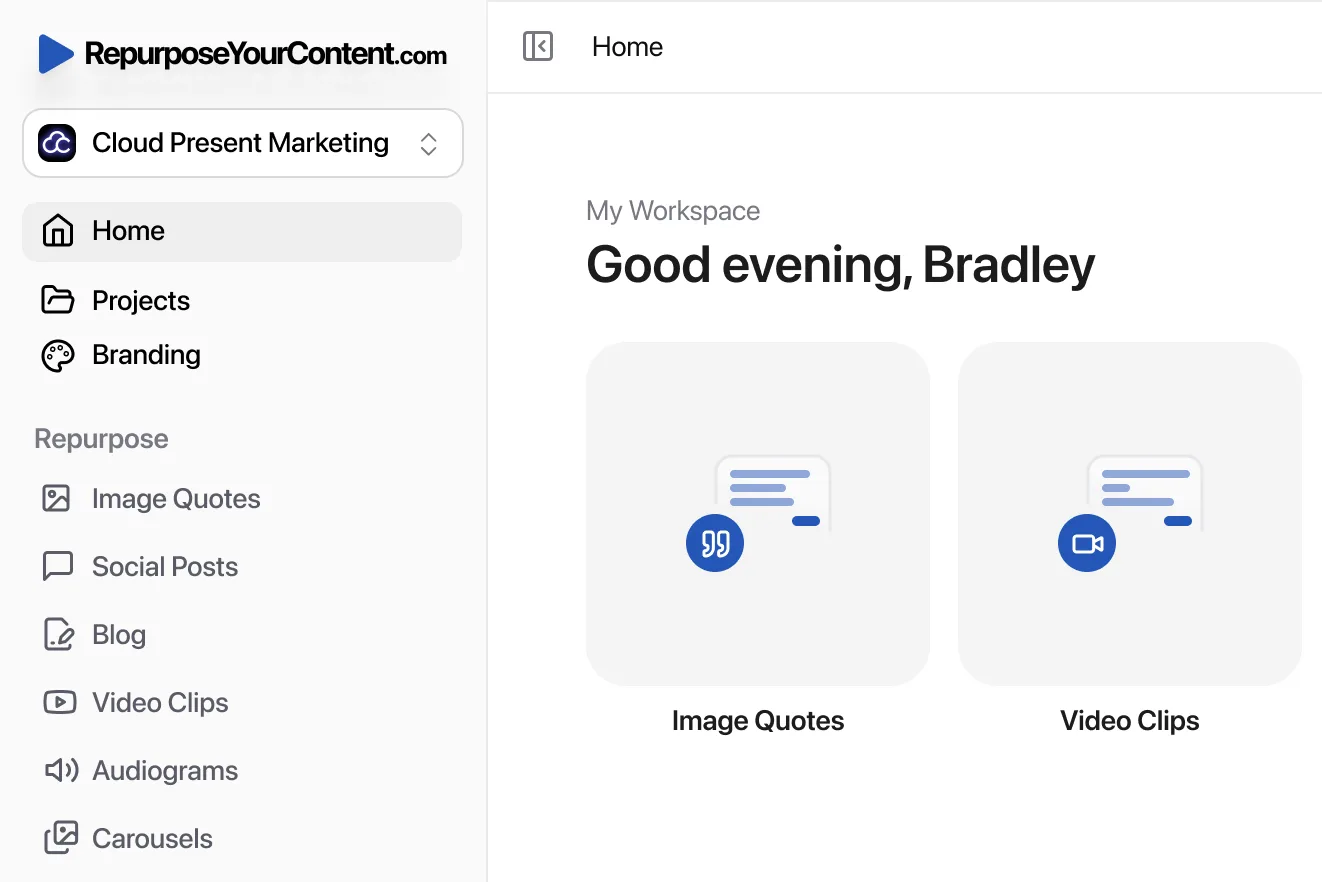
A traditional repurposing workflow requires a transcription tool, a video editor, a design tool, a copywriter, and a project manager to keep it all moving. RepurposeMyWebinar replaces that entire stack with a single platform your team can run on day one:
- Import your recording - paste a link from any supported platform or upload a file. The platform transcribes, analyzes, and identifies the best content automatically.
- Select your output formats - choose which assets you need for this recording: video clips, blog posts, social posts, audiograms, email sequences, podcast episodes, or quote cards.
- Brand Kit handles formatting - logos, colors, fonts, and tone-of-voice settings are applied to every output automatically. The formatting step that used to take hours now happens in the background.
- Review, refine, publish - edit any piece in-platform, then download or schedule. Your workflow goes from raw recording to a full content calendar in minutes.
- Repeat with every webinar - the same workflow template applies to your next recording, creating a repeatable process your team can run without a detailed SOP.
See how it works for your team. View pricing or read our guide on content repurposing workflows for small teams.
Repurposing Workflow vs Similar Concepts
| Concept | What it means | How it differs |
|---|---|---|
| Repurposing Workflow | The production process for turning one asset into many | Focuses on how content gets made, step by step |
| Content Calendar | The schedule for when and where content publishes | Focuses on distribution timing, not production steps |
| Content Supply Chain | The end-to-end system from ideation to measurement | Broader scope - includes strategy, creation, distribution, and analytics |
| Content Atomization | Breaking one piece into the smallest possible units | Describes the output strategy; the workflow is the process that executes it |
Frequently Asked Questions
A standard repurposing workflow follows six core steps: (1) record or capture the source asset, (2) transcribe the content, (3) identify key highlights and themes, (4) clip and extract segments, (5) reformat and apply branding for each target channel, and (6) review, approve, and schedule for distribution. Some teams add a seventh step for performance tracking and iteration.
Manually repurposing a single 45-minute webinar into a full suite of content assets - clips, blog posts, social posts, audiograms, and emails - can take a content team 15-25 hours. With AI-powered tools like RepurposeMyWebinar, the same process can be completed in under an hour, because transcription, highlight detection, clipping, and formatting happen automatically.
In most B2B organizations, the content marketing manager or content operations lead owns the repurposing workflow. On smaller teams, a single marketer may handle the entire process. On larger teams, the workflow is typically shared across content strategists (who identify highlights), designers (who handle visual assets), and social media managers (who adapt content for each platform).
A repurposing workflow describes the production process - how you transform one asset into many. A content calendar describes the distribution schedule - when and where each asset gets published. The workflow feeds the calendar: once your repurposing process produces a batch of assets, the content calendar determines the order and timing of publication across channels.
The majority of the workflow can be automated in 2026. AI tools handle transcription, highlight identification, clip extraction, caption generation, and even blog post drafting. The steps that still benefit from human input are creative review, final approval, and strategic decisions about which assets to prioritize for which channels. Most teams find that automation handles the majority of the labor while humans add the final layer of quality control and strategic judgment.