What is AI Content Generation?
AI content generation is the use of artificial intelligence models - particularly large language models (LLMs) and multimodal AI - to draft, summarize, or transform source material into new content formats. In the context of content repurposing, AI content generation takes a single input such as a webinar transcript or recording and automatically produces derivative assets: blog posts, social captions, email sequences, and more.
The technology has matured rapidly. The majority of B2B marketers now report using AI tools in their content workflows, and adoption continues to grow year over year. The shift is not just about adoption - it's about where AI fits. Repurposing is one of the highest-ROI applications because the source material (your expert's words, your proprietary data) already exists. AI simply restructures it for different channels and audiences.
Key Concepts
- Transcript-to-text transformation: Converting spoken webinar content into written formats like blog articles, show notes, and summaries.
- Format adaptation: Reshaping the same core message for different platforms - a LinkedIn post reads differently from an email nurture touch, even when both originate from the same 30-second webinar segment.
- Tone and length calibration: AI can adjust output length, formality, and style to match specific channel requirements and brand guidelines.
- Batch generation: Producing multiple content pieces simultaneously from a single source, enabling batch content creation workflows.
Why AI Content Generation Matters for B2B Marketers in 2026
B2B marketing teams face a persistent tension: the demand for multi-channel content keeps growing, but headcount and budgets are flat or shrinking. Research consistently shows that creating enough content for all channels is the top challenge marketers face. AI content generation addresses this directly.
Pain points AI content generation solves
- Time-to-publish lag: Without AI, repurposing a 45-minute webinar into a blog post, 5 social posts, and an email sequence can take a content team 8-12 hours. AI reduces this to minutes.
- Content decay: Webinar insights lose relevance fast. If it takes two weeks to turn a session into social content, the conversation has moved on. AI enables same-day turnaround.
- Format bottlenecks: Many teams can write but struggle to produce video descriptions, audiogram captions, or carousel copy. AI generates channel-specific formats that teams would otherwise skip.
- Consistency at scale: When one person writes the blog and another writes social, messaging drifts. AI produces all assets from the same source, keeping the message aligned.
Real-World Examples
Post-webinar content sprint
A demand gen team hosts a monthly product webinar with an external analyst. Within an hour of the session ending, AI processes the transcript and generates a recap blog post, 6 LinkedIn posts (one per key takeaway), a 3-email nurture sequence for no-show registrants, and quote cards featuring the analyst's standout insights. What previously required three business days is live the same afternoon.
Multi-language content expansion
A global SaaS company records webinars in English but serves prospects in four languages. AI generates the English blog post and social assets first, then adapts each piece for German, French, and Spanish audiences - adjusting not just language but idiom and cultural references. The marketing team reviews and publishes across regions within 48 hours.
Sales enablement from customer webinars
A customer success team records quarterly business review webinars with key accounts. AI extracts the customer's own words about ROI and outcomes, generating quote cards, a case-study draft, and talk tracks for the sales team - turning customer conversations into sales enablement content without additional interviews.
How RepurposeMyWebinar Makes AI Content Generation Easy & Fast
Generic AI chatbots require you to paste transcripts, write custom prompts for each format, and manually format every output. RepurposeMyWebinar replaces that entire workflow with a purpose-built AI engine trained on B2B content patterns:
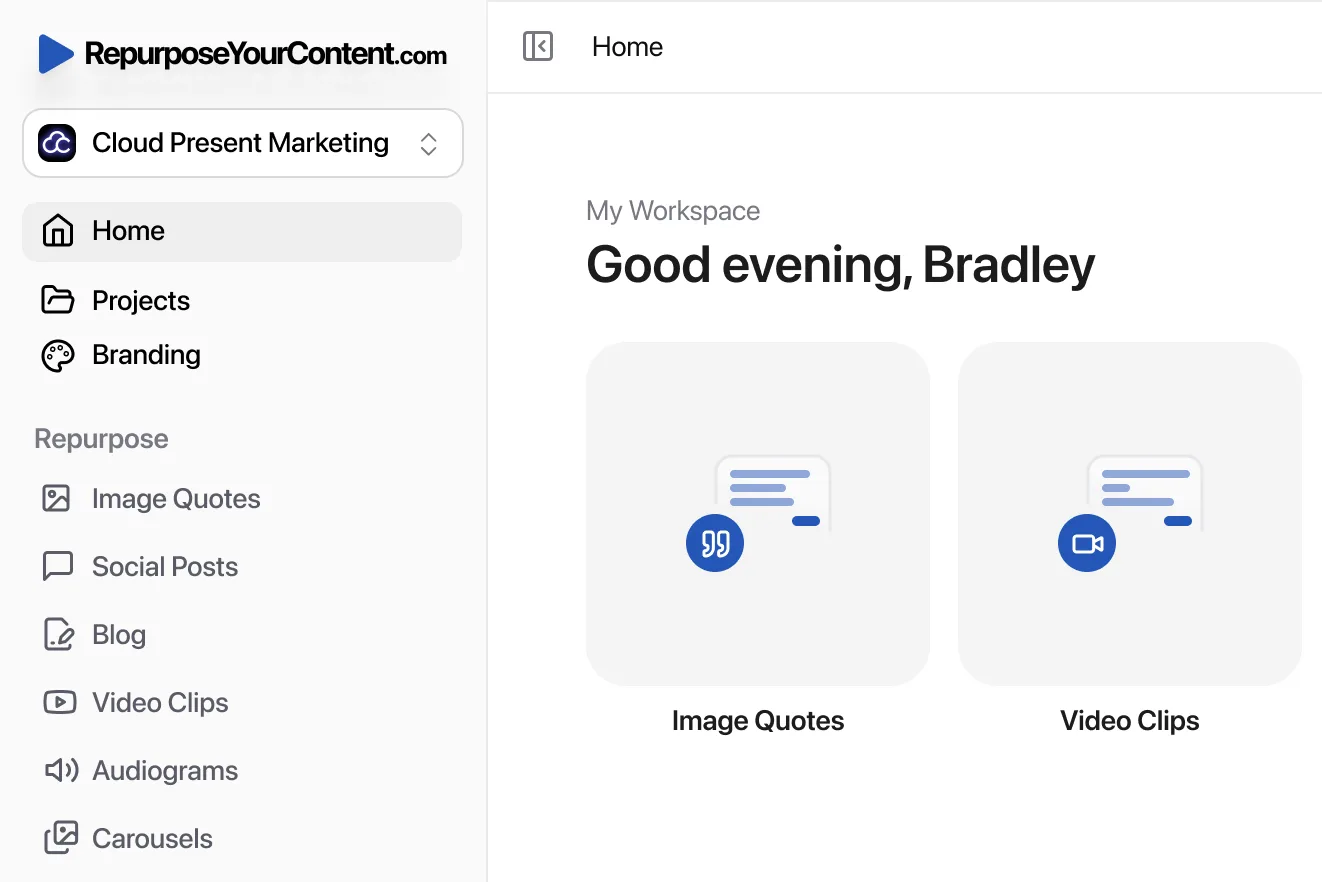
- Connect your recording source - paste a link from Zoom, Goldcast, or any supported platform, or upload an MP4/MOV file directly. The AI transcribes and analyzes your content in minutes.
- Choose your output formats - select any combination of blog posts, video clips, social posts, audiograms, image carousels, email sequences, podcasts, and image quotes. The AI adapts tone, length, and structure for each channel automatically.
- Brand Kit keeps everything consistent - your colors, fonts, logos, and tone-of-voice settings are applied across every generated asset, so a LinkedIn post and a blog article sound like they came from the same team.
- Edit in-platform, then publish - review every piece before download. Adjust wording, swap out clips, or tweak headlines without switching tools.
- Scale across webinars - process multiple recordings in the same session to fill weeks of your content calendar in a single sitting.
Replace hours of manual prompting with a single upload. See pricing or read how AI webinar repurposing works.
AI Content Generation vs Similar Concepts
| Concept | What it means | How it differs |
|---|---|---|
| AI Content Generation | AI transforms source material into new formats | Uses existing proprietary content as input |
| Content Spinning | Synonym swapping to create "unique" versions | Low quality, no format change, often penalized by search engines |
| Auto-Clipping | AI selects and extracts video segments | Focuses on video/audio extraction, not text generation |
| Automated Captioning | Speech-to-text subtitle generation | Produces a transcript, not derivative content formats |
Frequently Asked Questions
AI content generation in the context of content repurposing refers to using large language models and AI tools to automatically transform existing source material - such as a webinar recording or transcript - into new content formats like blog posts, social media captions, email sequences, and more. Rather than creating from scratch, AI analyzes the original content and produces derivative assets that retain the core messaging.
Yes. Google's guidance states that content is evaluated based on quality and usefulness, regardless of how it is produced. AI-generated content that is accurate, well-structured, and provides genuine value to readers can rank just as well as manually written content. The key is human review - editing AI outputs for accuracy, adding unique insights, and ensuring the content matches search intent.
Modern AI models can produce highly accurate summaries and reformatted content from webinar transcripts, but they are not infallible. Accuracy depends on transcript quality, topic complexity, and the specific AI model used. Best practice is to always have a human review AI-generated content before publishing - checking for factual correctness, brand voice consistency, and contextual nuance.
From a single webinar recording, AI can generate blog posts, social media posts for LinkedIn and X, email nurture sequences, podcast show notes, image quote text, carousel slide copy, audiogram captions, video clip titles and descriptions, FAQ content, and executive summaries. Some platforms can produce all of these formats simultaneously from one upload.
AI-generated content derived from your own webinars is considered original because the source material - your speaker's expertise, your data, your frameworks - is unique to your organization. The AI is reformatting and restructuring your proprietary insights, not fabricating generic content. This distinguishes repurposing-driven AI content from purely generative AI that invents text from training data.
Content spinning replaces words with synonyms to create superficially different versions of the same text, often producing low-quality, unreadable output. AI content generation, by contrast, understands the meaning and structure of source material and produces genuinely new formats - such as turning a spoken webinar into a written blog post or a series of social captions. The output is semantically aware, contextually appropriate, and designed for a different medium.