What is Content Repurposing?
Content repurposing is the practice of adapting existing content into new formats, for new channels, or for new audiences. Rather than creating every blog post, video, social update, and email from scratch, repurposing starts with a single rich source asset - often called anchor content - and transforms it into multiple derivative pieces.
A webinar is the most powerful source format for repurposing. A single 45-minute recording contains spoken expertise, visual elements, audience interaction, and narrative structure that can be broken into video clips, blog posts, social posts, audiograms, image carousels, email sequences, podcast episodes, and quote cards.
Many marketers who report improved content results cite repurposing existing material as a key contributor. The practice has shifted from a nice-to-have efficiency tactic to a core operational strategy, especially for B2B teams facing growing channel demands with flat or shrinking budgets.
The repurposing workflow
- Create once: Record a webinar, host a panel, or capture a presentation - investing deeply in one high-value piece of source content.
- Extract insights: Identify the key moments, quotes, data points, and narrative threads within the recording that can stand alone as individual assets.
- Adapt to formats: Transform each insight into the appropriate format for its destination - a 60-second clip for LinkedIn, a 1,500-word post for your blog, a 3-email nurture sequence for leads.
- Distribute across channels: Publish each asset on the platform where its format performs best, building a diverse content mix from a single source.
Why Content Repurposing Matters for B2B Marketers in 2026
The demand for multi-channel content has never been higher, but B2B marketing teams are not growing at the same rate. Repurposing bridges this gap by multiplying the output of existing resources rather than requiring proportionally more input.
What repurposing solves
- The volume problem: B2B buyers now engage across numerous channels before purchasing. Teams need to show up on LinkedIn, YouTube, email, search, podcasts, and more. Repurposing is the only scalable way to cover this many channels without a massive content team.
- The expert bottleneck: Subject-matter experts have limited time. A single webinar captures their knowledge once, then the content team (or AI tools) transforms that recording into weeks of multi-format content without going back to the expert.
- Message consistency: When a team creates each asset independently, messaging fragments across channels. Repurposing from a single source ensures your blog, social, email, and video all tell the same story with the same data points and key messages.
- Cost efficiency: Creating a blog post from scratch costs $500-2,000+ depending on complexity. Creating that same post by repurposing a webinar transcript costs a fraction of that in time and money - and produces a better result because it draws on real expert discussion rather than desktop research.
- SEO compound returns: Repurposed blog posts feed your content pillar strategy. Video clips drive social engagement that sends signals back to your site. Each format reinforces the others, creating a content flywheel where repurposed assets compound in value over time.
Real-World Examples
One webinar becomes a full month of content
A B2B marketing team records a 50-minute webinar with their VP of Product and a customer. From that single recording, the team produces: 12 video clips (4 for LinkedIn, 4 for YouTube Shorts, 4 for Instagram Reels), 2 blog posts (a full recap and a deep-dive on one key insight), 8 social posts, a 4-email nurture sequence, 5 quote cards, 3 LinkedIn carousels, and a podcast episode. That is 35 assets from one hour of recording - enough to fill an entire month's content calendar.
Agency scales client output without scaling headcount
A content agency manages 8 B2B clients. Instead of staffing separate writers, designers, and video editors for each client, they implement a repurposing-first workflow: one webinar per client per month, repurposed into the full content deliverable set. The agency delivers 25-30 assets per client per month with a team of 4 - a content multiplier that would be impossible without repurposing.
Demand gen team extends event ROI by 10x
A demand gen team sponsors a virtual summit with 6 speaking sessions. Instead of treating the event as a one-day pipeline play, they repurpose every session into clips, posts, blog content, and email nurture sequences over the following 8 weeks. The repurposed content generates more leads than the live event itself, extending the ROI of a single event investment across two full months of pipeline activity.
How RepurposeMyWebinar Makes Content Repurposing Easy & Fast
Content repurposing is only valuable when it is fast enough to justify the workflow shift. RepurposeMyWebinar was built to make repurposing faster than creating a single asset from scratch - so you get dozens of outputs in the time it used to take to write one blog post:
- Upload your anchor content - paste a webinar link from Zoom, Goldcast, ON24, YouTube, Riverside, Vimeo, or any supported platform, or upload a file directly.
- AI extracts repurposable moments - the platform identifies key frameworks, data points, quotes, and narrative segments that translate well into standalone content pieces.
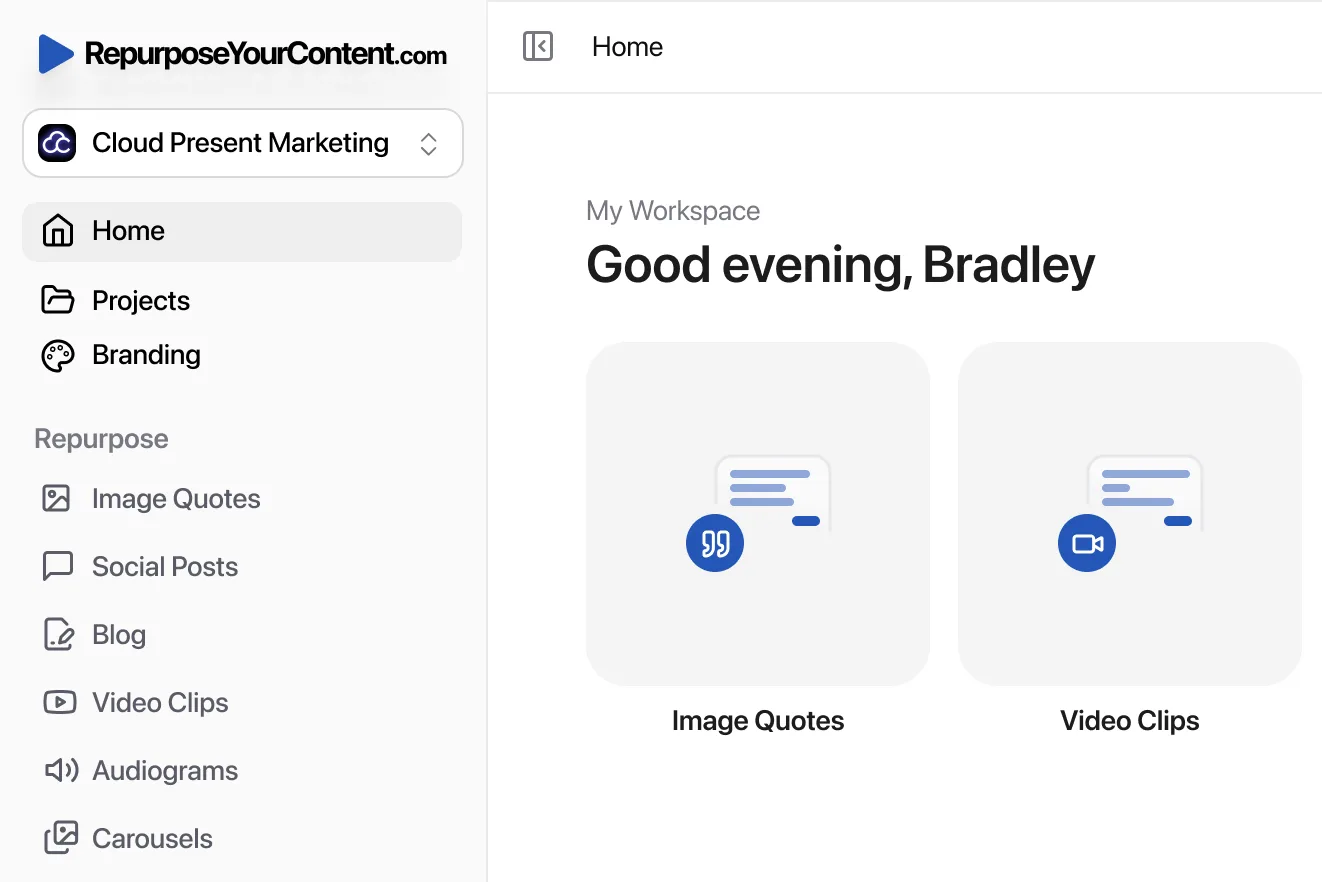
- Generate every format at once - produce video clips, blog posts, social posts, audiograms, image carousels, email sequences, podcasts, and image quotes - all branded with your Brand Kit.
- Review and refine - edit any asset in-platform to match your editorial standards, then download everything for distribution across your content calendar.
- Return for more - come back to the same recording weeks or months later to extract new derivatives from sections you have not used yet.
See how one webinar becomes 30 days of content. View pricing or read our guide to content repurposing strategy for 2026.
Content Repurposing vs Similar Concepts
| Concept | What it means | How it differs |
|---|---|---|
| Content Repurposing | Adapting content into new formats, channels, or audiences | Creates genuinely new derivative assets from source material |
| Content Distribution | Getting content to your audience across channels | Focuses on delivery; repurposing focuses on format transformation before distribution |
| Content Refresh | Updating existing content with new data and improvements | Updates content in its current format; repurposing creates new formats entirely |
| Content Atomization | Breaking one large asset into many smaller pieces | A specific technique within repurposing focused on breaking down; repurposing is the broader practice |
Frequently Asked Questions
Content repurposing is the practice of taking an existing piece of content and adapting it into new formats, for new channels, or for new audience segments. Instead of creating every blog post, video clip, social update, and email from scratch, you start with a single rich source asset - like a webinar - and transform it into multiple derivative pieces. The goal is to extract maximum value from the time and expertise invested in creating the original content.
Long-form video and audio recordings - especially webinars, conference talks, podcast interviews, and panel discussions - are the strongest candidates for repurposing. They contain spoken insights, visual elements, and speaker personality that translate naturally into many formats: video clips, blog posts, social posts, audiograms, email sequences, quote cards, and more. A single 45-minute webinar can yield 20-40 individual assets, making it the highest-leverage source format for B2B teams.
No. Content recycling means re-sharing the same piece of content again without changes - for example, re-posting an old blog link on social media. Content repurposing means transforming the source material into a genuinely new asset in a different format or for a different channel. Repurposing creates original derivative content; recycling just redistributes what already exists. Both have their place, but repurposing is far more effective for reaching new audiences and building a diverse content mix.
The time savings depend on your current workflow and tools. Teams that create every asset from scratch typically spend 4-8 hours producing a single blog post or video. With a repurposing workflow - starting from a webinar and using AI-powered tools - the same team can produce 20-30 assets in a fraction of that time. Most B2B content teams report saving 10-20 hours per week after implementing a structured repurposing process, because the research, ideation, and expert input are captured once in the source recording.
No, when done correctly. True duplicate content means publishing the same text on multiple URLs. Repurposing creates genuinely different assets - a video clip is not the same as a blog post, and a social post is not the same as an email. Even when two blog posts draw from the same webinar, they should target different keywords, take different angles, and provide unique value. As long as each repurposed piece is adapted to its format and audience rather than copy-pasted, there is no duplicate content risk.
At minimum, you need a recording platform (Zoom, Riverside, etc.), a transcription tool, and editing tools for each output format. However, this piecemeal approach is slow and requires multiple subscriptions. Purpose-built repurposing platforms like RepurposeMyWebinar handle the entire workflow in one place: upload a recording, apply your brand settings, and generate video clips, blog posts, social posts, audiograms, email sequences, and more simultaneously. This eliminates the need for separate tools for each format.