What is Format Adaptation?
Format adaptation is the process of converting content from one format to another while preserving its core message and value. Examples include turning a webinar recording into a blog post, extracting audio from a video to create a podcast episode, or transforming speaker quotes into visual quote cards.
Format adaptation is the technical execution layer of content repurposing. Where repurposing describes the strategy of reusing content, format adaptation describes the actual conversion work - reshaping a message to fit the constraints and strengths of a different medium. Most marketers who repurpose content report that adapting formats for specific channels is the step that has the biggest impact on performance.
Key dimensions of format adaptation
- Medium shift: Moving between fundamentally different content types - video to text, audio to visual, long-form to short-form. Each shift requires rethinking how the message is delivered.
- Platform fit: Each platform has its own constraints - character limits, aspect ratios, autoplay behavior, audience expectations. Adaptation means tailoring content to perform natively on each channel.
- Consumption context: A LinkedIn user scrolling during a meeting consumes content differently than someone reading a blog post over coffee. Format adaptation accounts for when, where, and how the audience will engage.
- Message density: A 45-minute webinar can cover 10 distinct topics. Adapting it into a 60-second video clip means selecting one idea and making it land in a fraction of the time.
Why Format Adaptation Matters for B2B Marketers in 2026
B2B audiences are spread across more channels than ever. Your prospects might discover you on LinkedIn, evaluate you through a blog post, and convert after watching a video clip. Format adaptation is how you meet them in each of those places without creating content from scratch every time.
Problems format adaptation solves
- Channel coverage gaps: Most B2B teams have strong content on one or two channels but are invisible on others. Format adaptation lets you take what already works and extend it to every platform your buyers use.
- Content creation bottlenecks: Creating original content for LinkedIn, YouTube, email, your blog, and podcasts separately requires enormous bandwidth. Adapting from a single anchor asset cuts production time dramatically.
- Inconsistent messaging: When each channel gets independently produced content, messaging drifts. Adapting from one source keeps your story coherent across every touchpoint.
- Low content ROI: A webinar that only lives as a recording on a landing page is underperforming. Format adaptation unlocks the full value of high-effort content by distributing it across multiple channels - multiplying your content ROI.
Real-World Examples
Webinar to multi-channel campaign
A B2B cybersecurity company runs a 40-minute webinar on compliance trends. The content team adapts it into 8 video clips for LinkedIn and YouTube Shorts, a 2,000-word blog post targeting "compliance automation" keywords, 6 social posts pulling key stats, and a 3-email nurture sequence for attendees. Each format is adapted - not just reformatted - to work on its target channel.
Panel discussion to thought leadership assets
An agency records a 3-person panel for a fintech client. They adapt each panelist's best moments into individual audiograms with branded waveforms, a LinkedIn carousel summarizing the panel's five key predictions, and speaker-attributed quote cards for each participant to share with their own networks - amplifying reach through personal distribution.
Product demo to sales enablement library
A demand gen team takes a 30-minute product demo webinar and adapts it into feature-specific 90-second clips for sales reps to share in outreach, a blog post walking through the demo's use cases, and a carousel highlighting before-and-after results. The same source content serves marketing, sales, and customer success teams in different adapted formats.
How RepurposeMyWebinar Makes Format Adaptation Easy & Fast
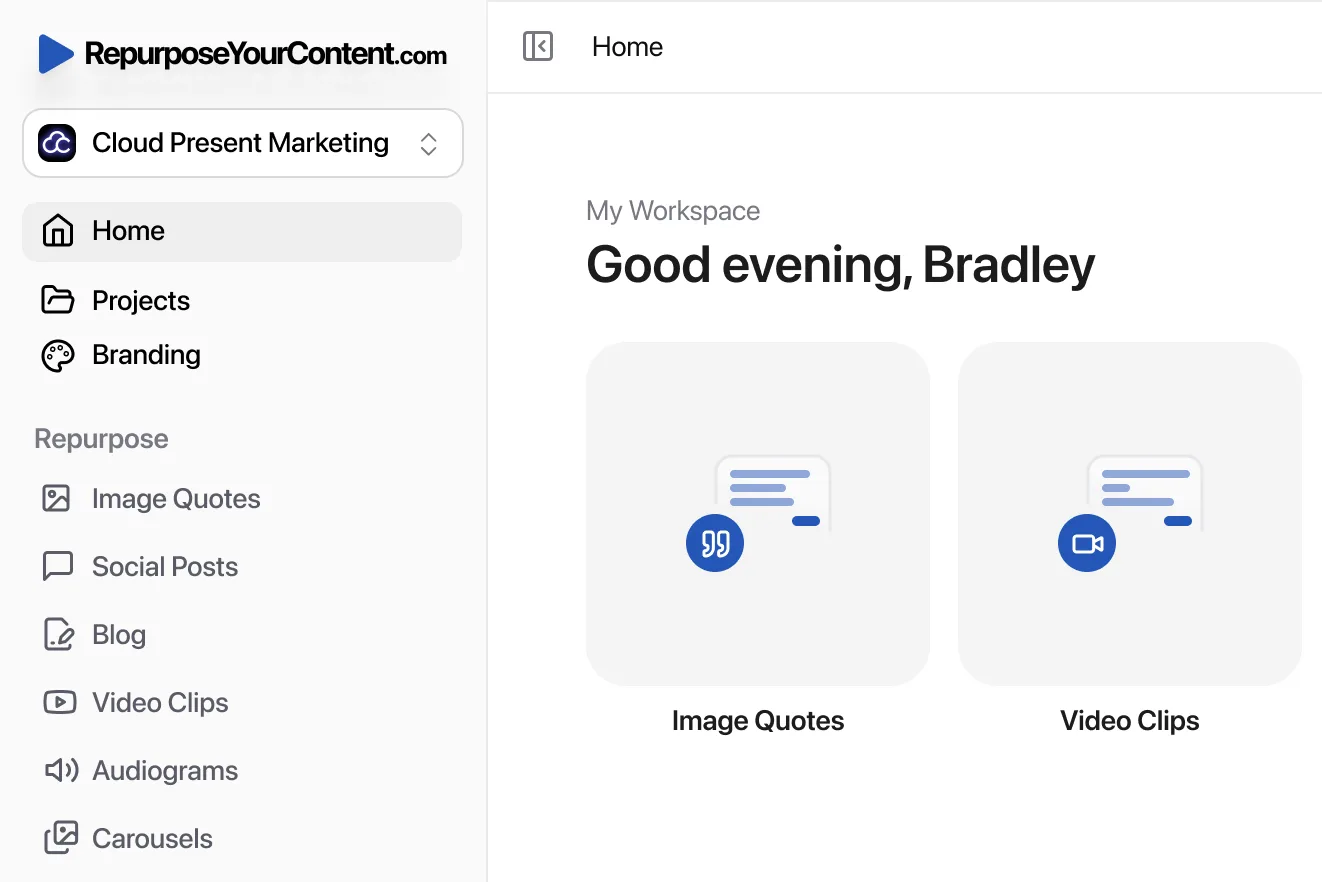
Format adaptation is where most content teams lose hours - resizing videos, rewriting text for different platforms, adjusting aspect ratios, and reformatting quotes into visual assets. RepurposeMyWebinar handles the conversion work so your team can focus on choosing which formats matter most for each campaign.
- Start with your source recording - paste a link from Zoom, YouTube, Riverside, or any supported platform. The platform accepts webinars, interviews, panels, and any video or audio file.
- Select your target formats - pick from video clips (vertical and landscape), long-form blog posts, social copy, audiograms, image carousels, email sequences, and podcast audio. Each output is shaped for its destination, not just reformatted.
- Let your Brand Kit do the styling - logos, colors, fonts, and voice settings apply to every adapted asset automatically. No switching between design tools for each format.
- Fine-tune and publish - review each adapted piece in-platform, make edits where needed, and download. A full multi-format content calendar from a single recording in minutes.
Adapt once, publish everywhere. See pricing or read how to build a content repurposing strategy for 2026.
Format Adaptation vs Similar Concepts
| Concept | What it means | How it differs |
|---|---|---|
| Format Adaptation | Converting content from one format to another | The specific conversion step - focused on format change |
| Content Repurposing | The overall strategy of reusing content across channels | Broader strategy that includes format adaptation as one step |
| Content Atomization | Breaking one piece into many smaller pieces | Focuses on splitting content into fragments; may or may not change format |
| Cross-Posting | Sharing the same content on multiple platforms | No format change - identical content posted to different channels |
| Channel-Native Content | Content built specifically for one platform's norms | The goal of good format adaptation - making adapted content feel native |
Frequently Asked Questions
Content repurposing is the broader strategy of reusing existing content across different channels and contexts. Format adaptation is the specific technical step within that strategy where you convert content from one format to another - for example, turning a video into a blog post or an audio clip into an audiogram. Format adaptation is the execution layer of content repurposing.
The most common format adaptations from a webinar recording include: video to short-form video clips, video to blog post or article, video to audio podcast episode, video to social media posts (text-based), video to audiogram (audio with waveform visuals), video to image carousel (slide-style graphics), and video to email sequence content. Each adaptation targets a different channel and consumption preference.
Not when done well. Effective format adaptation reshapes the message to fit the strengths of the new format rather than just copying and pasting. A 45-minute webinar insight condensed into a 60-second video clip should be tighter and more impactful, not watered down. The key is understanding what works on each platform and adapting accordingly - not just truncating or reformatting blindly.
Manual format adaptation of a single 45-minute webinar into multiple formats (clips, blog post, social posts, audiograms) typically takes a content team 8-15 hours. AI-powered tools like RepurposeMyWebinar can reduce this to under 30 minutes by automating transcription, identifying key moments, generating copy, and applying brand styling across all outputs simultaneously.
No. Not every piece of content works in every format. The best approach is to match your source material to the formats where it will perform best. A data-heavy webinar segment might work well as a blog post and carousel but poorly as a short-form video clip. A compelling speaker story might be perfect for a video clip and audiogram but lose impact as a static image quote. Let the content guide the format choices.