10 AI Tools for Podcast Repurposing in 2026
Compare 10 AI tools for podcast repurposing by clip quality, captions, pricing, review time, and when done-for-you support makes more sense.

AI tools for podcast repurposing can turn one recording into transcripts, clips, captions, show notes, and social copy much faster, but every output still needs human review. The best choice depends on whether you need one format, a connected DIY workflow, or done-for-you production.
B2B marketers often treat the recording as the finished product. That leaves useful ideas trapped inside a podcast episode, interview, keynote, sales call, livestream, course, or meeting. One supplied industry proof point says 73% of B2B marketers call recordings their top source of quality leads, while only 1 in 3 teams have a scalable content process. Those figures come from the publisher's supplied context, not the verified research set, so they should be treated as editorial context rather than independently sourced market data.
AI removes much of the mechanical work. Transcription that once required an hour or more can now arrive in minutes. Clip finders can surface candidate moments. Caption generators can create a first draft. Writing tools can produce show notes, newsletters, blog drafts, and social posts from the transcript.
The review burden remains. Auto-clipping misses context. Captions still misread names, brands, and technical terms. AI-written copy often sounds generic without strong guidance. The comparison is therefore not generation speed. It's transcript accuracy, clip-selection judgment, caption quality, output polish, review time, correction effort, and distribution fit.
The AI transcription market was valued at $4.5 billion in 2024 and is projected to reach $19.2 billion by 2034, implying roughly a 15.6% CAGR, according to Sonix's podcast transcription market summary. That growth reflects the infrastructure behind modern repurposing workflows. Transcription is the starting point for clips, summaries, posts, and articles.
1. Repurpose.io
Repurpose.io is strongest when the content already exists and the main problem is distribution. It can connect a podcast video, livestream, YouTube upload, or finished short clip to publishing workflows across major social destinations.
The workflow supports horizontal, square, and vertical formats. It can also handle images, carousels, captions, scheduling, and platform-specific destinations such as Shorts, Reels, TikTok, YouTube, LinkedIn, and Facebook. Podcast-focused templates and site embeds reduce setup work once the workflow is configured.
Where it saves time
Repurpose.io reduces repetitive publishing. A team can prepare finished clips once, then route them to several channels instead of manually downloading, renaming, resizing, and uploading every file.
That makes it useful for agencies and marketing teams with a reliable content library. It's less useful when the team still needs help deciding which moments deserve clipping. Distribution automation doesn't replace editorial selection.
Practical rule: Use Repurpose.io after the content has passed human review, not as a substitute for that review.
The initial setup takes care. Account connections, destination settings, naming conventions, captions, and publishing rules all need testing. Workflows can also require reconnection or troubleshooting when a social destination changes its requirements.
Best fit and trade-offs
Repurpose.io isn't a deep video editor. Teams seeking advanced motion graphics, detailed audio repair, or highly polished visual storytelling will need another editing stage. It works best alongside a clip finder or editor.
For podcast teams that already have approved assets, it can become the distribution layer. Teams that need finished clips, written content, quote graphics, and brand review should compare it with a done-for-you podcast repurposing service instead of expecting a publishing workflow to handle the entire production process.
2. Castmagic
Castmagic focuses on the written layer around long-form audio and video. It can generate transcripts, summaries, show notes, newsletter drafts, blog drafts, titles, hooks, quotes, and social posts from an episode or imported source.
That focus makes it practical for podcasters who already have a video editor or don't need short-form video. The output categories are organized around common podcast deliverables, so the team doesn't need to build every prompt from scratch.
Where it saves time
The biggest gain comes after transcription. A clean transcript can feed show notes, episode summaries, newsletter copy, social posts, and article drafts. A practical podcast workflow from Podsuite estimates transcript cleanup at 15 to 20 minutes for a 45-minute episode, show notes at about 15 minutes, and a blog post at 45 to 60 minutes.
Those estimates describe a human-led workflow using a clean transcript first. Castmagic can accelerate the drafting stage, but it doesn't remove fact checking or voice editing. Names, claims, product terminology, and guest perspectives still need comparison against the recording.
Review burden
AI copy often captures the topic but misses the speaker's specific point. It may flatten a nuanced argument into a generic marketing statement. That creates risk for B2B brands, where an inaccurate summary can misrepresent a guest or make a technical claim too broad.
Castmagic also uses usage-based credits. Longer recordings and higher publishing volume require careful plan sizing. Teams should calculate expected minutes and outputs before choosing a plan.
Written assets still need an owner. A transcript can support a draft, but a person must approve the meaning, tone, and claims.
Castmagic isn't a full video editor. Pair it with OpusClip, Vizard.ai, Descript, or a human production team for polished Shorts and Reels. For teams that want the written package without managing revisions, human-produced blog content removes the final editing responsibility.
3. OpusClip
OpusClip is built around turning long video into short-form clips. Its AI identifies candidate moments, applies captions, reframes footage for vertical viewing, tracks speakers, and can add elements such as B-roll, emojis, and caption templates.
It's a sensible starting point for a video podcast, interview, or recorded keynote where the priority is Shorts, Reels, TikTok, or LinkedIn video. The tool can produce a useful first batch without requiring a traditional timeline editor.
Clip discovery versus clip judgment
OpusClip's strength is candidate discovery. It can help a producer scan a long conversation quickly and find moments with a clear hook, strong statement, or active exchange.
The limitation is that an attention signal isn't the same as editorial value. A clip can sound dramatic while omitting the qualification that makes the statement accurate. It can also begin mid-thought, include a weak setup, or select a moment that doesn't support the brand's positioning.
A 2026 workflow guide says the mechanical work of clipping, reframing, captioning, and chaptering is “mostly solved,” while the human decision layer remains the bottleneck. It recommends generating 12 to 20 candidate clips and hand-picking only 3 to 5 that fit the intended positioning and context, as described in Causo's podcast video repurposing guide.
Output quality and review
Auto-reframing and speaker tracking reduce editing time. Captions provide a strong first pass, but the producer still needs to correct names, acronyms, jargon, punctuation, and line breaks.
Cloud processing also means the workflow depends on uploads and plan limits. Output volume and credit rules affect the true cost. A low monthly fee can become less attractive when a team processes long episodes regularly.
For teams that want candidates but don't want to approve every caption and cut, human-reviewed video clips combine AI speed with editorial control.
4. Munch
Munch combines video clipping with written content generation. A single upload can produce short clips, captions, LinkedIn posts, X threads, newsletters, blog drafts, pull quotes, and other channel-specific assets.
That combination fits marketing teams that want one recording to support both social video and text distribution. It can reduce handoffs between a clipper, copywriter, and scheduler, although the review burden shifts toward checking whether every output reflects the source accurately.
Where Munch helps
Munch's relevance and performance signals help producers prioritize clips from long interviews. The signals are useful for narrowing a large set of possible excerpts to candidates that appear aligned with a campaign message.
Scoring highlights broad trends but can miss the nuance B2B content requires. A clip may match a popular topic while lacking the qualification, customer detail, or technical precision that gives the statement meaning. Reviewers should confirm the full exchange, the speaker's intent, and the clip's fit with the brand before approving it.
Scheduling and strategy-oriented features support a planned publishing sequence from one recording. Teams can move from source footage to a queue of video and written assets without changing tools for every format.
Copy review and credit planning
AI-generated writing requires at least a light editing pass. Review should be more careful when recordings include regulated subjects, customer stories, performance claims, or sensitive internal information. Generic hooks, unsupported wording, and incorrect terminology can make a polished post unusable.
Munch uses credits called “Munches,” rather than a minute-based plan. Estimate the complete asset bundle before comparing monthly prices, especially when one episode produces several formats.
- Review the source: Confirm that each post and article matches the recording.
- Rewrite the hook: Replace generic openings with the speaker's actual insight.
- Check channel fit: LinkedIn copy, a newsletter, and a short-video caption need different treatment.
- Approve the bundle: Do not schedule every generated asset automatically.
Munch suits teams that want clips and copy together. It still requires brand editing. Teams that want finished LinkedIn posts and visual assets without reviewing generated drafts can use done-for-you social post production.
5. Quso.ai
Quso.ai, formerly Vidyo.ai, is a practical short-clip workflow for podcasts and long videos. It supports AI clip detection, captions, exports in vertical, square, and horizontal formats, scheduling, and analytics.
The minutes and credit structure maps reasonably well to podcast workloads. That makes planning easier than a model based only on vague output bundles. A producer can estimate how much source footage needs processing and compare that with the available allowance.
What works well
Quso.ai is useful for teams that want a straightforward clipper without adopting a heavier editor. Its format options support common social placements, while silence removal on higher tiers can reduce some manual cleanup.
The free level is useful for testing the workflow. Production teams should check export resolution, retention, watermark rules, and storage limits before relying on it for client or brand publishing. The supplied product notes identify 720p as a free-plan limitation, with limited retention, so the free tier may not suit final production.
The hidden labor
AI clip detection still creates a review queue. The producer must watch each candidate, confirm the opening and ending, check whether the speaker's meaning survives the cut, and remove anything that sounds misleading.
Caption correction takes additional time. Names, company names, product terms, acronyms, and industry jargon are common failure points across automated caption systems. A clean-looking caption style doesn't guarantee accurate wording.
A clipper can produce a publishable file. It can't decide whether publishing that file is defensible.
Quso.ai is primarily a video clipper. Teams also wanting articles, newsletters, social posts, and quote graphics need a writing workflow or production partner. Its continuity for former Vidyo.ai users is useful, but teams should still confirm current credit rules before scaling.
6. Riverside Magic Clips
Riverside Magic Clips sits inside Riverside's remote recording workflow. That makes it convenient for hosts who already record interviews or podcasts there and want automatic highlight clips without moving files between services.
The feature can detect moments, focus on speakers, respond to keywords on certain plans, and export clips for social publishing. Riverside also offers AI show notes on some plans, which can help teams produce a first written summary alongside the video assets.
The integrated advantage
The main benefit is continuity. The recording, source files, speaker information, and clip generation remain in one environment. That removes a handoff and reduces the chance of downloading the wrong file or losing track of a session.
The supplied product notes say Magic Clips typically generates about 2 clips per 5 minutes of recording, with customizable duration and speaker focus. That output can create a useful candidate set, but the number isn't a quality guarantee.
A producer still needs to decide whether the selected moments have a complete thought. Some clips need new in and out points. Others need a different speaker focus or a stronger opening.
Who should use it
Riverside users who want convenient first-pass clips may find the integrated workflow sufficient. Teams choosing a recording platform solely for advanced clipping should compare selection quality and editing controls against specialist tools.
Paid tiers provide more customization and control. That matters when the brand requires specific caption styling, framing, title treatment, or speaker placement.
Magic Clips is less suitable when the final deliverable includes a complete promotion package. It generates useful media candidates, but show notes, social copy, blog content, and visual assets still require separate work or human production.
7. Descript
Descript treats audio and video editing like document editing. The transcript becomes the working interface, so removing a sentence, filler word, or repeated phrase can be as simple as editing text.
That makes Descript a strong choice for teams that want control over the full episode. It supports transcript-level edits, filler-word removal, Studio Sound processing, captions, multicam editing, screen recording, and social exports. Its AI actions can also assist with show notes and written assets.
Why transcript editing matters
Traditional editing requires searching a timeline for exact words. Transcript-based editing makes the spoken content searchable and easier to review. That is especially helpful for interviews with multiple themes, where the producer needs to find a precise claim or answer.
Descript also gives humans direct control over the final cut. The producer can read the surrounding context, select a complete exchange, and adjust the edit before exporting a short.
This control comes with a learning curve. Descript is more capable than a single-purpose clipper, so new users need time to understand scenes, transcript edits, layouts, audio processing, caption styling, and export settings.
Total workflow cost
Descript's AI allowances and credits can make plan selection confusing. Teams should model the source duration, number of edits, number of exports, and required collaborators before committing.
It also doesn't automatically solve editorial selection. The tool can help identify or create clips, but a human still decides which moments fit the audience and campaign. A polished clip that makes the guest sound careless is still a bad asset.
Descript is the best fit for hands-on producers who want transcript-based editing and full episode control. It isn't the fastest route for a busy founder who wants finished assets without becoming the editor.
8. Swell AI
Swell AI is designed for podcast operations. It can generate transcripts, show notes, summaries, titles, newsletters, social posts, and long-form articles from episodes.
Its workflow supports RSS and Apple Podcasts imports, bulk processing, back-catalog work, recurring templates, and multi-show operations. That makes it more relevant to agencies and content teams than to a host producing one occasional episode.
Strongest use case
Swell AI helps standardize written production across multiple shows. A team can establish recurring output types and process episodes through a consistent workflow instead of writing every show note from a blank page.
Swell Chat can help teams query episode material. That is useful when a producer needs to locate a discussion point, identify an answer, or build a draft from several episodes.
The main limitation is scope. Swell AI isn't a deep video editor, so short-form clips and visual polish require another tool. The team must also review generated articles and posts for accuracy, voice, and repetition.
Review for multi-show teams
Consistency doesn't mean correctness. A template can keep headings and formatting stable, but it can also reproduce the same generic phrasing across every show.
Editors should check:
- Speaker attribution: Confirm who made each claim.
- Episode context: Make sure summaries don't combine separate ideas.
- Brand voice: Remove phrases that don't sound like the host or company.
- Search intent: Adjust the article around a real audience question.
- Sensitive content: Review names, customers, internal details, and claims.
Public pricing can be difficult to assess for larger operations, with direct quotes common. Teams should request a plan estimate based on episode volume, number of shows, and back-catalog requirements.
9. Vizard.ai
Vizard.ai shortens the path from a long podcast video to social clips. It can identify clips, resize them for vertical, horizontal, and square formats, generate captions, and provide a basic editor for corrections.
The workflow suits creators and small marketing teams that need quick output without learning a complex editing environment. A free plan makes testing easier, but confirm current limits for minutes, exports, watermarks, and resolution before relying on it for regular publishing.
Where it performs well
Vizard.ai has a low learning curve. Start with a long recording, review the suggested clips, correct the caption draft, and export versions for common social channels. That process can reduce setup and training time, especially when one person handles production.
The basic editor also keeps small corrections in the same workspace. Reviewers can adjust captions or framing without opening a full non-linear editor, though the time saved depends on how many suggestions need revision.
Its scope remains focused. Vizard.ai handles clipping, captions, and formatting, but long-form editing, written content, approvals, and distribution require other tools or manual work.
Review the selection, not just the export
Vizard.ai surfaces usable moments, but strategic value requires context the AI does not evaluate. A clip can open with a strong hook while missing the podcast's central positioning. It can also be accurate yet depend on an earlier exchange that viewers never hear.
Review the complete clip, not only its opening. Check the spoken meaning, caption timing, names, visual framing, and ending. Captions should communicate clearly without audio while preserving the speaker's meaning. Those checks determine whether the workflow saves hours or shifts the work into corrections.
Vizard.ai fits a hands-on creator who wants a clip-first workflow. It is a weaker fit for teams seeking posts, graphics, carousels, articles, approvals, and scheduling in one production system.
10. Podsqueeze
Podsqueeze is built for solo podcasters who need written assets quickly. It can generate transcripts, timestamped show notes, chapters, blog drafts, newsletters, social posts, clips, and audiograms from an episode file, link, or RSS source.
The podcast-first workflow keeps the output close to the needs of an episode publisher. A host can create a transcript, summary, timestamps, and promotion drafts without stitching together several separate systems.
Best for written collateral
Podsqueeze is useful when show notes and social copy are the priority. Timestamped notes give listeners a clear way to jump to sections of the episode, while blog and newsletter drafts create a starting point for owned-channel publishing.
Its light clip and audiogram support can help a solo host create basic promotional media. The output is more limited than a specialist video clipper, so teams seeking polished Shorts or Reels will need another stage.
Where careful review matters
Generated show notes can overstate a conclusion, mislabel a speaker, or turn a tentative discussion into a firm claim. The host should listen back to important sections before publishing, especially when the episode includes medical, financial, technical, or customer-related material.
Official pricing and minute or clip limits aren't always prominent, so plan fit requires direct checking. That matters for a growing show with a back catalog or frequent publishing schedule.
Podsqueeze is a good fit for a solo host who wants one podcast-focused workflow. It isn't a complete replacement for a human editor, a visual production team, or a distribution manager.
Top 10 AI Tools for Podcast Repurposing, Feature Comparison
| Tool | Core capabilities | Best for (target audience) | Key strengths (unique selling points) | Limitations / caveats | Pricing model / limits |
|---|---|---|---|---|---|
| Repurpose.io | Build repurposing workflows, resize formats, auto‑publish across platforms | Agencies / teams needing end‑to‑end distribution | Robust automation, podcast templates, multi‑platform scheduling | Not a deep visual editor; setup learning curve | Subscription, tiered plans |
| Castmagic | Transcripts, summaries, show notes, social copy and blog drafts | Podcasters who need fast written deliverables | Speeds writing work, podcast‑centric outputs | Usage/credit caps; not a clipper/editor | Usage‑based credit system |
| OpusClip (Opus.pro) | AI clip finder, virality scoring, auto‑reframe, captions | Creators focused on Shorts/Reels/TikTok | Auto detection of viral moments, polished social clips fast | Cloud‑only processing; credit/minute limits | Credit/minutes‑based tiers |
| Munch (Munch Studio) | Video clipping + multi‑channel copy (posts, threads, blogs) | Teams wanting clips + native copy from one source | Combines clips and text outputs, scheduling/strategy tools | Credit ("Munches") model; AI copy needs light editing | Credit bundles (Munches) |
| Quso.ai (Vidyo.ai) | AI clip detection, exports in multiple ratios, scheduler, analytics | Podcasters wanting practical, minutes‑based clipping | Minutes‑based metering, generous free tier for testing | Free plan 720p cap; pair with writing tool for text | Free tier + minutes/credit paid plans |
| Riverside Magic Clips | Auto‑generates short clips from Riverside recordings | Riverside users wanting integrated record→clip flow | Eliminates tool‑hopping, fast clip outputs from sessions | AI segments may need manual tweaks; advanced features require paid tiers | Included/added in Riverside plans (tiered) |
| Descript | Text‑based editing, transcript edits, filler removal, Studio Sound, clip exports | Editors and podcasters who want edit→repurpose in one tool | Full editing + repurposing workflow, rich feature set | AI credits/pricing complexity; steeper learning curve | Subscription tiers with AI allowances |
| Swell AI | Transcripts, show notes, long‑form articles, bulk/RSS ingest, episode chat | Agencies and multi‑show podcast operations | Designed for scale, bulk/back‑catalog processing, RSS workflows | Public pricing often opaque; not a video editor | Tiered / enterprise quotes common |
| Vizard.ai | AI clip maker with presets, captions and simple editor | Creators who want an easy on‑ramp to Shorts | Simple editor, social presets, free plan to trial | Limited long‑form editing and advanced motion graphics | Free + paid tiers with export/minute limits |
| Podsqueeze | Transcripts, timestamped notes, blog/newsletter drafts, simple clips | Solo podcasters and indie hosts | Rapid show notes, all‑in‑one text outputs, RSS support | Pricing/details not always published; basic clip quality | Tiered plans (details sometimes unpublished) |
Choose Your Workflow, Not Just Your Tool
The right choice depends on the bottleneck. A team editing complete episodes by transcript should start with Descript. A team mainly seeking short-form clip candidates should compare OpusClip and Vizard.ai. A podcast operation focused on show notes, articles, newsletters, and social copy should assess Castmagic, Swell AI, or Podsqueeze. A team with finished clips and a distribution problem should consider Repurpose.io.
No tool wins every stage. Clip finders optimize for likely patterns, not necessarily meaning. Transcription systems accelerate the first step, but names and jargon still need checking. Caption tools make a strong first draft, yet timing and wording require approval. Writing systems can create useful structure, but brand voice needs a human editor.
A realistic DIY workflow looks like this:
- Transcribe the recording: AI can complete the first pass in minutes. Human cleanup still checks speaker labels, names, jargon, and obvious errors.
- Select clips: Review transcript candidates, listen to surrounding context, and choose moments with a complete thought. Manual clip selection and editing can take 2 to 3 hours per recording, as specified in the supplied workflow requirement.
- Edit the video: Reframe the speaker, remove dead space, adjust the opening, and create platform versions.
- Correct captions: Caption and brand corrections can take 30 to 60 minutes.
- Review written copy: Show notes, social posts, newsletters, and blog drafts can take another 30 to 60 minutes to fact check and rewrite.
- Schedule the assets: Uploading, naming, tagging, and scheduling can take 15 to 30 minutes.
The exact workload varies by recording and quality standard. The important point is that AI handles speed while humans handle context, voice, names, jargon, brand fit, and final approval.
Manual transcription remains expensive in time. One professional workflow estimates manual transcription at around 4 hours per hour of audio, according to Sonix's transcription workflow example. Other workflows reduce transcript review to 15 to 20 minutes for a 45-minute episode when a clean transcript arrives first. AI changes the starting point, but it doesn't remove the production queue.
A structured workflow can produce 3 to 5 clips lasting 30 to 90 seconds each, with burned-in captions, after transcription and cleanup, according to Vocova's podcast transcription workflow. Another workflow recommends identifying 5 to 8 strong segments, then using them as short-form videos and social quotes. One recording can fill 3 to 4 weeks of scheduled content, according to Komet Media's repurposing guidance.
The distribution question
More assets don't automatically mean better distribution. Current podcast coverage increasingly treats repurposing as a distribution system, not just a production shortcut. ZenMic's 2026 state-of-the-market guide describes a move toward linking clips, transcripts, blog posts, interactive pages, podcast feeds, YouTube, and AI search.
That creates a measurement problem. Teams need to track which formats produce traffic, qualified conversations, subscriptions, or sales activity. A workflow that generates many clips but no meaningful audience response may be efficient production and poor marketing.
The done-for-you alternative
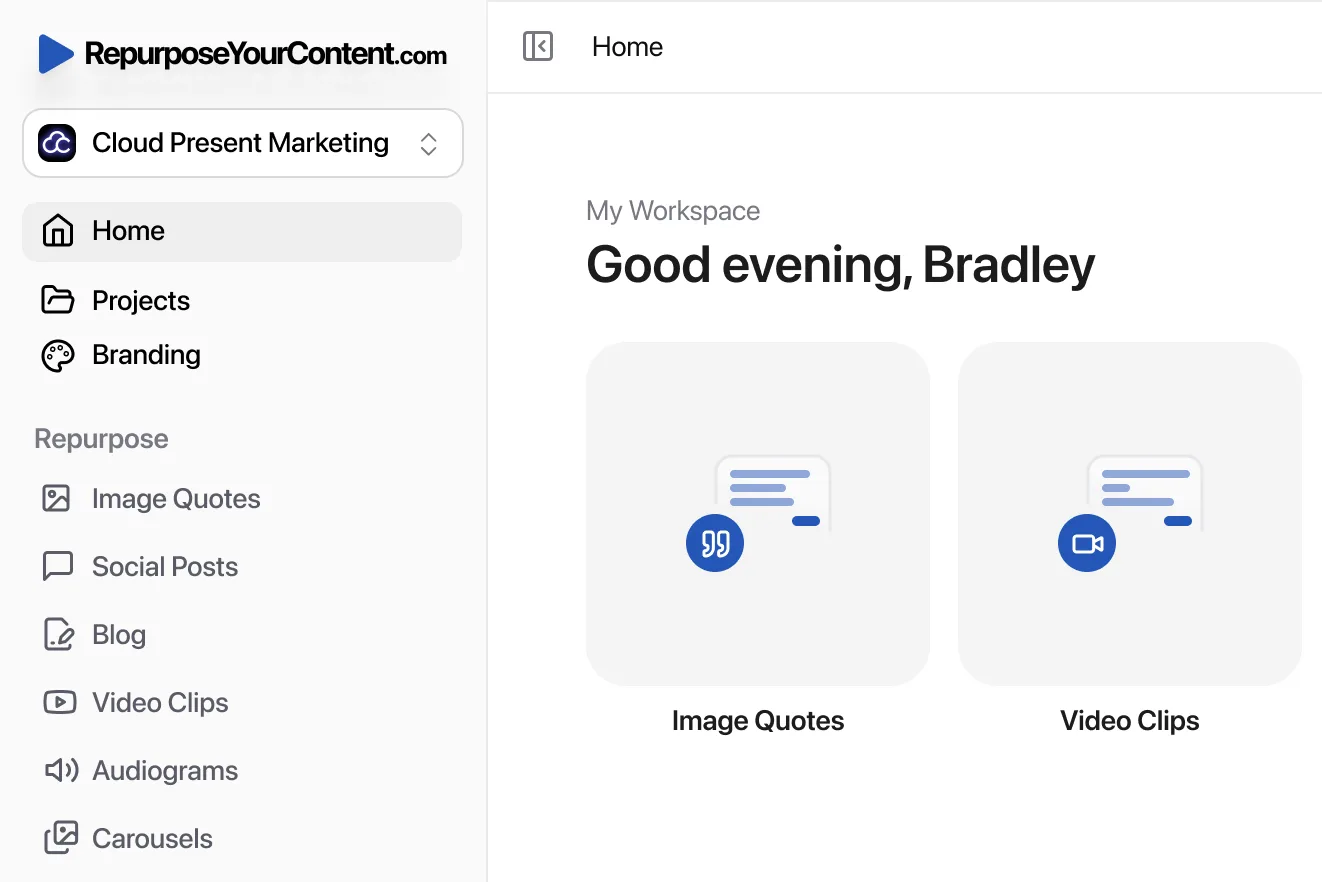
RepurposeYourContent handles the judgment layer for teams that don't want to become editors. A client sends one podcast, interview, keynote, sales call, livestream, course, or meeting recording. The production team returns 20 to 30 ready-to-publish assets in 72 hours, including video clips, LinkedIn posts, quote graphics, carousels, audiograms, and an SEO blog post.
The client's time is about 15 minutes for each recording. Content is prepared in the client's brand voice, reviewed by people, and supported with unlimited revisions. A 72-hour turnaround guarantee applies, or the client doesn't pay.
Plans start at $999 per month, and pricing can reach as little as $14 per finished asset, based on the supplied publisher information. One 45-minute recording becomes 30 assets, so the service covers the transcript, selection, copy, design, quality assurance, and packaging that a DIY workflow leaves with the client.
For a busy founder or B2B marketing team, that distinction matters. Software reduces production friction. A done-for-you service removes the recurring review queue.
Book a call with RepurposeYourContent or request a sample from a recent podcast episode. Send one recording, spend about 15 minutes sharing the brand context, and see how the team turns it into finished content within the 72-hour guarantee.
Tags: