Content Marketing for B2B: A Practical Playbook
A practical guide to content marketing for B2B teams, covering strategy, channels, repurposing, KPIs, and a 90-day playbook you can run this quarter.
Content marketing for B2B works when it operates as a production system, not a collection of isolated blog posts. The practical model is simple: record one useful conversation, extract the strongest ideas, and turn them into a month or quarter of channel-specific assets.
That matters because only 29% of B2B marketers rate their content strategy as extremely or very effective, while 58% call it moderately effective, according to the 2025 B2B content marketing benchmark. The problem usually isn't a lack of ideas. It's the missing workflow between recording, editing, publishing, distributing, and measuring.
The State of Content Marketing for B2B in 2026
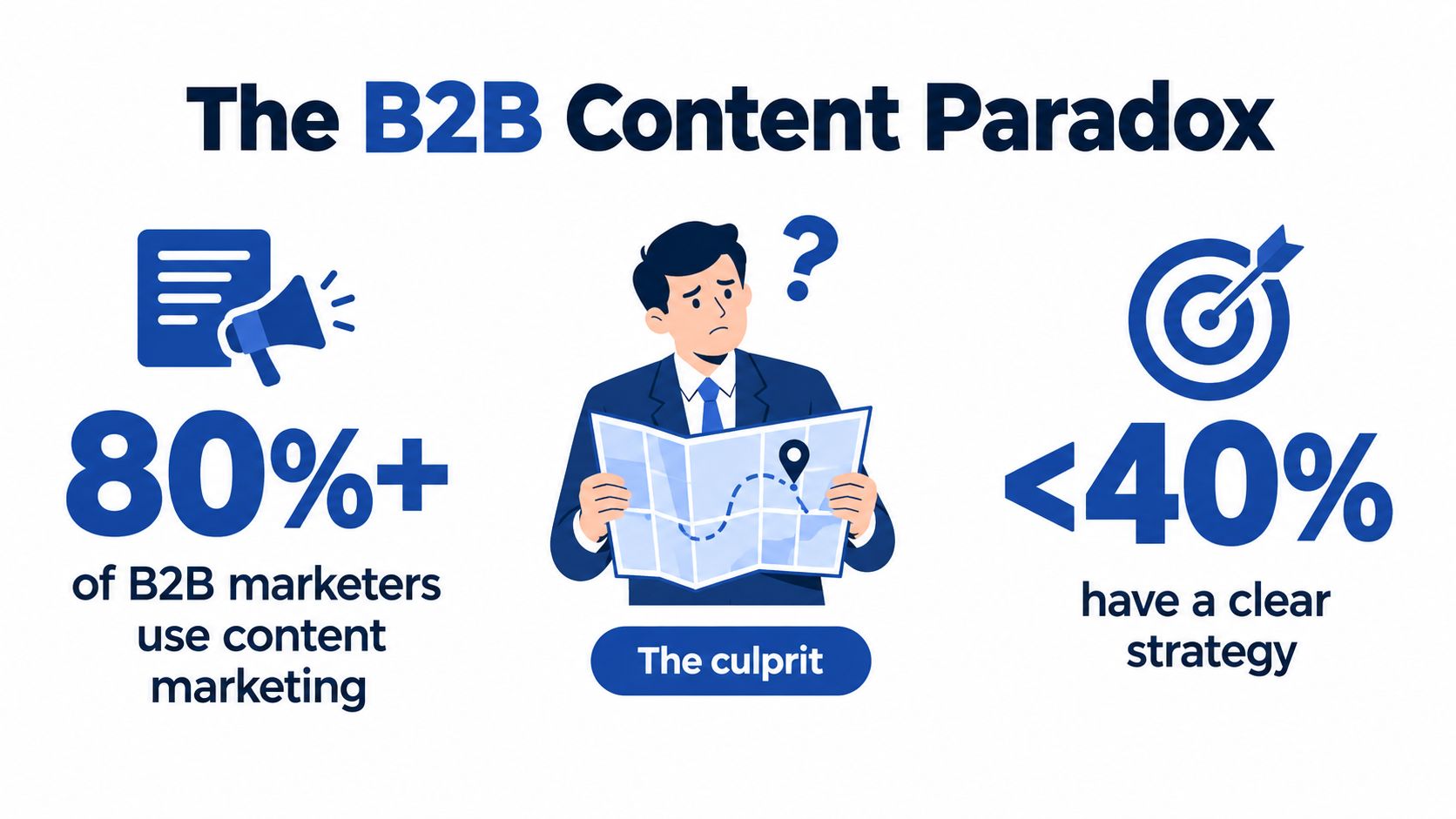
B2B content marketing is widely established, but execution remains inconsistent. Research surveying 1,186 B2B marketing professionals globally between June 25 and August 16, 2024, found that only 29% rated their strategy extremely or very effective. 12% rated it not very effective, and 1% rated it not effective at all. The same CMI and MarketingProfs research found that 54% cited a lack of resources, 45% lacked a scalable content creation model, and 56% struggled to attribute return on investment.
Those constraints turn content into an operations problem. A team can have strong subject-matter expertise and still fail to publish consistently if recording, editing, approvals, distribution, and measurement sit in separate workflows. Publishing calendars then depend on individual effort instead of a repeatable production system.
Brand value is not the primary obstacle. 87% of B2B marketers said content marketing generated brand awareness during the preceding 12 months, according to the same benchmark. Recognition exists. The gap lies in converting expertise into a reliable stream of assets that sales, buyers, and internal stakeholders can use.
Why programs stall
A writer may produce a strong article, yet still lack the capacity to create its supporting social posts, video clips, newsletter copy, graphics, sales enablement version, and follow-up distribution. Treating each asset as a separate assignment increases review time and leaves fewer pieces ready to publish.
Two production models sit at opposite ends:
- Standalone production: Every blog, post, and video begins from a blank page.
- Pillar production: One substantial idea becomes a coordinated set of assets with shared research, terminology, and positioning.
Pillar production makes better use of recorded expertise. A podcast interview, executive keynote, customer conversation, or sales call already contains objections, examples, questions, and language from a real buyer context. The work is to identify useful sections, verify the claims, and adapt each piece for its channel.
Operational rule: A recording is not finished when it goes live. It is finished when its strongest ideas are packaged for every relevant buyer touchpoint.
A documented B2B content marketing strategy should define owners, review stages, source files, naming conventions, delivery dates, and channel adaptations. Teams can build this workflow internally, or use a done-for-you production partner when editing, repurposing, and distribution would otherwise consume the capacity needed for strategy and performance analysis.
What B2B Content Marketing Actually Is
B2B content marketing is an operating system for helping business buyers define a problem, compare options, reduce risk, and justify a purchase. It combines blog posts, podcasts, interviews, research, customer stories, sales documents, videos, email, and social content around the same positioning and evidence.
A buyer may consume content before speaking with a vendor, while comparing suppliers, or while building internal agreement. Buyers spend about 17% of their purchasing time in direct contact with potential vendors, leaving approximately 83% for independent research and internal evaluation, according to this B2B buying journey analysis. Each asset should answer a practical question, show relevant proof, and give the buyer a clear next action without requiring a live sales conversation.
B2B content has to work across a buying group. It must explain technical implications, survive internal forwarding, address objections from different departments, and give stakeholders enough evidence to continue the evaluation. That makes content operations a system problem: teams need a source of truth, repeatable production steps, defined reviewers, and a record of where each asset is used.
| Dimension | B2B | B2C |
|---|---|---|
| Buyer | A buying group with different responsibilities | Usually an individual or household |
| Main risk | Budget, implementation, compliance, switching cost, internal approval | Personal value, price, convenience, and preference |
| Content role | Educate, reduce uncertainty, and support consensus | Create interest, preference, and purchase intent |
| Shelf life | Often useful across a long evaluation period | Can be short-lived or campaign-led |
| Strong formats | Research, interviews, demos, comparisons, case studies, and guides | Short video, product content, social posts, and promotions |
| Conversion event | Form completion, sales reply, meeting, opportunity, or expansion | Purchase, checkout, or direct response |
The funnel vocabulary should stay consistent. TOFU, or top of funnel, addresses problem recognition and early education. MOFU, or middle of funnel, helps buyers compare approaches and assess fit. BOFU, or bottom of funnel, supports selection, implementation, and internal approval.
For example, at MOFU, a VP of Marketing may use a customer case study to compare operating approaches and assess whether the solution fits the team. At BOFU, a finance lead may use that same case study to examine implementation risk, approval requirements, and the evidence needed for an internal recommendation.
An MQL, or marketing-qualified lead, has shown enough engagement to meet a marketing-defined qualification threshold. An SQL, or sales-qualified lead, has been reviewed by sales and accepted for direct follow-up. Those labels only help when each asset has a defined conversion event and an owner for the next step.
A documented B2B content engine framework connects audience questions, source material, approvals, distribution, and measurement. Used well, it helps teams attract qualified B2B leads without treating every asset as a new project.
The Four Strategic Pillars You Need First
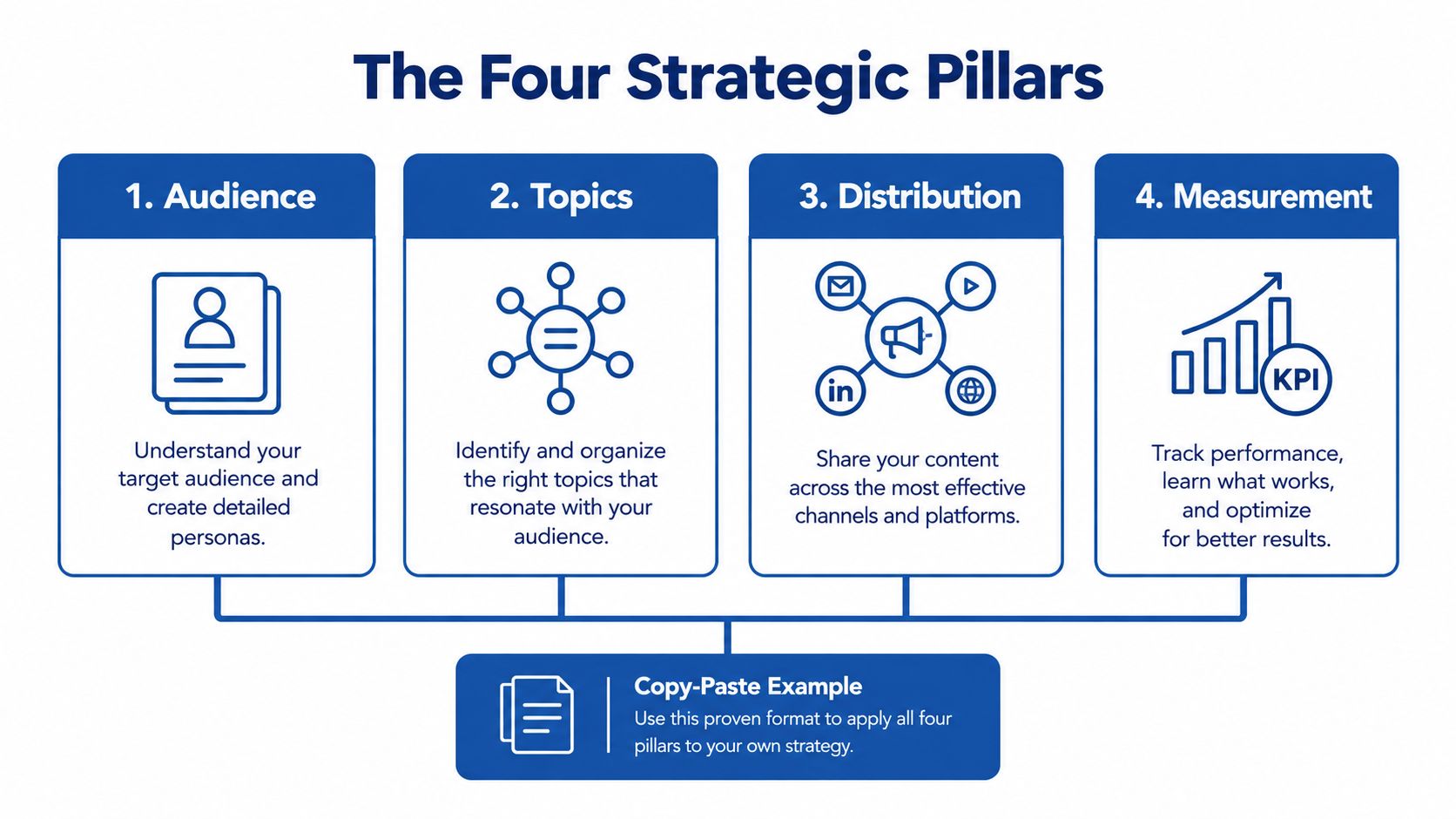
A repurposing workflow cannot fix unclear positioning. Before anyone edits a recording, define four operating decisions: who the content serves, where each idea fits in the funnel, which themes it supports, and how it reaches buyers. Store those decisions in a one-page Notion template with fields for owner, funnel stage, source recording, asset type, CTA, approval status, and publication date. Link the template to the content operations playbook for B2B so the team can apply the same process to every recording.
1. Audience
Create a one-page persona sheet for three named buyers. For each buyer, record:
- Business pain: What problem creates cost, delay, risk, or missed opportunity?
- Success measure: Which KPI must the buyer improve?
- Search questions: What three questions do they ask before contacting sales?
- Objection: What could stop the purchase?
- Evidence required: What proof would make the recommendation credible?
A practical set might include a VP of Marketing seeking predictable demand, an operations lead concerned about implementation disruption, and a finance lead building a defensible business case. One recording can serve all three. The asset brief must specify which buyer it addresses and which evidence it should emphasize.
2. Funnel mapping
Assign every buyer question to a funnel stage and conversion event.
| Buyer question | Stage | Asset | Conversion event |
|---|---|---|---|
| Why does our current process keep failing? | TOFU | Short post or educational article | Return visit |
| Which operating model fits our team? | MOFU | Interview-led guide or comparison | Form completion |
| How difficult is implementation? | BOFU | Customer story or implementation guide | Demo request |
| Can finance defend this investment? | BOFU | Business case or sales one-pager | Sales reply |
The map exposes gaps between awareness and purchase. A team may publish useful TOFU material while giving buyers no MOFU comparison content or BOFU evidence for internal approval.
3. Editorial pillars
Choose three to five recurring themes tied to business outcomes rather than product features:
- Reducing production bottlenecks
- Improving buyer education
- Making expert knowledge reusable
- Connecting content engagement to pipeline
- Supporting sales with clearer evidence
Tag each recording segment to one theme, one buyer, and one funnel stage. That combination gives writers a usable brief and lets editors create multiple assets without repeating the same post.
4. Distribution
Choose one primary and one secondary channel for each funnel stage. Channel benchmarks can guide the initial choice, but buyer behavior, available production capacity, and sales usage should determine the final plan.
A LinkedIn post can state the executive implication. A YouTube clip can preserve the explanation and searchable context. An article can define terminology and answer related buyer questions. Record the channel, owner, CTA, format, and repurposing deadline in the same operating template.
Paid amplification needs its own line. Otherwise, the team finishes a polished asset without a dependable route to the audience.
Governance protects consistency as output grows. Define who approves claims, who owns each CTA, and where the final files live. A repurposing system can scale expertise, but without those controls it can scale inconsistent messaging just as quickly.
Turn One Recording Into a Month of Content
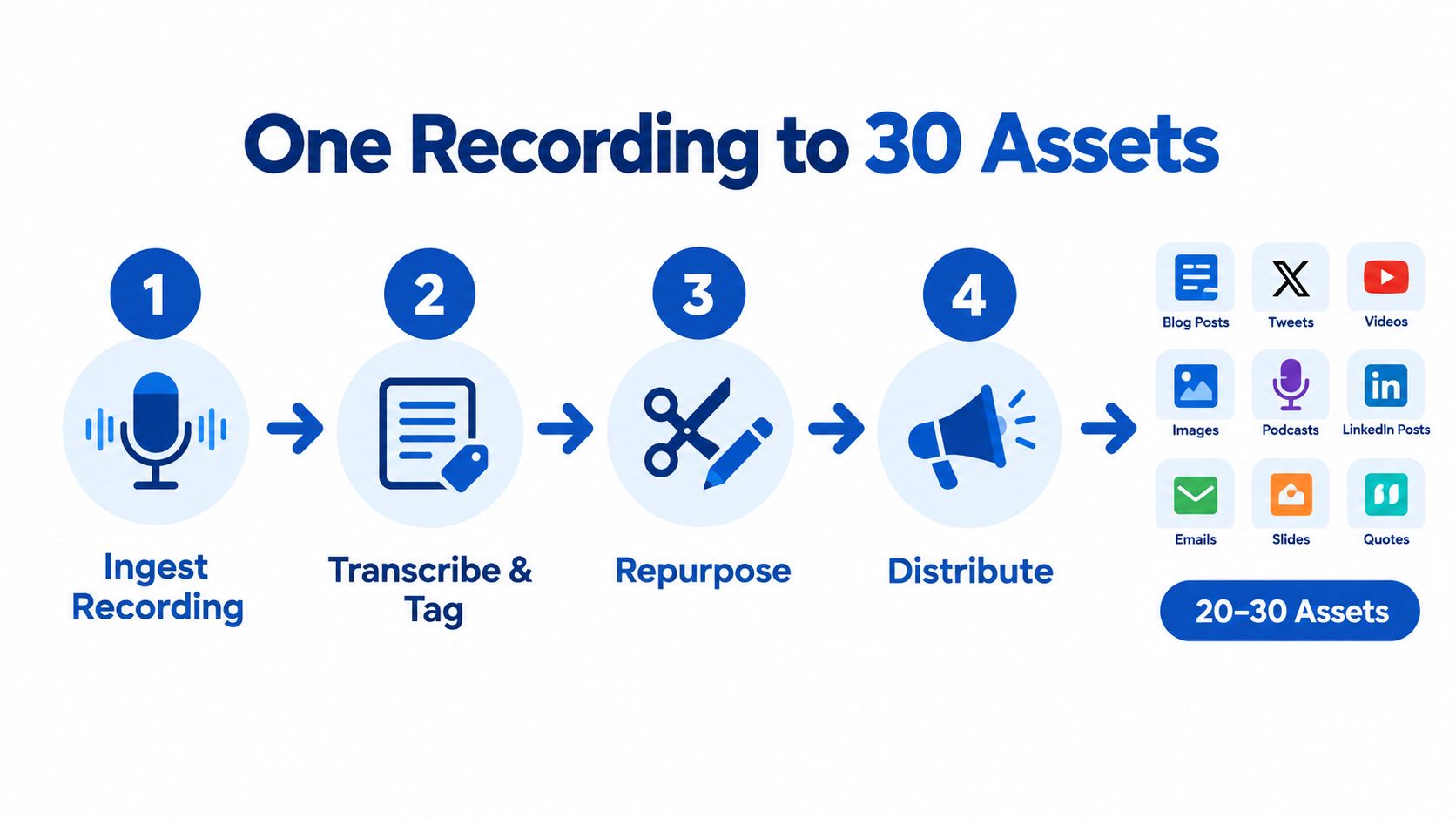
A 45-minute recording can become 20 to 30 distribution-ready assets when the team plans the output before editing begins. The source could be a podcast, keynote, customer interview, livestream, course session, or sales call. The format matters less than the density of useful expertise.
The following workflow gives a skilled generalist a realistic production estimate.
Step 1 Ingest and transcribe
Collect the raw video or audio, confirm the speaker names, check the brand guide, and generate a searchable transcript. The work takes about 30 to 45 minutes when files and instructions are organized.
The transcript needs more than spelling correction. It should identify unclear phrases, product names, customer references, technical terms, and moments where the speaker makes a claim that needs supporting evidence.
Step 2 Segment and tag
Read the transcript once for structure. Then tag sections by topic, funnel stage, buyer role, and asset type. Pull five to eight quotable insights that contain a clear opinion, explanation, example, or practical instruction.
This step takes about 60 to 90 minutes for a skilled generalist. Beginners may need two to three hours because they often select memorable sentences instead of complete ideas.
Step 3 Build the pillar asset
Draft one long-form article, guide, or newsletter from the strongest narrative. The draft should preserve the speaker's distinctive judgment while adding headings, definitions, proof, limitations, and a next action.
Allow two to three hours for a skilled generalist. A beginner may spend four to six hours, especially when the recording contains scattered ideas that need rearranging.
Step 4 Atomize the source
Turn the pillar asset and transcript into a coordinated set:
- Short-form video or audio clips
- LinkedIn posts
- Quote graphics
- Image carousels
- Audiograms
- Email snippets
- A newsletter section
- A sales enablement summary
- A search-focused blog post
Editing and formatting usually take two to three hours for a skilled generalist. Beginners can spend four to six hours checking captions, resizing visuals, rewriting hooks, and preparing files for each channel.
Step 5 Schedule distribution
Map the assets across four to five weeks. Avoid publishing every derivative on the same day. Use the first post to introduce the problem, later posts to explain the operating implication, and the final assets to support evaluation or a sales conversation.
Scheduling takes about 30 to 60 minutes when copy, files, and links are approved. The full DIY workflow totals roughly six to eight hours for a skilled generalist and 12 to 16 hours for a beginner.
A practical sequence looks like this:
- A founder records a 45-minute conversation about implementation risk.
- The editor tags sections about onboarding, ownership, reporting, and common objections.
- The writer creates a detailed article and a newsletter from the full argument.
- The team produces clips, posts, graphics, and a carousel from the tagged sections.
- Distribution runs across LinkedIn, YouTube, email, and the company blog.
- Sales receives a concise summary for prospects asking about implementation.
The recording repurposing workflow works because every derivative traces back to an approved source. That protects the brand from generic content and stops editors from inventing claims that the speaker never made.
The operational payoff is calendar stability. Instead of waiting for a new idea every few days, the team begins with a substantial source and distributes its strongest ideas deliberately.
Content Types and Channels by Funnel Stage
A channel should earn its place by helping a buyer move through a defined stage. Reach alone isn't enough. A popular post that creates no return visits, conversations, or account progression may be useful for awareness, but it hasn't proved commercial value.
| Funnel Stage | Primary Content Types | Best Channels | Primary KPI |
|---|---|---|---|
| TOFU | Short posts, SEO articles, short-form video, podcast appearances | LinkedIn, YouTube, organic search, guest channels | Qualified return visits and target-account coverage |
| MOFU | Original research, benchmark reports, interviews, webinars, case studies | Email, LinkedIn, blog, communities, partner channels | Form completion and engaged accounts |
| BOFU | Comparison guides, implementation material, customer stories, ROI content, sales one-pagers | Sales sequences, email, website, account-based outreach | Opportunity creation and pipeline progression |
Owned channels
Owned channels include the company blog, email list, resource centre, and LinkedIn page. The team controls the publication schedule and can connect each asset to a form, internal link, or sales action.
Email deserves first-class treatment. It gives the business a direct way to distribute a recording's ideas to known prospects and customers, rather than relying only on algorithmic reach.
Earned channels
Earned distribution includes podcast guesting, guest articles, analyst conversations, customer communities, partner newsletters, and industry discussions. These channels can add third-party context, but they require stronger editorial discipline. The team must adapt the idea to the host audience without turning the appearance into a product pitch.
Paid channels
Paid options include sponsorships, boosted posts, retargeting, and search campaigns. Paid distribution works best when the destination matches buyer intent. Sending a cold audience directly to a sales form often wastes the strongest part of the asset, which is the useful explanation.
A useful set of SaaS marketing funnel examples can help teams compare conversion paths before assigning budget. The decision rule is straightforward: if a channel can't be measured against a pipeline stage, it needs a clear strategic reason to remain.
Recorded expertise is often underused. Teams publish a podcast episode or interview, then move to the next recording. They miss the clips, objections, explanations, and proof points that could support search, email, sales, and social distribution.
KPIs That Connect Content to Pipeline
Pageviews, follower counts, and impressions describe exposure. They don't explain whether the content helped an account evaluate a supplier or create an opportunity.
A practical measurement stack starts with three metrics:
- Assisted pipeline: Opportunities where content appeared during the buying journey.
- Sourced pipeline: Opportunities where the first meaningful response came from a content interaction.
- Pipeline velocity: The pace at which content-engaged opportunities move through evaluation.
Use consistent UTM naming for every channel, campaign, recording, and asset. Connect forms to the CRM, retain the original source, and record subsequent content interactions against the account. This creates a usable trail without pretending that one touchpoint deserves all the credit.
Last-touch reporting answers a narrow question. Multi-touch reporting gives a broader view of influence. Leadership should review both, while sales and marketing agree in advance on which model supports budget decisions.
The benchmark research found that 56% of B2B marketers find ROI attribution difficult, which makes a small, consistent reporting template more useful than a large dashboard. The content marketing ROI measurement framework should fit on one page.
Include:
- Assets published during the period
- Target accounts reached
- Return visits from priority accounts
- MQLs and SQLs influenced
- Opportunities sourced
- Pipeline assisted
- Sales usage and qualitative feedback
- Next production decisions
Measurement rule: Keep reach as a diagnostic signal. Use account progression and pipeline as the decision criteria.
Your 90-Day B2B Content Playbook
A quarter-long program needs owners, deadlines, and handoffs. Without those details, the calendar becomes a list of intentions.
Phase 1 from days 1 to 30
The first month establishes the operating base.
| Week | Owner | Time | Friday deliverable |
|---|---|---|---|
| Week 1 | Strategist | 6 hours | Refreshed ICP, three buyer profiles, and priority business outcomes |
| Week 2 | Strategist | 5 hours | TOFU, MOFU, and BOFU question map with conversion events |
| Week 3 | Writer | 7 hours | Three to five editorial pillars and a reviewed topic backlog |
| Week 4 | Editor | 8 hours | Content audit, source library, brand guide, and approval workflow |
The audit should include existing articles, recordings, customer stories, sales documents, newsletters, and social posts. Mark each item as reusable, updateable, replaceable, or retired.
Phase 2 from days 31 to 60
The second month proves that the machine can produce consistently.
| Week | Owner | Time | Friday deliverable |
|---|---|---|---|
| Week 5 | Strategist | 4 hours | Flagship recording brief and distribution plan |
| Week 6 | Editor | 10 hours | First repurposing matrix and approved asset templates |
| Week 7 | Writer | 12 hours | One flagship asset plus the first repurposed batch |
| Week 8 | Distributor | 8 hours | Channel schedule, email sequence, and sales enablement summary |
The target is 20 or more assets from two recordings during this phase. The team should learn where approvals slow down, which formats need more editing, and which channels generate useful buyer responses.
Week six is usually the bandwidth cliff. The team has completed the strategy work and now sees the actual production load. A freelancer or done-for-you partner often becomes necessary at this point, not because the strategy failed, but because execution requires dedicated capacity.
A visual production system can also help teams scale content marketing with Bulk Image Generation, particularly when every asset needs consistent visual treatment.
Phase 3 from days 61 to 90
The final month connects publishing to commercial learning.
| Week | Owner | Time | Friday deliverable |
|---|---|---|---|
| Week 9 | Distributor | 6 hours | Paid amplification plan and target-account outreach sequence |
| Week 10 | Strategist | 6 hours | CRM fields, UTM naming, and pipeline reporting template |
| Week 11 | Writer | 8 hours | Sales objections article and updated BOFU asset |
| Week 12 | Strategist | 5 hours | Retrospective, channel decisions, and next-quarter calendar |
The retrospective should answer four questions:
- Which topics created qualified conversations?
- Which assets did sales use?
- Where did production wait for approval?
- Which formats deserve more or less effort?
The playbook should survive staff turnover. Store briefs, transcripts, source files, templates, approvals, and performance notes in one shared system. A new writer should be able to understand the audience, the claim standards, the channel rules, and the next deliverable without relying on undocumented knowledge.
The Done-for-You Alternative and Next Step
This playbook assumes roughly 15 to 20 hours of internal bandwidth each week once planning, production, reviews, distribution, and reporting are included. Lean teams often have the expertise but not the spare capacity.
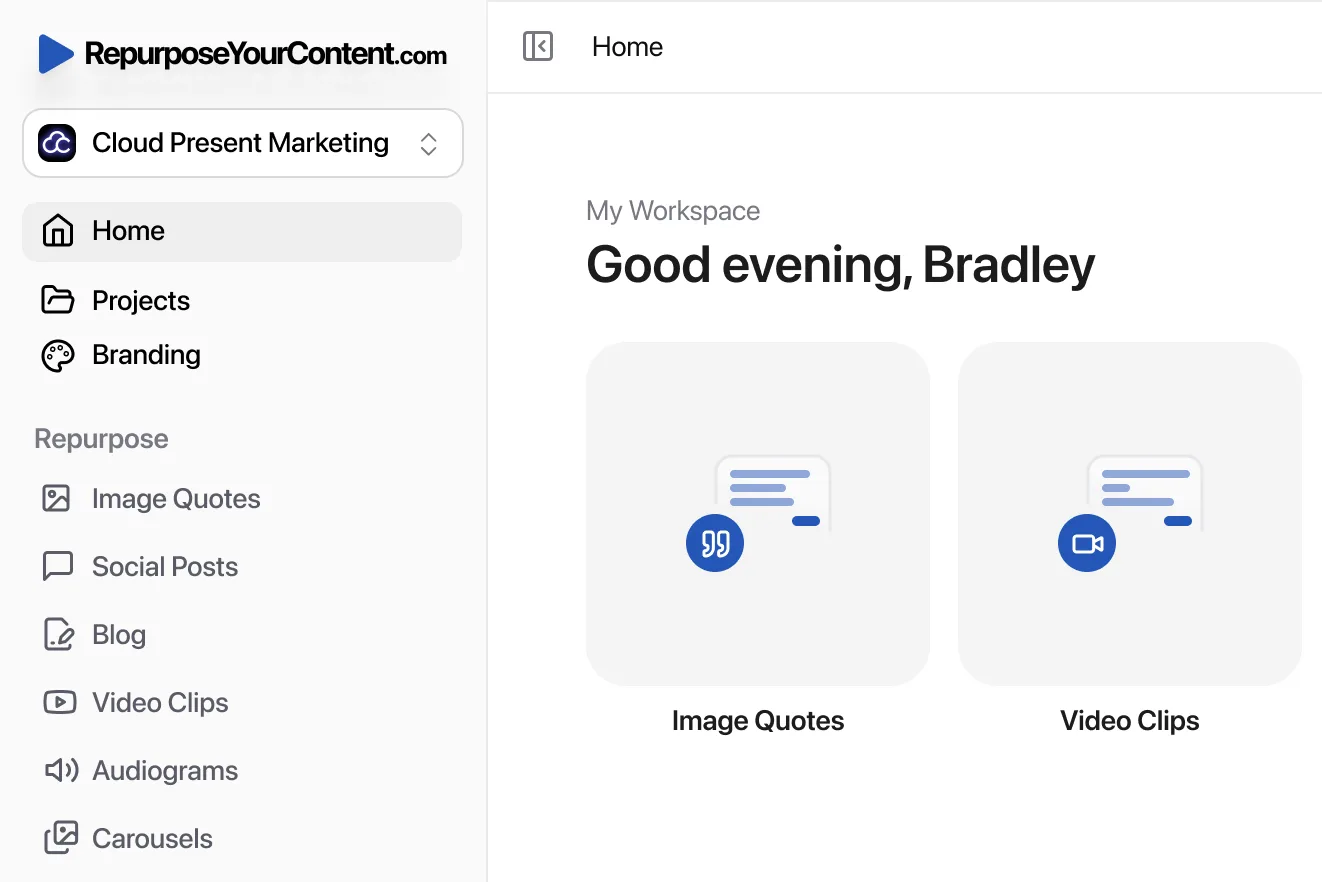
A done-for-you operation removes the assembly burden. Clients send one podcast, interview, keynote, sales call, livestream, course session, or other long-form recording. RepurposeYourContent returns 20 to 30 ready-to-publish assets in 72 hours, including video clips, LinkedIn posts, quote graphics, carousels, audiograms, and a blog post. The stated client time is about 15 minutes, with content written in the brand voice and unlimited revisions included.
The service cites a 72-hour turnaround guarantee, or the client doesn't pay, and pricing from $14 per finished asset. A single 45-minute recording becomes 30 assets when the source is structured and the output matrix is agreed in advance.
The decision comes down to three operating choices:
- Create from a system, not from isolated ideas.
- Repurpose evidence without stripping away context.
- Measure account progression, not attention alone.
Book a 30-minute call to scope a quarter of content production, or request a sample repurposing pack built from a recent podcast, interview, keynote, sales call, or livestream. Send the recording and the brand guidelines, then evaluate the finished assets against the team's actual publishing needs.
Tags: