Podcast Social Media Strategy: Turn Episodes Into Content
Podcast Social Media. Turn podcast episodes into a month of social content with this step-by-step repurposing guide. Get practical tactics, time estimates
A podcast episode can reach people who never open a podcast app. Edison Research found that 73% of Americans aged 12 and older had consumed a podcast in audio or video form, an estimated 210 million people, according to the 2025 Infinite Dial findings. Podcast social media isn't a promotional afterthought anymore. It's the discovery engine that introduces new listeners to the full episode.
The practical shift is simple. One recording should create clips, posts, quote graphics, carousels, audiograms, and a search-friendly article. The episode provides depth. Social content creates the first contact.
Why Podcast Social Media Is No Longer Optional
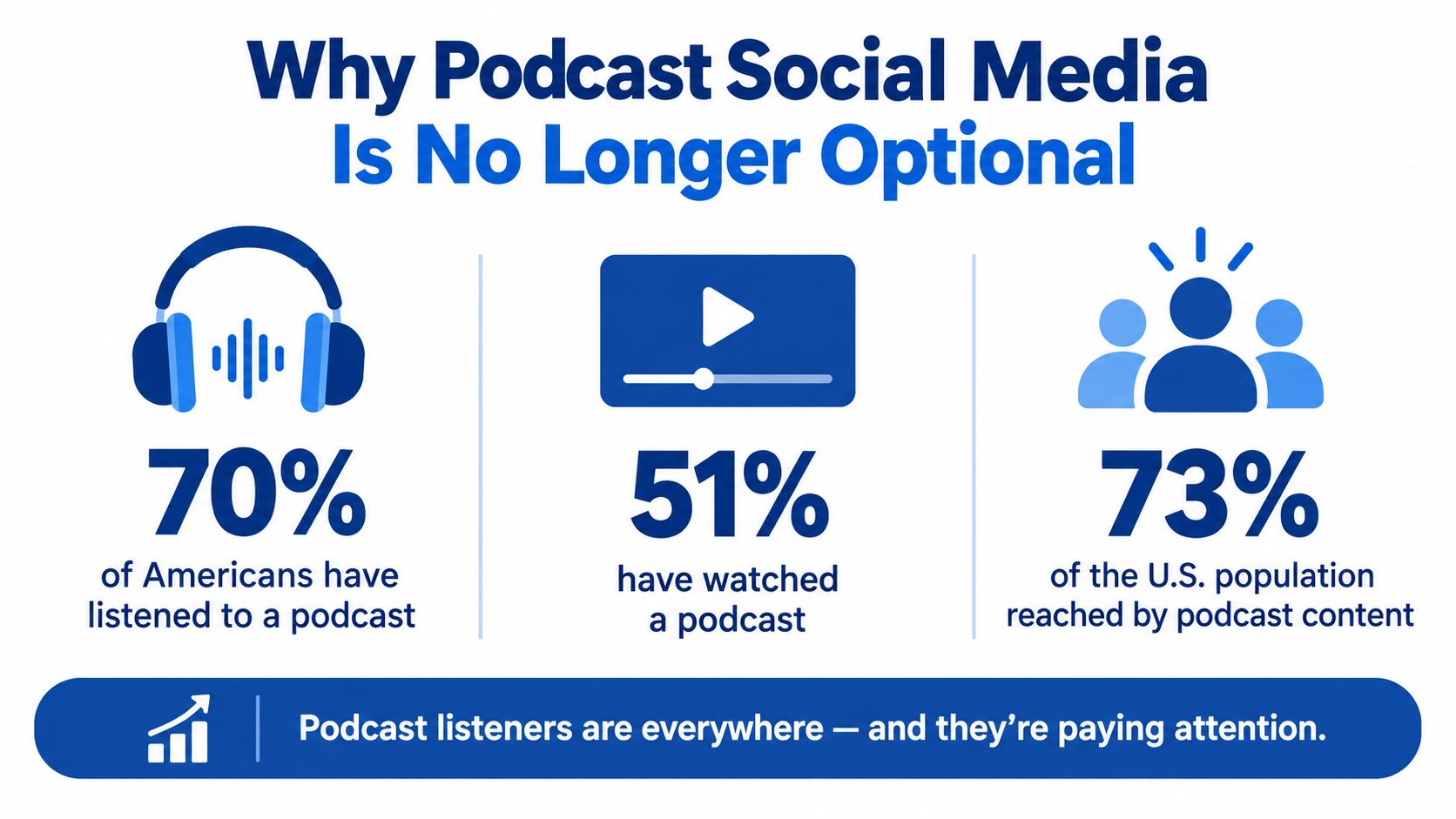
73% of podcast consumption now includes video, according to the 2025 Infinite Dial survey. The same research found that 70% of Americans aged 12 and older had ever listened to a podcast and 51% had watched one, reaching an estimated 210 million people across audio and video.
That changes the production brief. A podcast is a source of visual, written, and audio assets that can meet people in search results and recommendation feeds. The recording supplies depth. Social content creates the first opportunity to earn attention.
YouTube now sits inside the podcast funnel
YouTube was the most-used service among U.S. weekly podcast listeners, cited by 33%, ahead of Spotify at 25% and Apple Podcasts at 15%, according to Edison Research's 2025 findings. Long episodes build depth and searchable authority. Short clips offer low-commitment introductions that can bring unfamiliar viewers into the show.
Younger audiences show the same shift through different behavior. Among Gen Z monthly podcast consumers, 28% discovered podcasts most often through YouTube search, while 26% relied on social posts for suggestions. Among weekly TikTok users aged 13 and older, 47% said they use TikTok to discover podcasts, rising to 51% among users aged 13 to 24.
A subscriber link asks for a click. A clip earns attention from someone who has never heard of the show.
Practical rule: Build every episode for discovery from the start. Plan the clips, captions, visuals, and written assets alongside the recording rather than adding them after publication.
That workflow supports a broader podcast content marketing strategy. The episode remains the source of truth, while social assets create entry points for different levels of interest. Discovery begins with the clip, then progresses to the full episode and the wider content library.
How to Extract Clips That Actually Drive Discovery
Good clips don't begin with editing software. They begin with a stronger selection filter.
A discovery clip should stand on its own, create curiosity, and make the next action obvious. A polished excerpt that needs ten minutes of episode context won't perform that job.
Four filters for every candidate moment
1. Test for a complete idea.
A viewer should understand the argument without hearing the question that preceded it. Cut around the conclusion, conflict, framework, or surprising explanation. Remove greetings, throat-clearing, and repeated setup.
2. Find the first-second hook.
The opening should make a clear claim, introduce tension, or promise a useful result. “Most founders measure the wrong podcast metric” creates a stronger entry than “Thanks for joining the show.”
3. Give the viewer a low-friction next step.
Use a direct action such as “Watch the full episode for the framework” or “Follow for the next part.” The clip earns attention. The call to action guides it.
4. Package for one platform.
A TikTok clip can move quickly through personality and contrast. A LinkedIn version may need more context and visible text. Don't force one caption, crop, or opening onto every network.
A useful review process scores each moment before editing:
- Clarity: Can the idea survive without the episode?
- Tension: Does the opening create a reason to keep watching?
- Value: Does the viewer gain a concrete insight?
- Conversion: Is the next action obvious?
- Fit: Does the format match the platform?
A strong clip doesn't summarize the episode. It proves the episode contains something worth hearing.
For creators exploring faceless formats, ClipNova's guide to faceless reels offers useful context on building visual short-form content without relying on a talking-head format. The same selection discipline still applies. Visual treatment can't rescue a weak idea.
More examples of this editorial approach appear in how to make viral podcast clips. The key principle stays consistent: cut for the hook, not the summary.
Platform-Specific Tactics for Podcast Social Media
The same excerpt can succeed on one network and disappear on another. Each platform creates a different viewing situation, so each version needs its own packaging.
A nationally representative U.S. survey found that YouTube generated 40% of favorite-show discovery. Facebook contributed 17%, TikTok 15%, and Instagram 14%. Together, YouTube and social platforms accounted for 61% of discovery, according to the Podcast Discovery Playbook.
Organic trust matters too. Among listeners who discovered a favorite show through social media, 60% encountered an organic post from an account they followed, compared with 33% who cited sponsored content. That makes useful, native content more valuable than a stream of announcements.
Platform Tactics Comparison
| Platform | Ideal Asset | Key Metric |
|---|---|---|
| YouTube | Searchable full episode plus vertical Shorts | Qualified episode starts |
| TikTok | Fast, personality-led clip with immediate context | Shares and qualified profile visits |
| Polished Reel, quote graphic, or carousel | Saves, shares, and follows | |
| Framework clip, text-led post, or carousel | Profile visits and attributable clicks |
YouTube Shorts should focus on reach and discovery. Standard episodes should carry the deeper explanation. YouTube's official policy categorizes square or vertical videos uploaded on or after October 15, 2024, and lasting up to three minutes as Shorts, as explained in YouTube's Shorts policy. Keep each clip within that limit, and make one complete idea the unit of production.
TikTok rewards speed, personality, and sharp changes in context. Instagram needs stronger visual polish and captions that make a statement worth saving. LinkedIn viewers usually need professional relevance, clear formatting, and a useful business application.
A scheduling workflow can help teams maintain consistency without treating every platform as identical. A resource such as ViralBrain's LinkedIn post scheduler may support planning, but scheduling won't solve weak hooks or generic captions.
For Instagram-specific packaging, see this guide to repurposing podcast content for Instagram. A native caption and a native call to action matter more than posting the same file everywhere.
The Repurposing Workflow and Real Time Costs
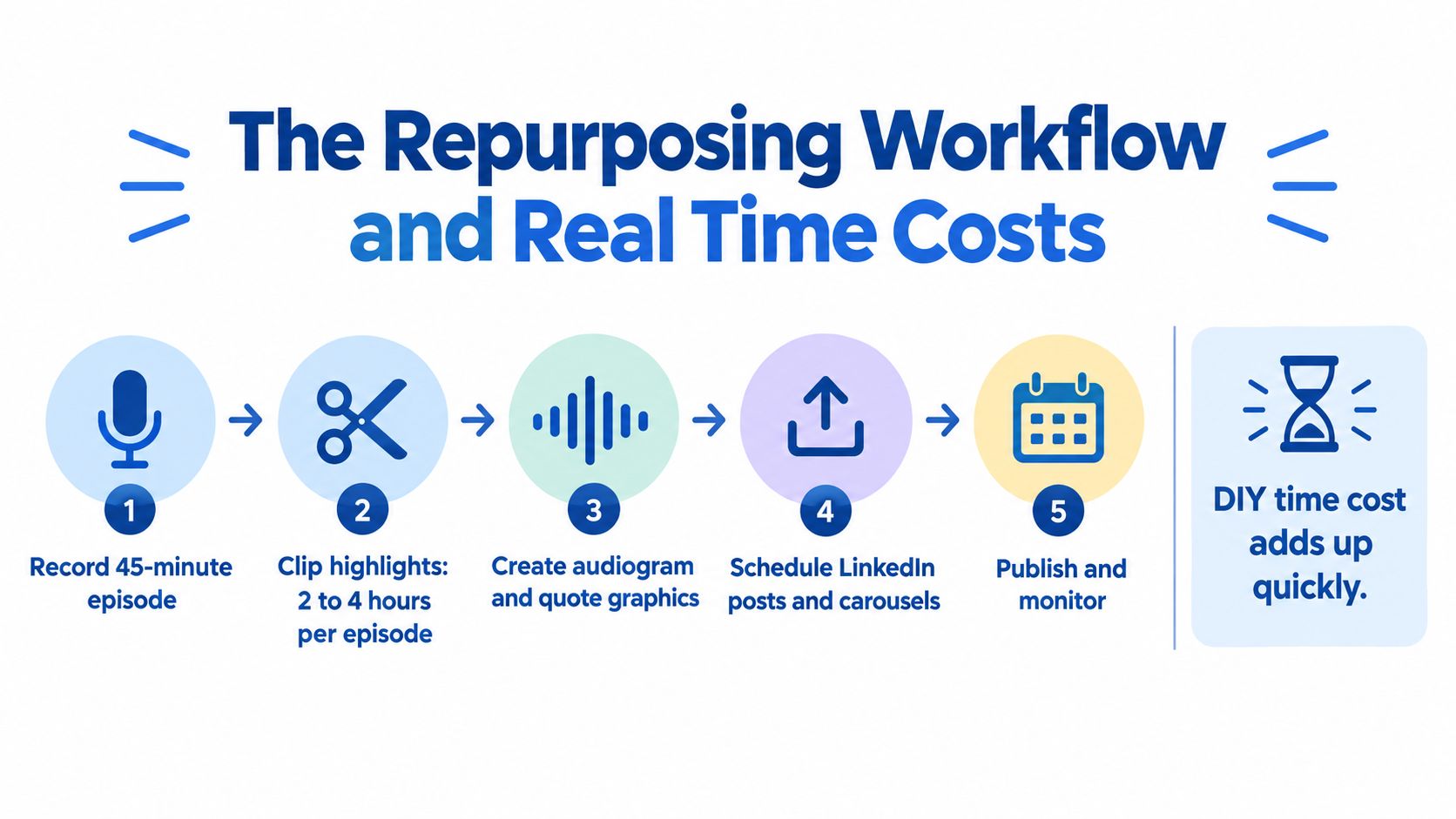
DIY production looks manageable until every task gets counted. A 45-minute recording can require two to three hours of manual clipping, about an hour for platform captions, and another two hours for quote graphics and carousels. Publishing then requires recurring scheduling, quality checks, and comment monitoring.
That workload is why many strong podcasts publish once and disappear. The recording took preparation. The post-production workload makes consistent distribution hard.
A practical five-step workflow
Step 1, record the source.
The source can be a podcast, interview, keynote, sales call, livestream, course session, or meeting. A 45-minute recording usually contains several independent ideas. Good audio and clear speaker separation reduce later cleanup.
Step 2, identify the moments.
A producer reviews the recording, marks timestamps, and labels topics, speakers, hooks, and possible calls to action. DIY clipping often takes two to three hours per episode because selection requires repeated listening, not just dragging a playhead.
Step 3, build the asset set.
The selected moments become vertical clips, audiograms, quote graphics, carousels, and written posts. Captions must be accurate. Names, figures, and technical terms need visible treatment.
Step 4, adapt each platform.
The editor changes aspect ratio, opening text, caption style, and call to action. A LinkedIn framework shouldn't receive the same caption as a TikTok opinion clip.
Step 5, publish and monitor.
The team schedules posts, adds tracking links, watches qualified behavior, and records what deserves a second version. Publishing is part of production because the feedback improves the next episode.
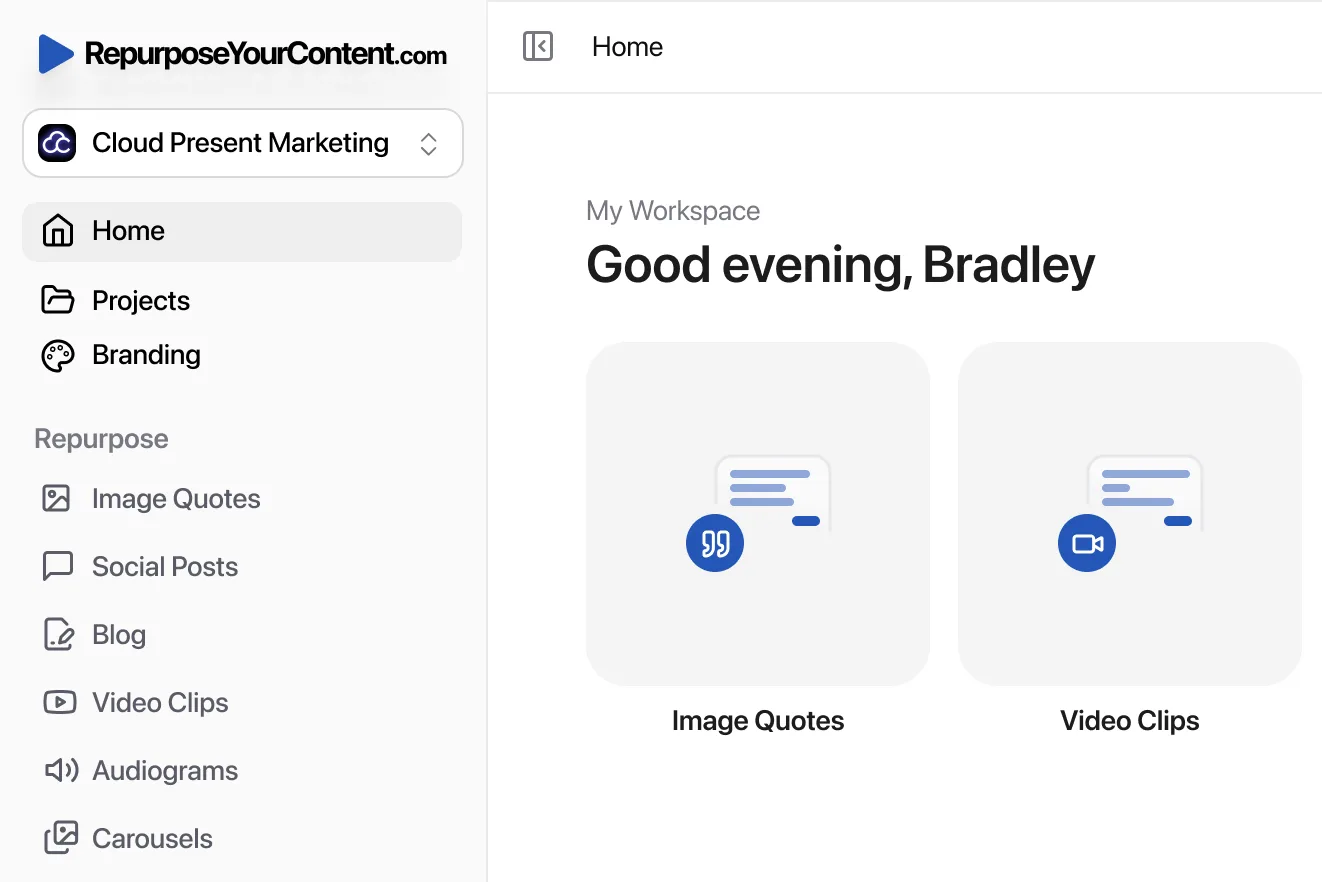
A done-for-you workflow changes the time equation. Clients send one recording, whether it's a podcast, webinar, keynote, interview, or meeting. RepurposeYourContent returns 20 to 30 ready-to-publish assets in 72 hours, including video clips, LinkedIn posts, quote graphics, carousels, audiograms, and a blog post. Client time is about 15 minutes.
The service lists a 72-hour turnaround guarantee, or the client doesn't pay, and pricing starts from $14 per finished asset. One 45-minute recording becomes 30 assets, with the finished work delivered in the client's brand voice. The DIY alternative may cost nothing in software, but it costs hours that founders and marketing teams rarely have.
A detailed version of this process appears in how to repurpose podcast content.
Measuring What Actually Moves the Needle
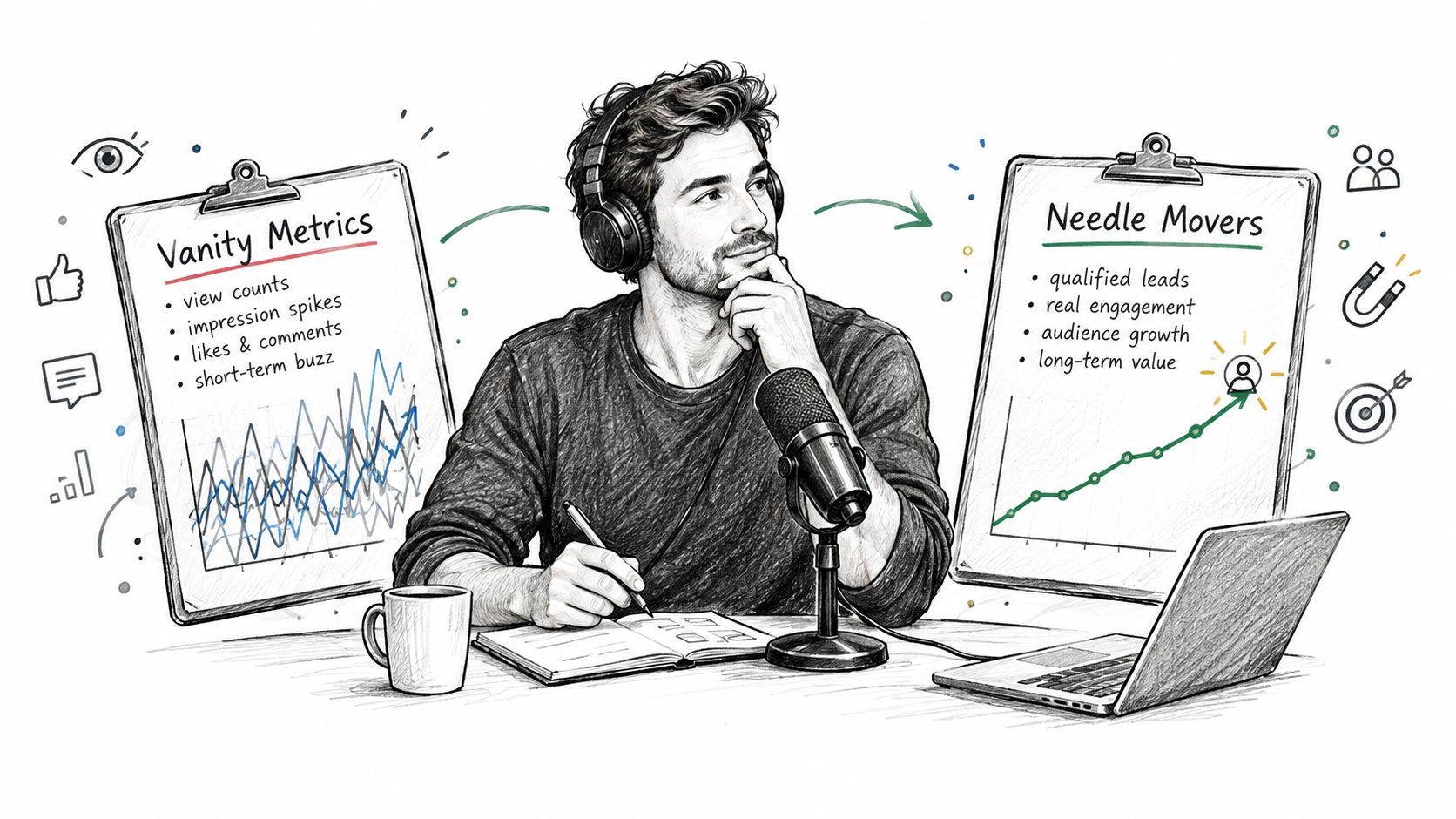
Views are useful for awareness, but they don't prove that a podcast gained a listener. A clip can attract attention while sending almost nobody to the full episode. Measurement must separate creative quality from platform distribution and audience differences.
Track the path from clip to episode
For every asset, record the source episode, timestamp, topic, speaker, hook type, duration, aspect ratio, captions, platform, and publication time. Add impressions, average watch time, completion rate, shares, saves, comments, profile visits, follows, and link clicks.
The most useful discovery measures include:
- Qualified profile visits: Did the viewer seek more information?
- Click-through rate: Did the post move someone toward the show?
- Follows per 1,000 views: Did attention create an ongoing relationship?
- Attributable episode starts: Did the audience reach the actual content?
- Saves and shares: Did the idea earn future use or peer recommendation?
Published benchmark ranges place average engagement at 1% to 3% on Instagram and LinkedIn, 0.5% to 1% on X, and 3% to 8% on TikTok, according to Headliner's podcast optimization guidance. These figures shouldn't be compared directly. Each network uses different denominator definitions and recommendation systems.
Use controlled testing, not lucky winners
Run a two-cycle test. First, publish several clips covering different topics and hook types. Then repeat the strongest concepts while changing one element, such as the first sentence, on-screen text, thumbnail, or duration.
Don't judge the system by the best-performing clip. That creates survivorship bias. Use a consistent observation window and compare median performance, not only the mean. A viral outlier can hide a weak content system.
Engagement rate should also stay consistent within each platform. A practical formula divides total likes, comments, shares, and saves by follower count. The result helps compare posts on the same account, but it doesn't make Instagram and TikTok interchangeable.
Teams needing a more technical measurement reference can consult Mallary.ai's developer guide to measuring social media engagement. The important operational choice is to define success before publishing. Reach, audience growth, episode consumption, and lead generation require different creative decisions.
Turning One Recording Into a Month of Content
A podcast becomes a reliable discovery engine when each asset has a defined job. A short clip earns attention from new viewers. A carousel explains the framework. A quote graphic reinforces the main idea. The full episode builds trust, while a blog post captures search intent and gives sales teams a durable page to share.
The recording happens once. Distribution then adapts its ideas for YouTube, TikTok, Instagram, LinkedIn, email, and search. Each channel gets a native format, so the team does not force one edit into every feed.
A monthly sequence can stay simple:
- Choose one episode idea that addresses a clear audience problem.
- Extract several self-contained moments with different hooks.
- Package each moment natively for its intended platform.
- Attach a relevant next step, such as watching the full episode or following for the framework.
- Measure qualified behavior, not views alone.
- Repeat winning topics with controlled creative changes.
The calendar gives those assets room to work. Week one can feature the framework clip. Week two can reinforce it with a quote graphic. Week three can use a carousel that explains the process. Week four can publish the blog recap and link back to the full episode. One recording creates four weeks of touchpoints without pretending that every audience wants the same post.
Use a content multiplication framework to connect the pieces. The framework keeps production focused on one source idea while giving audiences several useful entry points. It also exposes the key trade-off: more formats create more opportunities for discovery, but only if every asset has a clear purpose and a manageable review process.
The alternative is spending the week editing, writing captions, building templates, scheduling posts, and reviewing weak signals. A month of content works when the team plans the discovery path before recording starts. The shows that grow are the ones where every asset has a job before the recording stops.
Tags: