How to Choose a Content Creation Agency
Find the right content creation agency for your brand. Learn what they do, how to evaluate one, and why it matters for your 2026 strategy.

A content creation agency is a specialized service that produces, manages, and distributes branded content from existing recordings. Pricing can start from $14 per finished asset, with turnaround as fast as 48 hours.
That matters because few teams lack ideas. They lack the production capacity to turn a podcast, keynote, interview, sales call, livestream, or course recording into consistent content. A 45-minute recording can become 30 finished assets, but only when someone handles the editing, writing, design, review, and delivery.
What Is a Content Creation Agency
A content creation agency fills the gap between recorded expertise and published marketing content. Research indicates that 54% of B2B marketers lack sufficient resources for content production, while 45% don't have a scalable content-creation model (LinkedIn's summary of B2B content research). The problem usually isn't a shortage of podcasts, interviews, meetings, or presentations. It's the work that begins after recording ends.
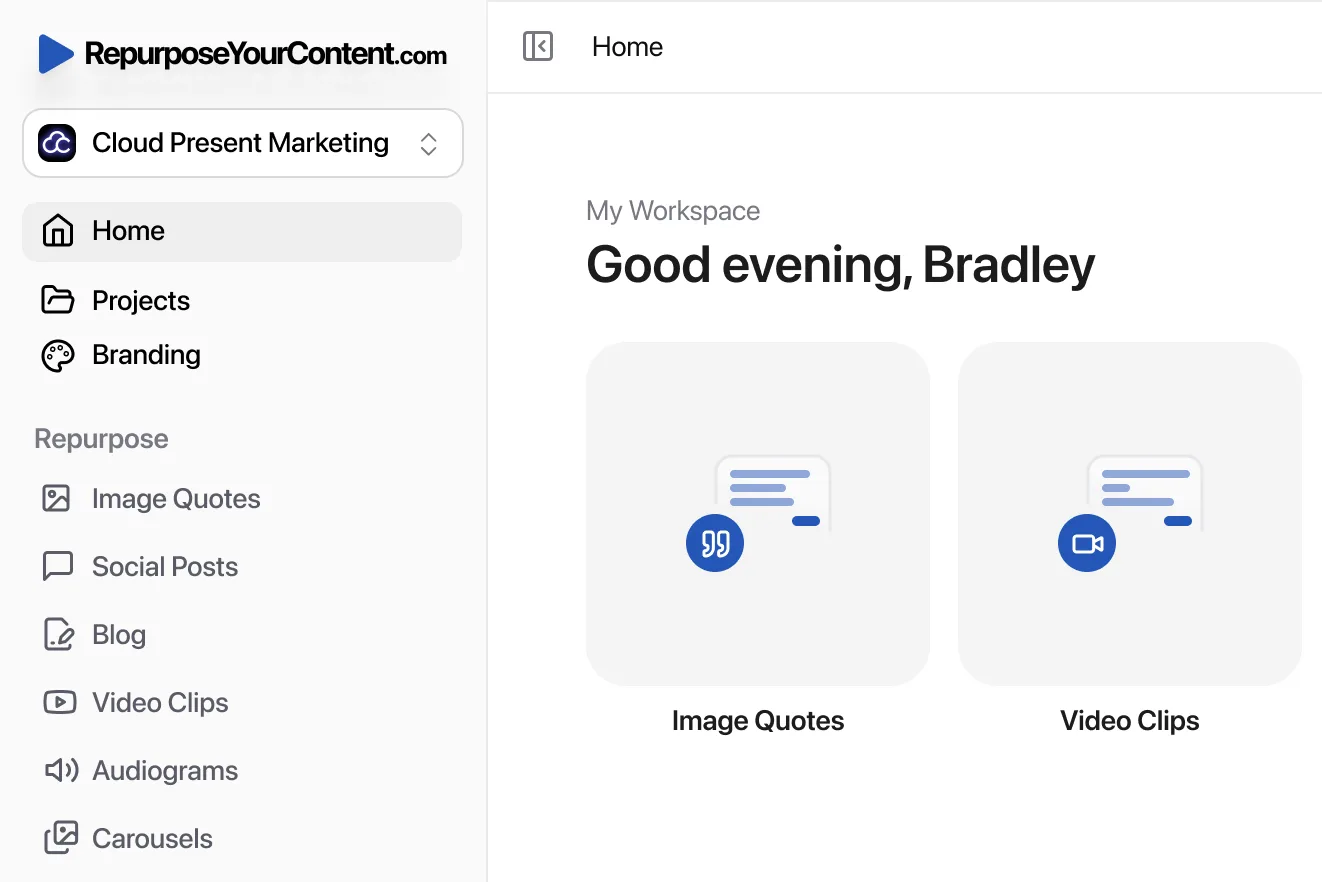
A specialist agency takes one long-form source and develops a coordinated publishing system around it. That may include short-form video clips, LinkedIn posts, quote graphics, carousels, audiograms, email content, and an SEO-ready blog post. Each asset should fit its channel while preserving the speaker's ideas, terminology, and brand voice.
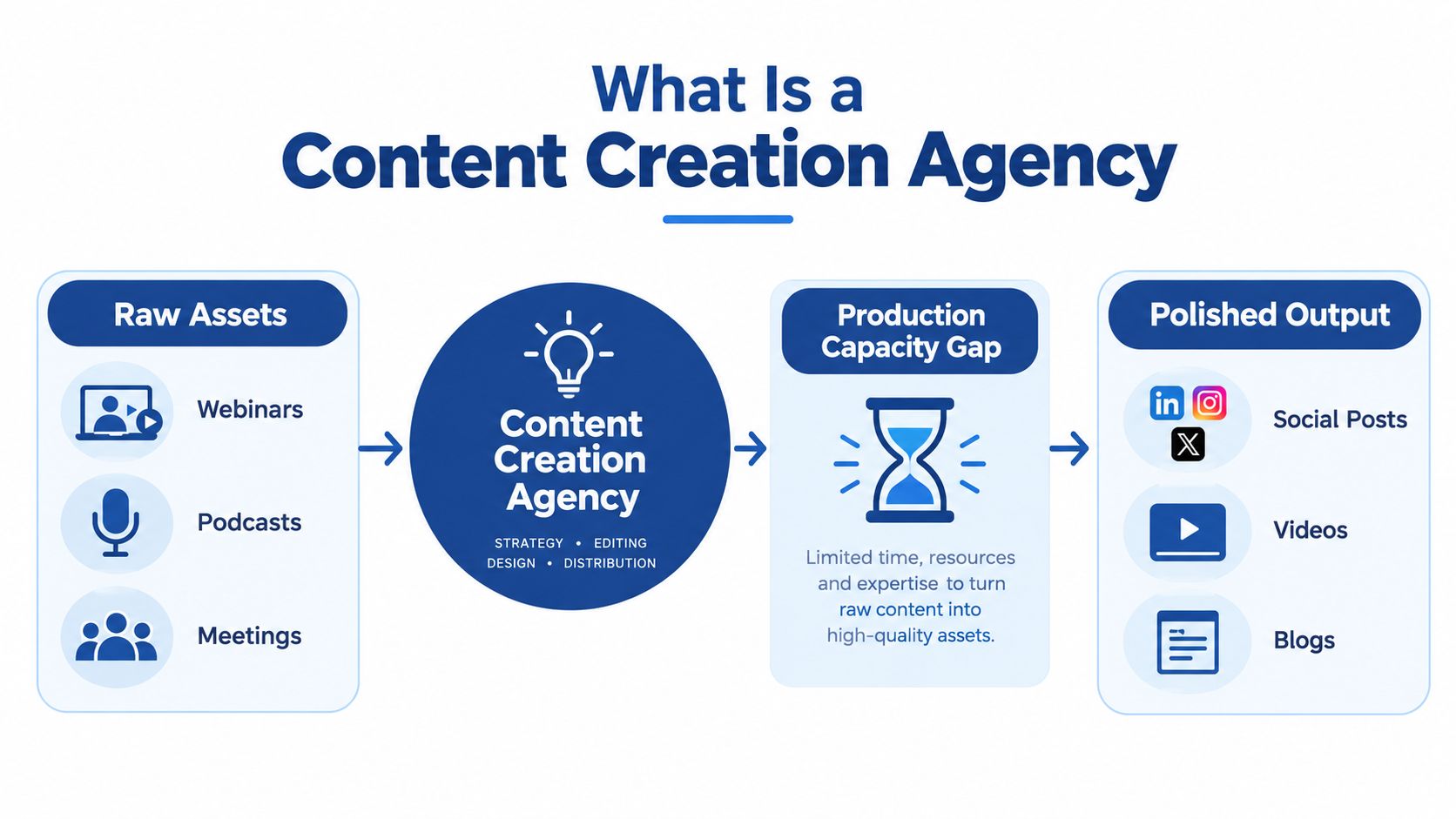
The agency model is operational
A generalist content marketing partner may handle strategy, search research, editorial planning, social publishing, or campaign assets. A repurposing-focused content creation agency concentrates on extracting more value from material that already exists.
That distinction changes the buying decision. The client isn't paying only for creative execution. The client is buying editorial capacity, production coordination, quality control, and reliable delivery without hiring separate editors, designers, writers, and project managers.
A useful overview of what a content marketing service includes can help teams compare broader services with a focused repurposing model. The key question is whether the provider can connect every derivative asset to a source recording and a defined business objective.
The wider market supports this specialization. The creator economy represented approximately $250 billion in addressable economic activity in 2024 and is projected to reach roughly $480 billion by 2027, according to Goldman Sachs estimates summarized by Everything PR. The sector includes brand partnerships, advertising, subscriptions, digital products, direct audience payments, and platform monetization.
As more experts operate like media brands, demand shifts toward repeatable workflows. One-off editing isn't enough. Founders and B2B teams need consistent production, channel-specific formatting, and publishing support that turns existing knowledge into a dependable content engine.
Agency vs In-House vs Freelancer Models
The right production model depends on volume, complexity, and internal capacity. An in-house team offers close brand access, but its output is limited by headcount and available skills. A freelancer can handle a defined task well, but consistency becomes harder when the workflow requires editing, copywriting, design, review, and distribution.
Production Model Comparison
| Model | Scalability | Control | Cost Efficiency |
|---|---|---|---|
| In-house team | Limited by internal headcount and specialist availability | High brand control and fast internal communication | Efficient at steady volume, but fixed staffing costs remain |
| Freelancer | Flexible for individual assignments | Strong when one person understands the brand | Efficient for narrow scopes, less efficient when multiple specialists are needed |
| Content creation agency | Scales through a coordinated production team | Controlled through documented workflows, approvals, and brand guidelines | Efficient when one partner replaces several specialist roles |
B2B teams often choose in-house production because it appears easier to manage. The picture changes when content requires video editing, social copy, graphic design, captions, SEO structure, and publishing instructions. A single content manager may understand the strategy but lack the hours or specialist skill to complete every output.
Freelancers solve part of that problem. One editor can create clips, and one writer can create posts. Yet the client still has to coordinate the handoffs, explain the brand voice, review accuracy, chase deadlines, and manage revisions. That coordination becomes a hidden operating cost.
Practical rule: Choose an agency when the bottleneck is production capacity, not subject-matter expertise.
When each model makes sense
An in-house model fits teams with stable content volume, established specialists, and enough demand to support full-time roles. It also suits organizations with strict legal, compliance, or security requirements that require constant internal access.
A freelancer fits a focused assignment, such as editing one podcast series or writing a specific set of posts. The model works best when the client already owns the workflow and needs extra hands.
An agency fits teams that have valuable recordings but lack a complete production department. The partner can standardize intake, transcription, selection, writing, design, review, and delivery. Teams evaluating whether to outsource can also compare the operational implications in this guide to outsource content repurposing.
The central decision is simple. If content repeatedly waits in a folder after recording, the organization needs a production system rather than another isolated contractor.
Core Services and Deliverables
A complete content creation service begins with an asset matrix. The agency reviews a source recording, identifies its strongest ideas, and assigns each idea to the format where it can work best.

A strong delivery may include:
- Short-form video clips: Complete ideas edited for vertical or platform-specific viewing, with accurate captions and clear openings.
- LinkedIn posts: Written from the speaker's point of view, with a practical argument rather than a transcript pasted into social media.
- Quote graphics: Concise statements paired with brand colors, fonts, and visual hierarchy.
- Image carousels: Several connected insights structured for sequential reading.
- Audiograms: Audio excerpts supported by captions and visual branding.
- SEO-ready blog posts: A structured article built around search intent while retaining first-hand expertise.
The difference between a content system and an asset bundle is editorial judgment. An automated transcript can identify words, but it can't reliably decide which idea deserves a clip, which statement needs context, or how a point should change for LinkedIn versus a blog.
The hidden cost of DIY production
Independent podcasters reported an average production range of 4 to 8 hours per episode, covering editing and preparation before derivative content exists, according to a 2025 survey summarized by Cited. That workload only covers the original episode.
A manual repurposing workflow adds more time:
- Reviewing the recording: The producer listens for useful themes and memorable moments.
- Selecting clips: The editor finds complete ideas rather than arbitrary time ranges.
- Editing video or audio: The team removes pauses, improves pacing, adds captions, and exports platform-ready files.
- Writing social copy: A writer develops posts that make sense without the original recording.
- Designing visuals: A designer creates graphics and carousels in the correct brand format.
- Reviewing and scheduling: Someone checks accuracy, requests changes, and prepares publishing instructions.
The exact workload depends on recording quality, brand complexity, and approval requirements. Video adds visual editing, caption review, layout decisions, and export management. The result is a full production project, not a quick formatting task.
For teams that need consistent short-form output, a specialist service such as video clips for repurposed content should include selection, editing, captions, review, and delivery rather than only a raw cut.
A useful production specification also includes one primary call to action per asset, accessible contrast, accurate terminology, speaker-verified claims, and a source map showing where each excerpt came from.
How to Evaluate and Choose an Agency
A polished portfolio is not enough. A content creation agency should prove that it can deliver reliable production at the required speed without damaging the client's voice.
Only 29% of marketers with a documented content strategy rated that strategy extremely or very effective, according to the Content Marketing Institute's content strategy benchmarks. A documented workflow matters because creative quality alone doesn't prevent approval delays, inconsistent messaging, or missed publishing windows.
Five checks before hiring
1. Ask for the production workflow. The provider should explain intake, source review, clip selection, writing, design, fact-checking, approval, and delivery. Vague promises usually produce vague deliverables.
2. Confirm the turnaround. The proposal should state whether delivery takes 48 hours, 72 hours, or longer. It should also explain when the clock starts and what happens if the deadline is missed.
3. Read the revision policy. Unlimited revisions, fixed revision rounds, and approval-based workflows create very different client experiences. The policy should identify what counts as a revision and how quickly changes are handled.
4. Test brand voice preservation. The agency should request brand examples, preferred terminology, visual guidelines, and a clear list of claims or phrases to avoid. Human review is essential when content represents a founder, expert, or regulated organization.
5. Demand traceability. Each clip, quote, and written claim should connect to a timestamp or transcript location. That source map reduces fact-checking time and makes corrections easier.
Pricing should also be connected to defined outputs. RepurposeYourContent's published service structure includes plans from $999 per month for one recording to $2,499 per month for a full weekly content engine, with costs as low as $14 per finished asset. These figures appear in the publisher's content repurposing service information, so buyers should still confirm current scope, delivery terms, and revision conditions.
External agency review tools can help organize provider evaluation, but the final decision should rest on process evidence. A useful partner can show an asset matrix, approval stages, sample source maps, and clear reporting.
Teams comparing specialist providers can also review the differences between content repurposing services. The strongest choice is the agency that can connect production activity to publishing and commercial outcomes.
Real Workflow and Case Examples
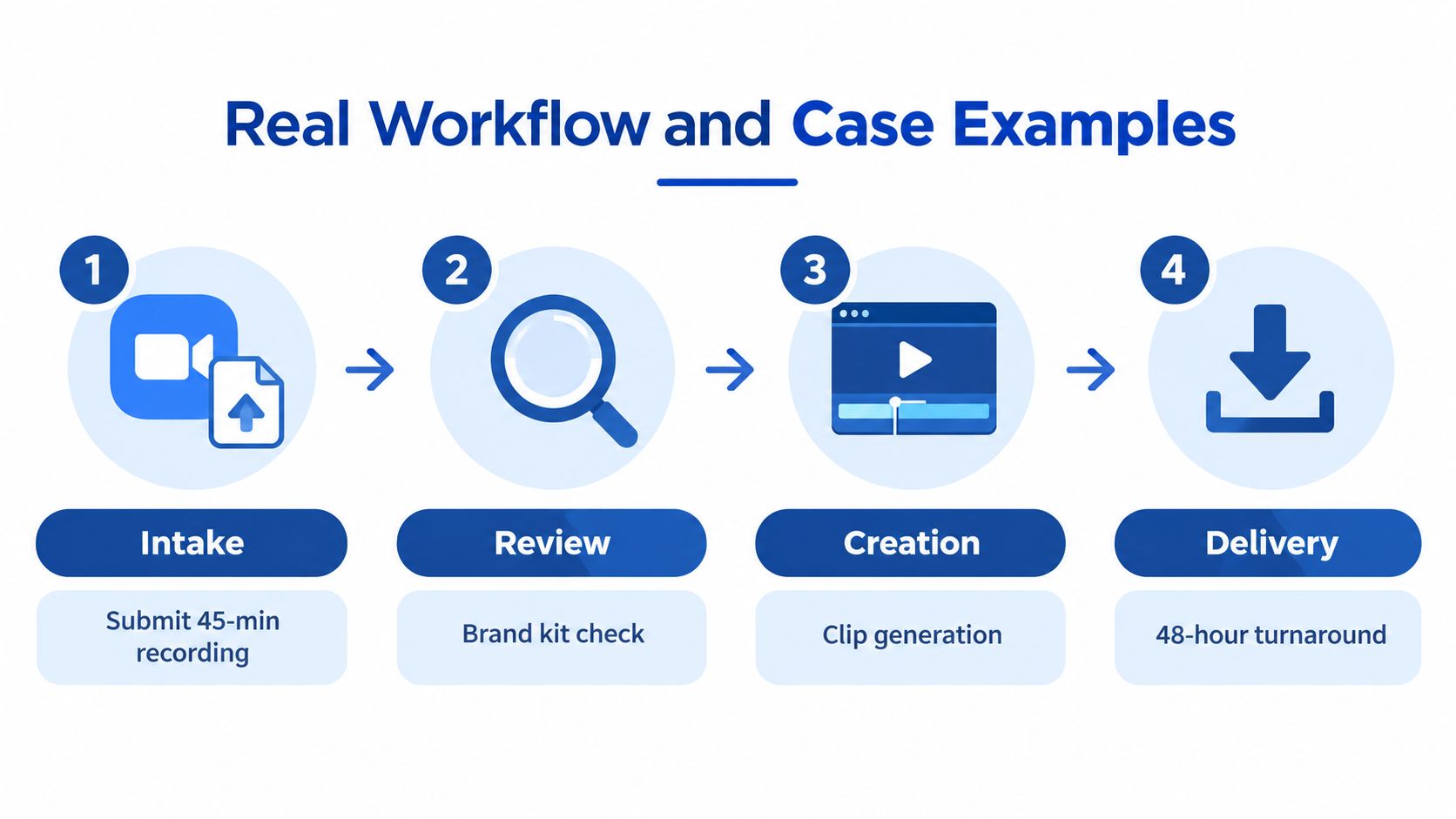
Consider a founder with a 45-minute interview recorded through Zoom. The recording contains product insights, customer objections, personal experience, and several practical recommendations. The founder has no time to edit it, write posts, or brief a designer.
Step 1 Intake
The client sends the Zoom recording, a raw file, or a published link. The intake form captures the target audience, campaign objective, preferred call to action, brand kit, and any sensitive topics.
The client doesn't need to edit the recording first. The agency handles the initial review and identifies production requirements.
Step 2 Review
A human reviewer studies the transcript and recording together. Clip selection follows complete ideas, not random timestamps. A useful excerpt should make sense to the viewer, present a clear point, and support the intended buyer stage.
The reviewer also flags claims that require confirmation. Quotes receive transcript verification, and captions receive a separate accuracy check.
Step 3 Creation
The editor produces short clips with platform-appropriate framing and captions. The writer develops LinkedIn posts and a blog article that add context instead of duplicating the transcript. The designer applies the client's logo, colors, fonts, and layout rules to graphics and carousels.
Google emphasizes that repurposed content should preserve originality and audience value through format-specific editorial transformation, rather than simple transcript duplication, as explained in its guidance on helpful, people-first content.
The resulting process resembles structured content atomization, where one source becomes connected outputs with distinct jobs. A practical explanation of content atomization helps teams distinguish strategic transformation from careless duplication.
Step 4 Delivery
The agency delivers the finished assets with approval status, file names, captions, suggested publishing order, and calls to action. A client may receive the first batch within 48 hours, or under a wider 48-to-72-hour delivery window, depending on the service terms.
The client's involvement remains limited to source submission, brand guidance, and approval. The benefit is not merely the number of files. It's the removal of coordination work that usually keeps recorded expertise unpublished.
The Done-for-You Alternative
A done-for-you content creation agency handles the production work after the recording ends. RepurposeYourContent is one example of this model. Clients send a podcast, keynote, interview, sales call, livestream, course recording, or meeting recording, and the service returns finished content for publication.
One 45-minute recording can become 20 to 30 ready-to-publish assets. The batch can include video clips, LinkedIn posts, quote graphics, carousels, audiograms, and a blog post. Clients spend about 15 minutes providing the recording and relevant brand information.
The published offer specifies delivery within 72 hours, with a guarantee that the client doesn't pay if the deadline is missed. Client reports also describe 20 to 30 assets within 48 hours, with costs as low as $14 per finished asset. Buyers should confirm the applicable turnaround and package terms before purchase.
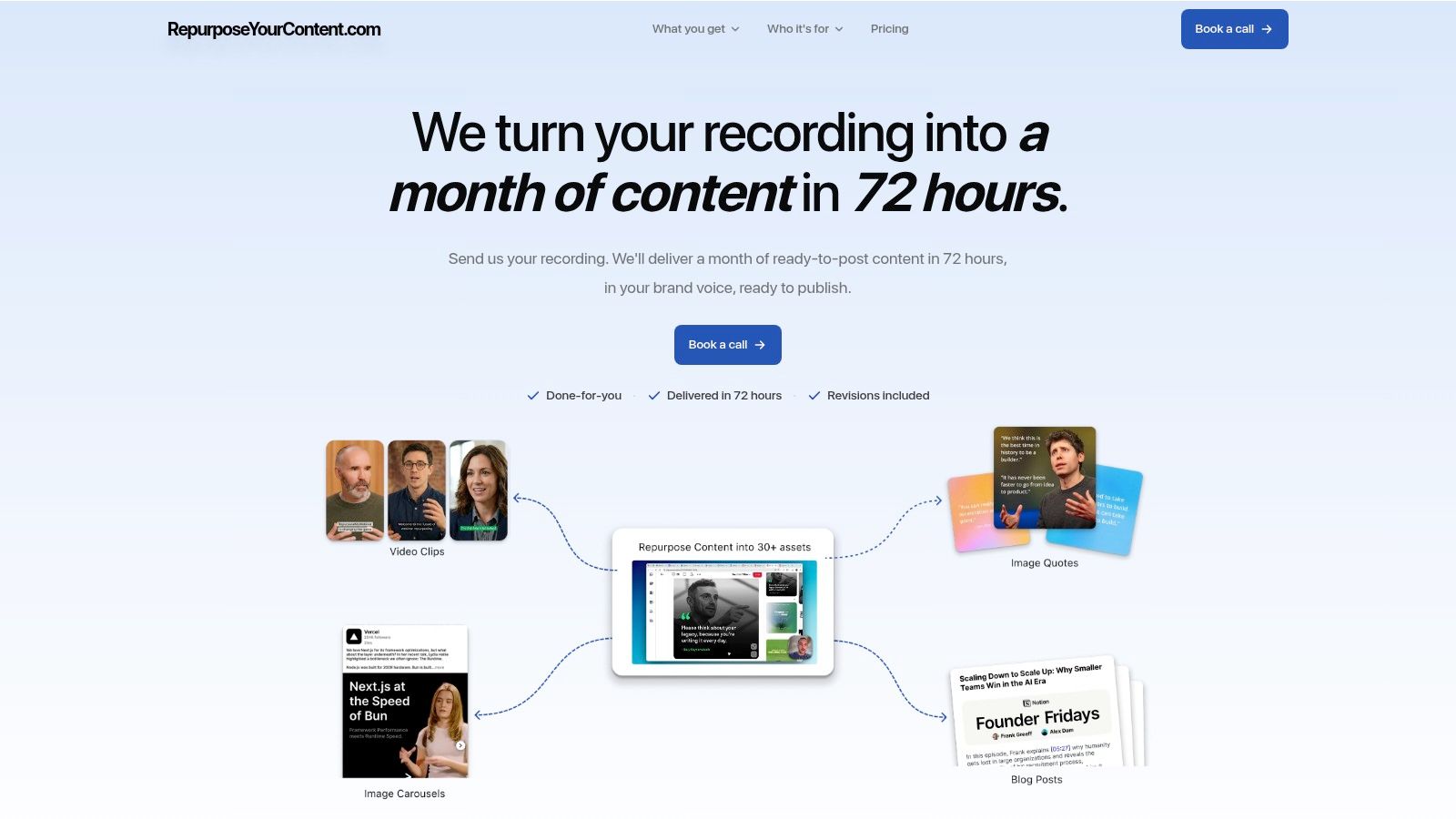
This is a service, not an editing application. Human editors, writers, and designers handle the work. Human review protects the speaker's voice, checks claims against the source, and prevents a high-volume workflow from producing repetitive or context-free material.
AI-assisted production can support transcription, discovery, and initial organization. It shouldn't replace editorial accountability. Brands need clear ownership, consent, accurate captions, rights checks, and an approval path.
A separate ShortGenius AI ad generator may suit teams producing synthetic advertising variations, but it serves a different need. A recording repurposing agency preserves the source speaker's actual expertise and transforms it into channel-specific content.
Next Steps and Booking a Call
The decision comes down to one operational question: does the organization need more recordings, or does it need more production capacity after recording?
Most founders, podcasters, speakers, and B2B marketers already have useful material. Podcasts contain opinions and stories. Sales calls reveal objections. Keynotes contain frameworks. Interviews surface customer language. Livestreams and courses hold explanations that can support future campaigns.
A content creation agency turns those inputs into a repeatable publishing workflow. The right partner should provide:
- Clear deliverables: Every recording should produce a defined asset matrix.
- Reliable deadlines: Turnaround should be written into the agreement.
- Human review: Editors should check voice, facts, captions, and context.
- Revision access: Clients should know how changes and approvals work.
- Commercial measurement: Content should connect to audience, campaign, and pipeline objectives.
The strongest workflow doesn't chase volume for its own sake. It prioritizes useful ideas, relevant audiences, suitable formats, and measurable calls to action. A niche clip that addresses a serious buyer objection may matter more than a widely viewed but commercially irrelevant post.
Teams with recordings waiting in folders should contact RepurposeYourContent to book a call or request a sample. The call should establish the source format, target audience, brand requirements, delivery expectations, and the asset mix that fits the next campaign.
Book a call with RepurposeYourContent and send one suitable recording for review. The team can show how that source could become a month of branded content without adding headcount or consuming another working week.
Tags: