Best Webinar Clipping Tools for Social Media 2026
Discover the best webinar clipping tools for social media 2026! Compare 10 top tools to effortlessly create engaging clips for TikTok, LinkedIn, & Instagram.

B2B webinar clips fail for a simple reason. The clip is chosen for energy, not for meaning.
A webinar rarely produces creator-style highlight moments every few minutes. The parts that perform on LinkedIn are usually different. A strong explanation. A sharp answer to a real objection. A line a prospect can paste into an internal Slack thread. That is the gap between hype-driven clipping and useful webinar repurposing.
This guide focuses on tools that can help B2B marketers find narrative value, not just audio spikes. That matters if the goal is pipeline support, not empty reach. A good webinar clip should stand on its own, make sense without the full recording, and lead naturally into broader content repurposing across social, email, and sales enablement.
The shortlist covers 10 tools used to turn webinar recordings into social-ready assets for LinkedIn, Instagram, and TikTok. The comparison looks at practical buying criteria. Clip detection, speaker framing, captions, brand control, workflow speed, and whether the tool is built for insight-heavy webinars or fast creator edits.
If webinar-first workflows are the priority, this webinar clip generator guide for B2B teams is a useful reference point before comparing the tools. For teams also reviewing adjacent creator workflows, this roundup of best tools for content creators adds context.
1. RepurposeYourContent

RepurposeYourContent is the most complete option here for B2B teams because it doesn't stop at clipping. It treats the webinar as a campaign source, not just a video file. That's a big difference when a social manager also has to feed email, blog, and nurture channels.
Most AI clip tools are built for creator-style content. Fast delivery. Fast reactions. Fast cuts. RepurposeYourContent is built around spoken expertise. It looks for narrative value first, which is what makes a webinar clip useful on LinkedIn.
Why it stands out
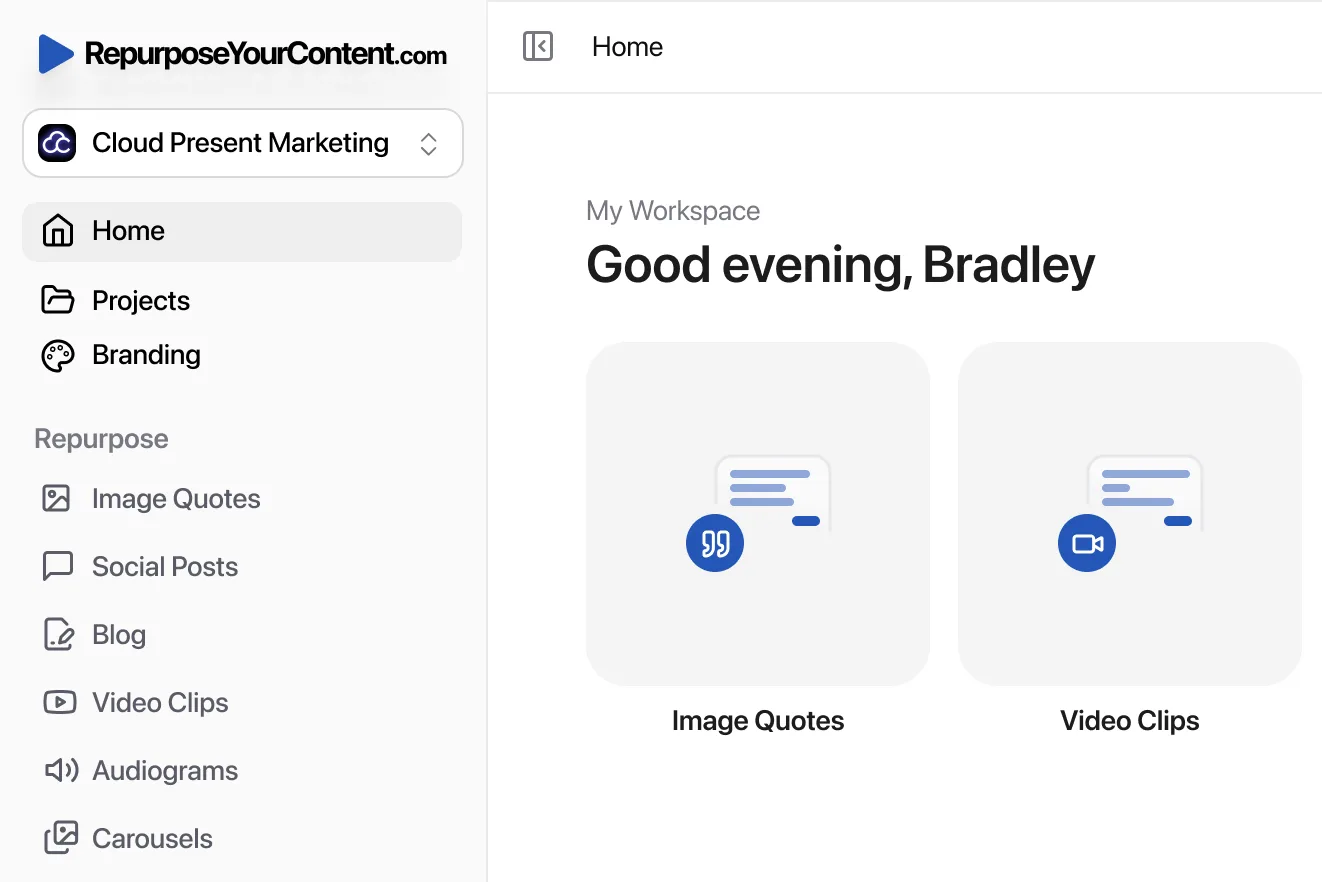
The workflow is simple. Upload the recording, choose the content types, pick how many outputs you want, generate, then review and publish. It supports uploads from common webinar and video platforms, and it applies brand styling across outputs instead of leaving the team to patch consistency later.
For a time-poor marketer, the bigger win is format range. One recording can become video clips, blog posts, social posts, audiograms, image quotes, newsletters, LinkedIn carousels, and timestamps. That saves context switching.
Practical rule: If the social clip isn't strong enough to become a quote card or carousel point, it probably wasn't the right webinar moment.
A useful starting point is this guide to a webinar clip generator. It shows the logic behind clipping for webinars, not generic talking-head video.
How the feature set helps
RepurposeYourContent distinguishes itself from single-purpose clippers.
- Video clips: Short social edits for LinkedIn, Instagram, and similar channels.
- Blog posts: Turns spoken expertise into a draft the content team can refine.
- Social posts: Gives the social manager captions and angles without writing from scratch.
- Audiograms: Useful when the audio line is stronger than the visual moment.
- Image quotes: Good for speaker-led posts and paid retargeting creative.
- Newsletters: Helps extend webinar momentum while the session is still fresh.
- LinkedIn carousels: Useful when the strongest moments are structured teaching points.
- Timestamps: Speeds approval and review, especially when multiple stakeholders need to sign off.
The platform also fits broader content repurposing workflows better than clip-only tools.
Best for
RepurposeYourContent is best for B2B marketing teams, agencies, and demand gen teams that need clips plus surrounding assets. It's less ideal for teams that only want a cheap one-format clipper and nothing else.
2. OpusClip

OpusClip is popular for a simple reason. It turns long recordings into short clips fast.
That matters if your team is publishing from every webinar, virtual event, and customer panel. Upload the recording, let the AI find candidate moments, then export captioned clips in the formats social teams need. For a busy B2B marketer, that speed can clear a backlog in one afternoon.
Where it works well
OpusClip makes the most sense when volume is the priority. It handles reframing well, supports team workflows, and gives you enough output options to keep clips moving into paid, organic, or edited post-production paths.
It also works well for teams that start with a broad clip pass, then narrow down to the best few assets. If that is your process, a guide on how to repurpose webinar content for social media helps set the review criteria before you publish.
- Best fit: Marketing teams producing lots of webinar clips every month.
- Useful feature: Automatic resizing for vertical, square, and horizontal formats.
- Trade-off: The scoring system often favors energy and pace over depth.
The main limitation
This is the key trade-off with OpusClip for B2B webinar content. It is good at finding moments that feel active. It is less reliable at spotting the segment that explains a hard problem clearly, gives a sharp framework, or delivers a line your sales team can reuse in follow-up.
That distinction matters. Webinar value often sits in the middle of a measured answer, not in the loudest five seconds. A demand gen team promoting a technical webinar usually needs clips with narrative value, clear teaching points, and buyer relevance. Hype-based clipping models can miss those moments.
My view is simple. OpusClip is strong for speed and output volume. It needs a human review pass if your goal is insight-led distribution instead of generic social reach.
3. Quso.ai

Quso.ai sits between a clipper and a broader social suite. That makes it appealing for lean teams that want to clip, package, and publish in one place. Formerly known as vidyo.ai, it has kept the long-to-short DNA while adding planning and publishing features.
That broader scope is its main strength. A social manager can stay in one tool longer, which helps when the bottleneck isn't just editing. It's scheduling, asset handling, and handoff too.
When it makes sense
Quso.ai is a solid pick for teams that want clipping plus social workflow support. Smart scene detection, filler-word removal, templates, brand elements, and direct planning tools make it more useful than a narrow clip-only app.
This guide on how to repurpose webinar content for social media maps well to that kind of workflow.
Most teams don't have a clipping problem. They have a throughput problem.
The trade-off
The interface can feel denser than single-purpose tools. That's normal for products trying to cover creation and distribution together. Teams that just want clean webinar-to-clip output may find it less focused than specialist options.
Quso.ai is best when one person manages clipping and publishing. It's less attractive for teams that already have scheduling covered elsewhere and only want the strongest clip engine.
4. Vizard.ai

B2B webinar teams usually get more usable clips from a sharp sentence than from a big visual moment. That is why Vizard.ai works better for insight-led content than for hype-led clipping.
Its strength is the transcript. Teams can review the spoken content first, find the line with real narrative value, and cut around that moment fast. For product walkthroughs, customer education, analyst briefings, and panel discussions, that is often the right workflow. You spend less time dragging through a timeline and more time judging whether the point is worth posting.
Where Vizard fits
Vizard.ai covers the core webinar clipping tasks well. It turns long videos into short clips, resizes for different channels, adds captions, and gives teams templates to speed up output. It also includes social account support, which can help a small in-house team keep clipping and publishing close together.
The practical advantage is review speed. If a webinar has 40 minutes of solid information but only 6 or 7 moments with clear standalone value, transcript-led editing helps the marketer find those moments without watching the whole session again.
For teams that care about caption readability, this guide on adding captions to video clips for social posts is a useful companion workflow.
The trade-off
Vizard is efficient, but it still needs human judgment. Calm speakers, technical explanations, and nuanced answers do not always trigger the kind of AI selection logic that works well on creator-style content. A clip can be accurate and still feel flat on LinkedIn if the underlying point lacks tension, contrast, or a strong takeaway.
That is the core trade-off with Vizard. It is better at helping teams shape useful clips from transcript-rich webinars than at guessing the best moment on its own.
- Good choice for: Teams that review webinars by transcript and care about clear, insight-led clips.
- Less ideal for: Teams that want the tool to surface finished social moments with minimal editing.
- Best channels: LinkedIn and YouTube Shorts, where clarity, context, and a strong spoken point usually beat fast-cut energy.
5. VEED.io

VEED.io is closer to a browser editor with strong AI features than a pure webinar clipper. That matters if the team wants more control over styling and polish after the first draft is generated.
For UK teams, VEED's London base can also make procurement and compliance conversations simpler. That isn't a feature, but it can affect buying decisions in larger organisations.
Best use case
VEED is useful when the social team cares a lot about captions, visual consistency, and quick browser-based edits. Auto-subtitles, subtitle styling, templates, and brand kits are strong parts of the product. If a webinar clip needs clean caption burn-in and branded layout tweaks, VEED handles that well.
This guide on how to add captions to video clips is especially relevant for teams using VEED as the finishing layer.
Editorial note: Caption quality often matters more than transition quality on B2B social clips.
The real trade-off
VEED isn't the most opinionated webinar clipping tool here. That's good if the team wants flexibility. It's less good if the team wants a tool to decide the moments for them.
Some AI features also sit behind higher tiers, so teams need to test the exact workflow before committing. VEED is best for marketers who want social-ready polish in the browser, not fully automated webinar intelligence.
6. Kapwing

Kapwing is easy to hand to a non-editor. That alone gives it a place on this list. It doesn't feel intimidating, and that lowers the chance that webinar repurposing gets delayed because only one person knows the tooling.
Its strengths are collaboration and clarity. Team workspaces, real-time editing, subtitle tools, scene finding, and resizing make it practical for distributed social teams.
Where it works
Kapwing is a good fit for teams clipping webinars as part of a broader social content mix. It handles the basics well and keeps collaboration simple. If several people need to review clips, adjust text, and publish quickly, the browser workflow helps.
- Strong point: Straightforward UI for non-specialists.
- Useful for: Teams sharing review and editing across marketing roles.
- Watch for: AI-heavy actions can consume credits quickly.
Where it falls short
Kapwing isn't built specifically around webinar narrative value. It helps shape clips. It doesn't always identify the right moments with the same focus as webinar-first tools.
For social managers who already know what moment they want, that's fine. For teams asking the software to find the insight, there are stronger options.
7. Descript

Descript is the control option. It isn't the fastest one-click clipper on this list, but it gives teams far better editorial precision. That's useful when webinar clips need approval from legal, product marketing, or leadership.
Editing by transcript is still one of the most practical workflows for B2B webinar content. A marketer can tighten a statement, remove filler words, clean up audio, and export a social cut without wrestling with a traditional timeline.
Best for careful review
Descript works well when a team needs to be exact. It also pairs well with faster clipping tools. One tool can find rough candidates, and Descript can turn the final picks into polished assets.
This guide to AI video editing tools for marketers is useful for teams comparing that hybrid workflow.
What to expect
Descript is not a pure auto-clip machine. It needs more hands-on work than tools built for instant short-form extraction. That extra effort is often worth it for sensitive categories, regulated industries, and executive webinars.
A simple workflow looks like this:
- Step 1: Upload the webinar and generate the transcript.
- Step 2: Mark the strongest claims, objections, or teaching moments in text.
- Step 3: Trim the wording, clean the audio, add captions, and export channel-specific cuts.
That workflow is slower than one-click clipping. It's usually better when the message has to be exact.
8. Riverside Magic Clips

Short-form viewing keeps growing. That makes recording quality matter more, because weak source footage becomes obvious once a webinar is cut into 30 to 60 second clips.
Riverside Magic Clips makes the most sense for teams that already record in Riverside. The advantage is operational. The webinar is captured, transcribed, and clipped in one place, so marketers spend less time exporting files, fixing sync issues, or cleaning up compressed recordings from another platform.
That matters in practice.
A strong webinar clip is not just a loud moment or a punchy sentence. For B2B teams, the useful cuts are often the parts where a speaker explains a problem clearly, handles an objection, or gives a concrete example. Riverside can help surface candidate moments quickly, but its true value still comes from reviewing whether the clip carries a complete idea.
Where it fits well
Magic Clips is a good fit for webinar teams that run expert interviews, panel sessions, or founder-led content inside Riverside and need social assets fast. The recording quality is usually better than a repurposing workflow built around downloaded event files, and that gives the editor more to work with.
It is especially useful when speed matters more than heavy post-production.
A common workflow looks like this:
- Step 1: Record the webinar or session in Riverside.
- Step 2: Generate Magic Clips from the full recording.
- Step 3: Review the suggested moments for narrative value, not just energy.
- Step 4: Trim the strongest clips for LinkedIn, X, or paid social.
The trade-off
Magic Clips is convenient, but it is still tied to the Riverside ecosystem. Teams running webinars in Zoom, ON24, BigMarker, or another event platform may find the workflow less practical if they want one clipping system across every source.
The other limitation is selection logic. Riverside is good at speed. It is less focused than tools built specifically to find insight-led webinar moments for B2B distribution. If the goal is to turn a 45-minute session into clips that support demand gen, sales follow-up, and executive content, a marketer still needs to check whether each clip stands on its own and says something useful.
Riverside works best when capture quality and workflow simplicity are the priority. It works less well when platform-agnostic repurposing or deeper editorial control matters more.
9. Wistia Social Clips

Wistia Social Clips only makes real sense for teams already inside Wistia. For those teams, it's efficient. The hosting library, transcript, clip creation, and analytics stay in one system.
That reduced handoff is the main advantage. A webinar manager doesn't need to move files around or rebuild context in another tool. Highlight a transcript section, generate the clip, and keep the workflow close to the source video.
Best fit
Wistia Social Clips is best for in-house teams with a webinar library already hosted in Wistia. Burned-in captions, auto-framing, and simple layout controls cover the core social needs for many B2B teams.
If the webinar archive already lives in one platform, staying there is often faster than chasing a slightly better clipping engine elsewhere.
Main trade-off
The limitation is obvious. If the organisation doesn't use Wistia heavily, this isn't the right tool to adopt just for clipping. Dedicated webinar clipping products offer more focused AI selection and often more flexible output options.
Wistia is about workflow convenience first. It's less about best-in-class AI moment detection.
10. Pictory.ai

Pictory.ai is a practical option for teams that want highlights, summaries, and short social edits from long sessions. It tends to work best when speed matters more than fine editorial control.
That makes it useful for busy webinar teams producing recap content. A session can become snippets, summary-style social assets, and quick follow-up content without much setup.
What it does well
Pictory's appeal is simplicity. It auto-detects highlights, adds captions, and helps shape summary content from longer recordings. For teams publishing webinar recaps on LinkedIn and YouTube Shorts, that's enough.
It also suits marketers who want a clear path from full webinar to short highlight reel. The onboarding tends to be easier than transcript-heavy tools.
Where it gives up ground
Pictory doesn't offer the same granular control as Descript or the same B2B webinar-specific framing as RepurposeYourContent. It is efficient, but less exact. That's fine for broad awareness clips. It's weaker for clips built around nuanced positioning or product education.
Top 10 Webinar Clipping Tools for Social Media, 2026 Comparison
| Product | Core formats & features | Workflow speed & ease | Best for (target audience) | Unique differentiator / value prop | Pricing (high level) |
|---|---|---|---|---|---|
| RepurposeYourContent | 8 formats: clips, blog posts, social, carousels, emails, audiograms, podcasts, quote cards | One-click multi-format generation; ~5 minutes; auto brand kit | B2B marketing, demand gen, agencies, content teams | Purpose-built for B2B webinars; all formats in one workflow; platform-agnostic | From $99/mo; Basic free tier; 7‑day trial; enterprise plans |
| OpusClip (Opus.pro) | AI highlight detection, animated captions, auto-reframe, scheduler | Very fast clip generation with virality scoring | Social teams creating platform-specific shorts | Virality Score + easy NLE exports; team workspaces | Credit-based metering; free plan with watermark |
| Quso.ai (vidyo.ai) | AI clips, Intelliclips, scene detection, templates, scheduling & analytics | Integrated create→schedule flow; moderate learning curve | Teams wanting clipping plus publishing & analytics | All-in-one clipping + planning + publishing suite | Tiered plans; pricing less prominent on site |
| Vizard.ai | One-click clips, transcript-first editing, auto-captions, resizing | Transcript-driven edits speed selection and polish | B2B teams that edit via transcripts | Transcript-first workflow; mobile app & templates | Tiered plans; credit/usage language varies |
| VEED.io | Auto-subtitles & translation, brand kit, vertical reframing, background removal | Browser-based, quick styled captions & exports | Teams needing strong captioning & UK procurement | Strong subtitle/translation features; UK HQ | Feature-gated tiers; check limits on captions |
| Kapwing | Smart Cut, Find Scenes, auto-subtitles, team workspaces, 4K export | Simple UI for non-editors; real-time collaboration | Distributed social teams and content creators | Collaborative browser editor with team features | Free with watermarks; paid plans remove watermarks |
| Descript | Text-based editing, filler-word removal, Studio Sound, dynamic captions | Precise editorial control; not fully one-click | Compliance-sensitive editors, podcast/webinar editors | Edit video by editing text; Overdub & studio audio tools | Tiered plans; transcription-hour quotas |
| Riverside Magic Clips | AI Magic Clips, multi-track local recording, export options | Good when capture and clipping occur in same platform | Teams that record natively in Riverside | Combines high-quality local recording + auto clips | Riverside subscription tiers; feature-dependent |
| Wistia Social Clips | AI-generated clips from hosted videos, burned-in captions, auto-framing | Fast highlight-text → clip flow inside Wistia | Teams already using Wistia hosting & analytics | Tight integration with Wistia hosting and analytics | Included with Wistia hosting plans |
| Pictory.ai | Auto-detect highlights, captions, summarization, simple editor | Quick highlight & summary generation; easy onboarding | Marketers needing fast highlight reels & summaries | Summarization + learning resources to shorten onboarding | Tiered plans with minutes/credits |
Final Thoughts
Webinar clipping volume is up. Useful webinar clipping is still hard to get.
That gap matters for B2B marketers. A webinar clip only works if it carries a point someone can learn from, share with a colleague, or send to a prospect. Many AI tools still rank moments by pace, facial movement, or audio spikes. That works for creator content. It often fails on webinars, where the strongest moment is a sharp answer, a clear framework, or a specific objection handled well.
That is the main decision in this category. Pick a tool built for attention, or pick one that can help surface insight.
A practical shortlist looks like this:
- Choose RepurposeYourContent if the webinar needs to become more than short clips. It fits teams that want social posts, blog drafts, email follow-up, carousels, and clips from the same source material.
- Choose OpusClip if speed and clip volume matter more than editorial precision.
- Choose Vizard or Descript if transcript-led review is part of the team's normal editing process.
- Choose Riverside if the team already records there and wants fewer handoffs.
- Choose VEED or Kapwing if browser-based editing and team collaboration are higher priorities than webinar-specific workflows.
- Choose Wistia if the video library already lives inside Wistia.
- Choose Pictory or Quso.ai if summaries and broader social asset production are also part of the job.
In practice, the teams that get steady results follow a simple process. Upload the recording fast. Review clips for message quality, not just energy. Turn the strongest moments into supporting assets. Publish while the topic is still relevant.
Speed matters, but selection matters more. A weak clip published quickly is still weak. A strong clip usually has one clear takeaway, one defined audience, and one reason to exist on LinkedIn or in an email follow-up.
If the brief is "find the loudest 20 seconds," several tools here can do that. If the brief is "turn one webinar into a useful B2B content package without adding more production work," RepurposeYourContent stands out because it is built around narrative value and multi-format output, not clip volume alone.
For teams also thinking about short-form creative from a broader social angle, this guide on how to make UGC that converts is a useful companion read.
Ready to turn webinar recordings into clips, blogs, carousels, audiograms, and follow-up content in minutes? Try RepurposeYourContent.
Tags: