Goldcast Alternatives for B2B Webinar Teams 2026
Searching for Goldcast alternatives for B2B webinar teams 2026? Compare platforms for price, features, and find a smarter, cost-effective tech stack.

Goldcast is usually the wrong default for B2B webinar teams.
Ultimately, the decision is not Goldcast versus a cheaper webinar tool. It is whether you want to pay enterprise software prices for one platform to do everything, or get better results by pairing a solid webinar host with a specialist repurposing engine like RepurposeYourContent. For a lot of B2B teams, the second option is the smarter buy and the better content system.
Webinars already produce strong lead quality for B2B marketing teams. The gap is what happens after the event. One live session should turn into clips, quotes, summaries, follow-up assets, and sales enablement content. Too often, it just becomes a recording that sits in a library and goes nowhere.
That is where Goldcast starts to look expensive. It gives you polished branding, stronger event presentation, and built-in workflows for post-event content. If your team runs high-production virtual programmes with multiple stakeholders, that package can make sense. If your team needs reliable hosting, CRM sync, and more output from every recording, buying those functions separately is usually the better move.
My recommendation is simple. Choose the webinar platform based on delivery, integrations, and attendee experience. Then add RepurposeYourContent for the post-event content engine. That combination usually gives you more usable marketing output for a fraction of Goldcast’s annual cost, often close to 10 percent depending on your plan mix.
This guide ranks the best Goldcast alternatives for B2B webinar teams in 2026 through that lens. Not just which platform is cheaper, but which stack gives you the best return once the webinar ends.
1. ON24
ON24 is what you buy when webinar attribution matters more than production flair.
It sits firmly in the enterprise tier. ON24 is built for demand gen teams that need webinar engagement data to flow into Salesforce, Marketo, and follow-up workflows without manual patchwork. If your VP of Marketing cares about influenced pipeline, lead scoring, and account-level reporting, ON24 belongs on the shortlist.
Where ON24 wins
ON24’s strength is structure. You get branded webinar consoles, clickable CTAs, resource hubs, audience engagement tracking, and the kind of reporting enterprise teams expect from a mature platform. It is designed for repeatable webinar programmes, not one-off events.
Bizzabo’s Goldcast alternatives review places ON24 in the enterprise class and notes that annual pricing for mid-market teams often lands between £15,000 and £50,000. That pricing checks out with how ON24 is positioned. You are paying for data capture, process control, and integration depth.
Recommendation: Pick ON24 if webinar performance needs to show up in revenue reporting, SDR routing, and campaign attribution. That is its real advantage over Goldcast.
Where ON24 is the wrong buy
ON24 is expensive, heavier to implement, and more platform than many B2B teams need. If you run a straightforward monthly webinar programme, the extra admin burden is hard to justify. You will pay enterprise money for features your team may only use halfway.
That is the trade-off many buyers miss. ON24 is strong at measurement. It is not the smart cost move if your main goal is to host solid webinars and turn recordings into more content afterwards.
For that job, a leaner webinar platform plus RepurposeYourContent is usually the better stack. You keep the live event reliable, then push the recording into a specialised repurposing engine that creates clips, summaries, quotes, and follow-up assets. In practice, that setup often gives B2B marketing teams more usable output for a small fraction of what ON24 or Goldcast will cost annually.
Best for
- Enterprise demand gen teams: Best fit when webinar data feeds lead scoring, attribution, and revenue reporting.
- Large operations teams: Better choice for companies with formal processes, multiple stakeholders, and CRM-heavy workflows.
- Sales-led follow-up: Strong option when SDR and AE teams act on engagement signals after every event.
Website: ON24
2. Livestorm
Buy Livestorm first if you run a standard B2B webinar programme and Goldcast feels too expensive for the job.
It is one of the clearest examples of where webinar buyers overpay. Livestorm handles the core work well. Registration, browser-based attendance, speaker access, basic automation, and post-event follow-up are all straightforward. For lean marketing teams, that matters more than premium event packaging.

Why Livestorm is the smarter buy for many teams
Industry comparisons have consistently positioned Livestorm as a simpler and lower-cost option than Goldcast for webinar-led teams, while also noting strong user satisfaction and an easy browser-based setup, as covered in Airmeet’s review of B2B webinar platforms and market projections for 2026.
That pricing gap matters because the software decision is rarely just about hosting. If you spend less on the webinar platform, you can put budget into output. That is the better strategy for many B2B teams in 2026. Use Livestorm to run the event, then use RepurposeYourContent to turn the recording into clips, summaries, quotes, and follow-up assets. In practice, that stack usually gives you more campaign material for a fraction of what Goldcast costs annually.
Where Livestorm fits, and where it does not
Livestorm is a strong fit for recurring webinars. Product marketing sessions, customer education, live demos, executive interviews, and demand gen panels all sit comfortably here. The setup is fast, guest access is simple, and your team does not need event specialists to get a webinar live.
It is a weaker choice for large conference-style production. If your programme depends on multi-session complexity, heavy sponsor requirements, or very large audiences, you will hit limits faster than you would on a more event-focused platform.
That is the trade-off. Livestorm is not trying to be a full virtual event suite. It is trying to make webinars easy to run.
Recommendation
Choose Livestorm if your team cares more about running reliable webinars every month than buying an expensive platform with extra event layers. Pair it with RepurposeYourContent and you get a more practical stack. The live event stays simple, and the content output after the event improves sharply without enterprise-level spend.
Best for
- SMB webinar programmes: Monthly demos, panels, customer education, and thought leadership.
- Lean marketing teams: Fast setup and fewer moving parts.
- Hybrid stack buyers: Strong host platform to pair with RepurposeYourContent.
Website: Livestorm
3. RingCentral Events
RingCentral Events makes sense when a team needs webinars and larger virtual events in one system.
Goldcast is strong for branded B2B webinars. RingCentral Events goes wider. It supports multi-track sessions, expo areas, networking, and summit-style formats that sit closer to a virtual event suite than a webinar tool. That gives event-led teams more room to standardise.

Where it fits
This is the alternative for teams running partner summits, customer conferences, or field-event extensions. If the brief includes sponsor exposure, networking, and multiple stages, RingCentral Events is a more natural fit than lightweight webinar apps.
That said, complexity comes with the territory. Teams buying it for single-session lead gen webinars usually pay for a lot of event structure they won’t fully use.
Where it loses to a cheaper stack
For standard B2B webinar operations, RingCentral Events often lands in the same trap as Goldcast. It offers more platform than the team needs. If the primary goal is to host clean webinars and turn recordings into campaign assets, a simpler webinar product plus a dedicated repurposing tool is usually better value.
Best for
- Event production teams: Better for summits and multi-session virtual experiences.
- Mixed webinar and event portfolios: One platform for both.
- Sponsor-heavy programmes: More room for expo and networking formats.
Website: RingCentral Events
4. BigMarker
BigMarker is a strong Goldcast alternative for teams that want evergreen webinars and flexible funnel-building.
It sits in the middle ground between SMB simplicity and enterprise depth. That’s useful. Many B2B teams don’t need ON24-level complexity, but they do need more than basic live hosting. BigMarker usually enters the shortlist when teams want recurring lead generation, on-demand experiences, and stronger landing page control.

Why marketers pick it
BigMarker is built around webinar variety. Live, automated, evergreen, and summit-style formats all sit under the same umbrella. That helps teams who treat webinars as an always-on engine, not one-off events.
It also tends to work well for partner marketing and recurring educational content, where one webinar often needs to keep converting long after the live date.
The cost question
BigMarker usually requires a sales conversation, and advanced plans can get expensive. That weakens its case against simpler platforms with public pricing. It’s a better fit than Goldcast when teams want flexibility without stepping fully into enterprise software. But it’s still not the cheap option.
A team buying BigMarker should be sure it needs evergreen funnels and format variety, not just better branding.
Best for
- Evergreen webinar funnels: Strong fit for on-demand and automated programmes.
- Partner marketing: Useful for repeatable webinar series.
- Mid-market teams: Better than Goldcast when flexibility matters more than community features.
Website: BigMarker
5. Demio
Demio is the cleanest option for teams that want a lightweight webinar tool without enterprise complexity.
It’s easy to learn, quick to launch, and focused on the basics that matter for demos, product education, and lead capture. Goldcast feels more polished at the high end. Demio feels more practical for teams that don’t have dedicated event producers.
Where Demio works best
Demio is a good fit for recurring webinars with simple production needs. Marketing teams can run registration pages, reminders, handouts, polls, and browser-based attendance without dragging in a heavyweight events team.
Its value is speed. Teams that need to ship webinars quickly tend to prefer tools like this over premium suites with deeper setup requirements.
Where it falls short
Demio isn’t the platform for large-scale virtual event strategy. It’s narrower. Teams running flagship conferences or complex hybrid programmes should look elsewhere.
For normal B2B webinar operations, that limitation is often a benefit. Less platform. Less admin. Less waste.
Best for
- Product marketing: Demos, launch webinars, and educational sessions.
- Small teams: Easy onboarding and low operational overhead.
- Cost-conscious buyers: Better fit than Goldcast when simplicity is the priority.
Website: Demio
6. Airmeet
Airmeet is the choice for teams that care about attendee interaction more than pure webinar efficiency.
It leans into engagement. Q&A, polls, networking lounges, and community-style features are stronger than what most lightweight webinar tools offer. That makes it useful for workshops, community events, and interactive B2B programmes where audience participation matters.

Why some teams prefer it over Goldcast
Goldcast is known for branded experiences and content-forward workflows. Airmeet feels stronger when the event itself needs more interaction. Teams running user communities, partner ecosystems, or educational programmes often care about networking and audience energy as much as lead capture.
That said, those same features can create production overhead. Lounges and networking spaces are only useful when someone plans and moderates them properly.
Clear recommendation
Airmeet is not the default choice for lean B2B demand gen teams. It is the right tool for interaction-heavy programmes. If the webinar is mostly a top-of-funnel content play, a simpler platform plus better repurposing will usually produce more value.
Best for
- Interactive webinars: Better for Q&A-driven formats and audience participation.
- Community-led programmes: Strong for education and ecosystem events.
- Managed event support: Useful when teams need more hands-on execution.
Website: Airmeet
7. Zoom Events, Zoom Webinars, Zoom Sessions
Zoom is the practical buy. If your team wants reliable webinar delivery without paying Goldcast prices, Zoom should be on the shortlist immediately.
It wins on familiarity, speed, and internal adoption. Speakers already know how to use it. Ops teams rarely need extra training. Procurement usually signs off faster because Zoom is already in the stack.
Why Zoom still belongs on the shortlist
Zoom is not trying to be a polished, content-first event platform. That is fine. A lot of B2B webinar teams do not need premium virtual venue features. They need a stable host that works every time and does not create friction for presenters or attendees.
That makes Zoom a better fit for lean demand gen programmes than many marketers expect.
The trade-off is branding. Zoom can look plain, and it will not give you the same high-end event presentation that pushes teams toward Goldcast. If branded experience is the product, Zoom will feel limited. If pipeline and content output are the goal, the economics are much better.
Clear recommendation
Use Zoom for hosting. Put your budget into post-webinar output.
That is the smart stack for cost-conscious B2B teams in 2026. Instead of overpaying for an all-in-one platform, run the event in Zoom and pair it with a specialised repurposing engine like RepurposeYourContent to turn one session into clips, transcripts, summaries, and follow-up content. For teams comparing the two directly, this Goldcast vs Zoom webinar comparison breaks down the trade-offs clearly.
This approach gets you the main thing Goldcast promises. More value from each webinar. It just does it at a fraction of the annual cost.
Best for
- Budget-controlled webinar programmes: A sensible choice when Goldcast pricing is hard to justify.
- Teams already standardised on Zoom: Faster rollout, less speaker friction, fewer internal blockers.
- Hybrid webinar stacks: Strong choice when hosting and content repurposing are handled as separate jobs.
Website: Zoom Webinars
8. BrightTALK
BrightTALK is not just a webinar platform. It is also a distribution channel.
That changes the buying logic. Most Goldcast alternatives focus on hosting and production. BrightTALK adds audience reach, especially for enterprise tech and B2B categories where external demand generation matters as much as owned-list performance.

Why that matters
A good webinar platform helps teams run events. BrightTALK can also help teams get those events in front of more relevant viewers. That’s useful for brands in crowded categories that need reach, not just software.
This makes BrightTALK stronger for top-of-funnel demand generation than for companies looking to replace Goldcast’s hosting layer at lower cost.
The trade-off
BrightTALK won’t be the universal answer for every team. It is quote-based, more specialised, and often most compelling for technology-focused B2B firms. Teams outside those categories may not get the same upside.
If owned audience is the constraint, BrightTALK deserves a closer look. If content output is the constraint, a simpler host plus RepurposeYourContent is usually the better buy.
Best for
- Demand generation in tech categories: Stronger reach than standard webinar platforms.
- Audience expansion: Useful when list size limits webinar performance.
- Managed distribution: Better fit for teams that want platform plus channel.
Website: BrightTALK
9. Hubilo
Hubilo sits in the marketer-first category. That makes it one of the more credible Goldcast alternatives for teams that want branding and analytics without fully stepping into enterprise complexity.
It focuses on landing pages, behavioural analytics, lead scoring, and operational ease. That combination usually appeals to B2B marketers who want to move fast but still need enough reporting to support pipeline conversations.

Where Hubilo stands out
Hubilo tends to make sense for teams that rejected Goldcast on cost but still want a polished, marketing-friendly experience. It has stronger event presentation than bare-bones webinar tools, but it doesn’t carry the same high-end enterprise baggage as ON24.
For teams running webinar-led campaigns with multiple stakeholders, that middle position can be attractive.
What to watch
Published pricing and packaging can change, so buyers should confirm current UK terms directly. As with any tool in this tier, the right question isn’t whether it has more features than Zoom. It does. The question is whether those features produce enough extra value to justify the spend.
Best for
- Marketing-led webinar teams: Better fit for branded campaigns and lead tracking.
- Mid-market buyers: Between lightweight tools and enterprise suites.
- Teams replacing Goldcast polish: Good option when branding still matters.
Website: Hubilo
10. Contrast
Contrast is worth attention from UK and EU buyers who care about browser-based UX, branding control, and HubSpot-friendly workflows.
It is newer than legacy platforms, which means fewer external tutorials and a smaller ecosystem. It also means a more modern product approach. For some teams, that trade-off is worth it.

Why Contrast belongs here
Goldcast’s appeal often comes from polished presentation and content-forward positioning. Contrast competes more directly on that ground than basic webinar tools do. Teams that want a modern attendee experience without defaulting to enterprise software should consider it.
That makes it especially relevant for SaaS growth teams and webinar programmes built around branded thought leadership.
The buying caution
Because it is a newer ecosystem, buyers should confirm fit on integrations, internal workflows, and support expectations. It may be a strong fit for specific teams, but it is not yet as established as older players.
Best for
- EU and UK webinar teams: Browser-based and modern.
- HubSpot-centric teams: Good fit when CRM alignment matters.
- Content-led webinars: Better than basic webinar tools on attendee experience.
Website: Contrast
Top 10 Goldcast Alternatives: B2B Webinar Platform Comparison, 2026
| Platform | Best for (Target Audience) | Core features / Strengths | Repurposing & time-to-content | Pricing & scale |
|---|---|---|---|---|
| ON24 | Enterprise B2B demand-gen & global programs | Branded consoles, engagement widgets, rich analytics, simulive | Recording + analytics; limited automated multi-format repurposing (manual workflows) | Enterprise / quote-based; high scale |
| Livestorm | EU/UK teams, recurring demos & onboarding | Browser-based, no-download UX, branded pages, automated sessions | Recordings & clips; basic automation, mid-market speed | Free → paid tiers; mid-market friendly |
| RingCentral Events | Multi-session virtual conferences & summits | Multi-track stages, expo/sponsor areas, networking tools | Event recordings; manual content extraction for repurpose | Quote-based; enterprise-focused |
| BigMarker | Evergreen funnels & high-capacity webinars | Live/automated/on-demand formats, landing pages, CDN scaling | Strong evergreen support; repurposing still manual or partial automation | Scales to large audiences; sales-engagement pricing |
| Demio (Banzai) | SMB / mid-market marketing demos & training | Clean UX, branded registration, chat/polls, HubSpot links | Recordings and clips; limited evergreen/automation | Transparent tiered pricing; cost-effective entry |
| Airmeet | Interactive B2B events & community programs | Q&A, polls, gamification, networking lounges | Recording exports; manual repurpose; managed services available | Premium for managed events; scalable |
| Zoom Events / Webinars | Teams standardizing on Zoom; broad use | Familiar join UX, robust recordings, large capacity, SSO | Recordings + basic clips; no native multi-format AI repurposing | Variable packaging; wide scalability |
| BrightTALK (TechTarget) | Demand gen with external audience distribution | Platform-as-channel, editorial distribution, managed services | Distribution-first; recordings syndication, manual repurpose | Quote-based; best for enterprise tech/IT |
| Hubilo | Marketer-first events with analytics focus | No-code pages, 1080p studio, behavioral analytics, lead scoring | Recordings + analytics; limited automated content outputs | Marketer-centric packaging; confirm current terms |
| Contrast (getcontrast.io) | EU/UK SaaS growth teams, HubSpot-aligned | Deep HubSpot workflows, strong branding, engagement metrics | Recording exports; collaborative production but limited repurpose automation | Public pricing page; EU-focused scaling |
Final Thoughts
Stop buying Goldcast by default.
If your team needs reliable hosting, clean registration, decent attendee data, and strong post-event output, Goldcast is often the expensive answer to the wrong problem. Its value is real for teams that want a premium all-in-one event stack. Its cost is hard to justify for everyone else.
The smarter buying decision is to separate live delivery from content production.
Use the webinar platform that fits your event format and budget. Then add a dedicated repurposing engine to turn one webinar into a campaign, not just a replay page. That represents the opportunity in this category, and it is why many B2B teams will get better results from a hybrid stack than from Goldcast alone.
How the hybrid approach works
Keep the stack simple:
- Pick the host platform based on the event itself. Livestorm, Zoom, Demio, and BigMarker cover most B2B webinar use cases without enterprise overhead.
- Run the webinar and capture the recording, transcript, and engagement data.
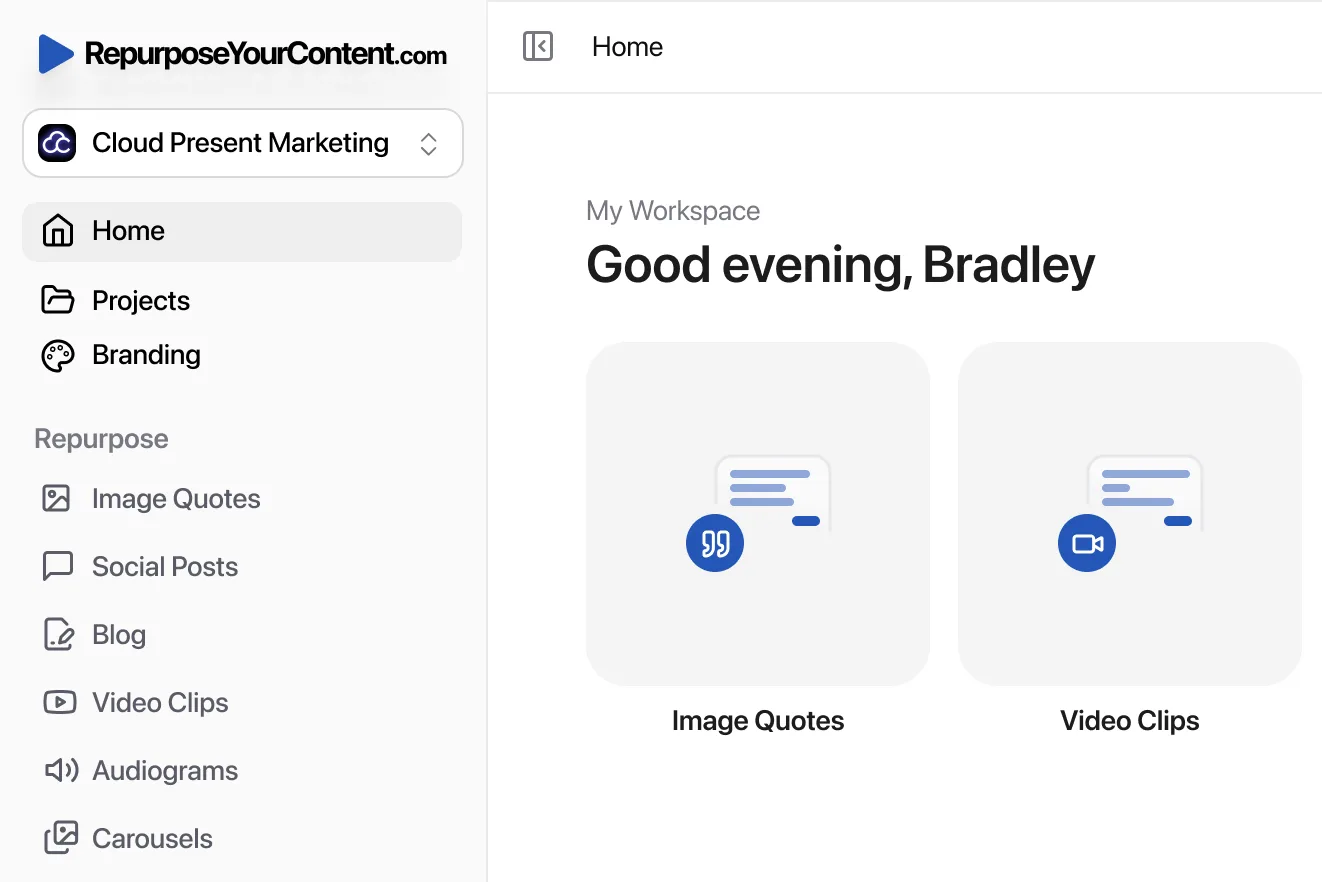
- Send the session to RepurposeYourContent to produce distribution-ready assets for email, social, sales follow-up, and nurture.
That changes the economics fast. Instead of paying premium platform pricing for features you may not use, you buy lower-cost hosting plus a specialist repurposing layer. For many teams, that gets you far more usable output for roughly 10% of the annual cost of Goldcast.
A better workflow for a time-poor team
A practical setup looks like this:
- Host in Zoom, Livestorm, or Demio.
- Upload the recording to RepurposeYourContent for Goldcast users.
- Choose the assets you need for the campaign.
- Generate clips, blog drafts, social posts, audiograms, quote graphics, newsletter copy, LinkedIn carousels, and timestamped highlights.
- Send those assets into paid social, email follow-up, sales enablement, and ongoing nurture.
This is the key trade-off. Goldcast bundles event delivery and post-event workflows in one product. A cheaper host plus RepurposeYourContent gives many B2B marketing teams more content output, more flexibility, and much lower software spend.
What to choose
Here is the direct recommendation.
Choose Goldcast if you want a premium event experience inside one platform and your budget can absorb it.
Choose Livestorm, Zoom, Demio, or BigMarker if your main goal is to run strong webinars without enterprise pricing.
Choose the hybrid model if content reuse matters as much as the live event itself. For a lot of B2B teams in 2026, that is the best option on the board.
Goldcast alternatives for b2b webinar teams 2026 should be judged on one standard. Which setup gets you live quickly, captures the signals your team will use, and turns one webinar into weeks of pipeline content without waste?
For many teams, the best answer is clear. Buy the webinar platform for hosting. Add the repurposing engine for output. Skip the premium all-in-one bill unless you need it.
Teams comparing options should review RepurposeYourContent’s Goldcast comparison page and then try RepurposeYourContent.
Tags: