How Agencies Scale Content Production: Boost Profits
Discover how agencies scale content production efficiently for maximum profitability in 2026. Learn strategies to optimize workflows and drive growth.

A new client should feel like margin expansion. In many agencies, it feels like a staffing problem.
You win the retainer. Then the maths hits. More blogs. More social assets. More approvals. More revisions. More channel-specific versions. Your team is already full, so growth starts looking expensive.
The core question is how agencies scale content production. Not how to make more assets. How to produce more client work without turning every new contract into lower profit.
The Agency Growth Paradox You're Facing
Most agency leaders know this moment. Sales closes a larger account. Delivery smiles in the meeting. Operations goes quiet.
The problem is simple. More clients create more production demand. If every new deliverable needs a new writer, editor, designer, and strategist, your cost base rises with revenue. Margins stay flat or get worse.

A 2025 Agency Growth Benchmark Study found that 74% of agencies grew revenue last year, and 49% achieved 25% or more growth by optimising existing resources rather than just hiring. The same benchmark notes that high-performing agencies track productivity per person and rely on systematic workflows.
That matches what happens inside growing shops. The bottleneck is rarely raw writing talent. It is approvals, unclear briefs, repeated formatting work, and too many one-off requests.
Growth creates hidden operational drag
Agency leaders usually feel the pain in four places:
- Brief quality drops: Account managers move faster, but instructions get thinner.
- Channel count rises: One idea now needs a blog, LinkedIn post, email, clips, and paid assets.
- Review cycles expand: More clients mean more stakeholders.
- Senior people become editors: Strategy time gets swallowed by cleanup work.
This is why agencies often explore support models like white label social media management when demand rises. It can help with capacity, but it does not remove the need for a stable production system.
Key takeaway: Revenue growth does not automatically improve agency economics. Process discipline does.
What profitable scaling means
Profitable scaling means your output grows faster than your payroll.
That requires one shift. Stop treating every content asset as a fresh production job. Start treating content as a system built around reusable source material, repeatable workflows, and controlled handoffs.
When agencies do that well, they stop asking, “Who else do we need to hire?” They start asking, “What part of this workflow should never be manual again?”
Analyse the Three Models for Scaling Agency Content
When work piles up, agencies usually choose one of three paths. Only one of them improves output without putting pressure on margin every month.

Model one hire more people
This is the default move. It feels safe because it is familiar.
You add a writer. Then an editor. Then a project manager to keep the first two moving. Output rises, but so do salaries, onboarding time, management overhead, and communication load.
Hiring works when demand is stable and you need deeper strategic capability. It works badly when the actual problem is fragmented production.
What works
- Stable books of business: Predictable retainer demand can support fixed headcount.
- Specialist needs: Deep industry writing or senior strategy still needs experienced people.
- Client intimacy: In-house team members often absorb brand nuance faster.
What does not
- Linear scaling: More output usually requires more people.
- Margin pressure: Payroll becomes your biggest constraint.
- Leadership drag: Senior staff spend more time managing than improving the system.
Model two outsource and freelance
This model can create fast capacity. It can also create chaos if your briefing and QA are weak.
A study of 120 UK digital agencies found that vague briefs cause 73% of delays and cost agencies an average of £4,200 in lost revenue per month. That highlights the primary outsourcing risk: not freelancers themselves, but weak operating discipline.
Outsourcing is useful when you need variable capacity, format specialists, or overflow support. It fails when agencies expect external talent to compensate for messy internal systems.
Where outsourcing helps
Freelancers are effective when the task is tightly defined.
Examples:
- Drafting a first-pass article from a strong brief
- Editing clips to a fixed style guide
- Turning approved messaging into a carousel design
- Formatting newsletters from a source transcript
Where outsourcing breaks down
Outsourcing struggles when:
- The client voice lives inside one strategist’s head
- Approval criteria keep changing
- Source material is thin or scattered
- Nobody owns QA before delivery
If you want a broader view on process-led output expansion, this guide on how to scale content creation is useful background. Agencies need that logic even more than in-house teams because every workflow failure hits margin.
Model three systematise with repurposing
This is the model that changes the economics.
Instead of producing every asset from scratch, you start with one strong source asset and build multiple channel-ready outputs from it. Agencies using systematic repurposing workflows can double or triple content output per team member, according to the agency benchmark context cited earlier. Agency content demand is not just bigger now; it is more fragmented. Clients want more formats, more variants, and faster turnaround. Repurposing meets that demand without resetting the production clock every time.
Why this model wins
- One source, many outputs: A webinar, interview, or briefing becomes blog, email, clips, and social assets.
- Lower rework: Teams create from approved source material, not fresh interpretation each time.
- Better training: Junior staff can execute a defined workflow.
- Controlled QA: Senior staff review final outputs, not blank pages.
Operational rule: If a client insight appears once, your team should not have to rewrite it five times for five channels.
Model Comparison
| Model | Best use case | Main benefit | Main risk |
|---|---|---|---|
| Hire more people | Stable long-term demand | Strong internal control | Higher fixed cost |
| Outsource and freelance | Flexible overflow work | Fast capacity | Quality and briefing risk |
| Systematise with repurposing | Multi-channel recurring content | Output growth without linear headcount growth | Requires SOP discipline |
Agencies rarely choose only one model. The most resilient setup combines all three. Hire for strategic roles. Outsource defined tasks. Systematise recurring production so neither model eats your margin.
Build Your Agency's Content Repurposing Engine
A repurposing engine is not a vague idea. It is an operating system.
The strongest version starts with a content type rich enough to feed many channels. For B2B agencies, webinars are a practical choice because they contain expert opinion, stories, objections, examples, and usable language straight from the client.

A UK Content Marketing Association report found that a rigorous process with workflow audits and AI integration can yield up to 40% efficiency gains, and agencies that turn one pillar asset into 10 derivatives see a 78% success rate in sustained traffic growth.
Choose your pillar asset carefully
Not every source asset is worth repurposing.
A good pillar asset has:
- Depth: Enough substance for several angles
- Authority: Real expertise, not generic commentary
- Clarity: Spoken or written in a way your team can extract quickly
- Longevity: Useful beyond one campaign window
For agencies, the best source assets are usually:
- Client webinars
- Founder interviews
- Product walkthroughs
- Customer roundtables
- Sales call debriefs with recurring objections
A weak source creates weak derivatives. No workflow can fix that.
Build one master SOP
Your master SOP should be specific enough for a junior team member to execute without asking six follow-up questions.
It should define:
- What source file enters the system
- Which assets get produced by default
- Who owns each stage
- What quality checks happen before delivery
- Where files live
- What naming convention the team uses
- What gets approved once, and what needs final review
A practical workflow example
This is a workable agency setup for one client webinar.
Step 1 The account manager collects the webinar recording, transcript, brand guide, target topics, and campaign goal.
Step 2 The project manager creates a job from a fixed checklist. Asset mix, deadlines, owners, and approval rules are set before any drafting starts.
Step 3 A junior content producer extracts the key themes, timestamps, speaker quotes, and strongest objections handled in the session.
Step 4 The team generates the agreed package. That may include a blog post, video clips, social posts, newsletter copy, image quotes, and a LinkedIn carousel.
Step 5 An editor checks factual accuracy, removes filler, fixes platform formatting, and aligns each asset with the client’s voice.
Step 6 The account lead reviews only what matters. Message fit, claims, and client sensitivity. Not every comma.
A framework like this looks simple on paper. It becomes powerful because the same package runs repeatedly across accounts.
For a more structured version of this model, the content multiplication framework is a useful reference point for deciding what one source asset should produce.
Tip: Standardise the package before you customise it. Custom packages for every client sound premium. They usually create operational drag.
Define the standard content package
Most agencies make the mistake of promising “ongoing content support” without defining what that means.
Define a default package per pillar asset. For example:
- One blog post: The main search-friendly asset
- Several short clips: Cut around one idea each, not broad summaries
- A LinkedIn carousel: Built from the clearest teaching sequence
- A newsletter: Short, practical, tied to one insight
- A set of social posts: Pulling from quotes, objections, or takeaways
- Image quotes and timestamps: Useful for fast approvals and easy reuse
That package should sit inside your SOP, pricing, timelines, and QA process.
Later in the workflow, tools can support this asset mix. One example is below.
Assign ownership like an operations team
Repurposing fails when everyone “helps” and nobody owns the workflow.
A clean agency setup usually looks like this:
| Role | Primary responsibility |
|---|---|
| Project manager | Owns deadlines, checklist completion, and handoffs |
| Junior content producer | Creates first-pass assets from the source |
| Editor | Checks accuracy, voice, formatting, and completeness |
| Account lead | Approves message fit and sends to client if needed |
This is how agencies scale output without turning senior talent into bottlenecks.
What good SOPs include that bad ones miss
Bad SOPs tell people what to make. Good SOPs tell them how to decide.
Add rules like:
- When to use a direct speaker quote
- What claims require fact checking
- How to trim spoken language into written language
- What makes a clip usable
- Which channels need native formatting
- Which phrases are off-brand
- What never gets published without human review
That is the difference between a repeatable system and a folder full of templates nobody trusts.
The New Economics How Agencies Scale Content Production
Most agency content systems break because the unit economics are poor.
If you buy content asset by asset, your margin gets squeezed fast. Every blog, post, clip, and email carries its own labour cost. That model can work for premium strategy work. It works badly for recurring multi-format production.
Why manual production hurts margin
Take a common agency reality. A client expects monthly content across several channels.
If you solve that with manual commissioning, the cost stack often looks like this:
- writer time
- editor time
- strategist review
- project management
- design support
- client revisions
You are not just paying for creation. You are paying for context switching.
The alternative is to start from one recorded expert session and turn it into a structured package. That changes the cost model because the expensive part is no longer “create every asset from nothing.” It becomes “extract, shape, review, publish.”
Cost Comparison Manual Creation vs. Repurposing System
| Metric | Manual Model (Freelance Writer) | Repurposing Model (Tool + Junior Staff) |
|---|---|---|
| Starting point | Separate briefs for each asset | One expert-led source asset |
| Content creation approach | Each item created individually | Multiple assets derived from one source |
| Labour profile | Higher reliance on experienced creators | More execution handled by junior staff with QA |
| Review load | Repeated across each separate asset | Concentrated on final polish and message control |
| Margin pressure | Higher | Lower |
| Speed to publish | Slower | Faster |
| Scalability | Adds cost as volume grows | Improves with standardisation |
This is also where workflow automation matters. Agencies that want to remove repetitive admin from production should review options like these content workflow automation tools for 2026.
How product features change agency economics
A tool changes the economics only if it removes real production work.
Useful features for agencies are practical:
- video clips from timestamps
- blog drafts from transcript themes
- social posts based on speaker insights
- audiograms for audio-first channels
- image quotes for fast-turn assets
- newsletters from key takeaways
- LinkedIn carousels from structured teaching points
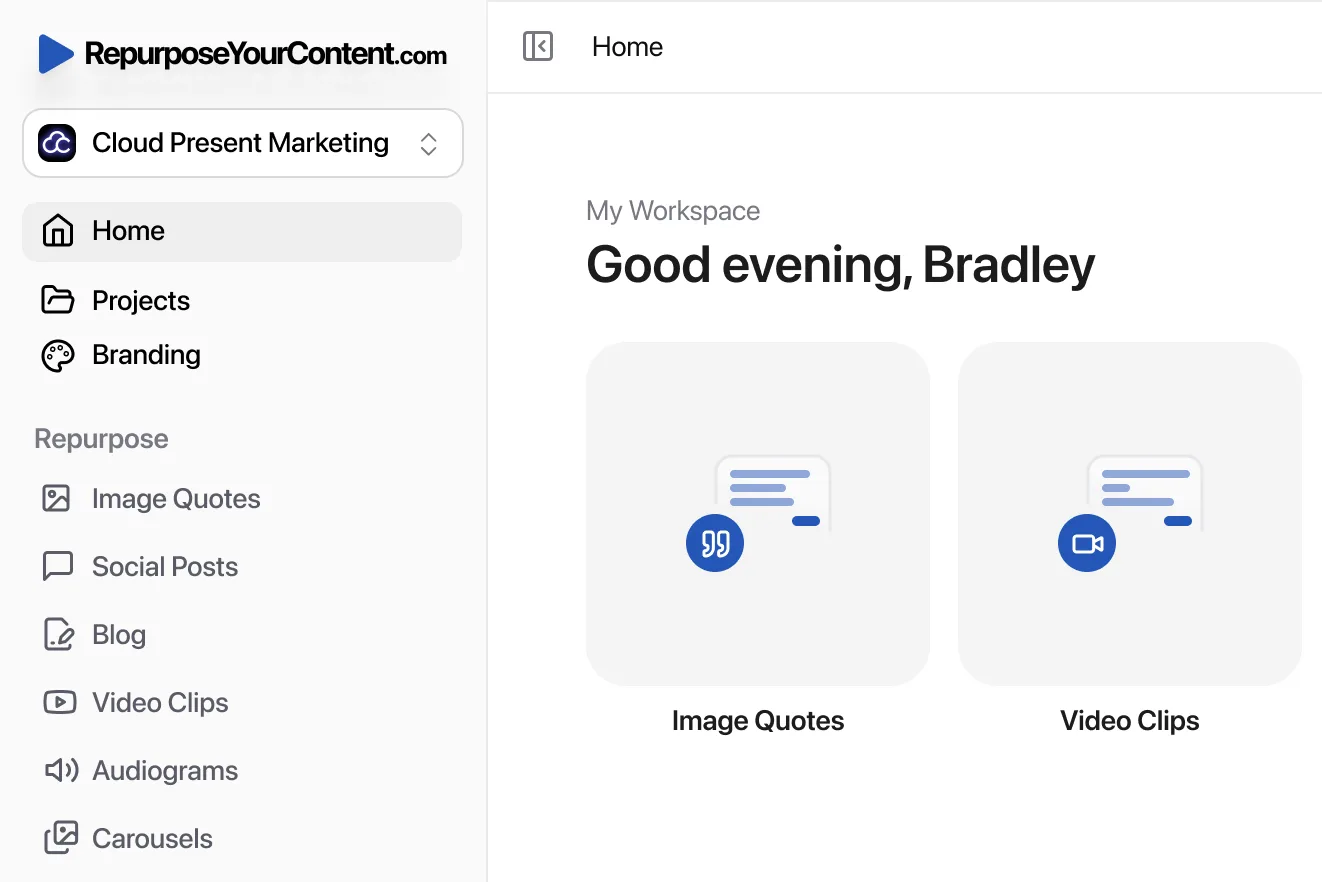
One option in this category is RepurposeYourContent, which takes a webinar recording, lets you choose outputs like video clips, blog posts, social posts, audiograms, image quotes, newsletters, LinkedIn carousels, and timestamps, then generates platform-ready drafts with brand kit support. That matters because agencies can shift more production work to junior staff and reserve senior time for QA.
Margin rule: Your best content systems do not reduce quality. They reduce expensive repetition.
What changes operationally
When this model works, agencies stop selling isolated assets and start selling a content system.
That changes delivery in three ways:
- Planning improves: The source asset defines the monthly package.
- Production becomes predictable: Fewer one-off requests and less scramble work.
- Gross margin improves: More client output comes from the same internal team.
That is the point of how agencies scale content production. More throughput is useful. Better economics are what make it sustainable.
Train Your Team and Maintain Quality Across Volume
Volume exposes weak training fast.
If your process only works when a senior strategist touches every asset, you do not have a scalable system. You have a heroic one.
A more durable model trains junior team members to run most of the workflow while senior staff control quality at the right checkpoints.

Top-performing agencies systematise production to create 50-200 ad creative variants per client monthly while cutting manual creation time by 70-80%. That same source notes the importance of disciplined QA and digital asset management.
Use a three-step training workflow
Junior staff do better with a short operating sequence than a long creative brief.
Train them on this:
Ingest Upload the source asset, collect the transcript, pull the brief, and confirm the client’s brand rules.
Generate Produce the agreed content formats using templates, prompts, and naming conventions already built into the workflow.
Polish Review every output for accuracy, voice, readability, and channel fit before it moves to editor review.
That structure works because it reduces ambiguity. It also makes coaching easier. If quality drops, you can see whether the problem happened during input, generation, or final polish.
For smaller delivery teams, this content repurposing workflow for small teams maps well to real agency conditions.
What junior staff should learn first
Do not start with “write better.” Start with judgement rules.
Teach them:
- What counts as a usable insight: Not every sentence in a webinar deserves reuse.
- How to spot a clear hook: Good clips and posts start with tension, not summary.
- What must stay verbatim: Claims, numbers, product details, and direct customer language.
- How platform formats differ: A blog intro is not a LinkedIn opening.
- What to flag for review: Sensitive claims, unclear examples, and anything that sounds off-brand.
This shortens ramp time and protects quality.
Quality control must be visible
A lot of agencies say they have QA. What they have is a tired editor fixing everything late.
A real QA system uses checklists before review starts.
Pre-editor checklist
- Accuracy check: Does the asset match the source material?
- Voice check: Does it sound like the client, not the tool?
- Format check: Is the asset built for the actual channel?
- Compliance check: Are claims, names, and details safe to publish?
Editor checklist
- Clarity: Cut spoken clutter and repeated phrases.
- Structure: Reorder points if the spoken source wandered.
- Specificity: Add timestamps, examples, or clear takeaways where useful.
- Consistency: Keep naming, formatting, and terminology aligned.
Tip: Quality falls fastest when teams confuse speed with skipping review. Fast systems still need checkpoints.
Protect authenticity as volume rises
A trade-off exists between output and authenticity.
As agencies push toward high monthly volume, content can start sounding templated. Posts repeat the same angle. Clips feel interchangeable. The audience notices before the team does.
The fix is not to slow everything down. The fix is to preserve the client’s raw material inside the workflow.
That means:
- starting from expert-led source content
- keeping direct language where it adds credibility
- editing for clarity without flattening personality
- varying angles instead of forcing every output into the same template
Measure the right operating metrics
Once the workflow is stable, stop obsessing over hours logged.
Track:
- output volume per client
- time from source asset completion to publish-ready package
- number of revision rounds
- percentage of assets approved without major rewrite
- which repurposed formats get reused by clients
Those metrics tell you whether the system is scaling cleanly or just creating hidden cleanup work.
Your 90-Day Plan for Profitable Content Scaling
Most agencies already know they need a better system. The issue is implementation.
A realistic plan works better than a giant transformation deck nobody follows. The point is to install one repeatable workflow, prove it, then expand.
A key challenge remains the trade-off between velocity and authenticity. Agencies scaling to 30+ pieces monthly risk audience fatigue or brand voice degradation, while expert-led webinars help preserve authenticity as tools handle the reformatting.
Days 1 to 30 audit one client and build the first SOP
Pick one client with recurring content demand and decent source material.
Do not start with your messiest account.
Focus on:
- Workflow mapping: List every handoff from recording to publish.
- Bottleneck review: Identify where work waits, repeats, or gets rewritten.
- Default package design: Decide what one source asset should produce every time.
- Version one SOP: Keep it simple enough to use next week.
At this stage, support documents help. A strong video content calendar template can help you schedule outputs once the package is defined.
Days 31 to 60 train one operator and refine the system
Now put one junior team member through the workflow.
Not in theory. In live delivery.
Watch for:
- where they hesitate
- where the SOP is unclear
- which outputs need better templates
- which review comments repeat every time
That repetition is useful. Repeated mistakes mean the process needs a rule, not another reminder.
Key takeaway: If the same fix appears in three reviews, add it to the SOP or template.
Days 61 to 90 roll it out across suitable clients
Once one workflow runs cleanly, expand to accounts with similar delivery needs. Agencies often overcomplicate things here. Keep the core stable:
- one pillar content type
- one standard asset package
- one owner for workflow
- one editor for final quality control
Then customise at the edges. Different topics. Different hooks. Different publishing priorities. Not different operating systems.
What success looks like after 90 days
A strong 90-day rollout does not mean every client gets identical content. It means your agency now has:
- a repeatable production engine
- clearer handoffs
- junior-friendly execution
- tighter QA
- better margin control
That is the practical answer to how agencies scale content production. They stop buying growth with headcount alone. They build a production model that turns one expert session into a useful set of channel-ready assets.
If you want to change the economics quickly, try RepurposeYourContent for your agency and see how the model fits your client delivery workflow. You can also review the agency-specific setup at /solutions/agencies.
Tags: