Podcast Promotion Strategy for New Episodes
Launch every podcast episode with a proven podcast promotion strategy for new episodes. Teasers, clips, guest packs, and a 14-day posting playbook.

A reliable podcast promotion strategy for new episodes runs as a 14-day campaign, not a single launch-day post. It starts with a pre-release teaser, uses a complete launch-day asset kit, and sequences clips afterward, with guest amplification doing the heaviest lifting.
A common release looks different. The host schedules the episode, wakes up to a live RSS feed, posts one link, and waits. By the next morning, the small spike has flattened. The episode may be strong, but distribution stopped before discovery began.
Podcast audiences are already large and habitual. Edison Research's Infinite Dial 2026 reported that 230 million Americans have ever listened to or watched a podcast, while 167 million consumed one in the last month and 130 million in the last week. Monthly reach was 58% of Americans aged 12 and older, and weekly reach was 45%. Among people aged 35–54, monthly reach reached 68%. (AudioGo's summary of the report)
That scale changes the job. A new episode needs repeated entry points, clear reasons to listen, and assets that guests can share without extra work.
Why Most New Episodes Disappear After Launch Day
At 5 a.m., the episode goes live. The show account publishes a link on LinkedIn. The host adds an Instagram Story. The guest receives a message saying, “Please share when you can.”
By midnight, downloads show a modest bump. The next morning, attention has moved elsewhere. Nothing is wrong with the interview. The release had one distribution event instead of a campaign.
The problem is usually not content quality. It's the gap between publishing and packaging. A listener may never see the episode link, but could stop for a sharp clip, a guest quote, or a search result answering a specific question.
Practical rule: Every episode needs multiple discovery paths before release, during launch day, and after the initial spike.
A 14-day campaign solves that gap with three layers:
- Pre-launch anticipation: Publish a teaser that creates a reason to return.
- Launch-day saturation: Release native clips, quote graphics, guest assets, email, and pinned links.
- Evergreen redistribution: Repackage the strongest ideas after launch week.
The timing matters because listening behavior extends beyond release day. A June 2025 Cumulus and Signal Hill report found that 70% of weekly podcast consumers listen within 24 hours of release, while 75% return to missed episodes later. (Cumulus Media's report)
The first figure supports a strong launch window. The second makes a one-day social push wasteful. The episode still has work to do after the initial audience checks its feeds.
A practical foundation for that work is this guide to repurposing podcast episodes. It treats the recording as source material for distribution, not as a file that disappears after publication.
Guest amplification deserves special attention. Personal recommendations and lightweight sharing have long supported podcast discovery. The Canadian Podcast Listener 2018 study found that 65% of monthly listeners had shared podcasts with others during the previous six months, including 46% through word of mouth, 23% through social media, and 18% through email or text. (Podcast marketing statistics from Empire325 Marketing)
That's why a polished guest pack often beats another solo post from the host. The guest brings trust, context, and a second network.
The Pre-Launch Week Setup
A strong release begins before the RSS feed changes. The preparation window should produce approved assets, confirmed links, and a schedule that requires no editing on launch day.

Seven days before release
Day minus 7, lock the episode. Final editing, title selection, hook writing, and clip marking can take four to six hours for a solo creator. Select three possible moments that can stand alone in a feed. A useful clip doesn't merely summarize the interview. It creates tension, answers a painful question, or challenges a familiar assumption.
Day minus 5, build the written layer. Show notes with timestamps may take one to two hours. A search-focused blog post adds another two to three hours, depending on transcript quality and research needs. Use the guest's expertise to shape the topic, then connect the post to phrases listeners search.
For technical guidance on the written side, SEO and content for site promotion offers useful context around making published content easier to discover. The episode page should include a clear title, concise summary, timestamps, guest details, and a direct listening link.
Day minus 3, create the teaser package. Recording or editing a 60 to 90-second teaser can take 30 to 60 minutes. Add captions, create an audiogram, prepare a vertical video cover, and design a square quote card. Each asset needs the same episode promise and CTA.
Day minus 1, remove launch-day friction. Scheduling the email, checking links, preparing guest copy, and confirming distribution usually takes one to two hours. If the hosting service supports it, confirm the RSS pre-order or scheduled release settings.
The total DIY commitment lands between six and nine hours per episode, based on the workflow above. The exact cost depends on editing speed, design ability, transcript cleanup, and guest responsiveness.
The pre-launch checklist
- Choose the central promise. Write one sentence explaining who should listen and what they'll gain.
- Mark three clip candidates. Favor clear hooks over polite highlights.
- Draft show notes and timestamps. Keep each section useful to readers who haven't pressed play.
- Write the episode page or blog post. Include the primary topic, guest expertise, and related questions.
- Produce the teaser. Use one unresolved question or strong statement.
- Build the guest pack. Prepare files, copy, links, and instructions in one folder.
- Schedule every approved post. Nobody should be editing captions while the episode is going live.
More practical guidance appears in how to create podcast show notes from recordings. The preparation standard is simple. If an asset isn't approved before launch morning, it isn't part of the launch plan.
Your Launch-Day Asset Kit
The launch-day kit should function as a production line. Each layer has a job, and each asset should point toward the full episode.
The five layers
Layer one, the episode foundation. Host the audio, publish the transcript, and add chapter markers. Chapter labels should match the timestamps in the show notes, so listeners can jump to specific topics.
Layer two, the long-form written asset. A blog post or newsletter issue can quote the guest, link to referenced resources, and give search visitors a useful reason to continue. It shouldn't copy the transcript without editing. A clear argument, strong subheadings, and a direct listening CTA make the written version more useful.
Layer three, the clip stack. Prepare three to five vertical videos between 30 and 75 seconds. Open each clip on the hook, add captions for silent viewing, and export versions for vertical, square, and widescreen placements. The clips should feel native to each platform, not like one file resized repeatedly.
Layer four, the visual kit. Include an audiogram, quote graphics, guest headshots, and the branded episode cover. Keep the typography and CTA consistent, but vary the visual treatment enough to prevent repetitive feeds.
Layer five, the tracking layer. Use tagged links, short redirects, and a launch page that can collect email opt-ins. Tracking helps separate host traffic, guest traffic, email traffic, and platform discovery.
| Layer | Asset | Format | Purpose |
|---|---|---|---|
| Foundation | Episode, transcript, chapters | Audio and web page | Support listening, navigation, and search |
| Written | Blog post or newsletter | Long-form text | Capture search and email attention |
| Clips | Hook-led video moments | Vertical, square, widescreen | Create feed-level discovery |
| Visuals | Quote cards and audiograms | Platform-ready graphics | Support fast sharing |
| Tracking | Tagged links and redirects | Web links | Identify traffic sources |
The strongest clip should lead the launch. The remaining 8 to 12 clips can keep the episode visible across the following two weeks. Each clip should carry the same CTA, so repeated exposure reinforces one destination.
The podcast clips for social media guide provides additional context for selecting moments and adapting them to different feeds.
A launch kit also needs a guest-ready version. The guest shouldn't have to crop a video, write a caption, or search for the episode URL. Those tasks create delay, and delay kills coordinated sharing.
The First 24 Hours and the 14-Day Posting Cadence
The first 24 hours need speed and coordination. The campaign then needs enough spacing to prevent the episode from becoming invisible after launch day.
The hour-zero workflow
Step 1, publish the episode. Confirm the RSS feed, episode page, transcript, show notes, and full-episode links.
Step 2, post the strongest clip natively. Publish it on Reels, Shorts, TikTok, and the primary B2B channel within the first hour. Native uploads usually create a cleaner viewer experience than a link post.
Step 3, publish the written asset. Release the blog post with the transcript, episode link, guest details, and search-focused headings.
Step 4, send the newsletter. Send it on the same day as release. A practical format includes a personal opening, a short summary, one deeper insight, a few relevant links, and a clear CTA. Podcast newsletter best practices outlines this repeatable structure, while Spotify's creator guidance recommends emailing the audience each time an episode is released.
Step 5, activate the guest. Send the ready-to-share pack immediately. The guest should have a clip, quote graphics, copy, and the direct episode link.
Step 6, pin the destination. Pin the episode post and the first useful comment where the platform allows it. Add the episode to relevant Stories and profiles.
A newsletter mention works best when the episode connects naturally to the email topic. Wistia recommends a clear hyperlink or thumbnail that leads directly to the episode, rather than embedding a heavy player inside the email. (Wistia's podcast promotion guidance)
The 14-day cadence
- Day 1: Launch clip, quote graphic, newsletter, blog post, guest pack, and pinned links.
- Day 2: Publish the first follow-up clip with a different hook.
- Day 4: Release another clip focused on a practical takeaway.
- Day 6: Share a quote card in the feed and Stories.
- Day 8: Coordinate the guest cross-post and reshare the guest's version.
- Day 10: Publish a long-form LinkedIn rewrite built around one argument from the episode.
- Day 12: Share the episode in a relevant community with context, not a bare link.
- Day 14: Use one final insight as a soft teaser for the next episode.
For B2B audiences, morning posts often fit work routines. B2C shows may find evening publishing more natural. Scheduling still needs to follow the audience's own analytics, not a universal rule. A detailed growth playbook from Unfloppable offers additional ideas for free distribution and channel-specific publishing.
| Platform | Best Posting Window | Primary Outcome | Effort Level |
|---|---|---|---|
| Audience's workday morning | Qualified discussion and subscribers | Medium | |
| Instagram Reels | Audience's active browsing period | Clip discovery and shares | Medium |
| TikTok | Audience's active browsing period | New reach and clip testing | Medium |
| YouTube Shorts | Spread across the campaign | Searchable clip discovery | Medium |
| Release day, audience local time | Direct episode traffic | Low | |
| Communities | When discussion is active | Trust and targeted referral traffic | High |
The calendar should live in one shared document. It needs publishing times, approved assets, copy, URLs, and one owner for replies during the first hours. The B2B content calendar guide can help teams formalize that process without adding another coordination layer.
Guest Amplification That Actually Moves the Needle
Guest amplification works because the guest already has a relationship with a separate audience. The host's job is to make sharing fast, specific, and low-risk.
The seven-day guest workflow
Day minus 7, send the briefing. Collect the guest's social handles, preferred name, company details, and approved links. Include the release date, the episode promise, and the assets they'll receive.
Before launch, pull two usable quotes. Choose statements that make sense outside the interview. A quote that needs five minutes of context won't travel well.
Before launch, prepare the folder. Include a guest-branded clip, three platform-sized quote graphics, five prewritten posts, a 90-second vertical teaser, and the full episode link. The guest should be able to post from a phone.

On launch morning, the host posts first. The guest follows within four hours, and both accounts comment on the other's post during the first hour after publishing. That sequence gives the audience a clear path from familiar person to full episode.
A guest with an engaged audience can expose the episode to a second network at no media cost. Nothing else on launch day usually matches that effort-to-impact ratio. The message shouldn't ask the guest to “promote the episode.” It should say exactly what to post, when to post it, and which link to use.
A polished asset pack turns a vague favor into a five-minute publishing task.
Guest size still matters, but raw follower count isn't enough to predict results. A smaller specialist guest may produce more relevant listeners than a larger generalist account. The useful tiers are practical:
- Specialist guest: Focused audience, high topic relevance, strong fit for B2B or niche shows.
- Established creator: Broader reach, more sharing experience, and greater content demand.
- Recognized industry figure: High authority, but often slower approvals and more competing requests.
The workflow is documented further in how to repurpose podcast guest appearances.
The clip below can also help teams think about guest-facing promotion as a coordinated content workflow rather than a last-minute request.
Evergreen Redistribution and the Metrics That Matter
The second half of the campaign shouldn't require a new recording. It should reuse the assets that earned attention and place them in new contexts.
The strongest clip can become a pinned YouTube Short. An audiogram can become a LinkedIn carousel slide. A quote can seed a weekly X thread. The blog post can be adapted for other publishing channels with correct canonical handling.

The listening data supports this approach. The Cumulus and Signal Hill report cited earlier found 70% of weekly podcast consumers listen within 24 hours, while 75% return to missed episodes later. Those figures describe two different jobs. Launch activity captures immediate demand. Redistribution captures people who discover the episode through search, recommendations, clips, or the back catalog.
Clip discovery deserves its own measurement. A 2026 Podcast Atlas survey reported that 89% of listeners watch podcast clips at least sometimes, 72% watch them often or always, and 74% give clips their full attention. It reported engagement of 67% on YouTube and 63% on TikTok, while roughly one-third of clip viewers reliably continued to the full episode or became regular listeners. (Podcast Atlas findings from Barrett Media)
That last point matters. Clips are a discovery layer, not a guaranteed direct-response ad. A clip can build familiarity even when the viewer doesn't listen immediately.
The weekly review
Track the metrics closest to the business goal:
- Downloads per episode: Shows direct listening demand.
- Completion rate: Indicates whether the opening and structure hold attention. Average episode completion is around 52% to 58%, while top-performing shows exceed 70%, according to podcast growth benchmarks from Digital Applied.
- Subscriber delta: Shows whether discovery becomes an ongoing audience relationship.
- Guest-post click-through: Measures the value of partner distribution.
- Clip view-through rate: Shows whether the hook earns sustained attention.
- Branded search lift: Indicates whether repeated exposure is building recognition.
Raw impressions belong in the report, but they shouldn't lead it. A large impression count with weak completion, clicks, or subscriptions can hide an ineffective hook.
Teams looking for additional proven ways to grow fast can use the same principle across other recorded formats. The review question stays simple: which asset deserves another placement, which asset needs a new hook, and which asset should be retired?
The Done-For-You Launch Playbook
DIY promotion looks inexpensive until the full workflow appears on a calendar. Pre-launch preparation, asset production, launch-day coordination, guest follow-up, and 14-day scheduling can consume a working day or more per episode.
A solo operator may spend eight to 12 hours across the complete process. The stated loaded creator-time cost can reach $300 to $600, before opportunity cost. Editing skill, design ability, writing speed, and approval delays push the total higher.
Three operating models
| Factor | DIY Solo | Hybrid, Clips and Scheduling | Done-For-You Full Launch |
|---|---|---|---|
| Time required | Eight to 12 hours per episode | About two to four hours | About 15 minutes |
| Production | Host edits, writes, designs, and schedules | Service produces selected assets | Service produces the launch system |
| Guest coordination | Host manages every follow-up | Shared responsibility | Guest pack and schedule prepared |
| Output | Depends on available time | Clips, posts, and selected visuals | Video clips, LinkedIn posts, quote graphics, carousels, audiograms, and blog post |
| Best fit | Small volume and strong production skills | Teams with an internal owner | Busy hosts, founders, and B2B teams |
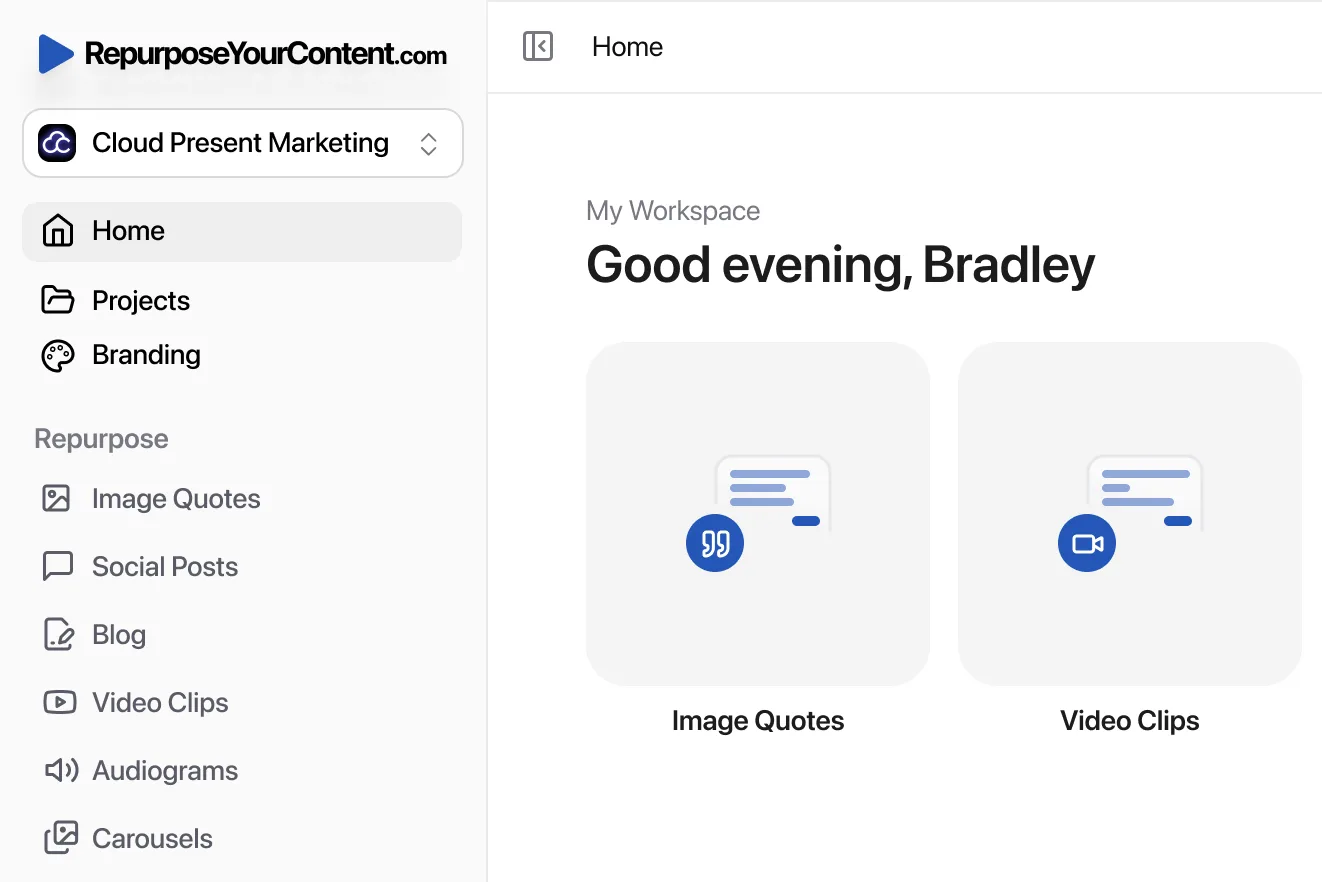
The done-for-you alternative is straightforward. A client sends one recording, such as a podcast, interview, keynote, sales call, livestream, course session, or meeting recording. RepurposeYourContent returns 20 to 30 ready-to-publish assets in 72 hours, including video clips, LinkedIn posts, quote graphics, carousels, audiograms, and a blog post, written in the client's brand voice with unlimited revisions.
The full process can turn one 45-minute recording into 30 assets. Pricing starts at $14 per finished asset, while a broader per-episode launch package can range from $450 to $900, depending on the production and scheduling scope. The service also includes the posting playbook, so the team knows what goes where and when.
Decision point: If the recording already exists, production time should go toward distribution decisions, not repetitive editing.
A done-for-you workflow leaves the client with one short task. Send the recording, approve the assets, and schedule the campaign. The stated client time is about 15 minutes, with a 72-hour turnaround guarantee, or the client doesn't pay.
Podcast operators who want a practical fit check can book a launch audit or request a sample episode plan. Bring one upcoming recording, the target audience, and the intended release date. That's enough to map the asset kit and identify where the next episode is likely to lose momentum.
Book a call with RepurposeYourContent or request a sample launch plan for an upcoming episode. Send one recording, and the team will show how its 14-day promotion campaign can turn that episode into ready-to-publish content across the channels that matter.
Tags: