How to Build a Content Engine for B2B and Scale Your Output
Learn how to build a content engine for B2B. Stop the content treadmill and multiply your marketing output with a proven system, not more headcount.

Your team is running on a content treadmill. You create more, but results are flat. This isn't a people problem; it's a system problem. The fix isn't hiring more writers. It's building a smarter system. A B2B content engine is a repeatable process to multiply your output from a fixed input. This guide shows you how to build a content engine for B2B. You will stop chasing endless new ideas and start scaling efficiently.
Your Content Problem Is a System Problem
If your team is burnt out and scrambling for ideas, your system is broken. High-performing B2B teams don't work harder. They build smarter workflows that scale content without scaling headcount. They operate like an industrial assembly line, not a creative agency.
Stop creating one-off content pieces. Instead, create one high-value ‘anchor’ asset each month. This could be a webinar, a podcast, or an expert interview. This single asset becomes the raw material for your entire month of marketing. This requires a solid content marketing strategy.

From One-Off Projects to an Engine
An engine has distinct parts working together in a repeatable cycle. Your content engine needs the same. It is built on four key components:
- Anchor Content Creation: The high-value webinar, podcast, or interview that fuels the system.
- Extraction & Repurposing Pipeline: The system for breaking down the anchor asset into smaller, derivative content.
- Multi-Channel Distribution: The plan for systematically promoting all assets across relevant channels.
- Performance Measurement & Iteration: The data feedback loop to refine and improve the engine.
This approach transforms your content operations from chaotic to predictable. You stop asking, "What are we posting today?" You start working from a planned inventory of high-quality assets you already have.
The Power of Content Multiplication
The math behind a content engine is simple. Its impact is massive. Instead of your team creating a blog post, then a social update, then a video clip separately, you create them all from a single source.
A single one-hour webinar can be systematically turned into a full month of marketing assets. For example, one recording can become 39 distinct pieces of content.
Here is what you can generate from one hour:
- 8 SEO-optimized blog posts
- 24 social media posts
- 4 short-form video clips
- 2 audiograms for thought leadership
- 1 comprehensive email newsletter
By adopting this model, you learn how to build a content engine for B2B that produces consistent, high-quality material without burning out your team. An automation layer makes this process even more efficient. To see how this system works in practice, review our guide on the content multiplication framework. The goal is to turn one hour of your team's effort into a month of marketing impact.
How to Fuel Your Content Engine With Webinars
Every content engine runs on consistent fuel. For B2B teams, this fuel is anchor content. These are substantial, expertise-packed assets like webinars, podcasts, or in-depth interviews. Think of it as the one big rock you create each month. You then break it down into a hundred smaller, valuable pebbles. You can find a detailed definition of anchor content in our glossary.
Without a solid anchor piece, your system will fail. You will be back on the content hamster wheel, creating one-off pieces to keep the lights on. A 'webinar-first' strategy solves this. It forces you to capture your team's best knowledge in a format filled with repurposing potential.
In the UK, 51% of marketing professionals rate webinars as a top-three most effective channel for B2B lead generation. This is just behind in-person events at 52%. UK B2B teams invest heavily in these events. Yet, much of the value is lost after the live broadcast ends. You can find more UK B2B marketing trends over on rootdigital.co.uk.
Start Planning Your Webinar With Repurposing in Mind
A successful anchor webinar is not a one-and-done live event. It must be designed from the start as raw material for an ecosystem of smaller assets. This requires a mental shift. You are not just hosting a presentation. You are producing a content goldmine for your production line.
Structure your webinar in modules. Design distinct segments that can stand on their own.
- Key Talking Points: Ensure each major point has a clear beginning, middle, and end.
- Customer Stories: Isolate specific anecdotes or case studies. These become powerful video testimonials or social posts.
- Data-Backed Claims: Present stats with clear context. They can be pulled out as standalone graphics or snippets.
- Actionable Tips: Dedicate specific sections to "how-to" advice. These are perfect for short video clips, checklists, or carousels.
When you plan a webinar for repurposing, you are not thinking about a single 60-minute presentation. You are building a bank of 10-15 self-contained, 3-5 minute micro-topics primed for extraction.
Pinpoint Topics That Actually Generate Demand
The best anchor content focuses on a specific, urgent pain point for your ideal customer. Do not waste your one big shot for the month on a vague topic. Find a subject that resonates so deeply that engagement is almost guaranteed.
Find these topics by listening to the questions your audience already asks.
- Talk to your sales team: Ask them, "What are the top three objections you hear every week?" or "What's the one question every prospect asks during a demo?"
- Comb through support tickets: Look for recurring themes or common points of confusion. A webinar that demystifies a complex issue serves both marketing and customer success.
- Do some SEO digging: What "how-to" or "what-is" questions in your industry have high search volume but poor answers from competitors? Fill that gap with your expertise.
Choosing the right topic is the first domino. Get this right, and you create a powerful anchor webinar. It will build the momentum needed to fuel a full month of high-impact marketing.
Building Your Extraction and Repurposing Pipeline
You just finished a great webinar. It was packed with insights. Now what? This is where most B2B content strategies stop. Manually slicing up an hour-long video, transcribing it, and writing a dozen social posts is a bottleneck. It kills momentum.
A scalable content engine runs on an efficient extraction and repurposing pipeline. It is not about working harder. It is about building a machine that breaks down your webinar into dozens of smaller content pieces with minimal effort.
The goal is to get enough volume and variety to feed all your channels consistently. You need video clips for LinkedIn, a blog post for your website, and audiograms for thought leadership. Creating each one-by-one leads to burnout. Using a content repurposing tool is a more efficient approach.
Designing Your Repurposing Workflow
Your pipeline needs to be a repeatable, predictable process. It is more like an assembly line than a brainstorming session. For every webinar you produce, have a standard menu of content outputs you will create.
Here is a simple, repeatable workflow:
- Upload the raw recording. This is your single source of truth.
- Select your desired formats. This might be 4 video clips, 2 blog posts, and 8 social posts.
- Let the system generate the assets. The pipeline should handle transcription, identifying clips, and creating first drafts.
This process moves you from being the creator of every asset to the editor overseeing the system's output.

As you can see, repurposing is not an afterthought. It is a dedicated stage in the production process. The biggest mistake B2B marketers make is treating repurposing as an optional task. A real content engine makes it a mandatory, systemized part of the workflow.
How RepurposeYourContent Helps
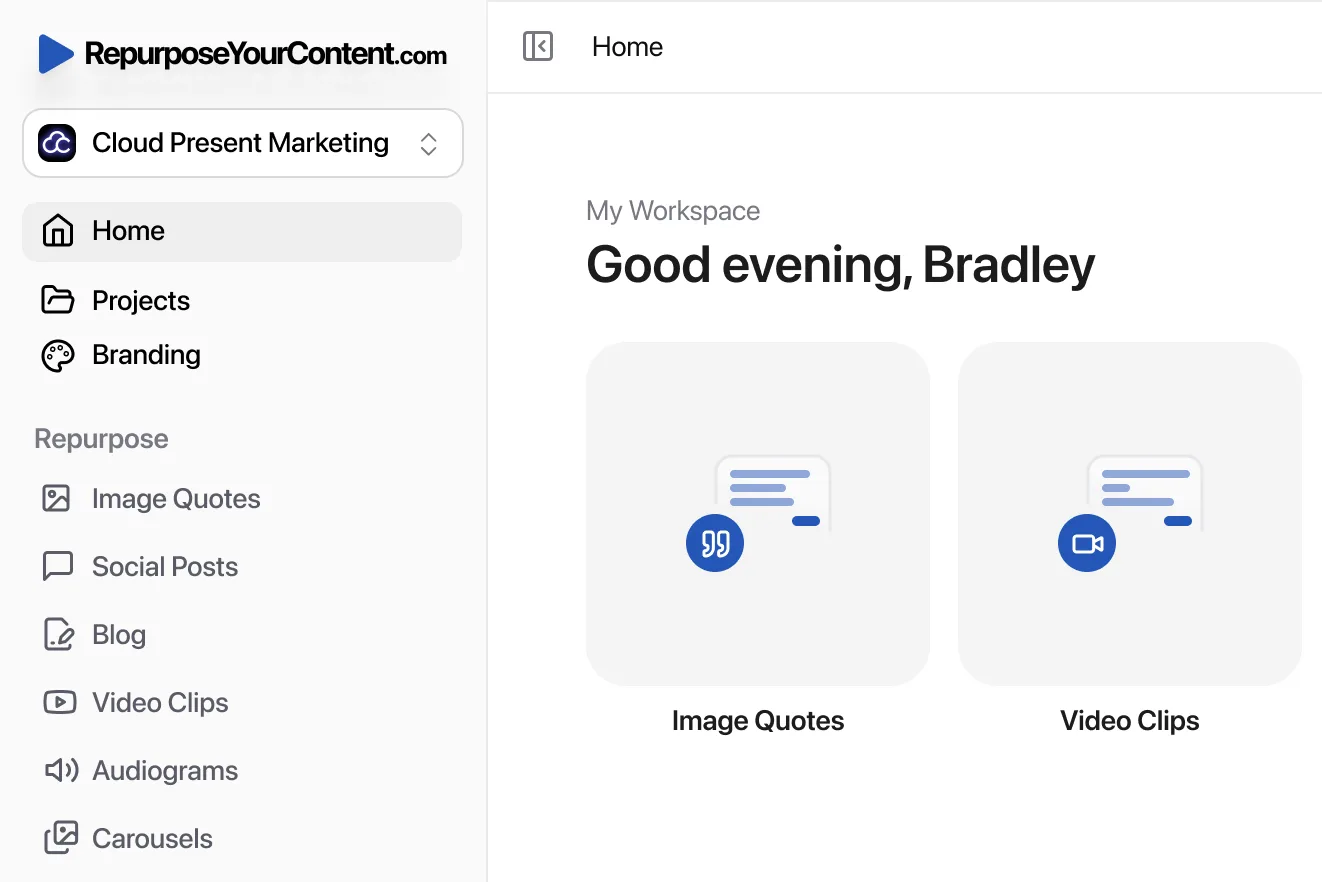
This is precisely what RepurposeYourContent does. It becomes the automated extraction and repurposing pipeline at the heart of your B2B content engine.
You upload your webinar recording. Our AI transcribes the entire session and automatically identifies the most valuable insights. From there, you can generate a whole suite of assets with just a few clicks:
- Video clips with timestamps and animated captions.
- Blog posts drafted from the spoken content.
- Social posts ready to publish.
- Audiograms and image quotes for visual impact.
- Newsletters that summarize the webinar’s key takeaways.
- LinkedIn carousels built from your core ideas.
- Timestamps to guide viewers to key moments.
Our system applies your brand kit across all generated content. This ensures everything is on-brand and ready to go live. It turns the most time-consuming part of running a content engine into the easiest. You can see this detailed in our content repurposing workflow for small teams.
A Real-World Workflow Example
What does this look like in practice?
- Step 1 (9:00 AM): You upload last week's webinar recording to RepurposeYourContent.
- Step 2 (9:02 AM): The AI has transcribed the video and suggested the best clips based on your talking points. You select the assets you need for the week: 3 video clips, 1 blog post draft, and 4 social posts.
- Step 3 (9:05 AM): The platform generates every asset, automatically applying your brand kit. You have a folder full of on-brand content ready for scheduling.
That’s how the engine works. You replace manual labor with a smart, repeatable system. Our platform integrates with the tools you already use, like Zoom, YouTube, and Vimeo. Explore our full list of RepurposeYourContent integrations to see how it fits your existing workflow.
This is how you stop scrambling for content. You build a predictable, high-output machine. You turn one hour of expertise into a 30-day content calendar with almost zero extra effort. Manually creating short-form video is a huge time sink, even though 78% of UK consumers prefer it for learning about services. Check out more UK content marketing trends on the-escape.co.uk. Automation removes this pain point.
Executing Your Distribution and Promotion Playbook
Creating content is only half the job. If your assets sit in a folder, they have no value. To get a return on your anchor webinar, you need a smart, systematic playbook for distribution. This is not about randomly posting on social media. It is about a disciplined, sequenced approach to get your content seen.

This process transforms a single webinar into a campaign that runs for weeks. Every asset has a role on a specific channel, creating a constant, valuable drumbeat for your audience. For a deeper dive, see our guide on powerful content distribution strategies.
Matching the Asset to the Channel
Your playbook must match the right asset to the right platform. A long-form blog post will get lost on a fast-moving LinkedIn feed. A 45-second video clip will not help your Google rankings.
Here is a simple way to think about it:
- Company Blog (SEO): This is for your SEO-optimized blog posts built from the webinar transcript. The goal is long-term organic traffic.
- LinkedIn: This is where your short video clips, quote graphics, and carousels will shine. Use them to start conversations.
- Email Newsletter: Send the full webinar recording to registrants. Then, use a summary to share takeaways with your wider list.
- Sales Team: Equip reps with specific video clips and customer stories from the webinar. These are valuable for outreach and follow-up emails.
This multi-channel approach meets your audience where they are, with content that feels native to that platform.
A Sample Weekly Content Distribution Schedule
You build momentum by dripping content out over several weeks. This keeps your audience engaged and extends the life of your anchor content.
A system is vital. UK B2B marketers are spending more on content, with 45% planning budget increases. But many still struggle to produce enough content. This is a miss, as 58% of marketers see direct sales growth from content marketing. With 96% of B2B marketers on LinkedIn, a steady flow of fresh assets is necessary. You can discover more B2B marketing statistics from this research.
Here is a simple playbook for sequencing your repurposed assets over one week.
| Day | Channel | Asset Type | Objective |
|---|---|---|---|
| 1 | Full Webinar Recording | Nurture registrants and drive on-demand views. | |
| 3 | Company Blog | SEO Blog Post | Capture organic search traffic for core topics. |
| 5 | Video Clip #1 | Generate engagement and spark conversation. | |
| 6 | Newsletter Summary | Share key insights with your wider audience. | |
| 7 | Image Quote | Reinforce a key message and drive brand recall. |
This is just a starting point. Adapt it to what works for you and your audience. A repeatable distribution playbook ensures every asset your engine produces is working hard for you.
Measuring Performance to Refine Your Engine
An engine is a feedback loop. It uses output data to improve, getting more efficient with each cycle. Your B2B content engine must work the same way. Without measurement, you are guessing. With the right data, you turn your content operation into a smart, self-improving system.
Ditching Vanity Metrics for Business Impact
Clicks and likes do not pay the bills. They do not tell you if your engine is moving the business forward. You need to answer the real questions about your content's efficiency and impact.
Focus on a few key performance indicators (KPIs) that show the true health of your engine:
- Asset Engagement Rate: Which repurposed assets get the most shares and comments on LinkedIn? This tells you what formats your audience prefers.
- Topic Popularity: Which themes from your webinar generate the most buzz in your blog posts and social clips? This tells you what to double down on in your next webinar.
- Content-Sourced Leads: How many demo requests or trial sign-ups came from people who engaged with your content? This draws a clear line between content and revenue.
- Sales Cycle Influence: Are your sales reps using the assets? Do they find that the content helps them have better conversations and close deals faster?
Tracking these KPIs is how you build a sustainable advantage. Every piece of data feeds back into your strategy. It informs your next webinar topic, the questions you ask, and the stories you tell. A content engine without a feedback loop is just a content factory. A true engine learns and adapts. This is essential for anyone learning how to build a content engine for B2B that lasts.
Building Your Performance Dashboard
You do not need a complex analytics setup. A simple dashboard, even in a spreadsheet, is enough. The key is consistency. Your goal is a clear, at-a-glance view of what works for each webinar.
Here is a basic template to track performance per anchor webinar:
| Metric | Target | Result | Analysis & Next Steps |
|---|---|---|---|
| Total Assets Created | 35 | 39 | Exceeded target. The workflow is efficient. |
| Top Performing Asset (Format) | Video Clip | Video Clip #3 (Customer Story) | Prioritize more customer story clips next time. |
| Top Performing Topic | "Reducing Admin Time" | "Reducing Admin Time" | This topic is a clear winner. Plan a dedicated blog post. |
| Content-Sourced Leads | 5 | 8 | "Reducing Admin Time" assets drove all the leads. |
Tracking this information turns gut feelings into hard data. You will spot patterns you would have otherwise missed. Stop wasting time on what does not work. Reinvest that energy into what does. This is the final, crucial piece of the puzzle. It ensures every webinar you create is more impactful than the last.
Ready to build the automation layer that makes all of this possible? Try RepurposeYourContent.
Frequently Asked Questions
So, How Much Time Does This Actually Take to Manage?
The system is designed to give you time back. Your main effort is creating one great anchor webinar each month. After that, with an automation layer like RepurposeYourContent, the rest is light work. We are talking a few hours a week to oversee repurposing and distribution. This is a huge drop from the 20+ hours it would take to do it all manually.
What If We Don’t Do Webinars?
No problem. The core principle is about having a rich, long-form 'anchor asset' to fuel everything else. You can use a long-form podcast episode, a customer interview recording, or a conference keynote. Anything packed with expertise and a decent length will work. The key is to start with one substantial piece of content.
Can a Small B2B Marketing Team Really Build This?
Yes. This system was designed for small, resource-strapped teams. It is about being smart and efficient, not just working harder. Instead of manually creating dozens of assets, you focus your energy on making one thing great. Then, you let smart workflows and automation multiply that effort. It is how a small team can deliver a multi-channel content strategy that looks like it came from a much larger team.
Ready to build the automation layer that makes this all possible? Give RepurposeYourContent a try.
Tags: