How to Repurpose Long Form Video Into Short Clips
Learn how to repurpose long form video into short clips with a practical workflow. Turn one long video into dozens of assets for LinkedIn, TikTok, and more.

Your team creates one 60-minute video. Your social media manager turns it into 47 pieces of content. This isn't a fantasy. It's the most efficient way to fuel your social media calendar. The workflow to repurpose long form video into short clips is a system you can build. It starts with finding high-impact moments in your recording. Then you edit them into 15- to 90-second clips, add captions, and format them for LinkedIn, TikTok, or YouTube Shorts.
This is how you turn a single video into a reliable stream of social content.
Find the Hidden Gold in Your Long-Form Videos

You have 60-minute webinars and interviews packed with expertise. They are sitting on a hard drive doing nothing. Your social media feeds are hungry for fresh content. This isn't about giving yourself more work. It’s about working smarter. Repurposing your long-form videos is the most efficient way to keep up.
Your existing videos are content goldmines. Each one has dozens of potential clips waiting to be extracted. Stop brainstorming new ideas from a blank page. Pull proven insights from content you have already created. This is how you multiply the ROI on your initial video production.
Why This Works for B2B Marketers
The demand for video is not going away. For B2B marketers, the pressure to feed social channels is immense. With daily social media time projected to hit 1 hour and 37 minutes per person in 2025, you have to cut through the noise.
Since 92.4% of social media clicks happen on mobile, vertical clips are essential.
This is where your long-form content becomes your advantage. A single one-hour webinar can be turned into a month's worth of assets for LinkedIn, TikTok, and YouTube Shorts.
We turn a single 60-minute recording into more than 47 individual pieces of content. That includes video clips, blog posts, social media updates, audiograms, newsletters, LinkedIn carousels, and image quotes. It’s about maximizing every second of your original video.
The Basic Workflow For Repurposing Video
Turning one long video into a library of short clips requires a clear path. The process moves from identifying key moments to formatting the final clips. A systematic approach means you get maximum value without getting bogged down.
Here’s an overview of the core workflow.
Quick-Start Workflow For Repurposing Video
This table breaks down the journey from one long video to a suite of short-form content.
| Phase | Action | Goal |
|---|---|---|
| 1. Identification | Watch the video and note timestamps of clip-worthy moments. | To map all potential high-impact segments. |
| 2. Extraction | Cut the chosen segments from the main video file. | To isolate each clip so it can stand on its own. |
| 3. Optimisation | Add captions, a brand template, and reformat to the right aspect ratio. | To prepare each clip for its specific platform. |
| 4. Distribution | Schedule and publish the clips across your social channels. | To keep your content calendar full of consistent posts. |
Once you follow this workflow, you get off the content treadmill. You build a sustainable system that gets more from assets you already own.
The identification phase is where it all starts. Getting good at strategic time-stamping for your videos is key. The point is to stop creating from scratch. Start using the value inside your existing video library.
How to Find Clip-Worthy Moments in Your Videos
A single 60-minute video can contain 15-20 fantastic short clips. The challenge is finding them without scrubbing through a timeline for hours. Manually hunting for these moments is a massive time-drain for a busy marketer.
You need a systematic way to spot high-impact segments. These moments will stop people scrolling on social media. Stop thinking about the full recording. Start looking for the mini-stories hidden inside. This is the most crucial first step to turn your long videos into compelling short clips.
What Makes a Moment Clip-Worthy
Not all parts of your video are equal. You are hunting for specific content types that grab attention. These moments have the best chance of performing well as short clips.
I focus on these four categories:
- Controversial "Hot Takes": Listen for moments where a speaker shares a strong, non-obvious, or controversial opinion. These takes go against the grain and get people talking in the comments. A clip that makes someone think, "I've never thought of it that way," is gold.
- Surprising Data Points: When a speaker drops a shocking statistic or a counterintuitive piece of data, that's a perfect clip. Data-backed insights give you credibility and make your content shareable. A clip starting with "Did you know that 73% of B2B buyers..." is an immediate attention-grabber.
- Actionable Mini-Tutorials: Your long video is packed with "how-to" nuggets. Find where a speaker explains a single, actionable tip or walks through a quick process. These tutorials offer immediate value and position your brand as a helpful expert.
- High Audience Engagement: If you're reviewing a live webinar recording, watch the chat or Q&A log. A question with many upvotes or a comment that created replies points to a topic your audience cares about. The answer to that question is almost always a fantastic clip.
How RepurposeYourContent Helps
Manually searching for these moments is slow. RepurposeYourContent automates this for you. Our AI analyzes your video's transcript. It automatically identifies the most clip-worthy moments based on insights, data points, and hot takes. You get a list of suggested clips, saving you hours of manual review. This means you can skip the clip map and go straight to editing.
Formatting Your Clips for Each Social Platform
A clip that performs well on LinkedIn will fail on TikTok if you don't follow platform rules. The secret to turning long-form video into high-performing short clips is not just what you clip, but how you format it.
Think of it as a technical checklist. Nailing these details for each platform gives your content the best possible chance to perform.
Match Clip Length to Platform Pace
You are constantly fighting for attention on social media. Your clip's length is one of the most important decisions you will make. A 90-second insight might be perfect for LinkedIn, but it’s an eternity on TikTok. You must tailor the length to what people expect.
Here’s a quick breakdown I use:
- LinkedIn Feed: Aim for 60–90 seconds. This gives you enough time to unpack a business-focused insight.
- Instagram Reels & YouTube Shorts: Keep it under 60 seconds. The sweet spot is 30–45 seconds for a punchy tutorial or a strong take.
- TikTok: Go short. Really short. Your clips should be 15–30 seconds. Get straight to the point, fast.
Aspect Ratios Matter More Than You Think
Have you seen a horizontal video on a vertical feed? It has ugly black bars. The video is tiny. It screams "I don't know what I'm doing." It’s one of the quickest ways to kill your engagement. Nobody will turn their phone sideways to watch your clip.
You must reformat every clip for its destination. It is non-negotiable.
For most B2B video, you'll use these three formats:
- 9:16 (Vertical): This is the king of mobile. It's the full-screen experience people expect on Instagram Reels, YouTube Shorts, and TikTok.
- 1:1 (Square): This format is a powerhouse for in-feed posts on LinkedIn and Instagram. It takes up significant screen real estate on a phone.
- 16:9 (Horizontal): This is your traditional widescreen format. Save this for the full video on YouTube or for embedding clips on your website.
Vertical videos can get up to a 90% higher completion rate than horizontal ones on mobile-first platforms. If you ignore the aspect ratio, you are leaving views on the table.
Burned-In Captions Are Not Optional
Here's a stat: around 85% of social media videos are watched with the sound off. If your clips don't have burned-in captions, most of your audience will scroll past. They will miss your message completely.
Captions are a deal-breaker. They make your content accessible. More importantly, they make it consumable in a silent-scroll world. They need to be clear, readable, and styled to match your brand. Using a tool to automatically generate and brand them is a massive time-saver. You can see how we handle automated video clips with captions with a single click.
For more details, exploring different content repurposing strategies can help you find new ways to maximize reach.
Short-Form Video Specification Cheat Sheet
This table is a lifesaver during production. Use it for a quick reminder of the correct format for each platform.
| Platform | Ideal Length | Aspect Ratio | Caption Style |
|---|---|---|---|
| 60–90 sec | 1:1 (Square) | Professional, clean | |
| Instagram Reels | < 60 sec | 9:16 (Vertical) | Bold, dynamic |
| YouTube Shorts | < 60 sec | 9:16 (Vertical) | Clear, on-brand |
| TikTok | 15–30 sec | 9:16 (Vertical) | Large, engaging |
Bookmark this or put it on a post-it note. It will save you headaches and ensure your clips always look native to the platform.
A Practical Batch Editing Workflow That Saves Hours
Editing clips one by one is a slow process. A smarter way to work is to think like an assembly line. Batch editing applies the same changes across multiple clips at once. This saves hours and keeps your brand consistent.
Here's a simple workflow. Step 1: Gather all your clip segments into a single project. Step 2: Apply a brand template, captions, and other effects to all clips simultaneously. Step 3: Export all the finished clips in their required formats in one go.
Templating and Branding in One Go
Your first batch action should be applying a consistent brand template. This includes your logo, brand colors, and standard graphics like a progress bar or caption font styles.
By applying this template to all clips at once, you create a cohesive set of assets. Every clip immediately looks like it belongs to your brand. This removes the tedious job of branding each video individually.
For example, you can take a 45-minute interview and produce 12 distinct, branded clips in under an hour. That could be four 9:16 clips for Reels, four 1:1 clips for LinkedIn, and four 16:9 clips for YouTube—all from a single editing session.
Generating and Reviewing Captions at Scale
As stated before, captions are non-negotiable. Manually transcribing and timing subtitles for a dozen clips takes a full day. A better way is to use a tool that generates them automatically for all clips at once.
Once generated, review them all together. This lets you make global stylistic changes with one command. You can also scan for transcription mistakes and fix them efficiently. Our guide on how to add captions to video clips provides a more detailed breakdown.
This batch approach to captioning delivers two key things:
- Speed: What would take hours is crunched down to minutes.
- Consistency: Every caption on every clip follows the exact same style guide.
Final Export and Delivery
The final stage is exporting all your clips. With a batch workflow, you can set up an export queue to render all clips in their required formats. Configure one batch for all your 9:16 vertical clips and another for your 1:1 square clips.
You hit "export," walk away, and come back to a folder of platform-ready assets. There is no need to watch the export process for each clip. This is the final step in a system designed for maximum output from minimum effort.
How RepurposeYourContent Automates Your Workflow

A batch-editing workflow is a huge leap forward. But you are still the one hunting for clips, making cuts, and formatting everything. This is where AI-driven automation helps.
Imagine this: instead of you reviewing a transcript to find key moments, RepurposeYourContent’s AI analyzes the entire video for you.
Upload your video file or paste a link from Zoom or YouTube. The AI transcribes the audio and pinpoints the most compelling insights, strong opinions, and crucial data points. It automatically isolates sections with the highest engagement potential. You can ditch the manual "clip map" for good.
The platform presents you with a list of suggested clips. Each has a headline and summary, ready for a quick review and one-click export. This is how you scale your content output without scaling your team.
How RepurposeYourContent Helps
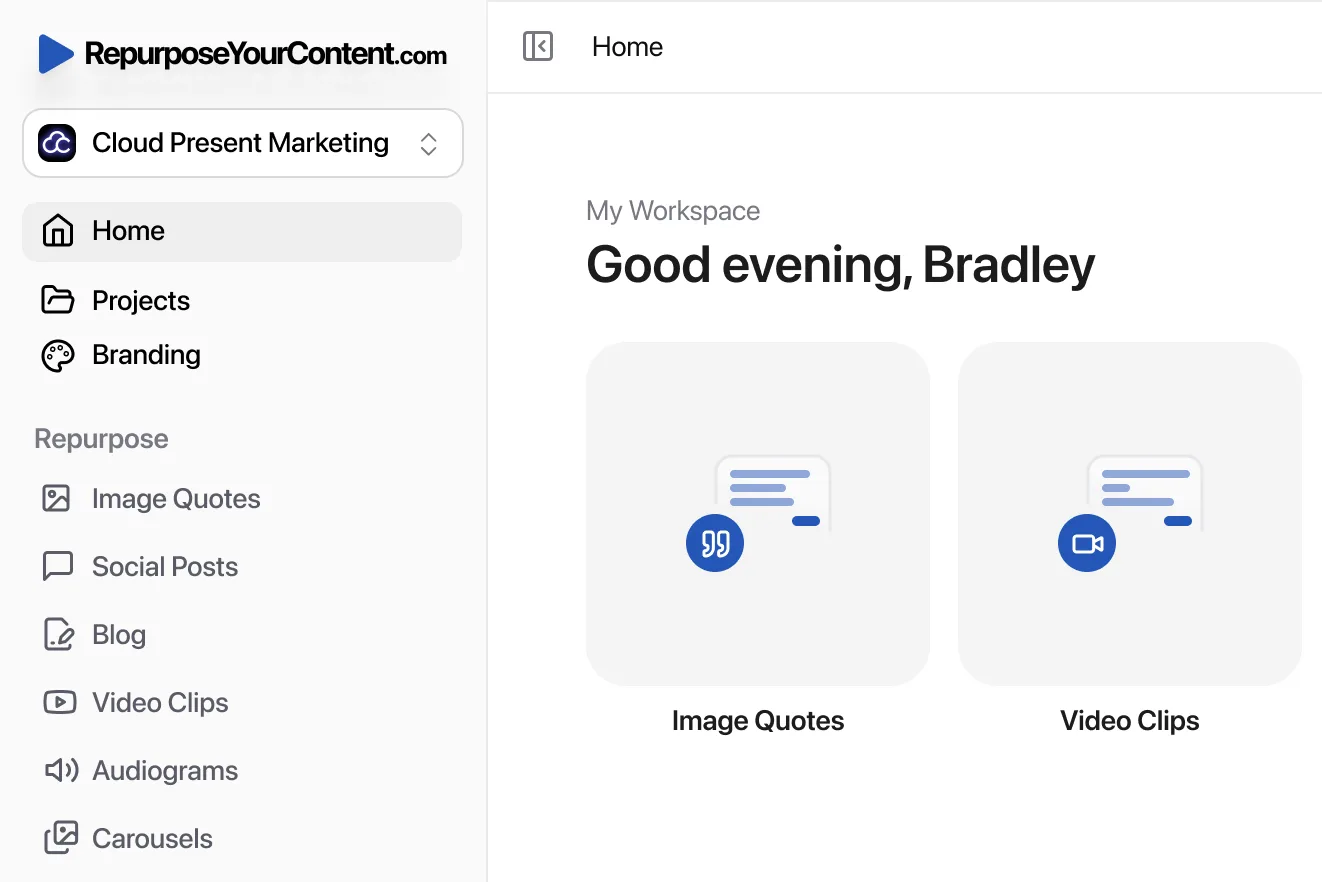
RepurposeYourContent was built to automate the entire process of how to repurpose long form video into short clips. It takes the tedious, time-consuming tasks off your plate. This frees you to focus on strategy.
Here’s what the platform creates from one video:
- Video clips: The AI finds the best moments and creates short clips with burned-in captions and your branding.
- Blog posts: It writes SEO-optimized articles based on the insights shared in your video.
- Social posts: You get ready-made captions for your social channels.
- Audiograms: It creates shareable audio clips for platforms like LinkedIn.
- Image quotes: Eye-catching quote cards from your speakers are generated automatically.
- Newsletters: It can draft email copy to promote your new content.
- LinkedIn carousels: It transforms key takeaways into branded, shareable slide decks.
- Timestamps: It generates a full list of key moments for your YouTube description.
This is a full content multiplication engine. And if you want to make your workflow even smoother, exploring advanced tools like Descript which integrate AI transcription can be a massive time-saver.
The goal is to remove the manual work. The AI handles discovery, extraction, and initial formatting. You only need to do a final review before publishing. That’s the difference between spending a day on one video and spending five minutes.
With this automation, you can build a sustainable content pipeline. Every webinar or interview becomes a source for dozens of high-quality assets. You can see the process in our deep dive on using a webinar clip generator.
This is the most efficient way to keep your social feeds packed with relevant content without burning out your marketing team.
Answering Your Video Repurposing Questions
You have the strategy and the workflow. But real-world questions are probably starting to appear. This is normal. Tackling these common queries is the final step before you can confidently turn long videos into a stream of short-form content.
Let's clear up these last few roadblocks.
How Many Clips Can I Get From One Long Video?
From a standard 60-minute webinar, you can comfortably pull 15-20 high-quality clips. If your video is packed with data or strong opinions, that number could jump to 30 or more.
But you have to resist chasing a specific number. The goal is quality over quantity. Each clip must offer a complete thought or a single, valuable insight. Chopping a video into 40 confusing fragments is not a strategy. I would rather have 10 powerful clips than 30 weak ones.
The most common mistake is aiming for an arbitrary number of clips. Instead, focus on the number of valuable moments in your recording. Let the quality of your source material dictate the final count.
What’s the Most Common Mistake People Make?
The biggest mistake is creating clips without context. If you drop a viewer into the middle of a complex thought, they will scroll past. Each clip needs to tell a tiny story with a clear beginning, middle, and end.
Another frequent slip-up is ignoring the technical specs of each platform. I still see horizontal (16:9) videos forced into a vertical feed like Instagram Reels. It looks sloppy and unprofessional. The algorithms tend to punish it.
You must reformat every clip for its destination. For mobile-first platforms, that means resizing to a vertical 9:16 aspect ratio. It's a small step that makes a world of difference.
Should Every Short Clip Have a Call to Action?
Not necessarily. Shoving a hard-sell CTA into every clip can feel desperate. The right approach depends on the platform and your goal for that piece of content.
For top-of-funnel platforms like TikTok, a simple, low-friction CTA is best.
- For Awareness (TikTok, Reels): Use something soft, like "Follow for more marketing tips" or "What do you think? Drop a comment below."
- For Consideration (LinkedIn, YouTube): Here, you can be more direct. Point viewers towards the full webinar, a related article, or a guide.
The key is to match the ask to the value you provided. A 30-second hot take does not earn you the right to ask for a demo. It does earn you the right to ask for a follow.
How Do I Know if My Repurposed Clips Are Working?
To know if this is worth the effort, you need to track a few key metrics. Focus on data that ties content to business goals. I find it helpful to organize measurement by the marketing funnel.
1. Top-of-Funnel (Awareness)
- Views and Impressions: Are people seeing your clips?
- Shares and Comments: A high share count is a strong signal that your content is resonating. It's much stronger than a simple "like."
2. Mid-Funnel (Consideration)
- Click-Through Rate (CTR): If you included a link, are people clicking it? This shows if you are moving people to the next step.
3. Bottom-of-Funnel (Conversion)
- Lead Generation: Use UTM parameters on your links to track how many leads came from your video clips. This is the ultimate test of ROI.
The metric that matters most to a B2B marketer is Contribution to Pipeline. You have to connect your social media activity back to revenue. Tracking these specific metrics shows how your repurposed clips are helping to fill that pipeline.
How RepurposeYourContent Helps
Doing all of this manually leaves room for guesswork. RepurposeYourContent can remove that guesswork.
Instead of you manually finding clip-worthy moments, our AI analyzes the transcript and automatically identifies the segments with the highest engagement potential. You just tell it how many clips you want, and it finds the best moments to match.
From there, it automatically generates video clips, blog posts, social posts, and LinkedIn carousels. Everything is created with your brand kit and burned-in captions, ready to go.
It’s time to stop guessing and start generating.
Ready to turn one video into a month of content? Try RepurposeYourContent today.
Tags: