How to Transcribe Video Automatically: A Practical Guide
Learn how to transcribe video automatically using top tools and a practical workflow to turn transcripts into blog posts, clips, and social content.

Your one-hour webinar holds at least 47 pieces of content. But that recording is likely gathering digital dust. Your most valuable expertise is trapped inside a video format few will watch end-to-end.
The first step to fixing this is learning how to transcribe video automatically. This process turns your spoken words into text. It is the raw material for scaling content production without hiring more people. A transcript is the bridge from a single video to a full content calendar.

Why You Need Automatic Video Transcription
Your team’s expertise is your most valuable marketing asset. Webinars capture this knowledge perfectly. The problem is, a one-hour video is hard for your audience to consume and invisible to search engines.
Automatic transcription solves this. It converts spoken dialogue into a searchable, editable text file. You are not just making captions. You are creating the foundation for a massive content repurposing engine.
From Spoken Words to Marketing Assets
Once you have a transcript, you can quickly scan for key insights. You can pull powerful quotes and pinpoint data points.
Suddenly, you can:
- Create SEO-optimized blog posts from the webinar's core themes.
- Pull punchy quotes for social media graphics and LinkedIn carousels.
- Identify short, shareable clips perfect for social video.
- Build newsletter content summarizing the most important takeaways.
This is how you stop creating new content from scratch. You multiply the impact of work you have already done. This framework is detailed in our guide to building a solid webinar repurposing strategy.
The Market Is Shifting
The business transcription market will grow from US$3.4 billion in 2026 to US$8.6 billion by 2033. This is a fundamental shift in marketing workflows.
For B2B marketers, 73% name webinars as their best source of high-quality leads. Automatic transcription is the standard for scaling content from video without increasing headcount.
A transcript is the bridge between your high-value video event and a high-volume content calendar. It turns one hour of effort into weeks of marketing assets.
Stop thinking of your webinar as a one-off event. See it as the source for dozens of assets. This guide shows you how to transcribe your videos automatically and turn that text into content that works.
Choosing the Right Automatic Transcription Tool
Picking the right transcription tool is about your specific goals. You must balance accuracy, speed, and cost against your marketing workflow.
For most B2B marketing teams, the decision comes down to these questions:
- How accurate does it need to be? For a technical white paper, you need near-perfect accuracy (99%). For internal blog outlines, 90-95% is often enough.
- How fast do I get it? A tool that makes you wait days for a transcript creates a bottleneck.
- Can it identify speakers? This feature, called speaker diarization, is essential for turning panel discussions or interviews into Q&A-style blog posts.
- What does it cost? Pricing models vary. Your content volume and budget will determine the best fit.
Comparison of Top Automatic Transcription Tools
Here is a quick look at four popular transcription services for marketers.
| Tool | Best For | Typical Accuracy | Pricing Model | Key Feature |
|---|---|---|---|---|
| Descript | Text-based video editing | 95% | Subscription | Edit video by editing the transcribed text. |
| Otter.ai | Meeting notes & team collaboration | 90-95% | Subscription (with free tier) | Real-time transcription and collaborative commenting. |
| Rev | Highest accuracy needs | 99% (with human review) | Per Minute | Human-powered transcription for mission-critical accuracy. |
| OpenAI Whisper | Developers & custom workflows | 90-98% (varies) | API usage / Open-source | Accurate open-source model for custom integrations. |
Descript is excellent for marketers creating video clips. Its feature for editing video by editing the text makes finding soundbites fast. You can see our full analysis of Descript for content repurposing.
Do not pick a tool on price alone. A tool that saves you hours of manual editing is always the cheaper option. Focus on the one feature that solves your biggest workflow problem.
The Problem with Standalone Transcription Tools
Getting a text file from a tool like Descript or Otter.ai is a good first step. But a raw transcript is not a finished piece of marketing content.
You are still left with manual work. You must:
- Read the entire transcript.
- Copy and paste key sections into another document.
- Write a blog post from scratch.
- Design quote graphics in another tool.
- Draft social media posts from a blank page.
This multi-tool process loses all the time you saved. The real value is when transcription is the first step in an integrated content generation workflow. Explore the full landscape of the 12 Best AI Powered Transcription Software Tools to see what is possible.
A Practical Workflow: How to Transcribe Video Automatically
Getting a raw text file is the easy part. The real work is turning that text into a useful asset without wasting hours. Here is a simple, repeatable process.
Step 1: Prepare Your Audio
Audio quality is the single biggest factor for transcription accuracy. A few minutes of prep can save you hours of manual editing.
- Reduce background noise: Use a free tool like Audacity to apply a noise reduction filter. This removes background hums that can confuse the AI.
- Normalize volume: If you have multiple speakers, normalizing the audio makes the entire conversation uniformly loud. This prevents the AI from missing quieter speakers.
This gives the AI the cleanest possible source file, which improves accuracy.

The choice between tools like Descript or Otter.ai depends on your priorities. Do you need editing features, team collaboration, or raw accuracy?
Step 2: Process and Configure
Upload your clean audio to your chosen transcription tool. Before you start, check the settings.
- Enable speaker identification: Always turn on speaker diarization. This automatically labels who is speaking and when. It is essential for interviews and panel discussions.
- Add custom vocabulary: Add your specific jargon, acronyms, and brand names to the tool's custom dictionary. This teaches the AI to recognize and spell niche terms correctly.
Spending 60 seconds on these settings will save you from frustrating errors.
Step 3: Edit and Refine
AI transcription is fast, but never perfect. It will misspell names and miss punctuation. Your final job is a quick clean-up pass.
The goal is not 100% verbatim accuracy. The goal is to make the text readable and useful for a marketer. Edit for clarity.
Scan for obvious errors. Correct names, fix mistakes that change meaning, and add paragraph breaks for scannability. This workflow is better than manual transcription, but still involves multiple tools. To move faster, you can automate webinar repurposing in a single platform.
From Raw Transcript to Finished Content
You have a clean, accurate transcript. This is a solid start, but it is not the finish line.
A transcript is just a raw ingredient. Its value comes from what you create from it. Treating the transcript as the final step is a missed opportunity. All you have is a wall of text, not a marketing asset. The goal is to turn that text into polished, channel-specific content.

The UK online audio and video services market is worth £4 billion and growing. Speech-to-text services now have a 70.6% market share in marketing transcription, according to research on online audio and video transcription services. Businesses must turn video into searchable content.
From Text File to Content Engine
Think of your transcript as a blueprint. Scan the text in minutes to find every key point. Then you can:
- Outline an SEO-optimized blog post: Use the main themes and questions to structure an article. Our guide on turning a webinar into a blog post shows this process.
- Pull powerful quotes: Identify memorable one-liners and turn them into social media graphics.
- Extract key soundbites: Pinpoint moments that would make great audiograms or short video clips.
You need a smart content repurposing strategy to turn raw text into a diverse range of formats.
Your transcript is not the final product. It is the starting point for a dozen other pieces of content. The faster you can turn text into assets, the higher your marketing ROI.
How RepurposeYourContent Helps
A disjointed workflow breaks down here. You have a transcript, but you still have to manually write blog posts, design graphics, and edit video clips. This manual labor eliminates the time you saved.
We built RepurposeYourContent to solve this problem. It combines transcription and content creation into a single step. You get finished content, ready to go.
Here's a real workflow example:
- Step 1: Upload your webinar video to RepurposeYourContent.
- Step 2: Our AI automatically transcribes it with 95%+ accuracy.
- Step 3: The platform instantly generates a draft blog post, social posts, video clips, an audiogram, image quotes, a newsletter, a LinkedIn carousel, and timestamps from that one transcript.
It’s transcription and repurposing combined. You get transcription plus content generation in one step.
Don't just get a transcript. Get content that grows your business. Try RepurposeYourContent for free.
How to Go from Video to Content in Minutes
The process described so far involves several tools. It works, but it is clunky. You transcribe with one tool, download the text, open another document to write, and use a third tool for social graphics.
Each handoff is a friction point where your time slips away. This manual stitching of tasks is where most marketing teams lose momentum. There is a more direct path.
Unify Your Transcription and Content Creation
Imagine a workflow where transcription powers content creation. Instead of just getting a text file, you get a full suite of ready-to-publish marketing assets. This is the difference between knowing how to transcribe video automatically and using that transcript to scale your content marketing.
RepurposeYourContent merges AI transcription with content generation. No more downloading, copying, or pasting.
You give it one video. In about five minutes, you get back an entire campaign's worth of content. This is a fundamental shift in how you produce marketing materials.
A Single-Step Workflow in Action
You just finished a one-hour product demo webinar. Your workflow now looks like this:
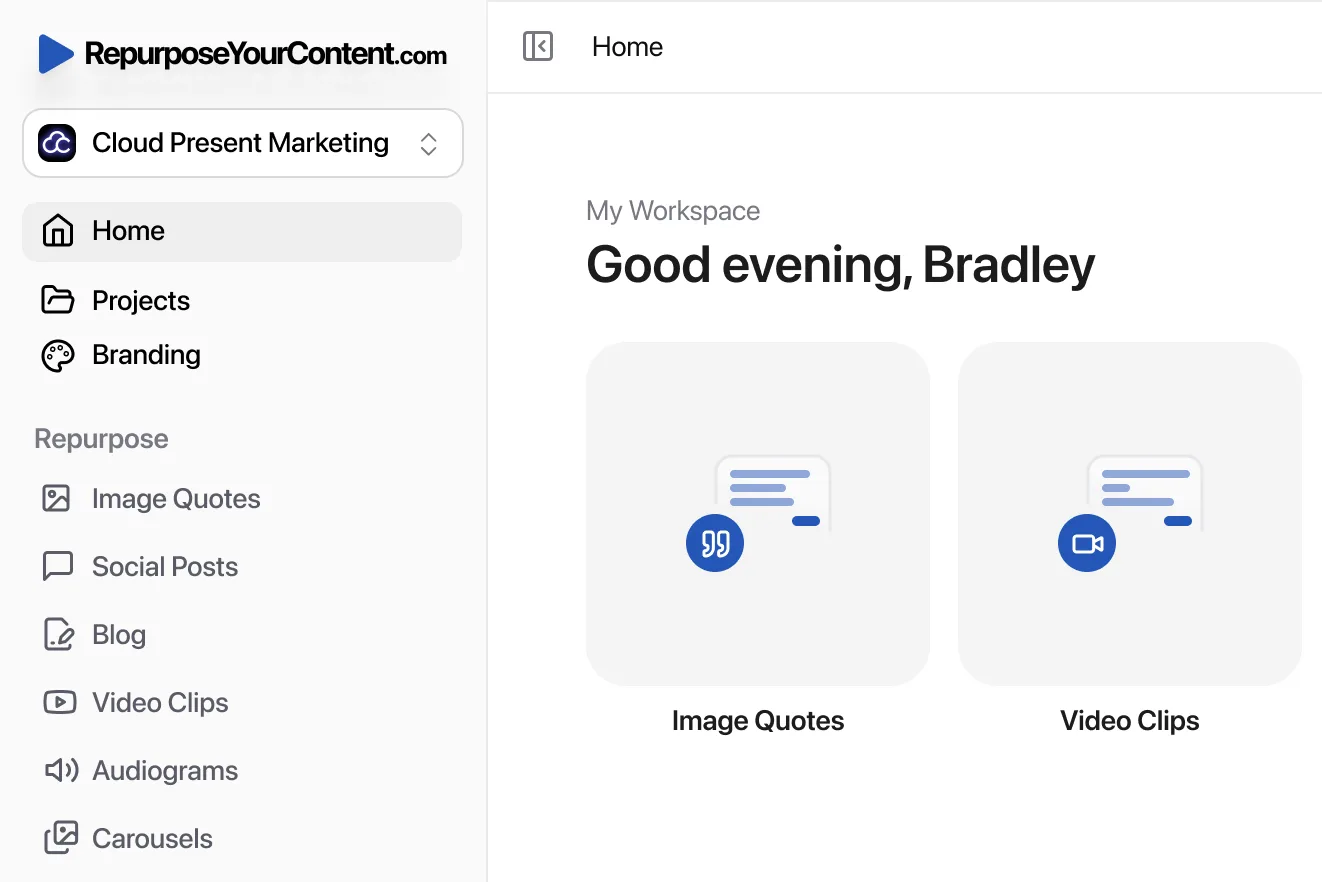
- Upload your webinar: Drag and drop your video file into RepurposeYourContent.
- Let the AI work: The platform transcribes the video and pinpoints key topics, questions, and statements.
- Get your content: The system instantly creates multiple content formats, styled with your brand kit.
You can review, edit, and download a complete content package in minutes.
The real bottleneck isn't transcription; it's the manual work that comes after. An integrated tool removes that bottleneck, turning hours of work into minutes.
From One Video to Eight Content Types
By tying transcription directly to content creation, you get more than a text file. Our platform uses the transcript to generate ready-to-distribute assets.
From a single webinar, you can instantly get:
- An SEO-optimized blog post structured around core themes.
- Short-form video clips with branded captions.
- Ready-to-publish social media posts for LinkedIn and other platforms.
- A LinkedIn carousel visualizing key takeaways.
- Image quotes highlighting your speaker’s most impactful lines.
If your team needs to extract video clips from a webinar, this process handles it for you. The platform delivers the finished product. This is how you focus on strategy, not low-value tasks.
Stop juggling tools. Start generating content. Try RepurposeYourContent today.
Frequently Asked Questions
Here are answers to the most common questions about automatic video transcription for marketers.
How accurate is automatic video transcription?
You can expect AI transcription tools to hit 90-95% accuracy. This depends on clean audio.
To get the best results, ensure your video has clear audio with minimal background noise. Use the "custom vocabulary" feature. Teach the AI your company names, speaker names, and industry jargon before you start. This step prevents the most common errors.
What is the best transcript format for SEO?
You need two different files from your transcription tool for SEO.
- A clean .txt file: This is your raw material. It is easy to copy and paste from to create your blog post.
- A captions file (.SRT or .VTT): Upload this file to your video host like YouTube or Wistia. Search engines crawl these caption files, making your video content more discoverable and accessible.
Can I transcribe videos with multiple speakers automatically?
Yes. Most modern transcription tools have a feature called speaker diarization.
It automatically identifies when a different person starts talking and labels their dialogue (e.g., "Speaker 1," "Speaker 2"). This is essential for transcribing interviews, Q&A sessions, or panel discussions. It simplifies formatting content into a Q&A style and attributing quotes correctly.
A transcript alone is just raw material. The real value is turning it into finished content like blog posts, social posts, and quote graphics. The key pivot is to use a tool that does transcription AND content generation in one step.
RepurposeYourContent was built to do exactly that. It not only transcribes your video but also immediately generates a variety of ready-to-publish content pieces. This positions it as transcription plus repurposing, combined.
Stop juggling tools. Start creating content that grows your business. Try RepurposeYourContent today.
Tags: