Mastering LinkedIn Posting Frequency Best Practices 2026
Discover data-backed LinkedIn posting frequency best practices 2026 for B2B. Learn how 3-5 posts weekly with diverse content boosts reach without burnout.

Most LinkedIn posting advice is still wrong.
Posting more doesn’t automatically help. Posting more of the same thing hurts. That’s the shift behind linkedin posting frequency best practices 2026 for B2B marketers running both company pages and executive profiles.
The practical target is simple. Company pages need a steady weekly cadence. Executive profiles need a visible personal rhythm. But neither should rely on copy-paste thought leadership, endless text posts, or thin promo updates. Frequency works when content variety keeps people reading, saving, commenting, and swiping.
For teams managing a brand page and two or three senior leaders, that creates a production problem fast. The winners in 2026 won’t be the teams with the biggest content team. They’ll be the teams with the cleanest system.
The 2026 LinkedIn Algorithm and Content Variety
The old advice said volume wins. That’s incomplete.
LinkedIn’s 2026 logic rewards accounts that publish consistently and hold attention. For UK B2B company pages, posts that keep readers engaged for 15 to 20 seconds can get a 1.45x reach amplification, while posting more than 5 times a week without rotating formats can trigger a 20% format repetition penalty according to Buffer’s 2026 LinkedIn timing analysis.
That changes the playbook. A company page can’t just post five text updates a week and expect reach to climb. A founder profile can’t recycle the same “three lessons learned” format daily and call it strategy.

What actually matters
Two mechanics deserve attention.
Dwell time multiplier means LinkedIn gives more distribution to posts people spend time with. Carousels are strong here because they ask for action. Readers swipe, pause, and keep going.
Format repetition penalty means frequency without variation starts to work against the account. If a page repeats the same content structure too often, LinkedIn reads that as stale output, not consistent expertise.
Practical rule: Increase posting frequency only if the content mix also expands.
That’s why smart B2B teams rotate formats across a week:
- Carousel posts for deeper teaching and stronger reading time
- Short native video clips for visibility and personality
- Text posts for direct opinions and comment prompts
- Quote cards or simple visuals for quick scanning in-feed
This also lines up with broader powerful LinkedIn marketing strategies for B2B growth in 2026, where the strongest programmes combine consistency, expertise, and multi-format publishing.
Why repetitive posting tanks reach
Repetition doesn’t only bore followers. It weakens topical authority.
If every post looks identical, the account starts to feel narrow and disposable. A varied mix tells LinkedIn the brand understands the topic from multiple angles. It also gives different audience segments something to respond to. Some people comment on sharp text posts. Others save carousels. Others watch clips.
That’s the operating model B2B teams should build around, not random posting. For teams developing a fuller page-level plan, this broader LinkedIn content strategy for B2B in 2026 helps frame cadence, format, and message together.
LinkedIn Posting Frequency Best Practices 2026
The numbers are clear enough to stop guessing.
For B2B SaaS companies, the best starting point is 2 to 5 posts per week, which delivers about 1,182 more impressions per post than posting once weekly, based on Postiv’s analysis of LinkedIn posting frequency. For UK B2B company pages, a more precise operating range is 3 to 5 posts per week. That’s the sweet spot for consistency without self-competition.
For executive and subject-matter-expert profiles, daily presence can work well. The brief calls for 1 to 2 posts per day. That’s directionally right for active personal brands, but it only works if quality stays high and formats rotate. Where a team needs a measured baseline, UK B2B personal profiles still perform well at 2 to 5 posts weekly, which is the safer floor before pushing volume.
2026 recommended LinkedIn posting frequency
| Profile Type | Optimal Frequency | Key Rationale |
|---|---|---|
| B2B company page | 3 to 5 posts per week | Keeps the page active, avoids feed self-competition, and supports format rotation |
| B2B SaaS company page | 4 to 5 posts per week | Tech and SaaS audiences consume content quickly and reward steady visibility |
| Executive personal profile | 2 to 5 posts per week | Strong baseline for expertise-building without audience fatigue |
| High-capacity executive brand | 1 to 2 posts per day | Viable only when the team can maintain quality, variety, and comment follow-through |
What busy teams should actually do
Teams shouldn’t always start at daily posting. They should earn the right to post daily.
A better progression looks like this:
- Fix consistency first. Get the company page to three strong posts per week.
- Build executive rhythm next. One or two leaders should publish several times weekly.
- Add volume only after variety exists. More posts without new formats creates drag.
One weekly post keeps the lights on. It doesn’t build momentum.
Wednesday is the strongest day overall, and the best engagement windows sit between 8 to 11 AM and 12 PM, with carousel posts generating 596% more engagement than text-only posts when timed well according to Buffer’s LinkedIn posting frequency research. Timing matters, but cadence matters more. A perfect posting time won’t rescue a weak publishing schedule.
Teams that want timing guidance alongside cadence should keep the best times to post on LinkedIn in 2026 close by and use it to refine scheduling after frequency is stable.
For readers studying examples and format choices, this breakdown of what actually worked on LinkedIn is useful because it focuses on execution, not theory.
Tailoring Your Cadence by Industry and Goal
Industry benchmarks help. Blindly copying them hurts.
The 2026 LinkedIn algorithm rewards consistency only when the content mix stays fresh. If a team posts more often but keeps repeating the same angle, format, or audience promise, reach softens. That makes industry context matter more than ever. A SaaS brand, a consultancy, and a manufacturer should not run the same schedule because they do not have the same volume of credible stories to tell.

SaaS should post more, but only with range
SaaS teams usually have the best case for a higher cadence. The category moves fast. Product updates, market commentary, customer use cases, founder opinions, webinar clips, and sales objections all create useful raw material.
The mistake is obvious. Teams raise frequency without widening the editorial mix.
A sensible SaaS setup looks like this:
- Company page at 4 to 5 posts weekly for steady demand generation
- Executive profiles active across the week with opinion-led posts
- A planned mix of product education, customer proof, category takes, and contrarian viewpoints
- At least three content formats in rotation so the feed does not become repetitive
If a SaaS team cannot support that variety, it should stay at the lower end. More posts will not save a narrow content strategy.
Professional services should protect signal
Consultancies, agencies, and advisory firms win on judgement. Buyers are screening for clarity, taste, and commercial thinking. They do not need constant posting. They need repeated evidence of expertise.
That makes moderate frequency the stronger choice for many firms. Keep the company page selective. Put more weight behind partner, director, or founder profiles. Publish fewer weak updates and more pointed commentary on client problems, industry shifts, and decisions buyers are struggling to make.
Credibility sets the ceiling. Frequency only works underneath it.
Manufacturing and specialist sectors should prioritise proof
Industrial and specialist B2B teams often produce content more slowly. That is not a weakness. It becomes a problem only when the calendar turns into the same facility photo, event recap, or generic company update every week.
These sectors need a practical mix. Use process explainers, engineer perspectives, compliance lessons, before-and-after project stories, customer education, and short clips from site visits or demos. The posting pace can stay modest. The variety cannot.
This is exactly why AI repurposing matters in 2026. It is the only realistic way for lean teams to keep output varied without forcing subject matter experts to create from scratch every day.
Match cadence to the goal
Cadence should follow the commercial objective.
| Goal | Better cadence approach | Why it works |
|---|---|---|
| Demand generation | Higher weekly consistency with multiple themes | Buyers need repeated exposure across different pain points and stages |
| Thought leadership | Moderate cadence with stronger opinions | Clear points of view outperform generic visibility plays |
| Launches and campaigns | Short-term increase tied to a defined message mix | Repetition helps, but each post should add a new angle |
| Community building | Steady publishing plus active comments | Replies and discussion strengthen recall faster than announcements alone |
Set the pace your team can sustain with quality. Then increase output only if you can also increase variety. In 2026, that is the primary constraint.
A Burnout-Proof Content Batching Workflow
Many teams don’t fail on strategy. They fail on production.
They know the page should post three to five times a week. They know executives should stay visible. Then Thursday arrives, the calendar is empty, and someone turns a webinar title into a rushed text post.
That cycle is avoidable.

A better system starts with one anchor asset and builds outward. For B2B teams, webinars are ideal because they already contain teaching, opinions, examples, and soundbites.
The three-step workflow
Step 1. Pick one anchor asset
Choose a webinar, panel, customer session, or product walkthrough with real substance. Demand gen teams should keep the mix at 60% educational and 40% promotional, based on LeadCRM’s LinkedIn posting strategy guidance.
That ratio matters because LinkedIn tests content early. The initial 60 to 90 minute network test influences whether a post spreads further. Thin promotional content often dies early.
Step 2. Build multiple formats from the same source
One webinar should not become one post. It should become several assets with different jobs.
A practical split might include:
- Carousel content pulled from a strong teaching segment
- Video clips from high-energy answers
- Text posts built around one opinion or takeaway
- Quote cards from a sharp line a speaker delivered
- Newsletter copy for audiences that prefer inbox distribution
This is also where content variety protects the account from repetition. The same message can be expressed in several formats without feeling duplicated.
Here’s a useful reference for teams formalising the process with a social media content batching workflow.
A simple weekly operating example
Step 1. Record or collect one webinar.
Step 2. Pull out the strongest teaching moments and objections.
Step 3. Turn those into a week or two of mixed LinkedIn formats.
Step 4. Schedule posts around audience timing.
Step 5. Reserve time after publishing to handle comments.
Comment response matters because engagement isn’t passive. Teams should plan for active follow-up in the first hour after a post goes live.
This walkthrough shows the batching principle in action:
Why this prevents burnout
Batching removes daily reinvention.
Instead of asking, “What should go out tomorrow?”, the team asks, “What did the webinar already give us?” That’s a better question. It cuts stress, improves consistency, and usually produces stronger content because the raw material came from actual expertise, not last-minute guessing.
How RepurposeYourContent Creates Two Weeks of Varied Content
The production problem is straightforward. LinkedIn now rewards consistency and variety. Most B2B teams have the expertise, but not the time to turn that expertise into enough formats every week.
That’s where a focused workflow tool earns its place.

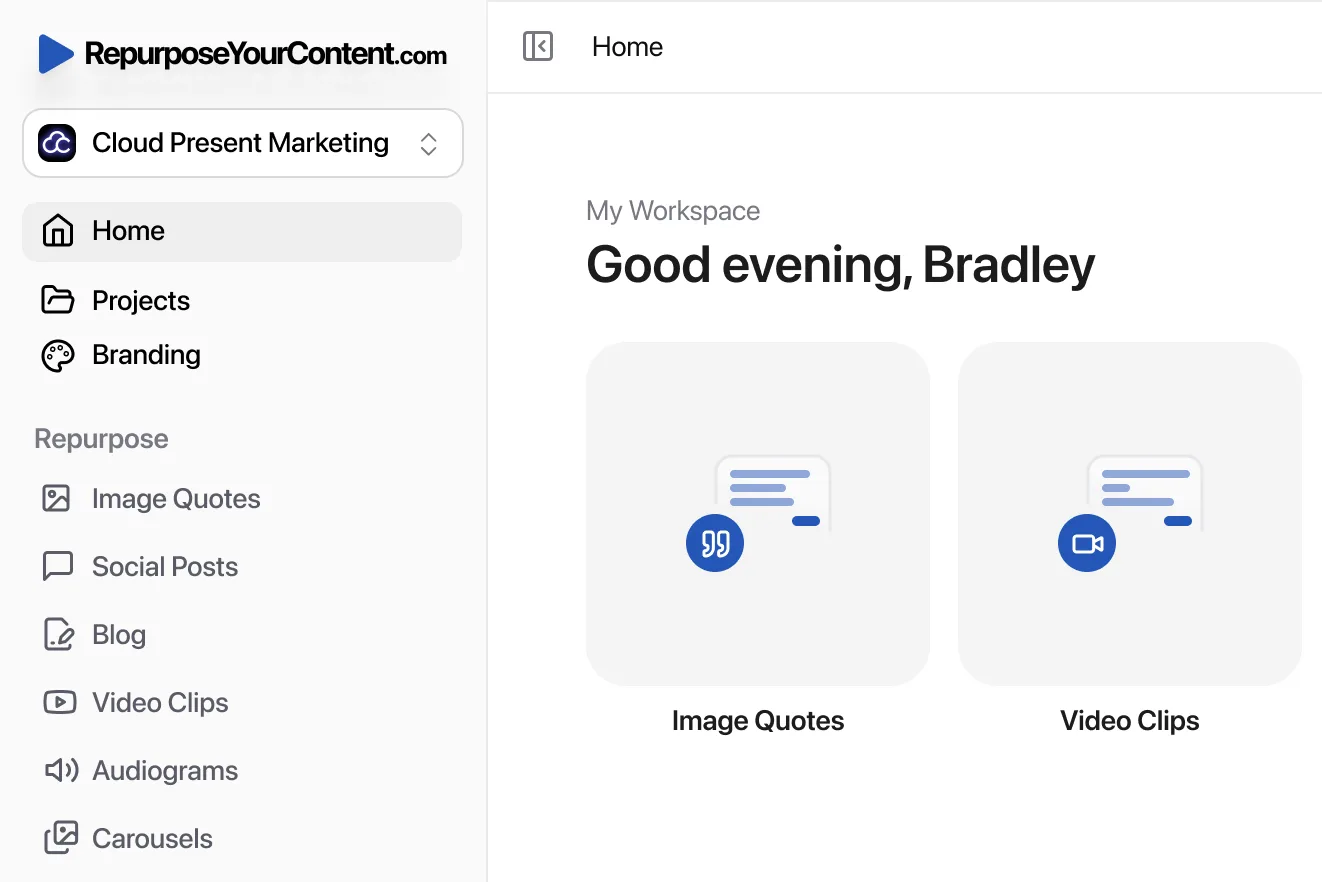
RepurposeYourContent starts with a recording. The team uploads a webinar file or pastes a link, selects outputs, chooses how many pieces it wants, and generates platform-ready assets. That includes video clips, blog posts, social posts, audiograms, image quotes, newsletters, LinkedIn carousels, and timestamps.
Why this fits the 2026 algorithm
The algorithm doesn’t want sameness. It wants content that keeps people engaged in different ways.
RepurposeYourContent helps teams publish that mix without manually rebuilding every asset from scratch. A single webinar can supply the raw material for:
- LinkedIn carousels that hold attention longer
- Short clips for executive profiles and company pages
- Text posts for opinion-led commentary
- Image quotes for simple, saveable posts
- Newsletter content that extends reach beyond social
- Timestamps that make long-form content easier to mine and edit
That format spread is the important part. It keeps a page active without making the content look repetitive.
A realistic team workflow
A B2B marketing team can run this process with very little friction:
- Upload the webinar recording from Zoom, YouTube, Vimeo, or another platform.
- Select outputs such as social posts, clips, carousels, image quotes, and blog content.
- Choose volume based on the next two weeks of the content calendar.
- Review and edit for brand tone and executive voice.
- Schedule by channel across the company page and personal profiles.
For marketers comparing approaches to repurpose content for social media, the key distinction here is output breadth. Most workflows can produce one or two asset types. This one is built for full-channel B2B publishing.
A useful companion read is this guide on how to create LinkedIn posts from a webinar, especially for teams building repeatable weekly operations.
How Social Posts helps
For pure LinkedIn execution, the most relevant product area is Social Posts.
It gives marketing teams a faster way to keep both brand and executive channels active without defaulting to repetitive text-only updates. That’s the main bottleneck in 2026. Not ideas. Format production.
Start Posting Consistently Today
The winning formula is simple. Frequency plus variety.
Company pages should keep a steady weekly cadence. Executive profiles should stay present and useful. Both need mixed formats, active comment handling, and a system that doesn’t collapse after one busy week.
That’s why editorial discipline matters more than bursts of activity. A practical starting point is this editorial calendar template for marketing teams.
| Final CTA |
|---|
| Teams that already run webinars are sitting on the easiest source of varied LinkedIn content. Try RepurposeYourContent and turn one recording into weeks of posts, carousels, clips, quote cards, newsletters, and more. |
Ready to stop guessing and start publishing consistently? Try RepurposeYourContent and turn one webinar into two weeks of varied LinkedIn content in minutes.
Tags: