Opus Clip Alternative for Webinar Marketers
Looking for an Opus Clip alternative for webinar marketers? Opus Clip misses B2B insights. We compare 10 tools built for insight density, not virality theatre.

Virality is a poor filter for B2B webinar content.
Opus Clip is quick, and that can be useful. The problem is the scoring model. It looks for spikes in energy, punchy phrasing, and moments that resemble social content. Webinar performance usually comes from something else. A clear explanation from a product marketer, a buyer objection answered properly, or a slide that gives a team a better way to frame a problem often drives more pipeline than the flashiest 20 seconds in the recording.
That is why webinar marketers should judge alternatives by insight density, not by how aggressively a tool hunts for viral moments. The job is not just to cut clips. The job is to find the parts a prospect would still care about a week later, then turn those parts into assets sales and marketing can use.
The tools in this list are here because they handle that job in different ways. Some are better at extracting useful sections from long-form recordings. Some are stronger at turning one webinar into a wider campaign pack. Some still prioritise speed over judgement, which can work if the team is willing to do more editing afterwards.
If your team is comparing workflows, these strategies for SaaS content teams are a useful reference point. The shortlist below focuses on a simpler question. Do you need an insight engine, or just a clip factory?
1. RepurposeYourContent

RepurposeYourContent is the most on-theme option in this list for teams that run webinars as a pipeline channel, not a social content feed. Its logic is closer to how B2B marketers work after an event. Pull out the strongest ideas, package them in several formats, and get them into the channels that influence deals.
That is a better fit for the article’s core test. Insight density matters more than clip velocity.
How the workflow actually helps
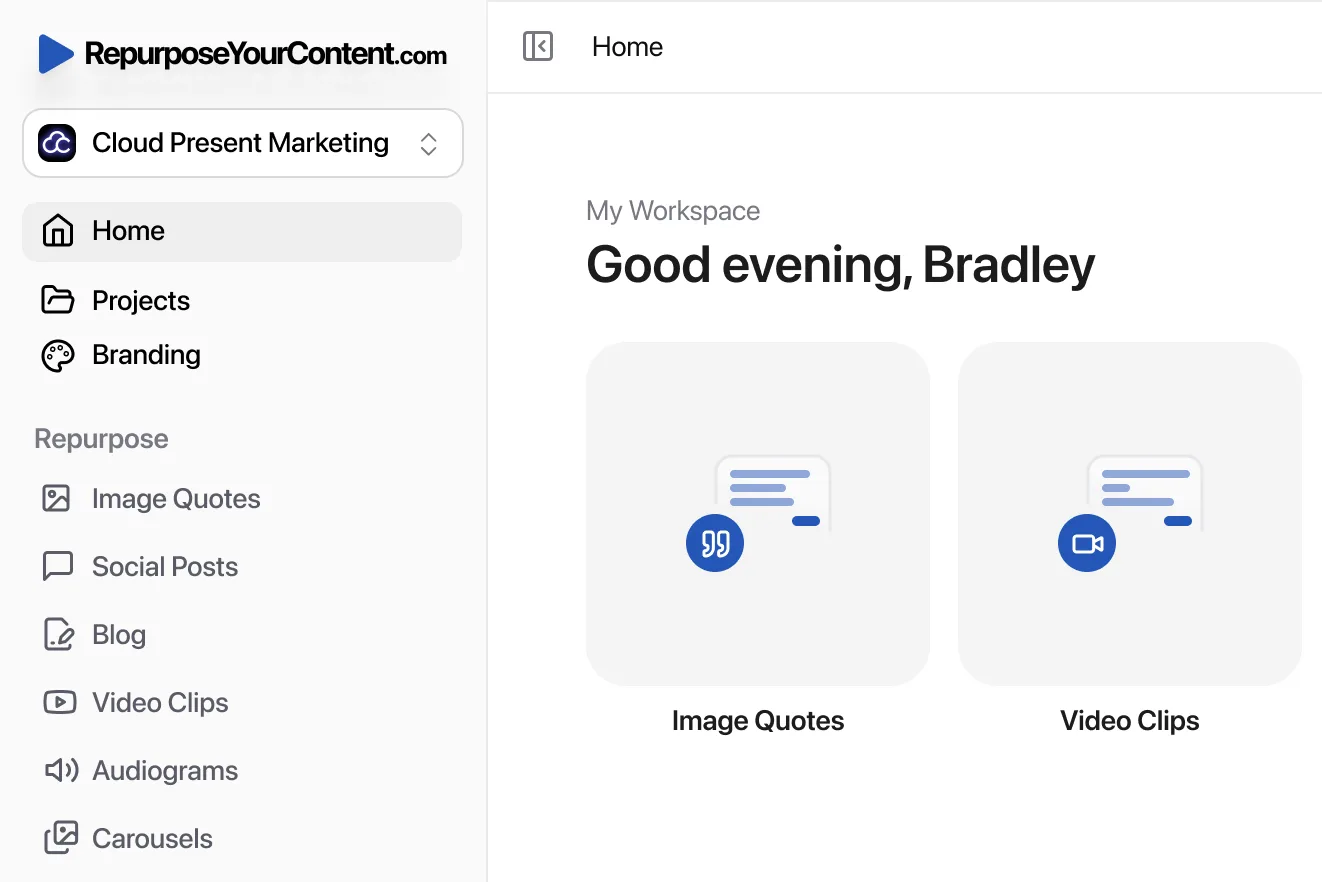
RepurposeYourContent treats the webinar as a source asset for a campaign pack. Upload a recording or paste a webinar link, choose the formats you need, set the number of outputs, and the platform generates clips, blog posts, social posts, audiograms, quote graphics, newsletters, LinkedIn carousels, podcasts, and timestamps.
For a lean team, that changes the post-webinar workload quickly. The practical gain is not only speed. It is fewer handoffs between tools and less time spent turning one useful segment into five separate assets.
That difference matters because clip-first tools still leave a lot of production work sitting with the team. If the webinar produced a strong explanation of a buyer objection, a product comparison, or a clear framework slide, the job is to reuse that insight across email, LinkedIn, sales follow-up, and content. A stack built only for short video does not finish that job.
Practical rule: If a tool stops at clips, your team still owns the hard part of repurposing.
Where it beats Opus Clip
Opus Clip is built for fast extraction of social-style moments. RepurposeYourContent is built for webinar follow-through.
The advantage shows up in a few practical areas:
- Multi-format output: One webinar can become clips, written posts, email content, carousels, audiograms, podcasts, and quote graphics.
- Brand control: Brand kits carry across more than the video layer, which helps when content is heading into several channels.
- Workflow fit: Uploads and links from common webinar and video platforms make it easier to work from the recording you already have.
- Team use: Review and collaboration features suit the reality that webinar content often touches content, demand gen, and product marketing at the same time.
If you want a direct product comparison, this RepurposeYourContent vs Parmonic comparison is a useful reference.
A useful adjacent read for webinar-led content operations is this guide to strategies for SaaS content teams.
Best fit
RepurposeYourContent suits teams that need each webinar to feed several downstream motions. That usually means LinkedIn distribution, nurture email, SEO content, and sales follow-up from the same recording.
The trade-off is straightforward. This is better for marketers who plan around campaign outputs and content reuse, not for teams that only want a handful of short clips as fast as possible. Credit-based systems reward that discipline. For webinar-heavy B2B teams, that is usually a fair exchange because the tool replaces several manual steps across the whole workflow, not just the editing step.
2. Parmonic

Parmonic suits webinar programmes that treat each session as a demand generation asset, not a pile of clips for social. That makes it a better Opus Clip alternative for B2B teams that care more about insight density than viral formatting.
The practical difference shows up in how the platform is used. Parmonic sits closer to the webinar operations side of marketing, with hosting, embeds, gated content workflows, and integrations that support lead capture after the live event. If the job is to turn a webinar into an on-demand asset library with clips, summaries, and follow-up content, that setup makes sense.
Where Parmonic works well
Parmonic is strongest in teams with a real webinar engine behind them. Product marketing, demand gen, and content teams can work from the same recording and publish assets that still feel tied to the original session, instead of chopping out isolated moments for reach.
It also helps when governance matters. Approval steps, stakeholder review, and enterprise controls are useful in larger B2B teams where webinar content often includes product claims, partner mentions, or regulated messaging.
For a direct feature comparison, this RepurposeYourContent vs Parmonic breakdown gives a clearer side-by-side view.
Parmonic fits teams that want webinars to keep generating pipeline after the event. It fits less well if success is measured by how many short clips can be pushed out by end of day.
Trade-offs
Parmonic is not the lightest option, and that matters. Teams running occasional webinars may find the platform heavier than they need, especially if the main goal is quick social distribution rather than structured repurposing.
There is also a format trade-off. Parmonic makes more sense when the webinar itself is a managed content asset with a landing page, embed, and follow-up journey. Teams that want a broader spread of ready-to-publish outputs from one upload may prefer a tool built more directly around repurposing volume.
For B2B webinar marketers, the choice is simple. Pick Parmonic if the webinar sits inside a lead capture and content distribution system. Pick something else if you just need a clip factory.
3. Chopcast

Chopcast makes more sense than Opus Clip for webinar marketers because it starts with the right assumption. A webinar is not raw material for random viral moments. It is a long-form asset full of useful points, objections, examples, and proof. That puts Chopcast closer to the way B2B teams repurpose content.
Its strength is narrower than that of a full repurposing platform, but the focus is useful. Chopcast is built around webinars and podcasts, so the clip suggestions tend to align better with speaker-led education than with creator-style hooks. For teams trying to surface insight density rather than chase hype, that is a better starting point.
Why webinar teams look at it
The practical appeal is speed with some subject awareness. A marketer can upload a webinar, identify sections worth clipping, add captions, and get social-ready edits without opening a heavier editing workflow. That matters after a live event, when the gap between webinar day and follow-up content often decides whether the session keeps driving pipeline or disappears into the archive.
Keyword-led discovery is also a better fit for B2B than generic virality scoring. If a team knows the webinar covered pricing objections, implementation mistakes, or a new product workflow, it can look for those moments directly. That is a more reliable route to useful clips than asking AI to guess which line sounds punchy in isolation.
What to watch
Chopcast is still mainly a clipping tool. It improves the video workflow, but it does not turn one webinar into a full campaign on its own. Teams that need blog drafts, email follow-up, sales snippets, and broader post-event content will still need other tools or a manual process around it.
There is also a quality trade-off. Focused clipping is helpful, but webinar clips still need editorial judgement. A segment can be technically clean and still miss the point if the slide context, setup, or speaker framing is stripped out.
- Best for: Teams that want webinar-aware clip selection and faster social production from long recordings.
- Less strong for: Teams that expect one upload to produce a full multi-format demand gen package.
- Useful extra: Service support can help lean teams that need production help as well as software.
Chopcast is a solid improvement on Opus Clip if the problem is poor fit for webinar content. It is less convincing if the primary goal is to extract insights once and turn them into every asset the campaign needs.
4. VEED

VEED is useful when the team needs flexibility more than webinar specialisation. It’s a broad browser-based editor with AI features layered in. That makes it easier to adopt than many heavier editing tools.
For webinar marketers, VEED works best as a fast production environment. It can create clips, captions, social variants, and translated edits without forcing the team into a desktop editing workflow. That’s good for small teams moving quickly.
Where VEED beats Opus Clip
The advantage isn’t clip intelligence. It’s control.
Opus Clip is more opinionated. VEED gives the team more room to refine outputs, adjust captions, handle translations, and reshape content manually in-browser. If a webinar includes slides, demos, or multiple speakers, that extra control can matter more than automated “virality” scoring.
Operational note: Webinar clips often fail because the framing is technically fine but the context is missing. Tools with stronger manual cleanup options help more than tools with stronger hype detection.
Trade-offs
VEED isn’t purpose-built for B2B webinar repurposing. It’s a video tool first. That means the team may still need other systems for blogs, email sequences, or carousels.
It’s a solid choice for teams that want a more flexible clip and editing workflow than Opus Clip offers. It’s a weaker choice for teams that want one upload to produce a wider content campaign without extra assembly work.
5. Descript

Descript suits webinar marketers who care more about extracting clear points than chasing reaction clips. That matters because B2B webinars rarely win on spectacle. They win on explanation, nuance, and a speaker saying one useful thing in a way a buyer can act on.
That transcript-first model is an effective alternative to Opus Clip’s virality logic. Instead of hunting for animated moments, Descript lets the team work from the words themselves. For webinars with dense discussion, product detail, or subject-matter experts who are stronger on substance than performance, that is usually the better editing starting point.
Why it works for webinars
Descript is strong at the messy middle of webinar repurposing. Cut filler. Remove tangents. Tighten answers. Turn a long explanation into a shorter clip without losing the sentence that makes it make sense.
It also reduces the friction for marketers who hate traditional timelines. Editing by transcript is faster for teams deciding what the speaker meant, what can be cut, and what should become a post, quote, or short video.
That makes Descript useful for insight extraction, not just clip production.
For a direct product comparison, this Descript alternative page gives the short version. If your team is also weighing browser-first editors, this piece on analyzing Veed IO for social videos is a useful contrast.
Where it still falls short
Descript is an editor first. That is both its strength and its limitation.
It helps the team shape the source material well, but it does not give webinar marketers a finished repurposing system by default. You still need judgement on which moments deserve distribution, where each clip fits in the funnel, and how to turn one event into a coordinated campaign across email, social, sales follow-up, and written content.
So the trade-off is practical. Descript beats Opus Clip when context carries the value. It is less efficient than a webinar-first repurposing platform when the brief is broader than editing and the team wants one upload to produce multiple audience-ready assets with less manual assembly.
6. Pictory

Pictory is a better fit than Opus Clip if the job is packaging polished video from existing material. It gives teams more control over branding, layout, captions, and format options, which matters when webinar content needs to look consistent across LinkedIn, landing pages, and follow-up email.
That said, Pictory still works more like a flexible video repurposing tool than a webinar intelligence system. For B2B marketers, that distinction matters. If the value sits in a specific explanation, objection handled, or framing line from the speaker, the team still has to identify that moment and shape it into an asset with context.
Where Pictory stands out
Pictory is useful for teams working across more than one content source. A webinar can become a highlight reel, but the same workflow can also turn blog posts, scripts, or long-form videos into branded clips. That range makes it attractive to agencies and in-house teams managing mixed content calendars rather than a webinar-only programme.
It is also a more controlled environment than virality-led clipping tools. That helps when the target is not "best hook in 15 seconds" but a clean, credible asset that keeps the original point intact.
For teams comparing it against a webinar-first platform, this Pictory alternative comparison shows where the workflow differs.
Best fit
Pictory suits marketers who need flexibility inside video production and care about presentation quality. It is a sensible choice if the team already knows what content to repurpose and needs a better way to turn that material into usable branded outputs.
The trade-off is speed to insight. Pictory helps produce better-looking assets, but it does not solve the harder B2B webinar problem by itself. It will not reliably surface the most commercially useful moments or map them into a full post-webinar campaign without more manual judgement. If insight density is the priority, not just output volume, that gap shows up quickly.
7. Quso

Quso is built for teams that care about clipping and publishing in one loop. It’s less about deep webinar understanding and more about keeping short-form output moving.
That makes it a practical alternative to Opus Clip for social-led teams. If the team wants automatic captions, silence removal, resizing, and direct publishing support, Quso is easy to understand and easy to run.
Where it fits in a webinar workflow
Quso works best when the webinar is just one input into a broader short-form content calendar. The team extracts clips, tidies them, schedules them, and keeps the distribution machine running.
That’s useful. But it still optimises around clip production. It doesn’t really solve the “what about the rest of the campaign?” problem that webinar marketers run into.
- Good match: Weekly webinars, regular social posting, limited editing bandwidth.
- Poor match: Teams needing blog posts, nurture emails, quote cards, and carousels from the same event.
- Main trade-off: Convenience on social output versus depth of repurposing.
For a tighter comparison against a webinar-first system, this Quso comparison page covers the difference.
8. Kapwing

Kapwing is the practical choice for teams that want collaborative browser editing without heavy onboarding. It’s simple. It’s fast enough. It works well for captioning, resizing, and turning one webinar segment into several social variants.
That simplicity is the main reason to pick it over Opus Clip. Not because the AI is smarter, but because the team can intervene quickly and polish assets together.
What it does well
Kapwing is easy to hand off across a marketing team. A marketer can cut a clip, a designer can tidy the visual treatment, and someone else can review captions or brand fonts. That’s valuable when webinar content touches several roles.
It also avoids the trap of pretending everything should be fully automated. For many webinar teams, a lightweight collaborative editor plus a clear workflow beats a black-box clip finder that picks the wrong moments.
Webinar marketers don’t need more clips. They need better judgement about which moments deserve distribution.
Limits
Kapwing is still a video workspace. It doesn’t become a full content repurposing system just because it has AI editing features.
If the team already has copy workflows elsewhere and mainly needs a better browser editor than Opus Clip offers, Kapwing is sensible. If the team wants one tool to convert a webinar into a multi-channel campaign, it isn’t enough on its own.
9. ContentFries
ContentFries is one of the more interesting middle-ground options. It doesn’t stay boxed into pure clipping, which makes it more relevant to webinar marketers than many creator-first tools.
That broader output matters because clip-only usage creates a dead end. UK webinar marketers report strong gains from repurposed content, and one cited benchmark says teams get far stronger lead nurturing from repurposed assets than from raw recordings alone, as noted in the wider market discussion earlier. ContentFries at least moves in that direction.
Why it stands out
ContentFries can produce clips plus written and visual derivatives such as blog-style output and quote graphics. That makes it a more sensible Opus Clip alternative for webinar marketers than tools that stop at vertical video.
It also fits agencies and founder-led teams that need repeatable content packages from recurring sessions. The model is practical. Run the webinar once, then spin out assets for social, blog support, and follow-up visuals.
What to watch
The trade-off is polish and control. Teams with strict brand governance or heavier approval needs may need more manual review. Larger organisations may also want stronger workflow controls than this type of tool usually provides.
Still, for teams trying to move beyond clips without buying into a heavier enterprise platform, ContentFries earns a look.
10. Munch Studio

Munch Studio makes more sense than Opus Clip for teams that want some signal behind clip selection. It looks at likely social performance rather than just cutting highlights at speed. That is useful if a webinar covers several angles and the team needs help deciding which one to test first.
The catch is the same one that comes up with a lot of AI clipping tools. Munch is still optimised for social distribution, not for extracting the densest B2B insight from a webinar and turning it into assets that support pipeline.
Where Munch helps
Munch is strongest for teams running an active social programme and wanting publishing support in the same workflow. The scheduling layer matters more than it sounds. For lean teams, cutting, captioning, approving, and posting often breaks down at the handoff, not in the edit itself.
It also gives marketers a more directed workflow than pure clip factories. Instead of pushing out a stack of generic snippets, teams get help prioritising what to publish first.
For a closer look at how that compares with a webinar-first repurposing workflow, see this Munch comparison for webinar marketers.
Where it still misses the brief
For B2B webinar marketing, better clip scoring is only a partial fix.
The core job is finding the strongest argument, objection handling, customer example, or stat-led segment in the session, then packaging that insight across channels. Munch helps with the first surface-level step. It does not solve the wider repurposing workload.
So the trade-off is straightforward. If social clips are the main output, Munch is a reasonable upgrade on a virality-first tool. If the webinar needs to feed follow-up emails, LinkedIn carousels, blog content, sales enablement, and campaign nurture, it still leaves too much work sitting with the team.
Top 10 Opus Clip Alternatives for Webinar Marketers
| Tool | Core features | Content formats | Best for | Speed & pricing |
|---|---|---|---|---|
| RepurposeYourContent (Recommended) | AI trained on B2B webinars; full brand-kit; team review & exports | Video clips, SEO blogs, social posts, carousels, email sequences, audiograms, podcasts, quote images | Marketing teams, agencies, demand-gen, content teams | ~5 min generation; plans from $99/mo; free Basic & 7-day trial; credit-based pricing |
| Parmonic | AI “Moments”, written derivatives, hosting, analytics, integrations | Clips, blogs/show notes, email copy, landing pages | Marketing & training teams; enterprise governance | End-to-end workflow; higher entry price; some “unlimited” tiers have fair-use limits |
| Chopcast | Key-moment detection, resizing, subtitling; optional done-for-you services | Shorts/Reels, transcripts, captions, social asset packs | Agencies, UK/EU teams, SMBs needing services | Fast clip exports; minutes-based pricing; first 60 minutes free; services can be costly |
| VEED | Browser editor with AI clips, auto-subtitles, translations/dubbing, templates | Highlight clips, captions, dubbed videos, multi-aspect templates | Non-editors and teams needing translations & simple collaboration | Simple UX; broad AI tools; pricing/credit caps can be complex |
| Descript | Transcript-first editing, AI clip creation, filler-word removal, Studio Sound | Clips, show notes, social copy, podcast-ready audio | Creators and teams focused on transcript-driven edits | Intuitive text-based workflow; media minutes & AI credit limits on plans |
| Pictory | Long-video summarization, script-to-video, stock footage & AI voices | Summaries, highlights, script-based videos, reels | Teams wanting video-from-text plus webinar repurposing | Good for summaries; minutes/credits model; less native email/carousel output |
| Quso (formerly Vidyo.ai) | AI clip gen, captions, auto-resize, direct publish & scheduling | Platform-ready clips, transcripts, scheduled social posts | Teams producing steady clip output; social schedulers | Clear Free→Growth tiers; built-in scheduling; branding/plan changes after rebrand |
| Kapwing | Browser editor, auto-subtitles, brand kit, collaboration, 4K export | Clips, captions, social variants, templates | Small teams and non-editors needing fast collaboration | Fast workflows; transparent plans; AI features use credits (monitor caps) |
| ContentFries | AI highlight detection, auto blog posts, quote visuals, thumbnails | Multiple shorts, blog post, quote images, thumbnails | Founders, agencies managing recurring video content | Multi-format from one upload; priced by videos processed; fewer enterprise controls |
| Munch Studio | Repurpose + content planner + automated posting; smart editor | Clips with captions, scheduled posts, content calendar items | SMBs wanting done-for-you repurpose + scheduling | All-in-one planning & publish; clear annual/monthly pricing; feature depth varies |
Your Pick: Insight Engine or Clip Factory?
Webinar marketers do not have a clipping problem. They have a packaging problem.
A virality-first tool optimises for movement on screen, punchy captions, and fast social output. That works for creator content and top-of-funnel entertainment. It is a weaker fit for B2B webinars, where the best moment is often a clear explanation, a sharp objection handle, or a useful framing that sales can reuse for weeks.
That is the split in this category.
Clip factories turn one long recording into short videos quickly. Opus Clip sits in that group. Quso, Kapwing, and parts of VEED do too. They are useful for speed, formatting, captions, and publishing, but they still leave the team to decide which ideas matter and how those ideas should travel across channels.
Insight engines start from a better assumption. A webinar is a bank of expertise. The job is to identify the strongest points, then turn them into assets that match how B2B buyers consume information. RepurposeYourContent and Parmonic fit that model best on this list. Descript and Pictory can support parts of it, but they usually need more manual shaping.
The trade-off is straightforward. Clip-first tools are faster if the goal is volume. Insight-first tools are stronger if the goal is pipeline support, post-event nurture, and content your sales team will use.
A good webinar workflow should produce more than clips. It should create assets that carry the same core idea in the right format for each channel:
- Upload the recording or paste the webinar link
- Select the outputs needed, such as clips, blog drafts, social posts, audiograms, image quotes, newsletters, LinkedIn carousels, and timestamps
- Set the quantity and brand rules
- Review the drafts and tighten the claims
- Publish across LinkedIn, email, the blog, podcast feeds, and sales follow-up
That process matters because repurposing breaks down at the review stage, not the generation stage. Teams can get clips from almost any AI editor. The harder part is getting assets that are accurate, on-brand, and specific enough to sound like your company rather than generic webinar filler.
The strongest webinar moment often looks quiet on video. It works because the point is useful.
That is why insight density beats virality for B2B webinar content. A buyer does not care whether the AI found a dramatic pause at minute 17. They care whether the clip, quote, or carousel gives them a reason to trust your thinking.
RepurposeYourContent is the strongest fit here because it is built around that job. It treats the webinar as source material for a campaign, not just raw footage for shorts. If the team needs branded, multi-format output from every event, start there.
Ready to turn one webinar into clips, blog posts, social posts, audiograms, image quotes, newsletters, LinkedIn carousels, and more? Try RepurposeYourContent for free.
Tags: