Best Parmonic Alternative for Webinar Repurposing
Parmonic alternative for webinar repurposing - Explore the best Parmonic alternative for webinar repurposing in 2026. Compare features, pricing, and output

A familiar problem keeps showing up in B2B teams. The webinar went well, the recording is live, and then nothing else happens because turning it into useful content takes too long.
That gap is expensive. Marketers who repurpose content are 2.5x more likely to report content marketing success, and 73% of B2B marketers identify webinars as their top source of quality leads, according to Parmonic’s summary of SEMrush-backed repurposing data. If webinar content is already producing strong leads, leaving the recording untouched is wasteful.
Teams looking for a parmonic alternative for webinar repurposing usually aren't unhappy with the core idea. They're frustrated by the operating model. They don't need more hand-holding. They need faster output, broader formats, and pricing that fits a working content engine.
Why You Might Need a Parmonic Alternative
Parmonic does some things well. It’s built for enterprise webinar repurposing, it’s closely associated with serious webinar programmes, and it fits teams that want support around the process.
That said, many B2B teams hit the same wall. The platform often makes the most sense when a company wants a managed experience and can justify a large annual spend for clip production. If your team already has content ops, that setup can feel heavier than necessary.

The managed model isn't always the faster model
White-glove support sounds efficient until a team needs to move quickly. If a webinar finishes in the morning, marketing teams want clips, posts, and follow-up assets ready the same day.
The bigger issue is workflow friction. A team with an editor, content marketer, or demand gen manager usually doesn't need a success manager to upload a file and trigger output. They need a self-serve tool that fits the way they already work.
Practical rule: If a team can already run webinars, manage a brand kit, and review drafts internally, it usually doesn't need a managed repurposing layer for every recording.
Cost pressure changes the buying decision
The economic implications are significant. Manual editing can require $3,000 per webinar, while automated solutions can process a webinar for as little as $75 or be included in a monthly subscription, according to Parmonic’s comparison of repurposing alternatives.
That same source notes that automation reduces repurposing timelines from weeks to minutes. For a team running a steady webinar calendar, that difference isn't marginal. It changes whether repurposing occurs.
For teams evaluating a more automated route, automating webinar repurposing workflows is often the cleaner path than adding more service dependency.
Video clips alone usually aren't enough
A lot of webinar teams start by asking for clips. That's reasonable. Clips are easy to distribute and easy to understand.
But clips don't cover the whole post-webinar job. B2B teams also need written follow-up, email nurture content, image assets, and search-friendly articles. If the tool mainly produces short video moments, marketers still have to build the rest manually.
Common signs a team has outgrown a clips-first workflow:
- The content manager still writes everything else by hand. Blog drafts, newsletters, and social posts remain separate work.
- Distribution is uneven. LinkedIn gets clips, but email and search get nothing.
- Publishing slows down after each event. The team spends days assembling assets from one recording.
- Brand consistency breaks. Video looks polished, while posts and visuals feel improvised.
That’s usually the point where a Parmonic user starts looking at alternatives.
Parmonic Alternatives Feature Comparison
A B2B team finishes a webinar on Thursday, wants assets live by Monday, and quickly finds the core decision is not just features. It is operating model. The question is whether to keep paying for a managed service to package the event, or give the content team a self-serve system that can turn one recording into a full campaign without waiting on a vendor queue.
That distinction drives cost, turnaround time, and how much value a team gets from each webinar.
Webinar Repurposing Tool Comparison
| Tool | Primary Use Case | Output Formats | Workflow Model | Typical Pricing |
|---|---|---|---|---|
| Parmonic | Enterprise webinar clipping and managed repurposing | Primarily short video snippets and webinar-derived assets | Managed or high-touch workflow | Custom pricing |
| RepurposeYourContent | B2B webinar-to-campaign repurposing | Video clips, blog posts, social posts, audiograms, image quotes, newsletters, LinkedIn carousels, timestamps | Self-serve | $99/month |
| Munch | Social video clipping | Short clips for social distribution | Self-serve | Custom or usage-based positioning |
| Castmagic | Audio and transcript-driven content drafting | Written content from recordings, transcripts, summaries, social copy | Self-serve | Subscription pricing |
| Descript | Editing-heavy video and audio production | Edited video, audio, transcripts, captions | Self-serve editor | Subscription pricing |
| Contentfries | Multi-platform video resizing and social distribution prep | Video variants for different channels, captions, layouts | Self-serve | Subscription pricing |
What matters more than the feature list
The practical split in this category is simple. Some tools help a team edit media. Some help a team publish a campaign. Those are different jobs, and buyers get into trouble when they treat them as the same purchase.
Webinars already produce high-intent material. The format question is important because the right tool should help a team redistribute that material across email, social, blog, sales follow-up, and on-demand content, instead of stopping at a few clips.
For B2B marketing teams, four buying filters usually separate the options fast:
- Output breadth. If the team needs blog drafts, social copy, visuals, and email assets, a clips-first tool leaves too much work behind.
- Workflow ownership. Managed service can help teams with low internal capacity. It can also slow down teams that already have editors, content marketers, and approval paths in place.
- Pricing clarity. Custom pricing is common at the enterprise end. Mid-market teams usually need a clear starting point before they commit time to sales calls.
- Speed to publish. Self-serve tools tend to win when the goal is fast turnaround after every event, especially for teams running a regular webinar program.
Parmonic fits companies that want support and are comfortable paying for it. That model can work well if the internal team is thin, approvals are formal, and consistency matters more than speed. The trade-off is cost and control. Teams with an established content ops process often do not need white-glove handling for work they can already manage themselves.
That is why self-serve platforms have become more attractive. A team can keep strategy, QA, and brand review in-house while using software to handle the repetitive production layer. For a direct look at that trade-off, this Parmonic alternative comparison for webinar teams is useful.
If your evaluation extends beyond webinar-specific tools, SpeakNotes' AI guide for creators is a helpful reference point for the broader creator-tool category.
Teams usually switch after they realize the current setup still requires manual work to turn one webinar into a usable multi-channel campaign.
A Deeper Look at Each Repurposing Tool
The best replacement depends on what the team is trying to produce after the webinar. Some tools are built for social clips. Some are editing environments. Some are closer to transcript engines. That distinction matters.

Parmonic
Parmonic suits enterprise teams that want structure around webinar reuse. It makes sense when a company values white-glove support, runs a formal event programme, and prefers a vendor-led process.
Its trade-off is flexibility. Teams that already know how they want to package content often find managed workflows slower than direct control. It's a fit for organisations with budget and low internal content capacity. It's a weaker fit for lean teams that want to publish quickly across many formats.
RepurposeYourContent
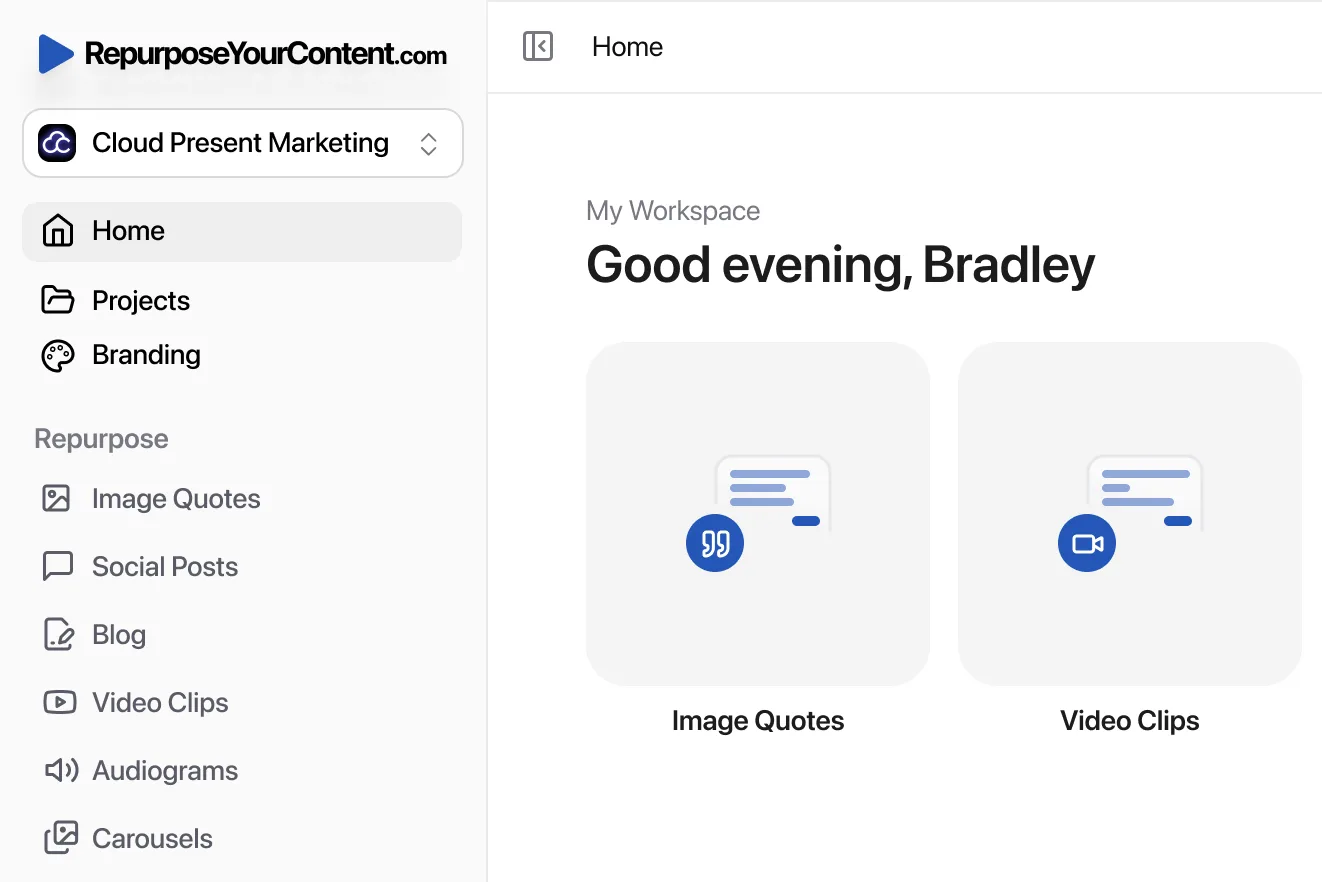
This tool is aimed at B2B teams that want one webinar to feed multiple channels without splitting the work across several tools. The available outputs include video clips, blog posts, social posts, audiograms, image quotes, newsletters, LinkedIn carousels, and timestamps.
That matters because webinar content usually needs more than editing. It needs packaging. A team can turn one event into campaign assets for search, social, email, and sales follow-up from one workflow instead of stitching the process together across separate apps.
For teams evaluating the broader category, this roundup of webinar repurposing tools is a useful starting point.
Munch
Munch is generally better thought of as a social clipping tool than a webinar content system. It’s useful when the main goal is finding short, punchy moments for distribution on social channels.
That makes it a reasonable option for teams prioritising top-of-funnel video output. It’s less complete for B2B marketers who also need written assets, structured follow-up, and reusable campaign materials beyond clips.
Castmagic
Castmagic is strongest when transcript-first output is the priority. It helps turn recordings into summaries, show notes, content drafts, and related text assets.
That’s useful for podcast-style workflows or founder-led content. It can be less suitable if the team needs polished visual output and webinar-specific packaging in the same place.
Descript
Descript is an editor. That’s both its value and its limitation.
If a team has someone who wants tight manual control over cuts, overdubs, layouts, and fine edits, Descript is a serious option. If the team wants fast webinar-to-campaign conversion with minimal editing, it may be too production-heavy.
Selection shortcut: Choose Descript when editing is the job. Choose a repurposing platform when distribution is the job.
Contentfries
Contentfries is useful for resizing and adapting existing video for different social formats. It works well for social managers who already know which clips they want and need channel-specific variants.
It usually sits later in the workflow. It doesn't replace the broader task of extracting themes, drafting articles, or building a full post-webinar campaign.
For a broader creator-focused perspective on adjacent tools, SpeakNotes' AI guide for creators is worth scanning. It helps clarify where general creator tools end and where webinar-specific B2B workflows begin.
Sample Workflow From Webinar to Full Campaign
A self-serve workflow only matters if it removes actual work. The simplest test is this. How many handoffs are required between the webinar ending and the campaign going live?
This seven-step visual shows the intended flow before the details.

A practical sequence that works
- Upload the webinar recording. Use a Zoom link, video file, or hosted recording URL.
- Choose the outputs. Select short clips, a blog draft, social posts, quote images, a carousel, and follow-up email content.
- Set quantity and style. Pick how many clips or posts the team needs.
- Apply brand settings. Add logos, colours, speaker names, and preferred presentation style.
- Generate assets. Let the tool segment the webinar and draft the selected formats.
- Review fast. Tighten headlines, trim awkward wording, and remove weak moments.
- Publish across channels. Schedule the assets into the content calendar and follow-up sequence.
Self-serve platforms pull ahead. The marketer stays in control from upload to approval. There’s no waiting for a service queue for standard output.
What the output bundle can look like
A typical B2B team might turn one webinar into:
- Short video clips for LinkedIn and paid social
- A blog article built from the strongest discussion points
- Quote graphics for follow-up promotion
- A LinkedIn carousel for executive audiences
- Email copy for registrants who didn’t book a meeting
- Timestamps so sales and customer teams can jump to the right moments
For smaller teams trying to systemise the whole process, this guide to a content repurposing workflow for small teams shows how to keep approvals simple without slowing distribution.
A good reference point for distribution planning is this piece on strategies for effortless multi-platform growth. It’s useful because it focuses on how one core asset can feed several channels without duplicating effort.
There’s also a product walkthrough worth reviewing before making a tooling decision:
How RepurposeYourContent Delivers Enterprise Output
A common B2B scenario looks like this: the webinar ends, demand gen wants clips for paid and organic social, content needs a blog draft, lifecycle wants follow-up emails, and sales asks for timestamps by topic before the week is over. In that setup, the question is not whether a managed service can help. The question is whether your team still needs one.
RepurposeYourContent fits teams that already know how to run approvals, edit copy, and publish across channels. The value is not white-glove handling. The value is speed to usable campaign assets without adding another service layer between the recording and distribution.
Output that matches how B2B teams actually distribute
Enterprise output is not just polished video. It is a usable bundle that supports pipeline work across search, social, email, and sales follow-up.
That distinction matters in practice. A clips-only workflow can look efficient until the rest of the team still has to build the written and visual assets manually. Then the cost moves from software to staff time, handoffs, and missed publishing windows.
For teams evaluating webinar repurposing workflows for marketing teams, the better test is simple. After one webinar, how much of the campaign can the team ship within a day?
A stronger self-serve setup should support output such as:
- Short video clips for LinkedIn, paid social, and retargeting
- Article drafts and transcript-based written assets for search and website publishing
- Email copy for registrants, no-shows, and post-event nurture
- Carousels and quote graphics for executive social distribution
- Timestamps and topic highlights for sales and customer-facing teams
That is closer to what enterprise marketing ops teams need from a single event.
The trade-off is operating model, not just features
Parmonic's service-led model can still work for large organisations that want vendor support built into the process and are comfortable paying for it. Some teams prefer that structure because it reduces internal production responsibility.
The trade-off is speed and flexibility. If your team already has content ops in place, routing each webinar through a managed process often creates extra waiting time for standard assets your team could review and publish itself. In-house marketers also tend to make faster judgement calls on messaging, compliance edits, campaign priorities, and channel-specific packaging.
Self-serve tools put more responsibility on the team. That is the trade-off. You need someone to own prompts, review outputs, and keep quality consistent. For many B2B marketing teams, that is still the better ROI because those capabilities already exist internally.
Text output matters more than clip-focused vendors admit
A lot of webinar repurposing comparisons still treat video snippets as the main deliverable. That misses how B2B buyers find and consume information.
Search matters. Email matters. AI-assisted discovery matters too.
Univid makes this point clearly in its article on repurposing webinars with AI. If a webinar page only contains an embedded recording, search engines and AI answer tools have far less text to interpret. Teams that also publish transcripts, summaries, and derivative written assets have a better chance of getting that material surfaced and cited.
A webinar page with only a recording is harder for search engines and AI answer tools to interpret than a page with useful text, transcript context, and structured written derivatives.
That is one of the clearest limits of high-cost, video-first repurposing. If the output stops at clips, the team still has to create the assets that support organic discovery, nurture, and enablement.
For B2B organisations with active demand generation, this is most relevant in marketing operations environments. The stronger fit is usually a tool that helps the team produce video, written, and visual assets together, then move them into review and distribution without extra vendor coordination.
Final Recommendation Making the Right Choice
A common B2B scenario looks like this. The webinar ends, demand gen wants clips, content wants a recap post, sales wants follow-up assets, and marketing ops wants everything approved and out the door this week. The right tool is the one your team can run without adding delay, handoffs, and service dependency.
When Parmonic still fits
Parmonic fits teams that want a managed service and are willing to pay for it. That model can work well in large enterprises where procurement already supports higher-cost vendors, internal teams are thin, and speed matters less than oversight.
It also fits organisations that mainly want polished short-form video and prefer a vendor-led process over building an internal repurposing workflow.
When other tools fit better
The alternative tools split along workflow lines. Munch and Contentfries are better matched to teams pushing social clips at volume. Castmagic is stronger when transcript output drives the process. Descript suits teams that want hands-on editing control and already have someone who can do the production work properly.
For B2B marketing teams with even a modest content ops function, the better option is usually self-serve software that can produce several asset types from one recording. That reduces vendor coordination, keeps review inside the team, and makes it easier to hit campaign deadlines.
The practical call
This is an operating model decision as much as a software decision.
If the team already knows how to review copy, trim clips, and publish across email, social, and the website, paying a premium for white-glove repurposing often hurts ROI. The service may be good. The problem is that it inserts another queue into a workflow the team could already handle internally.
That is why many B2B teams end up choosing a Parmonic alternative for webinar repurposing. They are not just replacing one platform with another. They are choosing speed, flexibility, and lower cost per webinar.
RepurposeYourContent is a practical fit for that setup. It suits teams that need one webinar turned into clips, written assets, visuals, and follow-up content inside a single workflow, without adding another managed-service layer.
Tags: