The 6-Part Webinar Follow Up Email Sequence Template That Converts
Stop sending just one email. Use this complete webinar follow up email sequence template to nurture leads and drive pipeline. Copy and paste examples inside.

You sent the webinar recording. Now what? For 90% of marketing teams, the answer is nothing. This is a huge mistake. Your most engaged leads just spent an hour with you. But the conversation dies after one email. The result? Warm leads go cold. Your webinar's ROI disappears. You need a complete webinar follow up email sequence template to keep leads engaged. One that does more than just share the replay. It must reinforce your message and guide leads to the next step.
Most teams stop at email one because creating assets for a full sequence is too much work. Manually clipping videos, writing summaries, and designing graphics takes time you don't have. This guide gives you the copy-and-paste templates and the workflow to solve this. You'll learn how to build a 6-part email sequence using repurposed content. This turns one webinar into a lead nurturing machine.
The Complete 6-Part Webinar Follow Up Email Sequence Template
Most marketers send one email: the recording link. That’s a missed opportunity. A multi-touch sequence nurtures leads far more effectively.
Here is a 6-part sequence you can use for your next webinar. It includes the timing, the goal, and the template for each email.
Email 1: The Replay (Send Same Day)
Your first email must be fast and functional. Send it within a few hours of the webinar ending. The goal is to deliver the recording and presentation slides to everyone who registered.
Subject Line: [Webinar Recording] {{Webinar Title}}
Body:
Hi {{FirstName}},
Thanks for registering for "{{Webinar Title}}."
If you attended, thank you for joining us live. If you couldn't make it, we missed you.
You can watch the full replay here: [Link to Webinar Recording]
You can also access the presentation slides here: [Link to Slides]
Thanks, {{Your Name}}
Email 2: The Key Takeaway (Send Day 2)
This email reinforces your core message. Don't just resend the recording. Summarize the single most important takeaway. Link to a blog post that expands on this point.
Subject Line: The key takeaway from our webinar
Body:
Hi {{FirstName}},
Yesterday we covered a lot in "{{Webinar Title}}."
The most critical point was {{Key Takeaway}}.
We wrote a short blog post that breaks this down further. It shows you how to apply this idea to your own strategy.
Read the post here: [Link to Blog Post]
Best, {{Your Name}}
Email 3: The Best Moment (Send Day 4)
Video clips are highly engaging. Find the best 60-90 second moment from your webinar. It could be a surprising stat, a customer story, or a great answer from the Q&A.
Subject Line: 90 seconds from the webinar you need to see
Body:
Hi {{FirstName}},
Wanted to share one of the best moments from our recent webinar.
In this short clip, {{Speaker Name}} explains {{Topic of Clip}}. It's a point that resonated with many attendees.
[Video Thumbnail Image Linked to Video Clip]
Watch the 90-second clip here.
Thanks, {{Your Name}}
Email 4: The Related Resource (Send Day 7)
Provide more value. Share a related resource that helps solve your audience's problem. This could be a guide, a checklist, or a case study. This builds trust and positions you as an expert.
Subject Line: A guide to help with {{Pain Point}}
Body:
Hi {{FirstName}},
During our webinar, we discussed the challenges of {{Pain Point}}.
To help you with this, we created a practical guide: "{{Guide Title}}."
It gives you a step-by-step framework to {{Achieve Outcome}}.
Download the guide here: [Link to Gated Resource]
Best, {{Your Name}}
Email 5: The Social Proof (Send Day 10)
Show, don't just tell. Use social proof to build credibility. Share a compelling customer story, a powerful testimonial, or a case study that shows your solution in action. An image quote can work well here.
Subject Line: How {{Customer Name}} achieved {{Result}}
Body:
Hi {{FirstName}},
It’s one thing to talk about {{Topic}}. It’s another to see it in action.
Our customer, {{Customer Name}}, was facing the same challenges we discussed on the webinar.
By implementing {{Our Solution/Strategy}}, they were able to achieve {{Specific, Quantifiable Result}}.
Read their story here: [Link to Case Study or Testimonial]
Thanks, {{Your Name}}
Email 6: The Soft CTA (Send Day 14)
You've delivered value for two weeks. Now it's time for a soft call-to-action. Don't push for a hard sale. Offer a no-pressure demo or a consultation to discuss their specific needs.
Subject Line: Ready to tackle {{Pain Point}}?
Body:
Hi {{FirstName}},
We've shared the recording, key takeaways, and resources from our webinar.
If you're looking for a more direct way to solve {{Pain Point}}, we can help.
We offer a brief, personalized demo to show you how {{Your Product}} can help you achieve {{Specific Outcome}}. No hard sell.
Interested? Book a time that works for you here: [Link to Demo Booking Page]
Best, {{Your Name}}
How RepurposeYourContent helps you do this in 5 minutes
This sequence is effective, but creating all the assets is the hard part. This is where most teams get stuck.
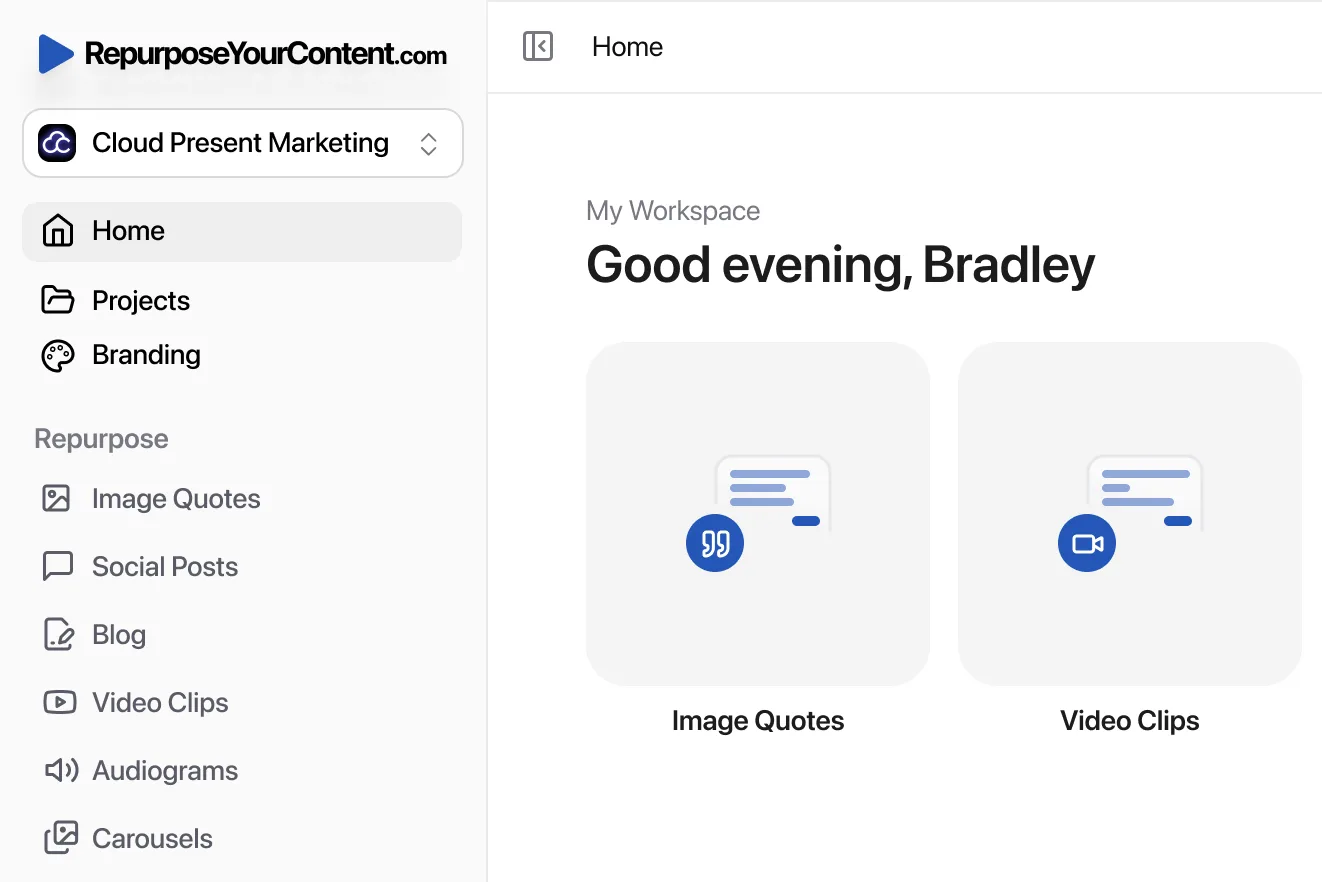
RepurposeYourContent automates this entire workflow. You upload one webinar recording. The platform generates the assets needed for each email in the sequence.
Here is the workflow:
- Step 1: Upload your webinar recording to RepurposeYourContent.
- Step 2: Our AI generates all your content. This includes:
- Short video clips (for Email 3)
- An SEO-optimized blog post (for Email 2)
- A full newsletter draft
- Social posts and LinkedIn carousels
- Audiograms and image quotes (for Email 5)
- AI-generated timestamps to find key moments fast.
- Step 3: Download your assets. Copy and paste them into your email templates. Your entire 6-part sequence is ready to go.
What takes hours of manual work is done for you in about 5 minutes. You can turn one 60-minute webinar into 47 unique pieces of content.

More Tools and Templates for Your Sequence
While RepurposeYourContent creates the assets for your emails, you'll need an Email Service Provider (ESP) to send them. Here are some tools that offer templates and automation features.
1. ActiveCampaign
For marketing teams already using ActiveCampaign, their marketplace offers a significant head start. Instead of building your logic from scratch, you can import their 'Webinar Follow-Up' automation recipe directly into your account. This provides a pre-built workflow designed to handle the complex segmentation required for effective post-webinar communication.

The primary strength of this resource is its structure. The recipe comes with pre-configured branching logic that separates contacts based on tags, such as ‘Attended Webinar’ versus ‘No-Show’. This saves considerable setup time, allowing your team to focus on writing compelling copy rather than mapping out complex automation rules. It integrates with other ActiveCampaign functions, creating a unified system for tracking engagement.
Website: ActiveCampaign Webinar Follow-Up Recipe
2. GetResponse
For teams that prefer an all-in-one solution, GetResponse offers a compelling proposition. Its native 'Post-webinar follow-up' automation template provides a guided workflow, ideal if you host your webinars directly within the GetResponse ecosystem. This removes the need for third-party integrations, creating a seamless connection between your live event and your email marketing.

The key advantage here is simplicity and cohesion. The template comes with pre-set wait times and a clear checklist of required elements, guiding you through the setup process. It’s designed to work with their complementary 'Webinar promotion' automation, allowing you to manage the entire event lifecycle from a single dashboard. Logic for segmenting attendees from no-shows is built-in, making it straightforward to send tailored messages.
Website: GetResponse Post-Webinar Follow-Up
3. Livestorm
For teams wanting a webinar platform with robust, built-in email functionality, Livestorm provides a strong starting point. Instead of relying on a third-party email service provider, you can manage your webinar follow up email sequence template directly within the platform. Livestorm includes a default five-email system that covers confirmation, reminders, and two separate follow-up messages, which simplifies the initial setup process considerably.

The primary advantage here is integration and speed. Because the email system is native to the webinar platform, segmentation for attendees and no-shows is automatic. This means less technical configuration and more time spent on customising the provided templates. You can edit the copy, add your branding, and create a consistent experience without leaving the Livestorm dashboard. The platform's template library is tailored specifically for webinar communication.
Website: Livestorm Email Templates
4. Demio
For teams who need ready-to-use copy without the technical setup, Demio's blog provides seven distinct webinar follow-up email templates. This resource focuses purely on the content, offering a practical, copy-and-paste solution that can be implemented in any email service provider or marketing automation platform. It removes the need for creative brainstorming, supplying a solid foundation for your communication sequence.

The main benefit here is the quality of the provided copy. The templates cover different scenarios, including separate messages for attendees and no-shows, and provide a suggested timeline for sending them. This makes it an excellent starting point for B2B marketers who want a proven framework for their messaging. Because the templates are vendor-agnostic, you are not locked into any specific platform to use them.
Website: Demio Webinar Follow-Up Email Templates
5. Zoom Webinars
For teams seeking a simple, integrated solution, Zoom Webinars offers built-in post-event email capabilities. This feature allows you to send basic follow-ups directly from the platform where you hosted the event, eliminating the need for complex integrations for straightforward communication. It provides separate, editable templates for attendees and absentees.

The primary benefit is its convenience. You can configure a simple ‘thank you and replay’ email for attendees and a ‘sorry we missed you’ email for no-shows within the webinar settings themselves. This zero-friction setup is ideal for small teams or those without a dedicated marketing automation platform. However, it lacks the advanced segmentation, branching logic, and multi-touch sequencing of specialised tools.
Website: Zoom Online Event Best Practices Guide
6. HubSpot
HubSpot offers more than just templates; it provides comprehensive guides for webinar execution. These downloadable resources bundle pre- and post-webinar email copy with strategic advice, all grounded in HubSpot's established lifecycle methodology. This approach connects your email sequence directly to broader sales and marketing processes.

The primary benefit is the combination of ready-to-use templates with process-level guidance. Instead of just getting email copy, you get a strategic framework for how and when to send it. These resources are designed for seamless integration with HubSpot Workflows, allowing for sophisticated segmentation based on attendee behaviour and lifecycle stage.
Website: HubSpot Webinar Execution Guide
Stop letting your webinar leads go cold. Automate your content creation and deploy a follow-up sequence that works.
Try RepurposeYourContent today and see how quickly you can build your next high-converting email sequence.
Tags: