What is Webinar Repurposing?
Webinar repurposing is the practice of transforming a webinar recording into multiple content formats - video clips, blog posts, social posts, audiograms, email sequences, and more - for distribution across different channels. Rather than letting a webinar recording collect dust in a cloud folder after the live event, repurposing extracts maximum value from every minute of content.
Webinar repurposing is the highest-ROI form of content repurposing because webinars are uniquely information-dense. A single 45-minute session contains roughly 5,850 to 6,750 spoken words, expert insights, audience Q&A, and both audio and video - making it the richest possible anchor content for a multi-format strategy.
What a repurposed webinar looks like
- 8-15 video clips: for LinkedIn, YouTube Shorts, Instagram Reels, and paid ads
- 1-3 blog posts: - a session recap, a deep-dive on a key topic, and an SEO-focused article
- 5-10 social posts: - captions, threads, and commentary for LinkedIn, Twitter/X, and other platforms
- 3-5 audiograms: with waveform animations and captions for audio-first social sharing
- 4-6 quote cards: from speaker highlights
- 2-3 image carousels: for LinkedIn
- 1 email nurture sequence: of 3-5 emails for post-event follow-up
- 1 podcast episode: extracted from the audio track
Why Webinar Repurposing Matters for B2B Marketers in 2026
B2B teams invest heavily in webinar production - speaker preparation, promotion, platform costs, and audience acquisition. Yet most teams use only a fraction of the content value locked inside each recording. The live event reaches attendees once, a follow-up email goes out, and the recording gets posted on-demand. Everything else is left on the table.
Problems webinar repurposing solves
- Content volume demands: B2B buyers engage across 6-8 channels before making a purchase decision. Marketing teams need to show up on LinkedIn, email, YouTube, podcasts, and more. One repurposed webinar covers all of them.
- Wasted production investment: Without repurposing, the cost-per-use of a webinar is high - you spent thousands producing an asset that gets used once. Repurposing spreads that investment across 30+ assets, dramatically lowering the cost per piece of content.
- Expert availability: Subject-matter experts and executives have limited time for content creation. A single webinar captures their knowledge once, then content teams can repurpose it for weeks without going back to the expert.
- No-show registrants: With typical attendance rates of 40-50%, half of your webinar registrants never see the content. Repurposed clips, blog posts, and drip campaigns re-engage these leads with the insights they missed.
- Short content shelf life: A live webinar's impact fades within days. Repurposing extends it to months through evergreen blog posts, on-demand clips, and social content that continues to generate impressions and leads.
Real-World Examples
One webinar, one month of content
A B2B SaaS marketing team hosts a monthly webinar on industry trends. Within 24 hours of each session, they upload the recording to RepurposeMyWebinar and generate their entire content calendar for the following month: daily LinkedIn posts, a weekly blog series, clips for paid social campaigns, an email nurture sequence for registrants, and a podcast episode. Total production time after the live event: under one hour.
Back-catalog gold mine
A demand gen team audits their webinar archive and finds 18 months of recordings sitting untouched. They run the best-performing sessions through a repurposing workflow, generating hundreds of derivative assets from content that was already paid for. The result: three months of content pipeline from zero new production.
Agency white-label repurposing
An agency offers webinar repurposing as a packaged service for B2B clients. Each client records one webinar per month, and the agency delivers a complete content package: 10 video clips, 2 blog posts, 8 social posts, 4 quote cards, and a nurture sequence. The batch creation model scales profitably across 20+ clients.
How RepurposeMyWebinar Makes Webinar Repurposing Easy & Fast
Manual webinar repurposing - watching the recording, timestamping moments, clipping video, writing blog posts, designing graphics, drafting emails - takes a content team 10-20 hours per session. RepurposeMyWebinar compresses the entire workflow into minutes:
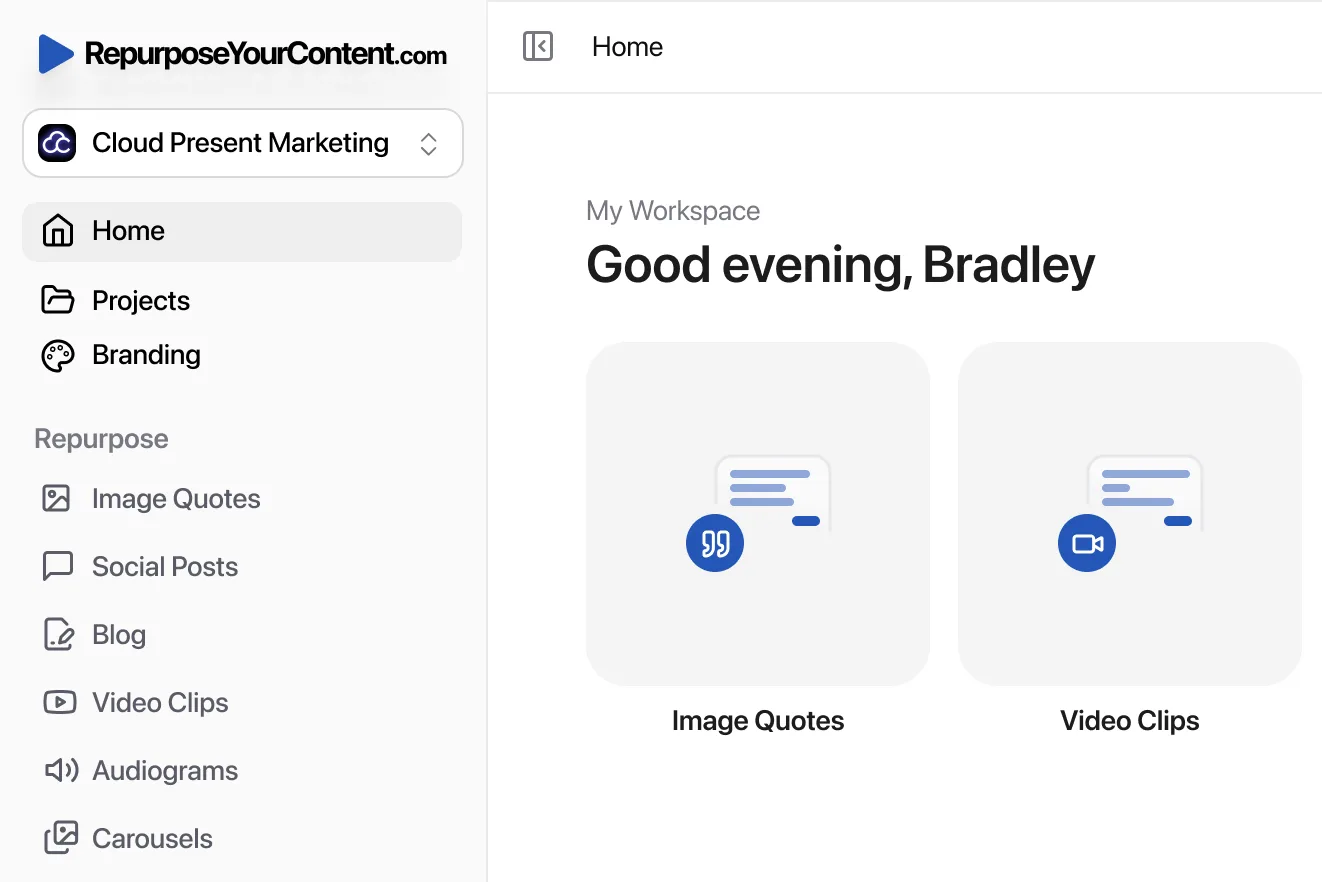
- Upload from any source - paste a link from Zoom, Goldcast, ON24, Riverside, or YouTube, or upload a file. The AI ingests the full recording, transcript, and audio track.
- Select every output format you need - choose video clips, blog posts, social posts, audiograms, carousels, email sequences, podcasts, and quote cards. One upload produces 25-40 assets across all formats.
- Brand Kit ensures on-brand output at scale - every derivative asset gets your logos, colors, fonts, and tone applied automatically. No manual design passes needed.
- Distribute on your schedule - edit any asset in-platform, then download or schedule for publishing. Space derivatives across days or weeks to maximize the content lifespan of each webinar.
- Repurpose your back catalog too - the platform is not limited to new recordings. Upload past webinars that are still relevant and generate fresh content from existing investments.
Multiply the ROI of every webinar your team produces. See pricing or read our complete guide on how to repurpose a webinar.
Webinar Repurposing vs Similar Concepts
| Concept | What it means | How it differs |
|---|---|---|
| Webinar Repurposing | Transforming a webinar recording into multiple content formats | Source-specific - uses webinar recordings as the input |
| Content Repurposing | Transforming any content into new formats or for new channels | Broader category - webinar repurposing is one type within it |
| Podcast Repurposing | Transforming podcast episodes into derivative content | Audio-only source - webinars offer video, audio, and slides for richer output |
| Content Atomization | Breaking one large piece into many smaller, standalone assets | Describes the breakdown process - webinar repurposing includes atomization plus format transformation |
| Content Distribution | Publishing and promoting content across channels | The next step after repurposing - distribution is how repurposed content reaches audiences |
Frequently Asked Questions
A single webinar recording can be repurposed into video clips for social media and ads, blog posts and articles, social media captions and threads, audiograms with animated waveforms, image carousels for LinkedIn, quote cards from speaker highlights, email nurture sequences, podcast episodes, show notes, and transcripts. A typical 45-minute webinar yields 20 to 40 individual content assets across these formats.
Ideally within 24 to 48 hours of the live event. The content is most relevant and timely immediately after the session, and your registrants are still engaged with the topic. With automated tools like RepurposeMyWebinar, you can generate derivative content within minutes of uploading the recording, making same-day repurposing practical.
Webinar repurposing is a specific application of content repurposing focused on webinar recordings as the source material. The principles are the same - taking one asset and transforming it into many - but webinars are uniquely suited because they combine video, audio, spoken insights, visual slides, and audience interaction in a single recording. This multi-layered source material produces more derivative formats than most other content types.
Manual webinar repurposing - watching the recording, identifying key moments, editing clips, writing blog posts, creating social copy - can take 10 to 20 hours per webinar. With AI-powered tools like RepurposeMyWebinar, the same output can be generated in minutes. The platform automatically identifies highlights, generates clips, writes copy, and applies brand styling, reducing the process from days to a single session.
If the speaker is an internal team member, your company typically owns the content rights. For external speakers or guests, best practice is to include content usage rights in the speaker agreement before the event. Most guest speakers expect their webinar appearances to be promoted and are happy to have clips shared - but having explicit permission in writing avoids any ambiguity.
You can absolutely repurpose older recordings, especially if the content is evergreen. Many B2B teams have months or years of webinar recordings sitting unused in cloud storage. As long as the insights are still relevant, these recordings are a goldmine of untapped content. Repurposing your back catalog is one of the fastest ways to fill your content pipeline without producing anything new.