B2B social media strategy 2026: The Playbook for Growth
B2B social media strategy 2026: Unlock a focused content engine that drives pipeline through smarter repurposing, not endless creation.

Your company's LinkedIn page is not working. For every 1,000 followers you have, your next post will be seen by just 16 of them. The old 'post and pray' strategy is dead. If you are planning your B2B social media strategy for 2026, that playbook belongs in the bin.
Your New B2B Social Reality: The End of Organic Reach

The ground has shifted for B2B marketers on social media. Creating original content for five different platforms is not a smart use of your time. For most teams, the effort is huge and the payoff is tiny. This is not a failure. It is a signal to adopt a new, more efficient approach.
LinkedIn is the undisputed king of B2B. It delivers 80% of all social media leads. But that dominance has a catch. Organic reach from company pages has tanked to a miserable 1.6% of followers. This forces you to rethink how your content gets seen. You can read more about navigating modern B2B social media on whitehat-seo.co.uk.
This requires a new strategy. The winning B2B social strategy for 2026 is about ruthless efficiency and impact, not just noise.
Key Trends Defining the New Game
This collapse in organic reach is happening alongside other major shifts. You need to build your strategy around what algorithms and your audience want.
- Video-First Content: Forget long, text-only posts. Short video clips that get straight to the point deliver instant value. They grab attention on platforms like LinkedIn.
- Your People Are Your Power: Your brand logo does not build trust. Your experts do. Content shared by employees gets 8x more engagement than the same post from your company page.
- Authentic Expert Snippets: Buyers are tired of slick corporate speak. They want genuine, practical advice from real people who know their subject.
- AI as Your Production Partner: The pressure to create is real. Smart AI tools now help you scale content creation. They can turn one core asset into dozens of high-quality pieces.
The central problem is clear: creating original content for every channel is a broken model. You need a system that multiplies your effort, not your to-do list.
The answer is not to work harder creating more content from scratch. It is to build a smart content repurposing pipeline.
Create one high-value piece of content, like a 60-minute expert webinar. Then, methodically slice it into weeks' worth of social media content. This is how you stay visible and valuable on your key channels without burning out your team. This is the engine that powers an effective social strategy.
Your 2026 Platform Framework for Maximum Impact
Trying to be everywhere on social media is a guaranteed way to get nowhere. Spreading your team thin across five platforms is a recipe for burnout, not business results. For a B2B social media strategy in 2026 that works, you need to be ruthless with your focus.
Stop chasing every new app. Channel all your energy into the two or three places that will build your pipeline. Everything else is noise.
Your team's time is your most precious resource. Wasting it on the wrong platforms is a costly mistake. There is a huge gap between where many UK marketers plan to spend and where their B2B audience spends time. Recent data shows a big push towards TikTok (73%), Instagram (69%), and Facebook (64%), according to UK social media trend reports.
For many B2B brands, that is like selling accounting software in a nightclub. You must be where the real business conversations happen.
This is why you need a focused framework. It stops you from getting distracted by fleeting trends. It forces you to build a powerful presence where it truly counts.
The Core Stack: LinkedIn and YouTube
For almost any B2B company, your social presence in 2026 must be built on two pillars: LinkedIn and YouTube. These are your non-negotiables.
LinkedIn: This is the center of the B2B universe. Your buyers, partners, and future talent are all talking shop here. A strong presence is mandatory for credibility.
YouTube: This is the world's second-biggest search engine. It is your permanent video library. It is the home for your deep-dive expert content. Think full webinar recordings and in-depth product demos. This content becomes the foundational asset for your entire repurposing engine.
These two platforms work together. YouTube is your content vault. LinkedIn is your distribution network. You share targeted, bite-sized pieces of that content directly with your audience. This gives you long-term, searchable value and immediate visibility in the feed.
Your goal is not to be everywhere. It is to be unavoidable on the platforms your customers use to make decisions. That starts with dominating LinkedIn and building a searchable video hub on YouTube.
2026 B2B Platform Selection Guide
With your core stack established, you can consider adding a third platform. This table breaks down the strategic focus for the main contenders in 2026. It helps you make a smart, data-driven decision.
| Platform | Primary B2B Use Case | Key Content Formats | Strategic Focus |
|---|---|---|---|
| Professional networking, lead gen, thought leadership | Text posts, carousels, articles, video | Build authority and drive direct business conversations. | |
| YouTube | Evergreen content hub, search visibility, deep-dives | Long-form video (webinars, demos), shorts | Own your niche with searchable, high-value video assets. |
| Brand building, employer branding, visual storytelling | Reels, carousels, stories, high-quality images | Humanise your brand, especially in visual or people-centric industries. | |
| X (Twitter) | Real-time news, event commentary, community engagement | Short-form text, threads, live audio/video | Tap into timely conversations and connect with industry journalists/influencers. |
| Niche Communities | Deep engagement, problem-solving, user feedback | Q&A, long-form posts, resource sharing | Become a trusted expert within a highly targeted group (e.g., Slack, Forums). |
Choosing a third platform is about strategic fit. Do not add a channel just for the sake of it. Ensure it serves a specific purpose that LinkedIn and YouTube do not already cover.
Choosing Your Third Platform
With LinkedIn and YouTube secured, you might have bandwidth for one more channel. How do you choose? The decision must be based on where your specific audience lives, not what is trending.
Here is a simple way to think through your choice:
- Follow Your Best Customers: Where do they hang out online to share ideas? If you are in a design-led field like architecture, a visual platform like Instagram might be a great fit.
- Find the Niche Watering Holes: Are there specific private communities where your buyers gather? Becoming a helpful member of a Slack group or industry forum can be very powerful.
- Play to Your Strengths: Does the platform’s content format align with what you do best? If your expertise shines through detailed diagrams, then LinkedIn carousels are a better fit than quick-cut videos. For more, see our guide on crafting a powerful LinkedIn content strategy for B2B.
By focusing on a tight stack of two or three platforms, you run a powerful and sustainable social strategy. It respects your team's capacity and delivers measurable results.
Building Your Content Repurposing Pipeline
Trying to create original content for every social platform is a fast track to burnout. You cannot win that game. The secret to a winning B2B social media strategy in 2026 is not creating more. It is working smarter with the expert content you already have.
The most effective social teams are master repurposers. They build a pipeline that takes one high-value asset, like a 60-minute webinar. They spin it into weeks of social media content. This is how you stay consistent without draining your team and budget.
You are not managing a dozen small streams. You are feeding one central reservoir that distributes content to your platforms.

It is a simple shift in mindset that changes everything.
The Anchor Content Workflow
This process turns your long-form video into a goldmine of social assets. It ensures every key insight gets the spotlight it deserves on the right platform. Here is how it breaks down into three steps.
Step 1: Find Your Anchor Content First, identify your 'anchor' content. This is the most valuable expertise you produce regularly. For most B2B teams, this is a webinar or an in-depth product demo. This 45-60 minute video is the raw material for your content engine.
Step 2: Define Your Content Pillars Next, watch the webinar back to pull out 3-5 core themes. These themes become your content pillars. For example, a webinar on AI in marketing gives you pillars like "Using AI for lead scoring" and "Automating content creation."
Every clip, quote, or carousel should tie back to one of these pillars. This gives your social feed a clear, strategic narrative, not a random assortment of posts.
Step 3: Systematically Extract and Distribute This is where you systematically pull different formats from the one webinar. Each format is designed for a specific platform. The goal is to turn one 60-minute video into 47 or more individual pieces of content.
This is not just about crudely chopping up a video. It is about creating assets that feel native to each channel. You can see a detailed content repurposing workflow for small teams to put this into practice.
How RepurposeYourContent Helps
You could do all this manually. But that means someone re-watches the video, finds highlights, edits clips, and writes copy. It is a huge time sink. Smart automation makes a massive difference.
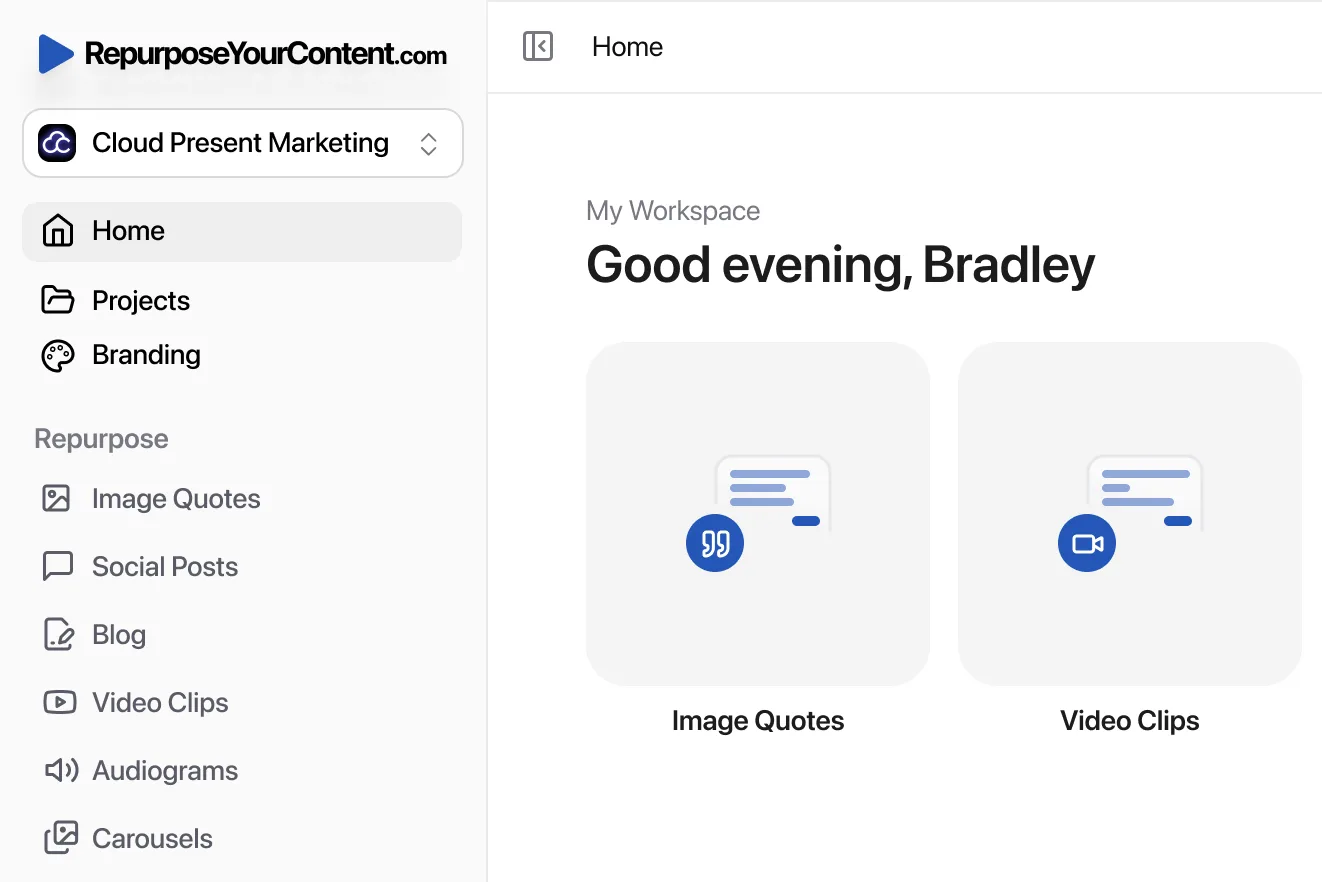
RepurposeYourContent is the engine for your repurposing pipeline. You upload your webinar recording. The platform automatically generates all the formats you need to fill your content calendar:
- Video clips: Instantly creates dozens of shareable, bite-sized clips perfect for LinkedIn and YouTube Shorts.
- LinkedIn carousels: Turns complex ideas into engaging, branded slide decks that stop the scroll.
- Image quotes: Pulls powerful statements and transforms them into eye-catching graphics.
- Audiograms: Creates animated audio snippets for sharing key insights.
- Social posts: Generates ready-to-publish captions and threads pulled from the webinar transcript.
- Blog posts: Converts your video content into a full, SEO-optimized article.
- Newsletters: Provides a summary and key takeaways for your email list.
- Timestamps: Creates a clickable table of contents for your YouTube video.
Instead of your team spending 15 hours manually creating these assets, you get a full suite of platform-ready content in minutes. This frees your team to focus on strategy, community engagement, and measuring pipeline.
Stop spending valuable time on manual production. Turn one webinar into a month of strategic content.
Try RepurposeYourContent today.
Integrating AI and Employee Advocacy
Two forces will define your B2B social media playbook in 2026: AI-powered creation and employee advocacy. Your strategy must blend them together. The goal is not to have robots replace your experts. It is to give your experts a megaphone so their authentic voice is heard at scale.
This approach solves a contradiction. By 2026, AI is a standard tool for UK social media marketers. 89.7% regularly use AI, and 71% have it in their core strategy. But at the same time, audiences demand content from actual humans.
You get smart here. You do not use AI to invent your message. You use it to process, package, and polish the genuine expertise that already exists in your company. It is how you keep things human while getting the speed and scale AI offers.

Using AI to Amplify Human Expertise
Think of AI as a production assistant, not a creative director. Its job is to take the gold from your webinars. It slices your unique perspectives into ready-to-post assets for every platform. This frees your team from the grind of manual production. They can focus on strategy and engagement.
To get this machine running, you need a solid grasp of social media automation in 2026. Understanding the mechanics helps you build a system that works.
The value of AI in B2B social is not writing soulless posts. It is capturing what your best people say and reshaping their insights into content.
You feed the machine with human brilliance. It handles the grunt work of getting it out there.
Employee Advocacy: The Ultimate Distribution Channel
AI has solved your content creation problem. But how do you get people to see it? Employee advocacy solves your distribution problem. Organic reach from company pages is a ghost town. Your employees' personal networks are your most powerful channel.
People trust people more than they trust logos. When your team shares content, it gets 8x more engagement than when posted from the company page. An employee advocacy program turns your organization into an authentic distribution engine. This mindset is required to grow on LinkedIn.
It does not have to be complicated. The game is to make sharing ridiculously easy.
A Simple Workflow for Employee Advocacy
Here is a simple workflow to get your teams sharing content without it feeling like a chore.
- Step 1: Find Your Champions. Start with a small, willing group who are already active on LinkedIn. Think leadership, your sales team, and customer success managers.
- Step 2: Give Them Ready-Made Assets. Your repurposed webinar content is perfect here. Create a shared library with short video clips, quote graphics, and pre-written post copy. Make it a simple grab-and-go process.
- Step 3: Encourage a Personal Touch. Ask them to add one sentence of their own. "I found this point interesting because..." is all it takes. This tiny addition makes the content feel genuine to their network.
This process removes all friction. Your employees are not asked to become content creators. They are equipped to share valuable insights. They build their personal brand, and the company gets a massive boost in reach and credibility.
Measuring Pipeline Influence, Not Vanity Metrics
Likes and shares feel good, but they do not pay the bills. The biggest mistake with your B2B social media strategy for 2026 is reporting on numbers your finance department does not care about. It is time to move past vanity metrics and start measuring pipeline.
Your leadership team wants to know if social media helps bring in revenue. Your job is to draw a straight line from a prospect watching your repurposed webinar clip to a sales conversation. That is how you prove your worth.
From Vanity Metrics to Pipeline KPIs
Getting beyond surface-level stats means changing what you measure. You need to zero in on KPIs that show business impact. This means swapping out old metrics for ones that tell a revenue story.
This table breaks down the shift you need to make:
| Outdated Metric (Avoid) | Modern KPI (Track) | What It Tells You |
|---|---|---|
| Likes and Shares | Pipeline Influence | Which deals were touched by social media content during the buyer's journey. |
| Follower Count | Content-Sourced Leads | How many new leads entered your CRM directly from a social media asset. |
| Impressions | Social Touchpoints per Opportunity | How many times social content engaged key accounts before they became a sales opportunity. |
| Reach | Cost Per Influenced MQL | The efficiency of your social spend in generating marketing-qualified leads. |
Tracking these modern KPIs requires a tight connection between your social channels, marketing automation platform, and CRM. This plumbing lets you see how specific posts influence deals. Properly measuring social media’s effect is a huge piece of understanding your webinar ROI.
Building Your Pipeline Influence Dashboard
The end goal is a dashboard. It must clearly and simply show the value your social activities are creating. This is not just about tracking numbers. It is about building a compelling story that defends your budget and proves your team's contribution.
Here is a simple workflow to get you started:
- Step 1: Get Your UTMs in Order. Ensure every link you share has UTM parameters. This is non-negotiable. It is how you trace traffic and conversions back to specific campaigns and posts.
- Step 2: Set Up Your CRM Properly. Work with your RevOps team. Set up attribution models that make sense for a long B2B sales cycle. A multi-touch attribution model is almost always your best bet.
- Step 3: Visualise the Story. Use your CRM’s reporting tools or a BI platform to create a visual dashboard. It should spotlight your main pipeline KPIs. It should be easy for anyone on the leadership team to see the impact.
This dashboard becomes your source of truth. It proves that your content engine is not just churning out noise; it is actively creating customers.
Ready to build a content engine that drives measurable pipeline? Try RepurposeYourContent today.
Your B2B Social Media Strategy Questions Answered
You have the playbook. But some questions can stop a great strategy in its tracks. Let's tackle the common hurdles marketers face when building a modern B2B social media strategy for 2026.
This is a straight-talking Q&A to clear up your biggest concerns.
How Often Should a B2B Company Post on LinkedIn?
Forget about rigid, arbitrary posting schedules. The goal is not to hit a quota. It is to be consistently valuable. For most B2B company pages, posting 3-4 times per week is the sweet spot. It is enough to stay on your audience's radar without becoming noise.
But the real action happens through your people. Your key leaders and experts should aim for 2-3 high-quality posts per week from their personal profiles. Content shared by employees gets 8x more engagement than the same post from a brand page. A winning LinkedIn presence is a team sport.
What Is the Ideal Length for a B2B Video on Social Media?
The video's length must match its job and the platform it lives on. There is no one-size-fits-all, but there are solid guidelines.
- LinkedIn Feed Videos: Keep these punchy, between 45 and 90 seconds. That is the perfect length to share a single, powerful insight that stops a scroll.
- YouTube Shorts: Stick to the under-60-second limit. These are built for quick, sharp expert takes that are easy to consume.
- Full Webinars on YouTube: Do not hide your long-form content. The full 45-60 minute webinar recording belongs on your YouTube channel. This becomes a resource for prospects deep in the research phase.
A smart video strategy uses all three of these lengths in harmony.
How Do I Convince My Sales Team to Participate?
Sales teams are driven by results. To get them on board, you have to answer their question: "What's in it for me?". The answer is more qualified conversations and a shorter path to closing deals. Do not just ask them to "post on social." That feels like a chore.
Instead, make it ridiculously easy for them to win. Here is a simple process that works.
- Step 1: Build Their Personal Content Library. Use a tool like RepurposeYourContent to create a central hub. Fill it with pre-approved, bite-sized video clips, quote cards, and carousels.
- Step 2: Give Them the Words. For every asset, write a short, customisable caption they can copy and paste. You are removing all friction and guesswork.
- Step 3: Show Them the Pipeline. After a month, pull the data. Show them how their activity is warming up target accounts and influencing pipeline. Connect their posts to real business outcomes.
When you make it easy and prove the return, your sales team will become your most enthusiastic advocates. It is not a "marketing task." It is a smarter way to sell.
Ready to build a content engine that answers every question and drives real results? Try RepurposeYourContent today.
Tags: