Brand Voice Consistency: A Practical Guide for Busy Teams
Learn what brand voice consistency really means, why it drives revenue and trust, and how to keep it tight across every channel without burning hours.
Brand voice consistency is the operating system behind recognizable content. It means a buyer can identify the same company across a podcast clip, LinkedIn post, landing page, email, and support message, even when each format sounds different.
Brand consistency also has a measurable commercial connection. Research associated with Lucidpress and Marq reports revenue gains in the 23% to 33% range for companies with consistent brand presentation, while 68% of companies said consistency contributed directly to revenue growth (brand voice consistency statistics). The challenge is execution. One long-form recording can become dozens of assets, and every rewrite creates another opportunity for the voice to fragment.
For busy founders, podcasters, and B2B marketers, the answer isn't producing less content. It's building a repeatable governance loop that preserves the speaker's personality while adapting each asset to its channel.
The Hidden Cost of an Inconsistent Brand Voice
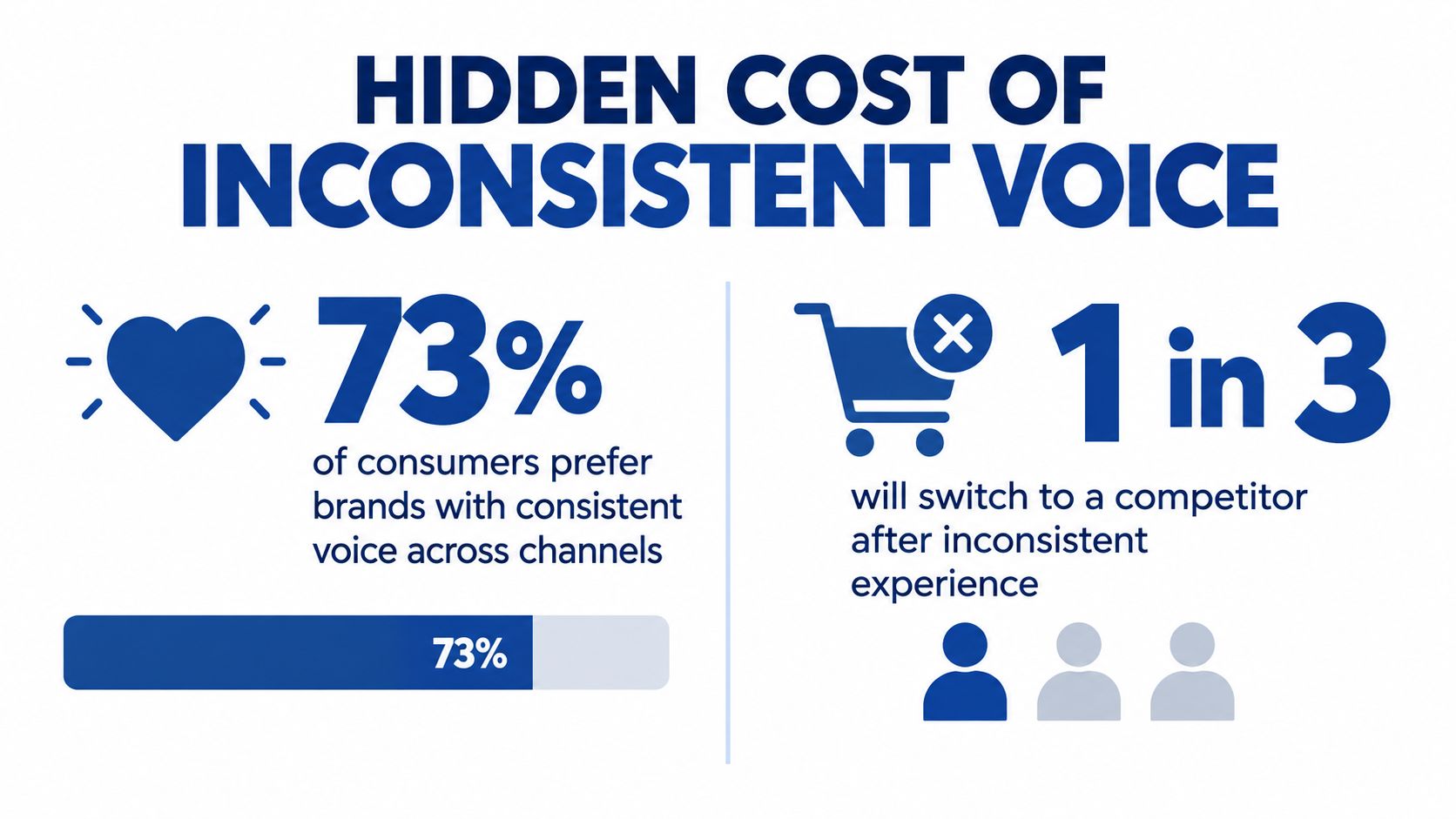
Buyers notice when a founder's podcast, the LinkedIn offshoot, and the sales email sound like three different companies. That inconsistency weakens recognition before a prospect has enough context to judge the offer.
Brand voice consistency means a reader, viewer, or listener can identify the same speaker within seconds, even as the channel, format, and author change. A founder's podcast may be sharp and opinionated. The resulting LinkedIn post may become generic, while a sales email turns formal and overloaded with jargon. Each handoff creates distance from the original point of view.
Where the leak starts
Voice failures often begin after a strong source asset gets divided into smaller pieces.
A long interview becomes a short video, social posts, quote graphics, an email, and a blog article. One writer paraphrases the guest. Another adds a generic hook. A designer softens the language to fit a template. A reviewer checks spelling but not personality. After several handoffs, the original perspective has been diluted.
The operational problem is governance. Teams can produce dozens of assets from one recording, yet few define who protects the speaker's language, which adaptations are acceptable, or when the source guide gets reviewed. Without those controls, drift can become the default within six months. The reported brand consistency findings show the gap between having guidelines and enforcing them consistently (the reported brand consistency findings).
Practical rule: A voice guide without an owner, review cadence, and examples is reference material, not governance.
Repetition can strengthen recognition, but it needs control. Visual devices such as watermarks also require a deliberate approach in fast-moving social content. FindClout's watermark strategy for meme advertisers explains how repeated branding can support recall without turning every asset into an identical copy.
The cost extends beyond awkward wording. Inconsistent content makes buyers reassess credibility at each touchpoint. Internal teams then spend more time rewriting, approving, and explaining material that should have been clear in the first draft. A repeatable review loop protects the source voice while still allowing each asset to fit its channel.
Voice vs. Tone: Where Consistency Lives
Voice and tone solve different problems. Voice is the stable personality behind the communication. Tone adjusts that personality for the situation, audience, and channel.
A B2B cybersecurity company might use a precise, calm, technically confident voice. Its tone can become reassuring in customer support, direct on a product page, and concise in a social post. The personality remains intact. The delivery changes to fit the room.
Brand guidelines should separate those layers. Watson Creative describes voice as the enduring company personality and tone as context-dependent guidance, alongside writing rules, terminology, and examples (brand voice guidelines system).
| Attribute | Voice, fixed | Tone, flexes by context |
|---|---|---|
| Point of view | What the company believes and prioritizes | How strongly that belief is expressed |
| Vocabulary | Preferred terms, banned phrases, complexity level | Terms selected for the audience and channel |
| Sentence rhythm | Typical pace, structure, and directness | Shorter, warmer, or more formal delivery |
| Attitude toward the reader | Respectful, practical, challenging, or supportive | Empathetic in support, declarative on a landing page |
| Calls to action | The brand's approach to asking for action | Urgency and framing based on the situation |
A practical definition is simple: voice is the speaker, tone is the volume, and consistency means the speaker stays the same when the room changes.
The distinction becomes visible during repurposing. A founder might say, “We remove the technical mess so your team can make a decision.” A consistent short-form caption keeps that direct, practical stance: “We remove the technical mess. Your team gets to the decision faster.” A fragmented version might read: “Find new solutions for your organization today.” The topic remains similar, but the speaker has changed.
That shift is easy to miss across 30 assets created from one long-form recording. Editors shorten sentences, social writers add enthusiasm, and subject-matter reviewers restore technical detail. Without a shared definition of the fixed voice, each handoff makes a local improvement while weakening the whole set.
Consistency compounds because the audience stops spending effort identifying the source. A reader who sees the same vocabulary, rhythm, and attitude across channels can focus on the message instead of decoding the company.
A separate study of communication consistency across digital touchpoints found that perceived consistency significantly predicted brand trust (digital communication consistency and brand trust study). The finding supports a practical standard: preserve the speaker's priorities and language patterns, then adjust only what the channel requires.
That standard does not make every asset identical. It gives editors permission to change format, length, and urgency without changing who is speaking.
A Four-Part Governance Framework That Scales
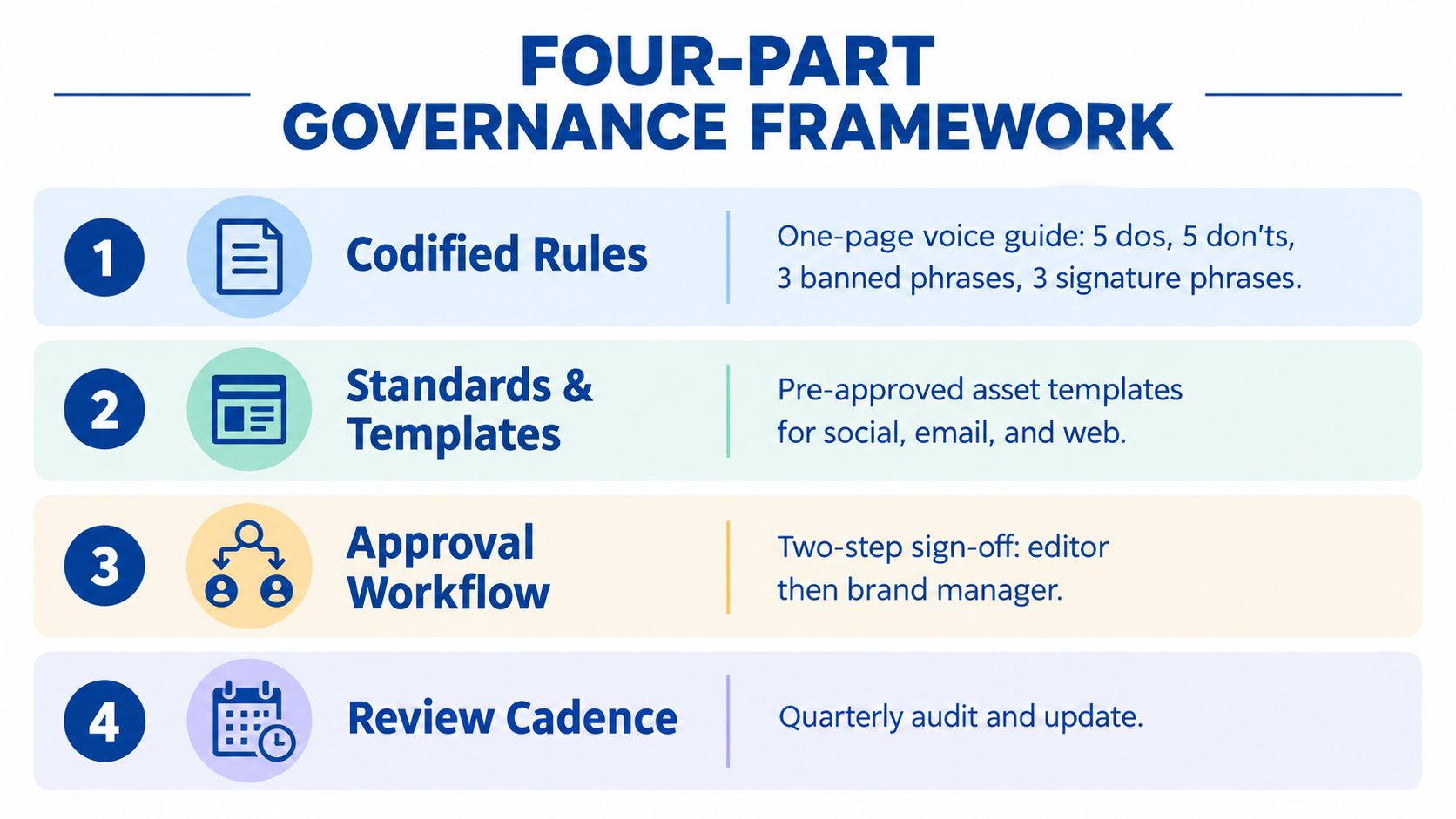
A scalable voice program needs four controls working together. Rules define the target. Audits expose drift. Automated checks increase coverage. Human review makes the final decision.
Codified rules
Start with a one-page voice guide. Keep it usable during production, not buried inside a brand book.
Include:
- Five dos: Use direct verbs, explain technical terms, lead with the practical point, preserve the founder's point of view, and write to one clear reader.
- Five don'ts: Avoid inflated claims, vague introductions, corporate filler, unnecessary exclamation marks, and generic motivational language.
- Three banned phrases: Choose phrases that appear often in weak drafts and remove them from every channel.
- Three signature phrases: Capture language the audience already associates with the brand.
- Vocabulary tiers: Mark preferred terms, acceptable alternatives, and words the company never uses.
Operational guidance also recommends a lexical field, channel-specific register, banned phrases, and annotated good-versus-bad examples (operational tone-of-voice guidelines).
Scheduled audits
Once a month, randomly pull ten assets from recent output. Score them against the guide and log the results in a shared sheet. Random selection matters because sequential review can miss late-stage drift.
Industry guidance recommends sampling 10% to 15% of a content batch and scoring five to eight measurable attributes, including warmth, formality, sentence complexity, CTA style, and humor presence (auditing AI-generated creative for brand voice drift).
Automated drift detection
Run lightweight checks weekly. Grammarly can flag tone changes. A custom prompt in an LLM can compare drafts against approved examples. A word-frequency check can identify missing signature terms or recurring banned phrases.
Automation should flag likely problems, not approve content. It catches patterns. It doesn't understand every strategic exception.
Human review
One named owner signs off each repurposed batch before publication. This person checks meaning, personality, claims, and channel fit.
Skipping this step is the reason many voice programs decay within a couple of quarters. The owner doesn't need to rewrite every line. The owner needs authority to reject a batch that sounds unlike the company.
Teams can document the full operating process alongside content lifecycle management for marketing teams. The point is a control loop, not a static checklist. Each audit should improve the rules, prompts, examples, or review threshold.
Turning One Recording Into 30 On-Brand Assets
A single 60-minute podcast, interview, keynote, livestream, or sales conversation can support roughly 30 assets. The output might include LinkedIn posts, short-form video scripts, quote graphics, carousels, audiograms, email copy, blog material, and search snippets.
The work is rarely as quick as the word “repurpose” suggests.
Step 1, transcribe the source
Transcription takes 45 to 90 minutes when someone checks speaker labels, obvious errors, names, and technical terms. Otter and Whisper can accelerate the first pass, but the transcript still needs review.
Step 2, mine the highlights
Allow about 60 minutes to identify eight to twelve quotable moments, useful explanations, objections, stories, and claims. The best source moments aren't always the loudest. A quiet explanation often makes a stronger carousel or sales post.
Step 3, draft for each channel
Channel-specific drafting takes two to three hours for the full set. A LinkedIn post needs a different opening from a short video caption. An email needs a different CTA from an SEO snippet. Copying the same paragraph everywhere creates repetition without creating distribution.
Step 4, design and edit
Visual assets take about 90 minutes when templates already exist. Video editing, captions, framing, audio cleanup, and thumbnails add production work. Designer reinterpretation can also weaken the voice when the visual treatment becomes too polished, playful, or soft.
Step 5, run voice QA
Reserve 30 minutes for review against the guide. Check vocabulary, sentence rhythm, claims handling, CTA framing, and channel-native conventions.
The active workload totals roughly six to eight hours. Drift usually enters through rushed rewrites, generic introductions, AI paraphrasing that removes sentence rhythm, and visuals that change the emotional register.
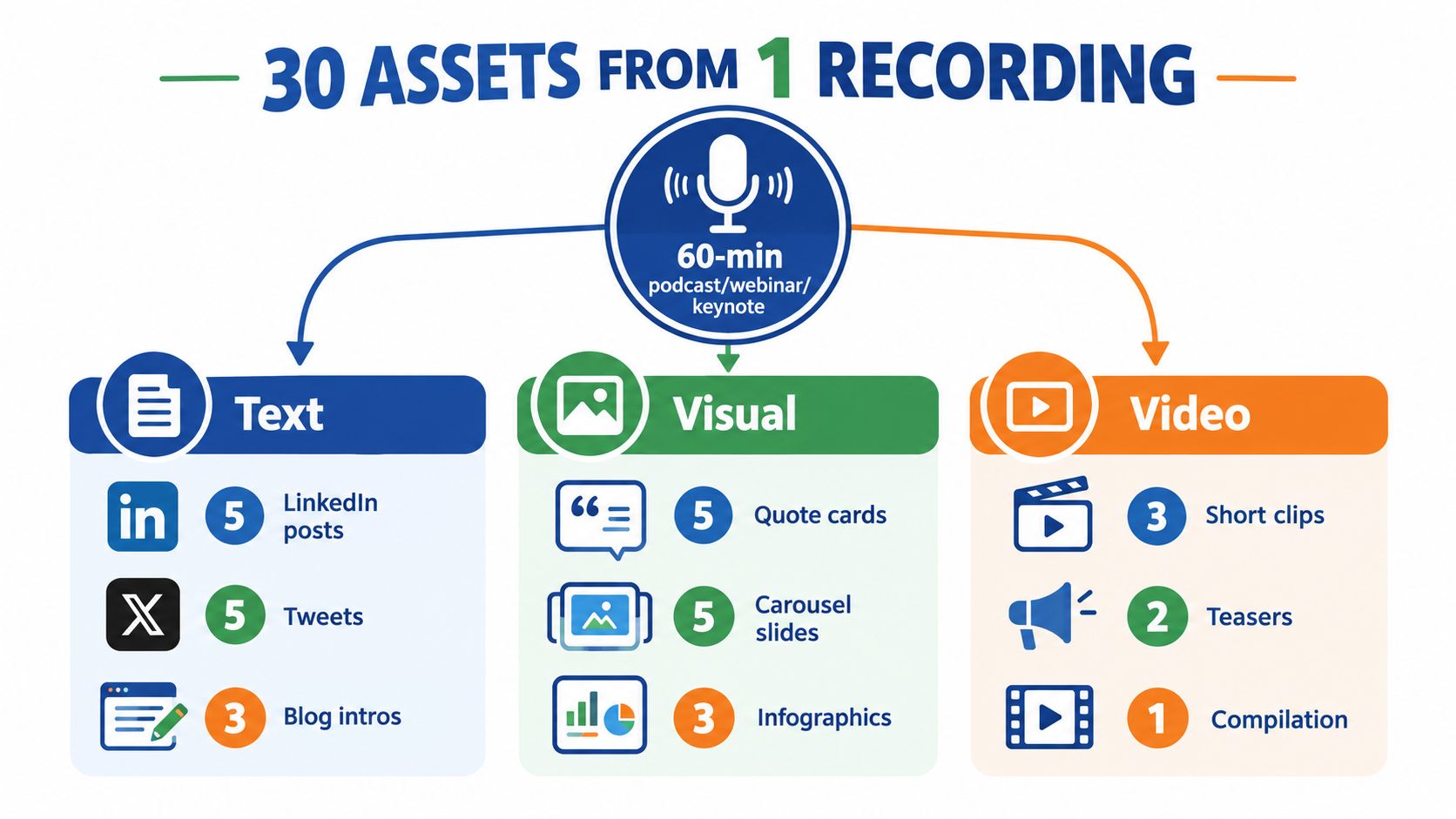
A practical content map should connect each source moment to a format and a purpose. Guidance on social media content creation use cases can help teams think beyond captions and include visual adaptations.
A structured content multiplication framework prevents the team from selecting random clips. Each asset should preserve the source argument while serving a clear channel purpose.
DIY With Tools vs Done-For-You: A Side-by-Side Comparison
DIY fits teams that want process ownership and enough capacity to protect quality. Done-for-you fits teams with an existing recording, a close publishing deadline, and a need to keep voice consistent without retaining every production task in-house.
| Criteria | DIY with tools | Done-for-you |
|---|---|---|
| Time investment | Six to eight hours of active work for one recording | About 15 minutes of client time |
| Skill required | Writing, editing, basic design, channel judgment, and QA | Source knowledge and clear brand guidance |
| Per-asset cost | Roughly $12 to $25, based on a blended internal rate of $60 per hour and tool costs | Around $14 per finished asset, based on published agency pricing |
| Turnaround | Depends on team workload and revision cycles | 72 hours, with a guarantee that the client doesn't pay if the deadline is missed |
| Control | Highest process ownership | Client retains review and revision control |
| Best fit | Tight budgets, technical content, and long-term capability building | Launch deadlines, thin teams, and high-volume repurposing |
The table hides the operational burden. DIY requires someone to maintain templates, review transcripts, correct captions, manage files, and resolve disagreements about what sounds on-brand. Tools speed up individual tasks, but editorial judgment still determines whether all 30 assets sound like the same company.
That workload also creates a governance gap. Without a named voice owner, approval rules, and a repeatable QA pass, teams often drift within six months as different people rewrite, edit, and publish each recording.
DIY can suit a contained requirement, much like the practical FlowHeadshots DIY approach suits teams that prefer handling production themselves. It becomes less attractive when every recording creates another half-day assignment.
The content repurposing agency versus DIY tools comparison helps teams assess capacity, risk, and ownership alongside headline price.
Choose DIY when internal expertise is the strategic goal. Choose done-for-you when the team needs finished assets without adding another production workflow to the calendar.
The 72-Hour Done-For-You Workflow in Practice
A reliable done-for-you workflow starts with one source recording and one agreed voice guide. The client doesn't need to write scripts, edit clips, or prepare a content brief from scratch.
Hour 0
The client sends a podcast, interview, keynote, course session, sales call, livestream, or meeting recording. A share link or raw file works. The client also provides existing style guidance, approved examples, and any words that require special handling.
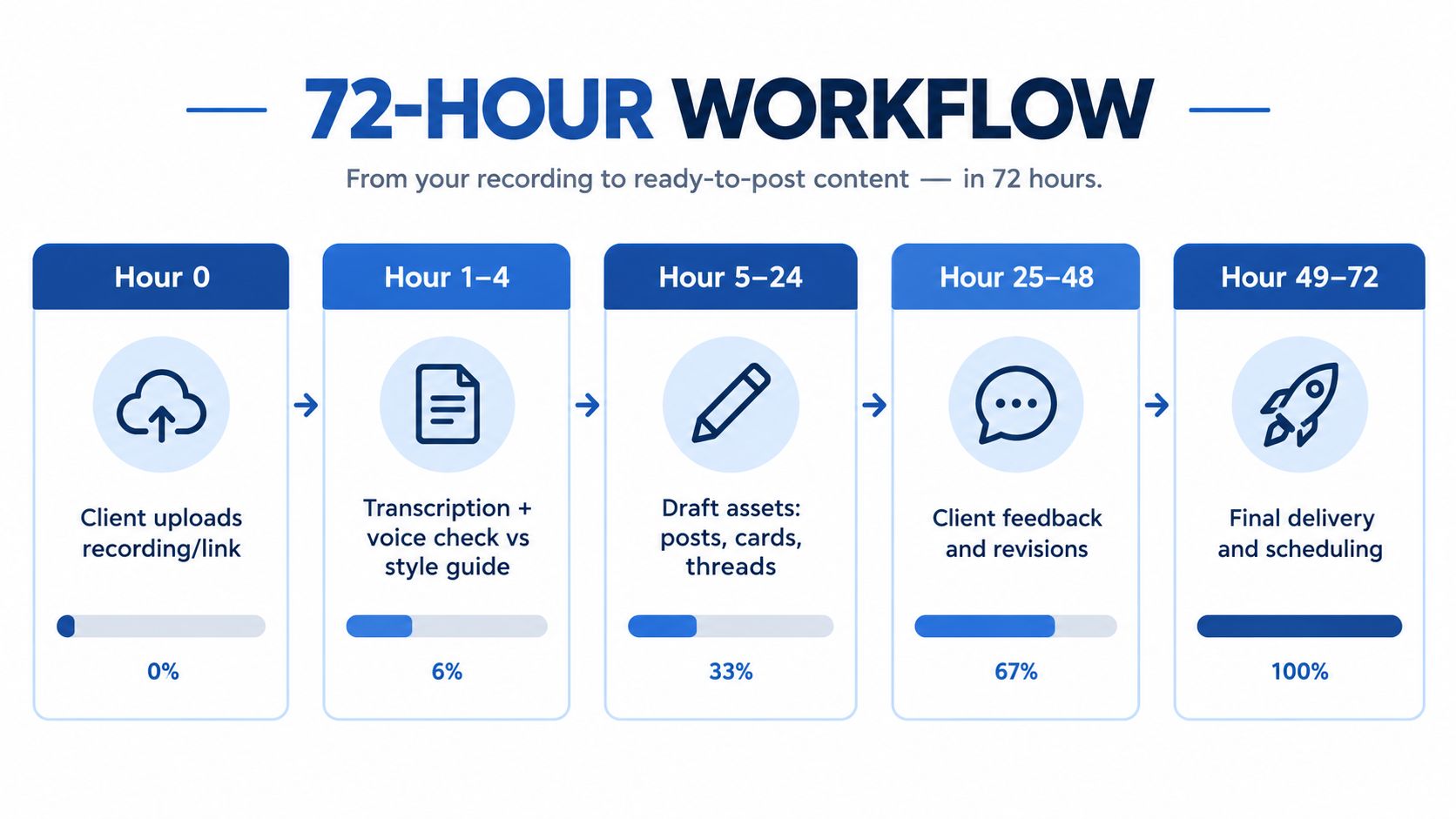
Hours 1 to 4
The team transcribes the source and performs a first-pass voice check. The review identifies the speaker's sentence rhythm, preferred vocabulary, recurring arguments, and phrases that should survive into the derivative assets.
Hours 5 to 12
Editors mine quotable moments, data points, stories, objections, and narrative arcs. Each moment gets mapped to an appropriate format rather than forced into every channel.
Hours 13 to 36
A senior writer owns the voice across the batch. Channel specialists then adapt each draft for length, structure, and audience expectations. This separation protects the personality while allowing format-specific execution.
Hours 37 to 60
Designers and editors produce quote graphics, carousels, video clips, audiograms, thumbnails, and supporting visual assets. The source message remains the anchor.
Hours 61 to 68
The batch receives a final QA pass. Reviewers use a five-point voice rubric and a second reviewer signs off. Claims, captions, file names, alt text, and channel fit are checked before delivery.
Hours 69 to 72
The client receives a single organized folder containing the finished assets, captions, alt text, and channel-ready file names. The workflow can also support related content transformations, such as turning webinars into podcast episodes, when the source format warrants it.
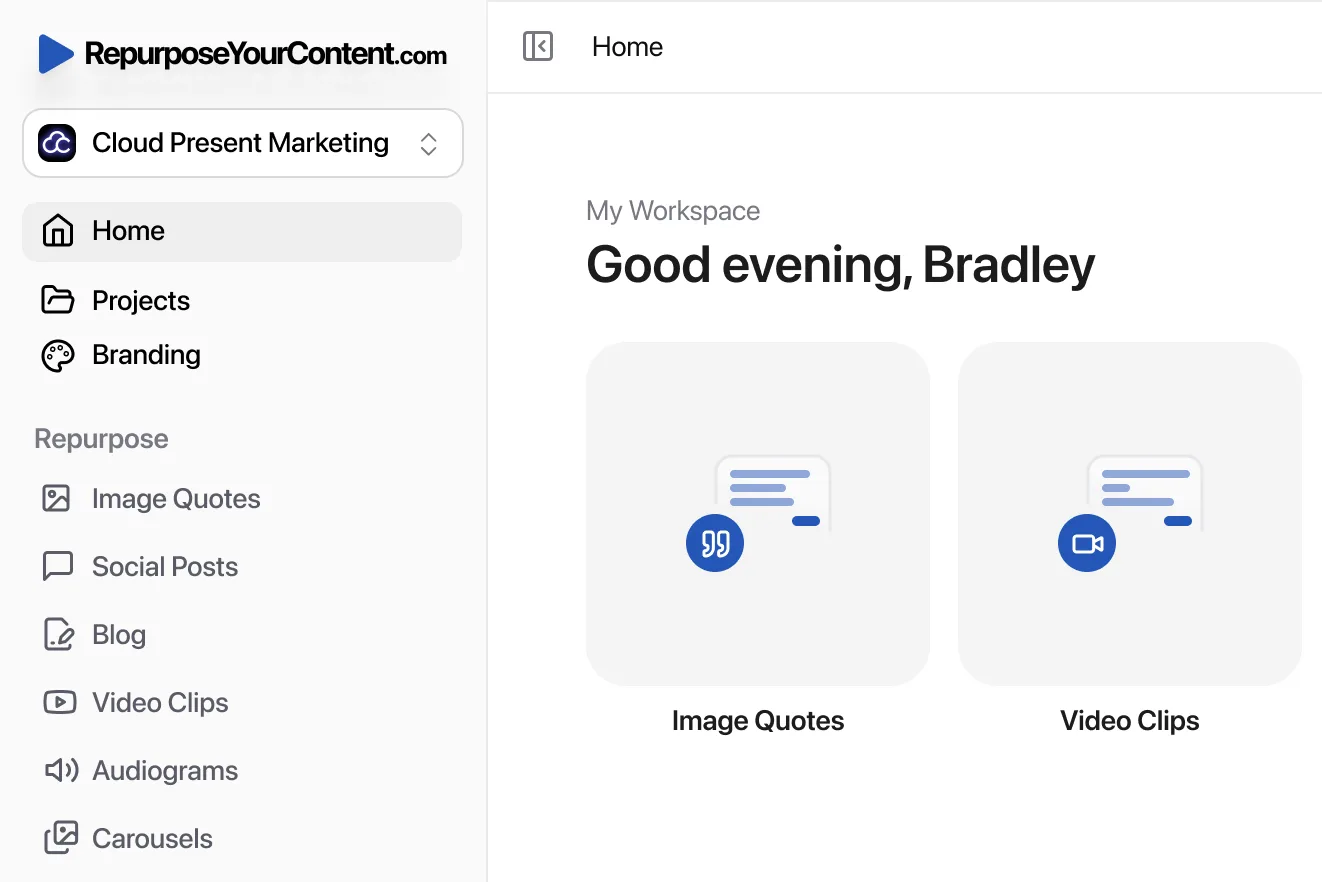
RepurposeYourContent is one done-for-you service that accepts a long-form recording and returns finished content in the client's voice. Its stated workflow uses about 15 minutes of client time, delivers assets within 72 hours, and prices work from $14 per finished asset. The service includes unlimited revisions, so the client can correct a voice mismatch before publication.
Three Measurement Moves That Catch Drift Early
A 30-asset batch can drift even when the source recording sounds right. Voice measurement works when reviewers make repeated decisions against the same standard, rather than relying on instinct or a polished average.
Use a five-point rubric
Score each sampled asset across the same dimensions:
- Vocabulary: Does it use preferred terms and avoid banned language?
- Sentence shape: Does its rhythm resemble approved source content?
- Claims handling: Are facts, qualifications, and examples treated responsibly?
- CTA framing: Does the ask match the company's usual directness?
- Format fit: Does the voice survive the conventions of that channel?
Set a five-point voice rubric with 80% reviewer agreement within one point as the minimum calibration standard. Keep standard deviation below 0.5 for each voice attribute, and flag any piece scoring below 3 for revision. These are useful reviewer-calibration benchmarks for voice scoring, not substitutes for judgment about a specific audience or channel.
Calibrate reviewers before scoring batches
Give reviewers a shared calibration set of 10 assets. Frequent disagreement usually means a criterion needs clearer wording or stronger examples. Revise the rubric before using scores to assess production quality.
Agreement matters more than the average score. A batch can appear acceptable overall while several outliers make the company sound unlike the original speaker.
Sample the batch randomly
Review 10% to 15% of every repurposed batch, selecting assets at random rather than taking the first items in sequence. This sampling range is a practical operating recommendation for teams managing production at scale. Random selection can expose late-stage fatigue, format-specific problems, and drift tied to a particular writer, template, or prompt.
Consistency is not a feeling. It is a repeatable decision made against the same standard.
Log scores by content type, language, writer, and channel. Patterns can show whether the problem begins in outlines, drafts, design, or final QA. The team can then adjust the relevant prompt, template, or approval threshold instead of rewriting the entire system.
Connect those review records to commercial outcomes through a structured approach to content marketing ROI measurement. A voice score will not explain every business result, but it can show whether the production process is preserving the recording's identity as one source becomes 30 publishable assets.
Send Us One Recording and We Handle the Rest
The raw material already exists. It may be a podcast episode, founder interview, keynote, sales call, livestream, course lesson, or customer conversation. The operational problem is turning that recording into useful content without making the company sound different in every format.
The exchange is straightforward:
- One recording sent over
- 20 to 30 ready-to-publish assets returned within 72 hours
- Video clips, LinkedIn posts, quote graphics, carousels, audiograms, and a blog post
- About 15 minutes of client time
- Around $14 per finished asset
- Unlimited revisions
- A 72-hour turnaround guarantee, or the client doesn't pay
The process preserves the original voice while adapting the message for each channel. A 45-minute recording can become 30 assets, giving a B2B team, founder, or podcaster a full publishing cycle without asking internal staff to spend another workday on production.
That trade-off matters when the team has enough expertise to create the source content but not enough capacity to multiply it. The goal isn't to replace subject-matter judgment. It's to turn completed conversations into consistent, usable distribution.
Book a short call or request a sample repurpose from an existing recording. The team will show how that recording can become finished assets in the company's own voice, so the next decision is based on real output rather than promises.
Tags: