Content Marketing for B2B SaaS Companies: A New Playbook
Stop the content treadmill. Learn a new playbook for content marketing for B2B SaaS companies that turns one webinar into a month of high-ROI assets.

Most SaaS teams don't have a content problem. They have a production problem.
The numbers make that obvious. UK B2B SaaS content marketing can deliver a 3-year compounded ROI of 844%, outperforming LinkedIn ads at 180% ROI by 4.7x when evergreen assets keep generating MQLs after publication, according to Averi's UK B2B SaaS ROI benchmarks. Yet plenty of teams still run content like a weekly scramble.
They publish disconnected blog posts. They push out safe thought leadership. They brief writers on topics buyers barely care about. Then they wonder why traffic doesn't turn into pipeline.
Content marketing for B2B SaaS companies works when it is product-led, buyer-aware, and operationally efficient. The best teams don't create every asset from scratch. They build one strong source of truth, then turn it into the formats buyers need at each stage.
Your B2B SaaS Content Is Working Too Hard for Too Little
The usual SaaS content model looks busy. It doesn't always look effective.
A marketer writes a feature post on Monday. A freelancer drafts a thought leadership article on Wednesday. Someone on demand gen asks for a customer story by Friday. Social needs clips. Sales wants a comparison page. Product marketing needs launch copy. None of it shares the same source material.

The treadmill problem
The issue isn't effort. It's fragmentation.
When every asset starts from a blank page, your team spends more time producing than learning. Writers paraphrase positioning decks. Demand gen rewrites webinar takeaways into emails. Social managers search recordings for one usable quote. Product marketers repeat the same explanations across five formats.
That process creates three common failures:
- Generic messaging that sounds clean but says nothing new
- Slow production that misses launch windows and follow-up windows
- Weak commercial intent because output is driven by the calendar, not by buyer questions
Practical rule: If your team creates each blog, email, post, and clip separately, you're paying the content tax multiple times.
Consequently, many SaaS teams never realise the upside of content, even when the channel itself is strong. The opportunity is there. The operating model is broken.
More output isn't the answer
Busy teams often respond by adding more process. More briefs. More approvals. More editorial meetings.
That often makes things worse.
What works better is reducing the number of original inputs. One strong piece of source material can support SEO, social, nurture, sales enablement, and customer education. That's the shift many teams miss.
A solid example of this mindset shows up in this content operations playbook for B2B teams. The useful takeaway isn't "publish more". It's "build a repeatable system around one core asset".
What smart SaaS teams do differently
They stop treating content like isolated deliverables.
Instead, they build around moments where expertise is present. Product walkthroughs. Customer panels. Feature launches. Integration demos. Buyer Q&A sessions. Those moments often contain clearer language than any brief.
That matters because SaaS buyers don't need more polished filler. They need evidence that you understand their workflow, their trade-offs, and the cost of choosing the wrong tool.
If your content engine can't turn real expertise into repeatable output, you're going to keep working hard for too little.
The High-Impact Content That Drives SaaS Revenue
Not all SaaS content deserves equal effort.
Some formats attract broad attention. Others help buyers make a decision. The second group matters more when you're trying to move revenue, not just traffic.
In the UK B2B SaaS sector, bottom-of-funnel content such as ROI calculators and comparison guides generates 2-3x higher conversion rates from MQLs to SQLs than top-of-funnel educational content, based on Directive's B2B SaaS content marketing guide.
That should shape your content mix.
Product-led content
Many SaaS teams underperform in this area.
Product-led content shows the product solving a specific job. Not a feature list. Not a vague benefits page. A real workflow.
Good examples include:
- Feature-focused blog posts that answer one operational problem
- Use-case pages tied to a team, role, or workflow
- Walkthrough articles with screenshots, timestamps, and clear outcomes
A strong post doesn't say your platform is flexible. It shows how a marketer builds a nurture sequence, how a RevOps lead routes lead data, or how a content team turns one event into multiple assets.
Comparison and alternative pages
These pages are commercial by design. That's why they're valuable.
Buyers reading comparison content are narrowing the shortlist. Your job is to make the decision easier, not to pretend competitors don't exist.
A good comparison page should do four things:
- State who each tool suits
- Explain real trade-offs
- Show product differences clearly
- Give the buyer a next step
If you want a simple example of content architecture that supports this approach, review how specialist SaaS sites organise comparison content around buying intent, then connect it to broader educational assets through structured internal links.
Integration content
Integration pages are often treated like documentation. That's a mistake.
For SaaS buyers, integrations answer a commercial question. Will this fit our stack without creating more work?
Your integration content should help technical evaluators and economic buyers at the same time. It needs enough detail to prove fit, but enough clarity to support the buying case.
Focus on:
- Workflow context rather than just naming the integration
- Setup expectations in plain English
- What changes after connecting the tools
- Who inside the team benefits
Many SaaS brands miss easy wins here. They publish a bare integration directory and leave buyer questions unanswered.
Customer story content
Customer stories don't need to be overproduced. They need to be specific.
Strong SaaS customer content shows the buyer's starting point, the decision trigger, the implementation reality, and the practical result. It should sound like something sales can send without apology.
Use different formats for different moments:
| Content type | Best use |
|---|---|
| Short written case study | Sales follow-up and nurture |
| Customer quote cards | Social proof on LinkedIn and landing pages |
| Panel discussion clips | Mid-funnel trust building |
| Problem-solution article | SEO plus sales enablement |
Thought leadership that earns attention
Most thought leadership is recycled opinion.
Useful thought leadership comes from proximity to the market. Product teams see pattern changes. Sales hears objections. Customer success hears friction. Founders hear strategic concerns from buyers.
That material is far more valuable than abstract commentary.
Buyers don't reward content because it sounds senior. They reward it because it reduces uncertainty.
A sharper content portfolio
For most SaaS teams, the priority set looks like this:
- Comparison and alternative pages for active evaluation
- Feature-focused posts tied to high-value use cases
- Integration pages that reduce technical risk
- Customer stories that add proof
- Thought leadership that frames the market
- Top-of-funnel education only where it supports the rest
If your current mix skews heavily to broad educational posts, fix that first. A useful framework for thinking about reuse across these asset types is in this content multiplication framework.
The Webinar-First SaaS Content Strategy
Here's the simpler operating model.
Run one strong webinar each month. Then build your content system around it.
That webinar can be a product update, a customer panel, an industry briefing, an integration demo, or a live teardown of a buyer problem. The format matters less than the source quality. You need expertise, specificity, and buyer relevance in one place.

Why webinars fit SaaS unusually well
SaaS content often fails because it gets polished too early.
By the time a blog post reaches the site, all the sharpness has been edited out. Product nuance disappears. Objections get softened. Real examples get replaced with generalities.
Webinars solve that. They capture the language your experts use.
That matters because 73% of B2B marketers identify webinars as their number one source of quality leads, while mainstream B2B SaaS guidance still doesn't show teams how to systematically repurpose the content inside those recordings, as noted in Averi's B2B SaaS startup playbook.
The gap is operational, not strategic. Teams already invest in webinars. They just don't build the downstream system.
The webinar as your source asset
A monthly webinar can feed nearly every high-value SaaS content type if you structure it properly.
Use recurring themes like these:
- Product updates for feature-led articles, launch emails, clips, and FAQs
- Customer panels for proof-driven blog posts, quote cards, and nurture content
- Industry insight sessions for thought leadership, newsletters, and LinkedIn posts
- Integration demos for technical content, setup guides, and comparison support
- Live problem-solving sessions for use-case pages and objection handling
This approach works because the webinar contains multiple layers of value. You have the strategic narrative, the product context, the customer language, and the proof.
What the operating model looks like
Think of the webinar as the centre of the system.
From one session, your team can produce:
| Webinar type | Best downstream assets |
|---|---|
| Product update | Feature blogs, launch emails, social clips |
| Customer panel | Case-study content, quote graphics, sales follow-up |
| Integration walkthrough | Integration pages, how-to articles, short demos |
| Market roundtable | Thought leadership, newsletter copy, LinkedIn carousels |
That changes the economics of production. Instead of inventing separate topics for each channel, you build multiple assets from one expert conversation.
One strong webinar gives your team something better than volume. It gives them consistency.
The architecture around the webinar
A webinar-first model isn't just a repurposing tactic. It's a planning discipline.
You choose one commercially useful theme. You bring in the right voice. You make sure the session covers practical buyer concerns. Then you route outputs into the channels that matter most.
For SaaS marketing leaders, that often means aligning content to three audiences at once:
- Demand gen needs follow-up assets that convert interest into meetings or trials
- Content and SEO need durable pages that capture intent over time
- Sales needs proof and explanation they can send during active deals
When the webinar is planned well, all three groups can work from the same source.
There's a good example of how this can be organised in a broader B2B webinar content strategy. The core idea is simple. The event isn't the finish line. It's the raw material.
A Practical Webinar-to-Content Workflow Example
A webinar-first system sounds clean in theory. The manual version is not.
Many teams discover that the hard part starts after the event. The webinar ends. Then someone has to turn a long recording into channel-ready content without losing the good parts.

A real workflow for one monthly webinar
Assume your SaaS company runs a monthly webinar called "How content teams turn product webinars into pipeline assets".
Here's the manual workflow.
Pick one commercial theme Choose a topic tied to buyer friction. Not a broad trend topic. Something like feature adoption, reporting workflow, attribution clarity, or campaign execution speed.
Build the session around proof Include a product lead, a marketer, or a customer. Aim for practical examples, clear objections, and specific moments you can reuse later.
Run the webinar with repurposing in mind Ask direct questions. Repeat the strongest takeaways clearly. Make sure speakers explain terms instead of assuming context.
Transcribe and review the recording Pull the transcript. Clean obvious errors. Highlight sections where the speaker says something useful enough to stand alone.
Extract the core themes Most sessions contain several content angles. One might become a product-led blog. Another becomes a customer proof post. Another fits email follow-up.
Create channel-specific assets Turn the same material into different formats. A blog post needs structure. A LinkedIn clip needs one sharp point. A newsletter needs a short argument and a next step.
What that output usually becomes
From one webinar, a lean team might produce:
- A blog post based on the strongest buyer question
- Several social posts built from speaker lines or objections answered live
- Short video clips for LinkedIn or sales follow-up
- A newsletter recapping the key lesson
- An internal sales asset with quotes and timestamps
At this point, manual work expands fast. Every asset needs selection, editing, rewriting, formatting, and approval.
Where teams get stuck
The usual bottlenecks aren't strategic. They're operational.
- Transcripts are messy and take time to clean
- Good moments are buried inside long recordings
- Writers weren't in the room and miss the nuance
- Video edits pile up behind design or motion resources
- Distribution slips because the content isn't ready when attention is highest
The first 24 hours after a webinar are often the best distribution window. Manual production often misses it.
That doesn't mean the workflow is wrong. It means the workflow needs better tooling. If you want to map the manual version in more depth, this content repurposing workflow for small teams shows the operational logic well.
How RepurposeYourContent Automates Your SaaS Content Engine
Manual repurposing breaks because too much of the work is repetitive.
The transcript needs cleaning. Clips need selecting. Quotes need pulling. Posts need drafting. Emails need shaping. Carousels need structure. None of that is intellectually hard. It just takes time your team doesn't have.

How the workflow changes
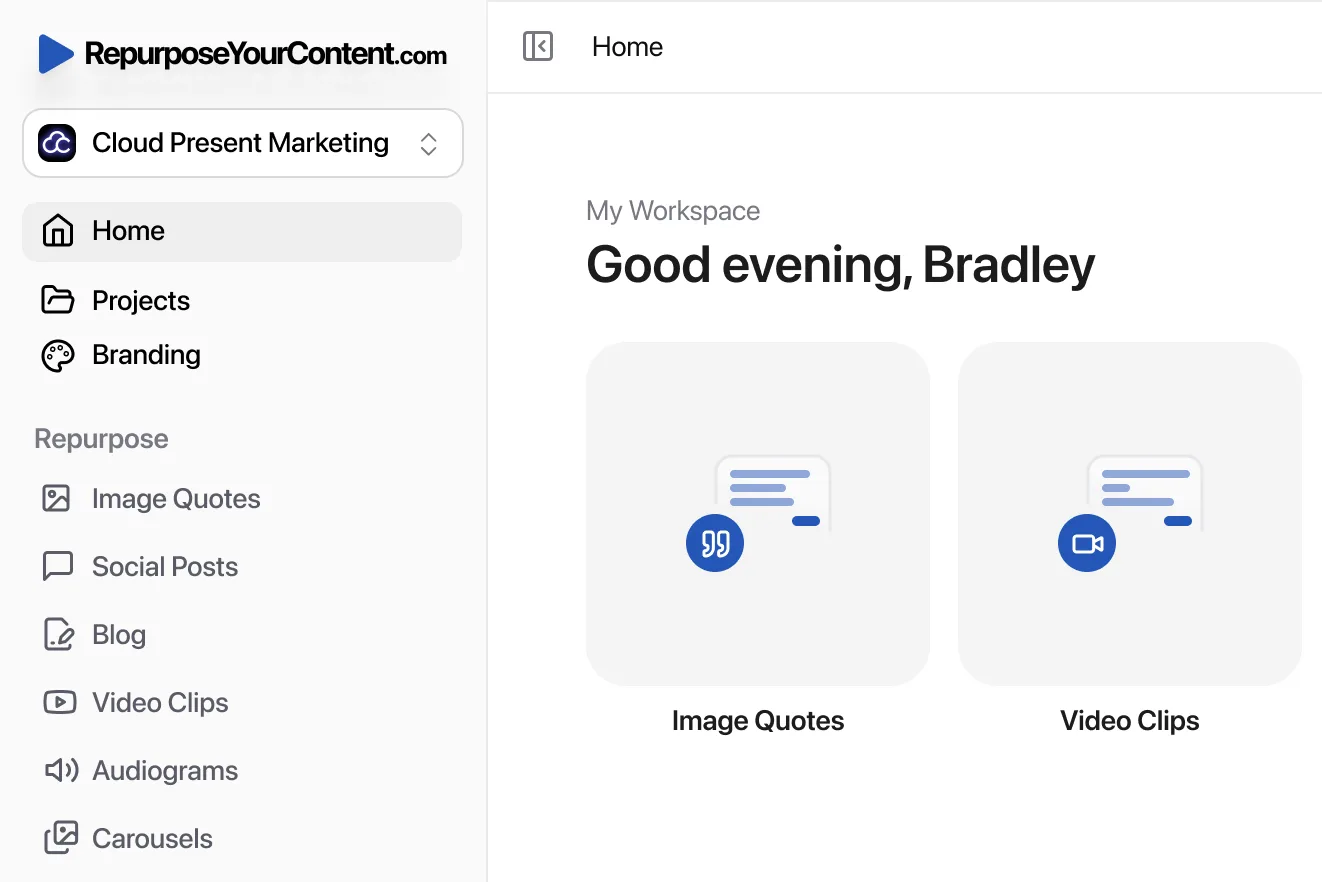
RepurposeYourContent fits this specific SaaS use case. You upload a webinar or paste a link, choose the content types you want, set how many outputs to generate, and the system creates platform-ready assets from the recording.
That matters because the outputs map directly to the manual workflow:
- Video clips replace the slow hunt for highlight moments
- Blog posts give content teams a draft built from spoken expertise
- Social posts turn speaker insights into publishable copy
- Audiograms support podcast-style distribution
- Image quotes pull useful speaker lines into branded visuals
- Newsletters turn the session into nurture content
- LinkedIn carousels organise the main ideas into swipeable format
- Timestamps help sales and marketing point buyers to the exact sections that matter
Why this fits SaaS teams
SaaS teams rarely need "more content" in the abstract. They need usable outputs tied to launches, campaigns, follow-up, and pipeline support.
A product webinar can become feature-focused blog content. A customer panel can become story-led nurture. An integration demo can become clips, a setup article, and social proof. The value is in shortening the distance between recording and distribution.
If you're also tightening the transcript and audio side of the workflow, WhisperAI has a useful piece on creating a powerful audio workflow with AI. It's relevant when your webinars need to serve both written and audio-first formats.
The practical gain
The biggest gain isn't novelty. It's consistency.
When the same workflow runs every month, your team stops rebuilding the machine. You run the webinar, generate the assets, review what's worth publishing, and push them into the right channels.
If you want to see the product itself, the main site is RepurposeYourContent.
Measuring Content Marketing for B2B SaaS Companies
If your reporting still starts with page views, you're making content harder to defend.
Leadership doesn't buy content because the blog looks active. They buy it because content influences pipeline, supports conversion, and reduces waste across the funnel.
For content marketing for B2B SaaS companies, the useful measurement framework is narrow. Track what content contributes to revenue decisions.
Start with pipeline, not traffic
The first question is simple. Which assets show up before meaningful commercial actions?
Useful metrics include:
- Content-sourced pipeline from buyers who first entered through a content asset
- Content-influenced pipeline where content supported the buying journey
- Trial or demo sign-ups tied to specific pages, webinars, or nurture paths
- MQL-to-SQL movement by content type
- Sales usage of assets in active opportunities
This gives you a better view than "organic sessions up this month". Traffic is context. Pipeline is the point.
Measure by asset type
Different SaaS content formats do different jobs. Report them that way.
| Asset type | What to measure |
|---|---|
| Comparison pages | Demo requests, assisted pipeline, sales reuse |
| Feature-focused blogs | Trial influence, product page clicks, time to next action |
| Integration content | Qualified visits from relevant accounts, demo influence |
| Customer stories | Sales usage, late-stage engagement, nurture clicks |
| Email nurtures from webinars | Click-through to product pages, meeting requests, trial starts |
This approach makes webinar-first programmes easier to justify. One source asset can influence several metrics across several teams.
Email deserves its own line item
A lot of SaaS content programmes under-report email because it feels like distribution, not content. That's a mistake.
In the UK B2B SaaS market, email marketing delivers £36 to £40 for every pound spent, according to Oliver Munro's SaaS marketing benchmarks. That makes email one of the clearest ways to turn content into attributable commercial value.
When you repurpose webinar insights into nurture sequences, you create a direct path from event engagement to pipeline movement. That's easier to measure than broad awareness content, and easier to defend in front of a CFO.
Report the webinar, the follow-up email sequence, and the downstream actions as one connected motion. That's how buyers experience it.
Keep the reporting simple enough to use
A good reporting pack should answer four things:
- Which content assets influenced pipeline
- Which formats moved buyers forward fastest
- Which webinar themes produced the most useful downstream content
- Where the team should invest next quarter
Don't flood leadership with dashboards they won't read. Give them a short narrative and a small number of commercial metrics.
What not to overvalue
Some metrics are still useful, but they shouldn't dominate the story:
- Raw impressions
- Social likes
- Blog publishing volume
- Unqualified traffic growth
- Average time on page without next-step behaviour
These can support diagnosis. They don't prove business impact on their own.
Strong SaaS content measurement ties output to movement. Not just attention. If your team adopts that standard, content stops looking like a support function and starts looking like a revenue contributor.
Build Your Content Engine Today
Most B2B SaaS teams don't need more ideas. They need a tighter system.
The pattern is clear. Broad content alone won't carry pipeline. Manual production won't scale efficiently. High-value SaaS content comes from product truth, customer context, and formats buyers can use.
A webinar-first model solves the operational side of that problem. One monthly session can feed product-led blogs, comparison support, integration content, customer proof, thought leadership, newsletters, clips, and sales follow-up. That gives your team one source of truth instead of a dozen disconnected briefs.
Small teams can compete well with this model because efficiency matters more than raw headcount. The teams that win aren't always publishing the most. They're publishing from the strongest source material, then distributing it across the right channels fast.
If you want to turn monthly webinars into a repeatable SaaS content engine, try RepurposeYourContent. Upload one recording and turn it into ready-to-publish clips, blog posts, social posts, emails, image quotes, audiograms, carousels, and more.
Tags: