How to Monetize a Podcast Without Wasting Episodes
Learn how to monetize a podcast with realistic CPM math, memberships, affiliates, and repurposed content strategies that actually scale in 2026.

You don't need a giant audience to make money from a podcast. You need the right mix of sales paths, and you need to stop waiting for a sponsor deal to rescue a show that isn't built for it yet.
The blunt truth is this. Ad-based revenue generally becomes realistic only after a show reaches meaningful scale. One independent guide puts affiliate offers and your own products first at 0 to 100 downloads per episode, donations and small direct sponsorships at 100 to 500, and direct sponsorship outreach plus premium content at 500 to 1,000. At 1,000+ downloads, multiple revenue streams and professional sponsorship rates become more likely. That is the framework for how to monetize a podcast without wasting months on the wrong pitch. Castos' monetization guide makes that threshold logic plain.
The Monetization Myth Most Podcasters Believe
Most podcasters think monetization starts with a sponsor logo. It doesn't. It starts with proof that your show can move attention, trust, and buying intent.
A sponsor is not buying your audio file. A sponsor is buying your audience, your niche, and your ability to show up like a real media property. If you only have a feed and a few episodes, brands see a hobby. If you have clips, posts, an email list, and a clear audience profile, they see a package.
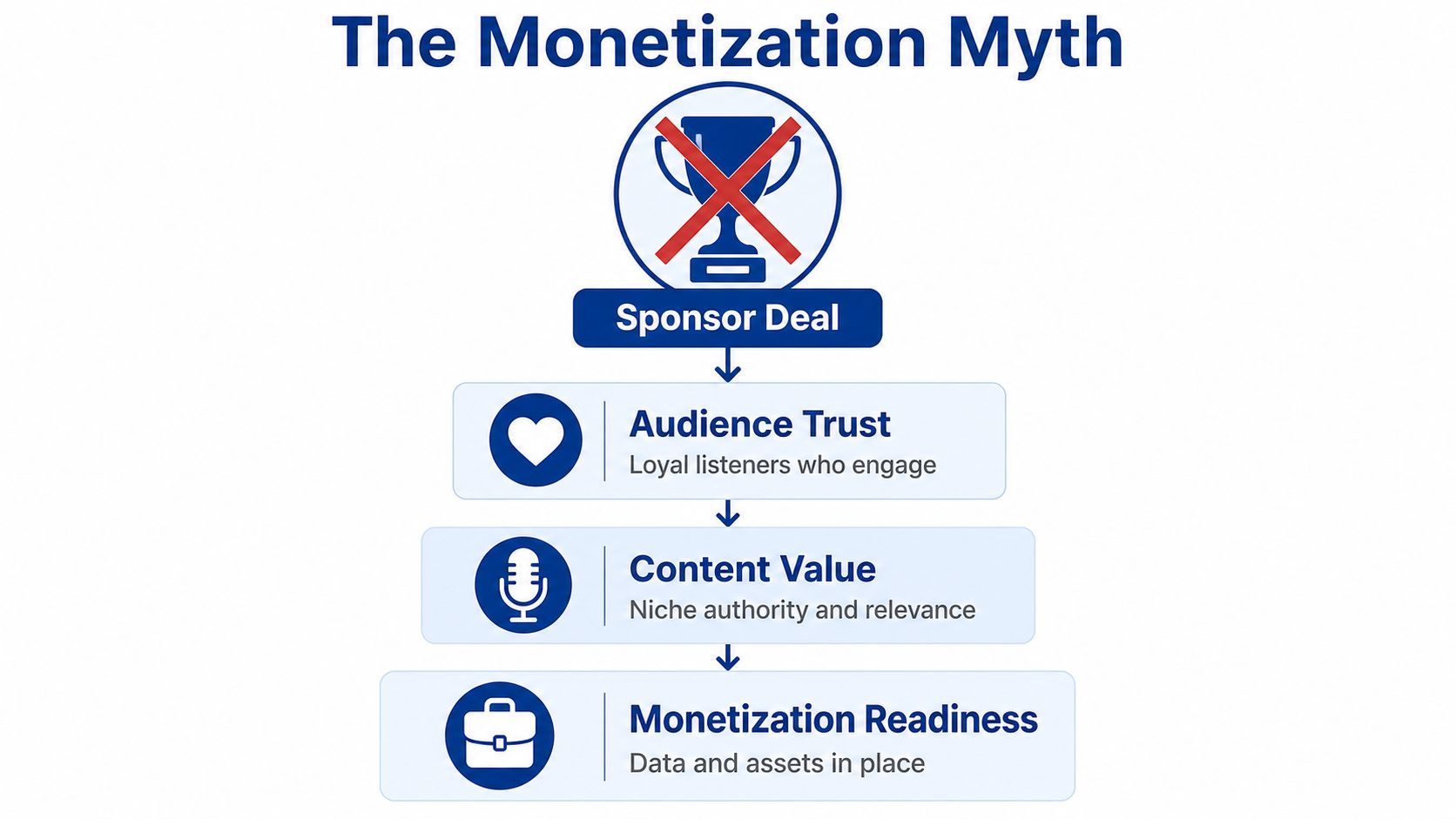
Practical rule: stop asking, “How do I get a sponsor?” Ask, “Which revenue paths fit my current audience, and what proof do I have this quarter?”
Treat monetization as a stack
A podcast earns more when it does more than sit in an app. A tight niche show can sell services, affiliates, memberships, and sponsorships in sequence. That is the smarter way to think about it.
The useful shift is simple. Monetization is not a single event. It's a stack of revenue paths. The right stack depends on where the show sits today, not where a media kit wants it to sit.
For a founder or B2B marketer, that means the early money usually comes from authority, not ad inventory. The show proves expertise. The offers convert that expertise into revenue.
The fastest mistake is waiting for downloads to tell you you're worthy. Downloads matter, but they're only one signal. Sponsors also want consistency, audience fit, and proof that you publish beyond audio.
What brands actually judge
Brands look at the whole footprint. They care whether the show feels active and whether the host can reach the buyer in more than one place. That's why repurposed clips, articles, and newsletters matter so much.
If the show looks like a one-channel hobby, sponsorship gets harder. If it looks like a distributed content engine, sponsorship gets easier.
The right question is not whether you qualify for money. It's which money you qualify for now. That answer changes the whole game.
Audit Your Show Before You Pick a Path
Start with your current data, not your ambition. Too many hosts build a membership page before they know whether listeners even want bonus content. That's backward.
A quick audit keeps you honest. It also saves hours of pointless setup.
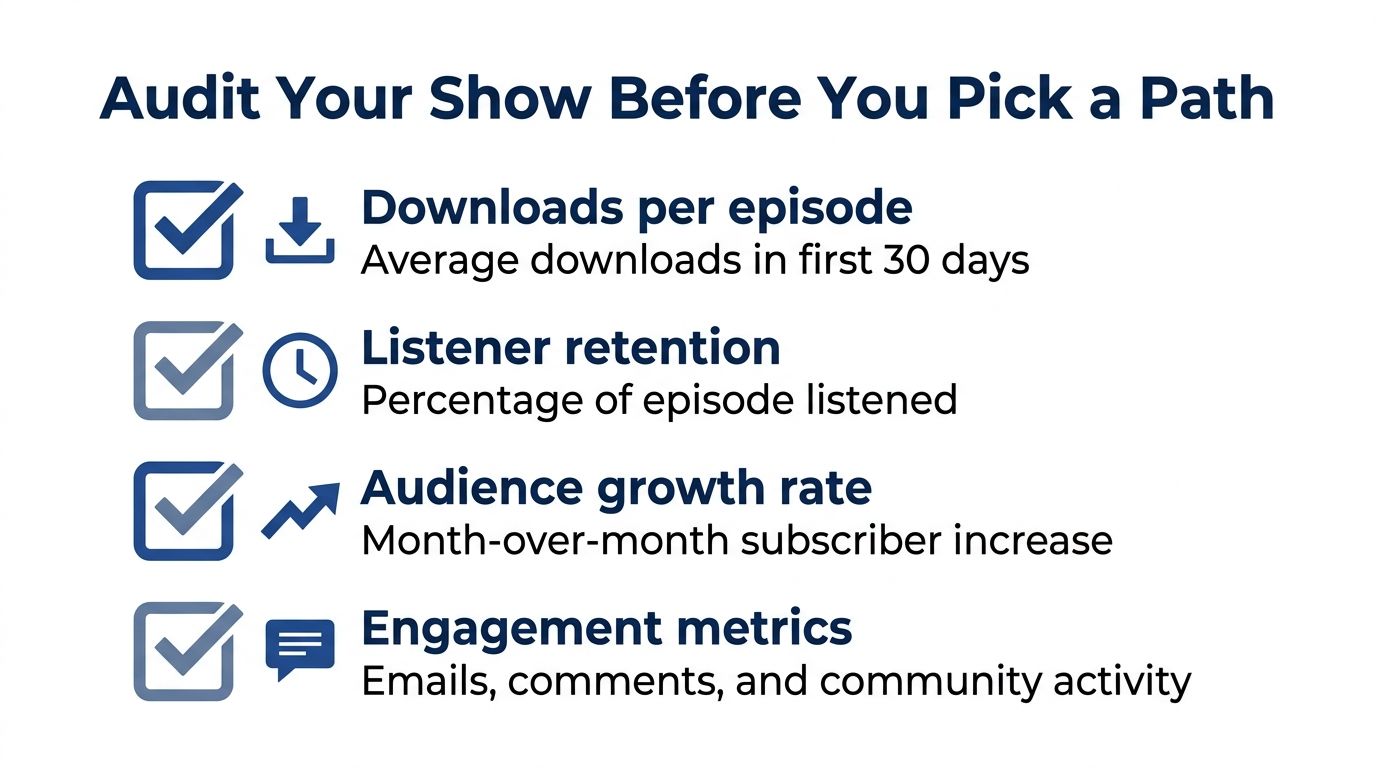
The four numbers that matter
Pull these from your hosting dashboard, email platform, and YouTube analytics if you use video.
- Downloads per episode. Use the average from the last 30 days, not a lifetime high.
- Listener retention. A show that keeps attention is easier to monetize than one that gets clicked and abandoned.
- Audience demographics. A niche B2B audience can be commercially attractive even when the raw audience is small.
- Owned channels. Email, YouTube, and LinkedIn give you advantages a podcast app never will.
A strong audit tells you whether you're too early for sponsors or ready to pitch premium packages. It also tells you whether listener support makes sense, or whether you should skip straight to direct-response revenue.
You can't price what you can't prove. Build the proof before you build the pitch.
Use a simple scorecard
Score your show in three buckets. First, audience size. Second, audience quality. Third, distribution outside audio.
If downloads are small but trust is high, sell your own offer first. If downloads are modest and the audience is loyal, listener support or a premium feed can work. If the show already travels well across video, email, and social, sponsors become easier to win.
That audit also tells you how much manual work you're signing up for. A show with weak retention and no owned audience is not ready for a big sponsor push. A show with clear niche authority and a growing email list is.
The best creators don't guess. They look at the numbers, then choose the path that fits.
Sponsorships and Ads With Honest CPM Math
Sponsorships sound glamorous until the math shows up. Then the whole decision gets clearer.
The formula is simple. Revenue per slot equals downloads times CPM divided by 1,000. That's the part most podcasters skip, and it's why so many sponsor dreams waste time.
What CPM actually means
Podcast ads are usually discussed in CPM terms, which means cost per thousand impressions. For a small show, the key question is not whether sponsorship exists. It's whether the audience size justifies the effort.
Here is the part to remember. Niche B2B and expert audiences can command stronger packages because advertisers pay for relevance, not raw volume. That's why a smaller show with buyer-fit listeners can beat a bigger, generic one.
| Downloads per Episode | $25 CPM | $35 CPM | $50 CPM |
|---|---|---|---|
| 1,000 | $25 | $35 | $50 |
| 5,000 | $125 | $175 | $250 |
| 20,000 | $500 | $700 | $1,000 |
A direct sponsorship pitch makes more sense once the show can show consistency and a credible audience profile. For many creators, that lands in the 500 to 1,000 downloads zone or above, depending on niche and package quality. The earlier threshold guidance is laid out in this podcast sponsorship glossary, and the key takeaway is that sponsors buy confidence as much as counts.
Why DIY sponsor management eats time
Managing sponsorships by hand is not passive. Someone has to pitch brands, answer email, negotiate placement, insert ad reads, track deliverables, and reconcile billing. For a solo host, that becomes a quiet part-time job.
The hidden cost is even worse for small shows. If the package is thin, the admin time can swallow the revenue. That's why audio-only ad deals often feel underwhelming until the show already has momentum.
A better play is to sell a sponsorship package, not a single read. Include audio, social clips, and a newsletter mention when you can. That makes the inventory more attractive and makes your show look like a media asset, not just a feed.
Memberships, Premium Feeds, and Listener Support
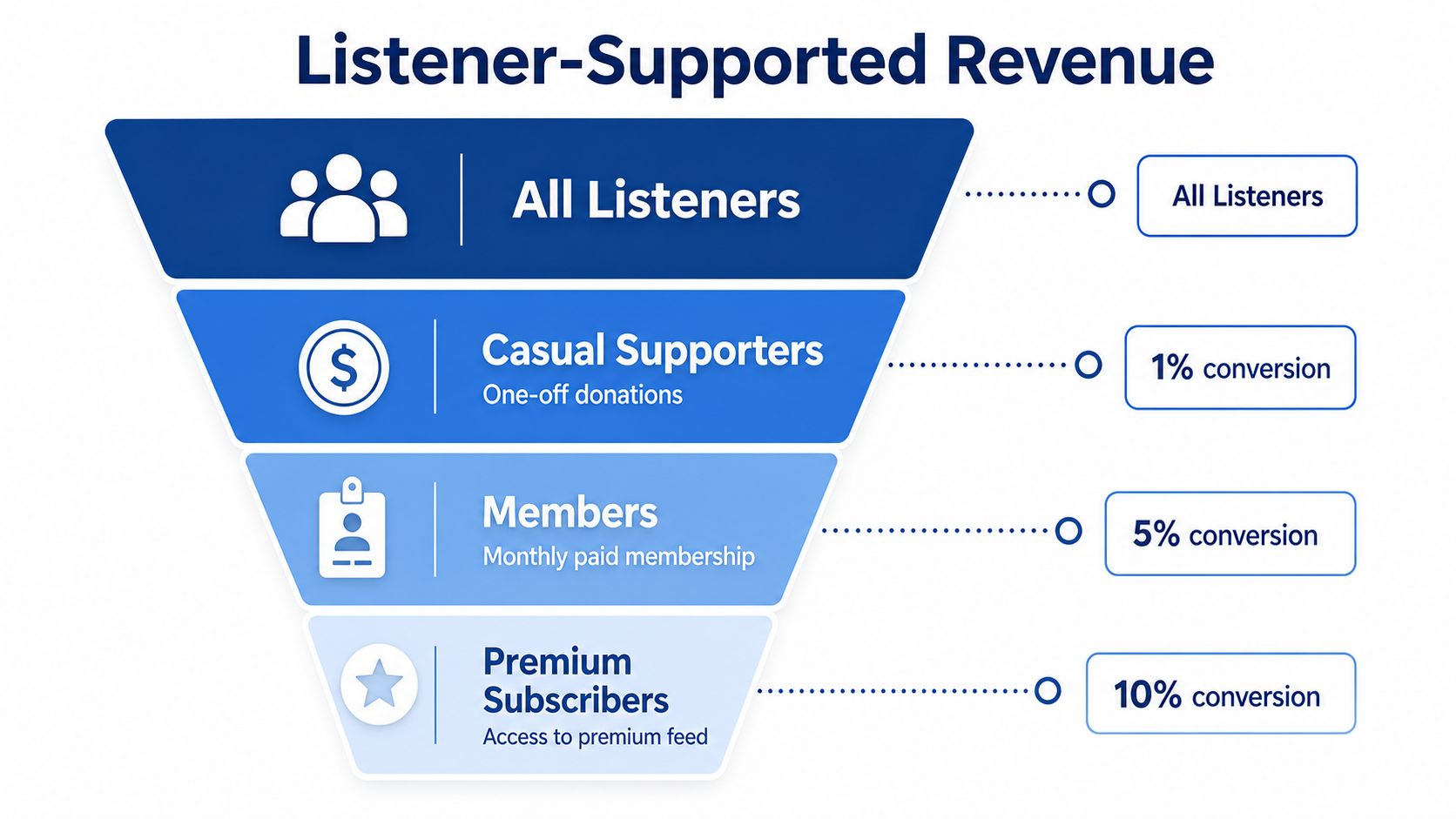
Listener-supported revenue works after the show has earned trust. That makes it a better fit for niche podcasts than broad, casual ones.
Spotify for Creators says podcast subscriptions are available in eligible countries once a show has at least 1,000 Spotify audience members in the last 30 days, 2,000 Spotify hours consumed in the last 30 days, and 3 published episodes overall. That is a real threshold, and it matters because it lets a show earn before it looks “big” by old podcast standards. Their guidance also points creators toward pricing research, exclusive content, and promotion to existing listeners, which is the order you should follow. Spotify for Creators lays that out clearly.
What people will pay for
A paywall around generic bonus chatter wastes time. Listeners pay for content that feels special, useful, or tied to their identity.
The offers that convert most often are simple:
- Bonus episodes. Behind-the-scenes stories, deeper analysis, or extended interviews.
- Early access. Let paid listeners hear episodes first.
- Ad-free feeds. Some audiences will pay to avoid interruptions.
- Community access. Private Slack, Discord, or member calls.
- Practical extras. Templates, checklists, and episode companion materials.
Memberships work best when the show already has repeat listeners. They work less well when the audience is broad and casual. A small, committed audience can still support a premium tier if the offer is specific and tied to what they already value.
Build the offer around listener behavior
Ask listeners what they would pay for before you build a full premium tier. A short survey and a few direct questions can save weeks of setup. If nobody asks for a premium feed, you just learned something useful.
Listener donations follow the same rule. They work when the host makes the ask clearly and repeats it often enough for people to remember. If the show never asks, the audience usually assumes support is not needed.
Owned channels help here too. A newsletter gives you a direct line to listeners who already care, and building a podcast-to-email newsletter strategy makes it easier to promote paid tiers without relying on platform algorithms.
Build the premium offer around what loyal listeners already ask for. Do not invent a membership and hope they care.
Affiliates and Your Own Products and Services
If you want the fastest path to revenue, start here. For many podcasts, this beats sponsorship hunting because it pays off through trust and relevance, not raw audience size.
A listener who trusts the host is already partway to buying. That is why your own service or product usually earns faster than chasing ad deals early. It also explains why a tight affiliate match can beat a generic read that feels bolted on.
Sell what your audience already asked for
Pick the offer that matches the show's real behavior, then build around that.
A few paths are worth testing first:
- Affiliate partnerships. Promote products the audience already needs.
- Digital products. Templates, checklists, workshops, and courses tied to episode topics.
- Services. Consulting, coaching, done-for-you work, or speaking services.
The host's expertise matters more than the download count. A founder podcast can sell advisory calls. A marketing show can sell audits or retainers. A niche operator show can sell templates or playbooks. The point is to match the offer to what listeners already come to the show for.
Affiliate marketing only works when the fit is tight. If the product feels random, listeners tune it out. If it solves the exact problem raised on the episode, it feels like part of the show instead of an interruption.
Keep the disclosure clean and the pitch short
Disclose affiliate relationships plainly. Say the relationship, explain what the product does, and move on. Long affiliate intros waste time and make the recommendation feel shaky.
Use affiliates as proof of taste, not desperation. If the audience sees the recommendation as useful, the conversion feels natural. If they smell random promo energy, trust drops fast.
A service or product should usually come before a membership idea. If the same listener questions keep coming up, package the answer into something paid. That can be a template, a short course, or a service package. The cleanest path is often the simplest one, and how to repurpose podcast episodes can help surface those repeat questions so you know what people would buy.
Repurposing the Recording Into New Revenue
A podcast episode is raw inventory, not a finished asset.
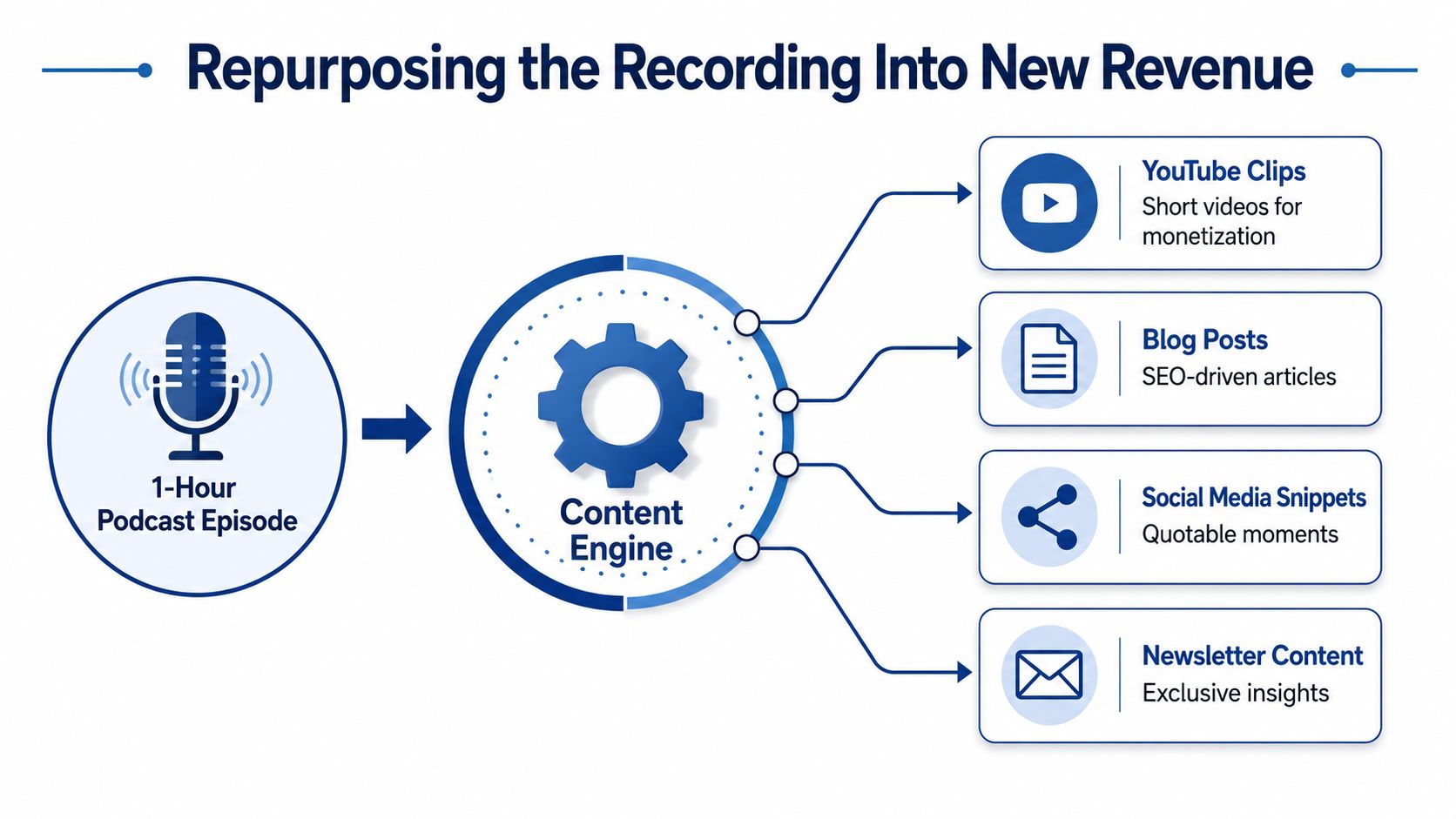
That matters because monetization usually grows through distribution, not through a single sponsor pitch. A show that leaves the recording in one place limits its reach. A show that turns one recording into clips, posts, articles, and newsletters creates more entry points for discovery, lead capture, and sponsor interest. A guide to repurposing podcast episodes shows the basic workflow, but the value comes from using that workflow to put the same episode in front of buyers more than once.
RepurposeYourContent's podcast repurposing service turns one recording into short clips, social posts, quote graphics, and a blog post, which is the kind of output that helps a show look bigger than its download count.
A real workflow for one episode
Start with the recording and build outward. One 45-minute interview can become the basis for an entire week of distribution, but only if you are disciplined about extraction and formatting.
Clip selection usually takes 1 to 2 hours. Pull the strongest moments first, then cut anything that sounds flat or repetitive.
Captioning and formatting usually takes 1 to 2 hours. Make each clip readable and native to the channel where it will live.
LinkedIn posts and newsletter copy usually take 1 to 2 hours. Turn the episode into text that drives clicks and replies instead of just replaying the audio.
Quote graphics and carousels usually take 2 to 3 hours. Use the sharpest lines and the clearest argument, not filler.
Blog post and SEO editing usually take 1 to 2 hours. Give the recording a search-friendly home so it can keep working after the publish week ends.
That is a real workload for anyone doing it properly. If the host is also running sales, booking guests, and managing the business, the production cost rises fast.
Sponsors buy reach across channels
Sponsors buy a footprint, not just an episode. If the show reaches buyers on audio, video, email, and social, the package is more valuable because the brand appears in more than one place.
That changes the pitch. The show is no longer just a podcast with a few listeners. It becomes a distributed channel with repeated exposure. Clips, articles, and newsletters prove that the audience can be reached in more than one format, which makes sponsor packages easier to sell.
A single recording can also feed YouTube ad revenue, newsletter sponsorships, and search traffic. Repurposing stops being a content chore and starts working as a revenue driver.
The Done-for-You Alternative and Next Steps
DIY repurposing sounds cheap until the hours stack up. One episode can turn into 8 to 12 short clips, 6 to 8 social posts, 4 to 6 quote graphics, 1 to 3 carousels, and a blog post, and that often takes a busy host 8 to 12 hours if they're competent. If they're not, it takes longer.
The faster option is simple. Send one podcast, webinar, keynote, interview, or meeting recording, and get back 20 to 30 ready-to-publish assets in 72 hours. That package can include video clips, LinkedIn posts, quote graphics, carousels, audiograms, and a blog post, all written in brand voice with unlimited revisions. Your time is about 15 minutes per recording.
Reality check: the expensive part is not the recording. It's the weeks of unfinished follow-through after it sits unused.
A workflow like that also changes monetization. More content means more distribution. More distribution means more sponsor proof, more leads, and more chances to sell your own offer. That's why this is a repurposing problem as much as a podcasting problem.
If the current show is sitting on strong recordings but weak distribution, stop patching it together. Book a call, or request a sample, and see what one recording looks like as a full content set.
Tags: