Podcast Repurposing Service: The 2026 Hiring Guide
Hiring a podcast repurposing service? This guide covers pricing, deliverables, and how to evaluate providers to turn one episode into 30+ content assets.

A podcast repurposing service turns a single audio or video recording into 20 to 30 ready-to-publish content assets and saves 4 to 6 hours of manual work per episode. That usually includes clips, social posts, quote graphics, show notes, a blog post, and newsletter-ready copy.
Most podcasters don't have a recording problem. They have a post-production problem. The episode gets published once, then stalls because clipping, writing, designing, and packaging everything else keeps getting pushed.
That's a bad trade. The podcasting market was valued at USD 32.48 billion in 2025 and is projected to reach USD 362.99 billion by 2035, driven by a worldwide listener base of about 584 million people in 2025 according to podcast industry growth data. More shows and more listeners mean more competition for attention after the episode goes live.
For buyers, the question isn't whether repurposing matters. It does. The question is whether hiring a podcast repurposing service makes more sense than burning internal time on work that rarely gets done consistently.
What Is a Podcast Repurposing Service
A podcast repurposing service takes one finished recording and turns it into a full set of marketing assets for different channels. Not just clips. Not just show notes. The useful services handle the full stack.
That usually means:
- Short video clips: cut for social discovery
- Written social posts: adapted for LinkedIn and other channels
- Quote graphics: built from strong one-liners
- Carousels: especially useful for B2B distribution
- Audiograms: for audio-first promotion
- A blog post: built from the episode's core ideas
- Show notes or summaries: for the episode page
- Newsletter copy: so the episode can reach an owned audience
A lot of people still confuse repurposing with basic editing. That's too narrow. Editing gets the episode ready to publish. Repurposing gets the episode seen, read, shared, and reused after publishing.
Why these services exist
The volume problem is obvious. Podcasting keeps growing, but post-production still eats time. Teams record the conversation, then get buried in everything that follows.
Practical rule: If a show publishes weekly but promotes sporadically, the bottleneck isn't recording. It's repurposing.
That's why this category exists. It fills the gap between “episode is live” and “episode is working across multiple channels.”
There's also a strategy gap. A recording contains far more usable content than most teams extract. One strong guest answer can become a clip, a quote card, a carousel slide, a LinkedIn post, and the hook for a blog article. That's the core logic behind this guide to what content repurposing actually means.
What a buyer should expect
A real service should deliver more than raw files dumped into a folder. It should produce assets that are usable without extra cleanup.
That means the provider should handle:
| What they receive | What they return |
|---|---|
| A podcast recording | Edited clips with captions |
| Topic context or brand notes | Written posts in the right voice |
| Basic brand kit | Branded graphics and carousels |
| Optional priorities | A blog post and supporting copy |
The best way to think about it is simple. A podcast repurposing service isn't a creative add-on. It's outsourced post-production and content distribution prep.
Typical Deliverables and What They Achieve
A weak service gives a podcaster “content.” A strong service gives assets with jobs.
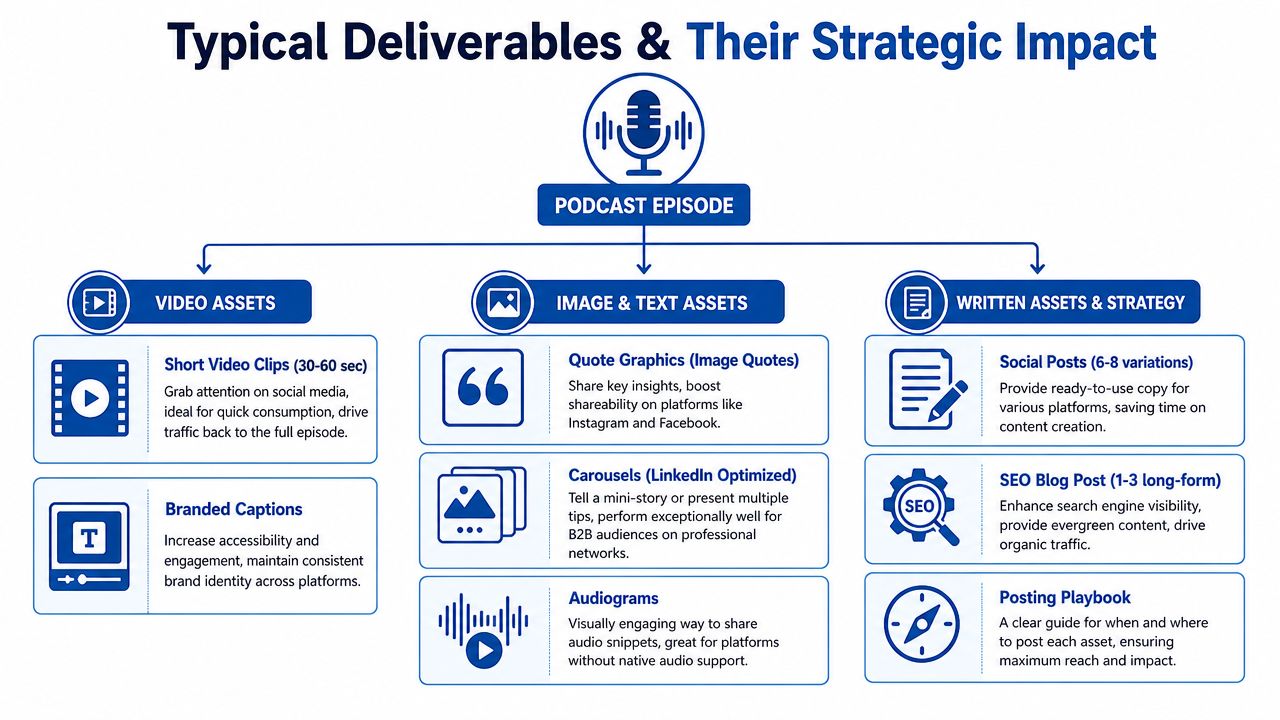
That distinction matters because every asset shouldn't do the same thing. Some create discovery. Some build authority. Some keep the guest involved. Some compound over time.
Video clips for reach
Short clips with branded captions are usually the most valuable deliverable for immediate attention. They travel better than a full episode link. They also work in muted feeds, where they are often initially encountered.
Good clip selection matters more than fancy transitions. A mediocre editor can cut a sentence. A good editor knows which moment earns a stop.
A buyer should expect clips that do at least one of these things:
- Create curiosity: a contrarian point or sharp opinion
- Teach one useful thing: one takeaway, one mistake, one framework
- Show personality: a guest reaction, story, or memorable phrase
Written assets for consistency
Most clipping services stop at video. That's a problem. The written layer is where consistency gets protected.
A solid package should include:
- Social posts: usually multiple variations so the team isn't forced to write from scratch
- Show notes: enough for a clean episode page
- Newsletter copy: so email doesn't become another forgotten task
- A blog post: the asset most podcasters never make themselves
The blog post is the sleeper asset. Social posts fade fast. A useful article keeps working in search and gives the episode a permanent home beyond the audio feed. That's why many teams use a system similar to the one in this article on how to repurpose podcast episodes.
The blog post usually has the longest shelf life. It's also the deliverable most DIY workflows skip first.
Visual assets for shareability
Quote graphics and carousels aren't filler. They package ideas differently.
Quote graphics work when the guest says something sharp and self-contained. They're easy to approve, easy to share, and useful for guest promotion.
Carousels are different. They turn one episode into a mini teaching asset. For B2B shows, that often means breaking one conversation into a sequence of lessons, steps, or mistakes.
Here's how the main deliverables stack up:
| Deliverable | Best use | What to look for |
|---|---|---|
| Short video clips | Discovery and reach | Strong hooks, clean captions, good judgment |
| Audiograms | Audio promotion | Useful when video isn't available |
| Quote graphics | Guest sharing and insight snippets | Strong quote selection and clean design |
| Carousels | Deeper engagement, especially on LinkedIn | Clear structure and readable slides |
| Social posts | Posting consistency | Voice match and platform fit |
| Blog post | Search visibility and evergreen value | Real framing, not recycled show notes |
A real workflow example
A practical repurposing workflow often looks like this:
- Step 1: A 45 to 60 minute episode gets reviewed for its strongest moments.
- Step 2: The editor flags several clips, key quotes, and the main teaching points.
- Step 3: A writer turns those into social posts, a blog draft, and carousel copy.
- Step 4: A designer builds quote cards, audiograms, and branded slides.
- Step 5: The podcaster receives a ready-to-publish package instead of another to-do list.
That's the difference between production and promotion. One creates the episode. The other makes the episode useful.
Podcast Repurposing Pricing DIY vs Done For You
Most buyers compare vendor pricing before they've priced their own time. That's backwards.
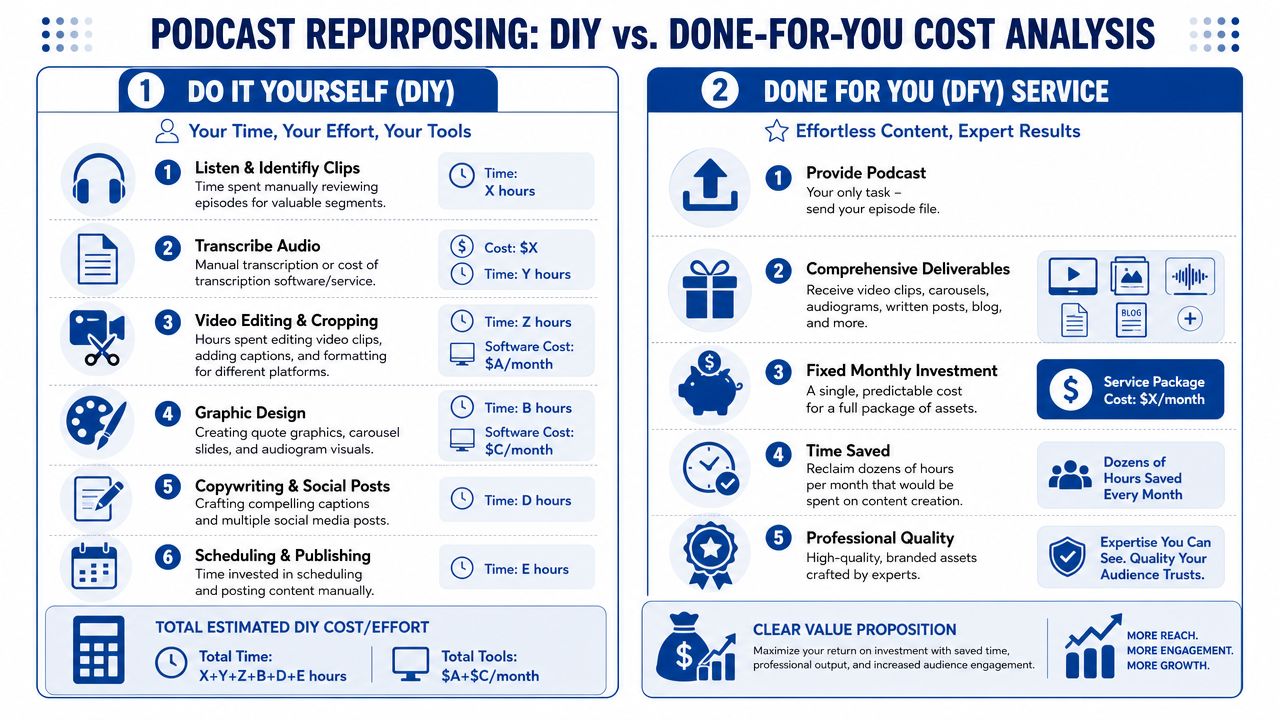
The hidden cost of DIY isn't just software. It's hours. Podcast content repurposing services save creators and marketing teams an average of 10 to 20 hours per episode according to this breakdown of podcast repurposing time savings. Even lean teams feel that drag fast.
What DIY really looks like
A realistic manual workflow per episode usually includes:
- Clip hunting: about 1 hour to review and mark moments
- Clipping and captioning: about 2 to 3 hours
- Writing posts and show notes: about 1 to 2 hours
- Creating graphics or carousel slides: about 1 hour
- Formatting a blog post: about 1 to 2 hours
That lands in the same range many teams already feel in practice. It also explains why consistency collapses after a few episodes.
For teams doing this with software, the work still exists. Descript or Castmagic can help. They don't replace editorial judgment, design polish, or a writer who can capture the host's voice. Anyone comparing options should read this roundup of podcast repurposing tools with the right expectation. Tools reduce friction. They don't eliminate labor.
Honest market pricing
Public pricing varies a lot, so the right way to compare providers is by model, not hype.
| Provider type | How they usually price | Tradeoff |
|---|---|---|
| Freelancer | Hourly or per project | Lower upfront cost, more management overhead |
| Agency | Monthly retainer | More capacity, usually less flexible |
| Productized service | Flat monthly or per-episode package | Clearer scope and easier budgeting |
A freelancer can work well when the buyer already has process, clip direction, brand standards, and editorial oversight. Otherwise, the podcaster becomes the project manager.
Traditional agencies usually cost more because they carry more overhead. That can be fine if the team also needs strategy, distribution support, and account management.
Productized services sit in the middle. They tend to work best for podcasters who want predictable output, fixed scope, and less coordination.
A better buying lens
The right pricing question isn't “What's the cheapest option?” It's “What does each finished asset cost, and how much internal time still gets burned?”
Cheap freelancers get expensive when the host still has to review every clip, rewrite every caption, and chase every deadline.
Per-episode economics matter. If one 45-minute recording becomes 30 assets, and the turnaround is fast enough to keep a publishing rhythm, the service is doing a real operational job. If the buyer still has to write half the package, it isn't done-for-you.
How a Podcast Repurposing Service Works
Most buyers imagine a messy handoff. It shouldn't be.
A professional workflow is simple on the client side and detailed behind the scenes.
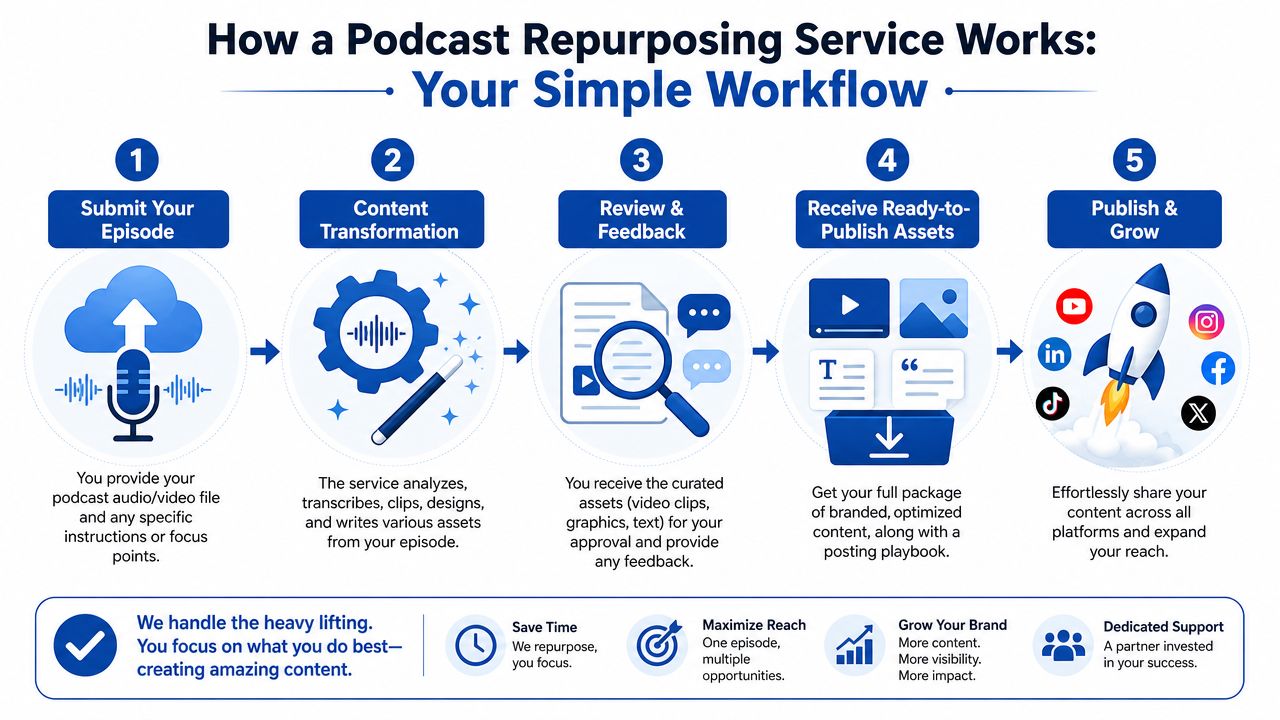
For a quick visual, this process is what a typical service should feel like:
The client side of the process
The podcaster sends one recording. That can be an audio file, video file, YouTube link, Zoom recording, keynote, interview, or sales call.
Then the service handles the heavy lift. The client may add simple notes such as:
- Priority topics: what should be emphasized
- Brand guardrails: tone, banned phrases, visual rules
- Guest context: names, titles, or offers worth mentioning
That's it. A good service doesn't need daily supervision.
What happens behind the scenes
The strongest workflows start with transcription. A technically optimized repurposing process begins with automated transcription using NLP-based tools such as Descript or Castmagic, which produce timestamped transcripts. Those timestamps help teams find strong moments without replaying the full episode and can reduce production time by 60 to 70 percent compared with manual methods, based on this workflow analysis of podcast repurposing.
From there, the service usually follows a chain like this:
- Transcript review: find the strongest ideas and clean up context.
- Clip selection: choose moments with actual stopping power.
- Asset drafting: write posts, blog copy, and graphic text.
- Design and edit: apply branding, captions, and formatting.
- Client review: send the package for approval or revisions.
The best services use automation for speed and humans for judgment.
That mix matters. Pure automation can produce output. It rarely produces taste.
What delivery should look like
A usable delivery package should include organized files, clear naming, and enough context that a marketing assistant or founder can post without asking follow-up questions.
That usually means:
- Ready-to-publish assets: not rough drafts
- Consistent branding: same tone and visual identity
- Clear file organization: by format and use
- A posting guide: what to post where and when
If the buyer receives a pile of exports with no structure, the service hasn't finished the job.
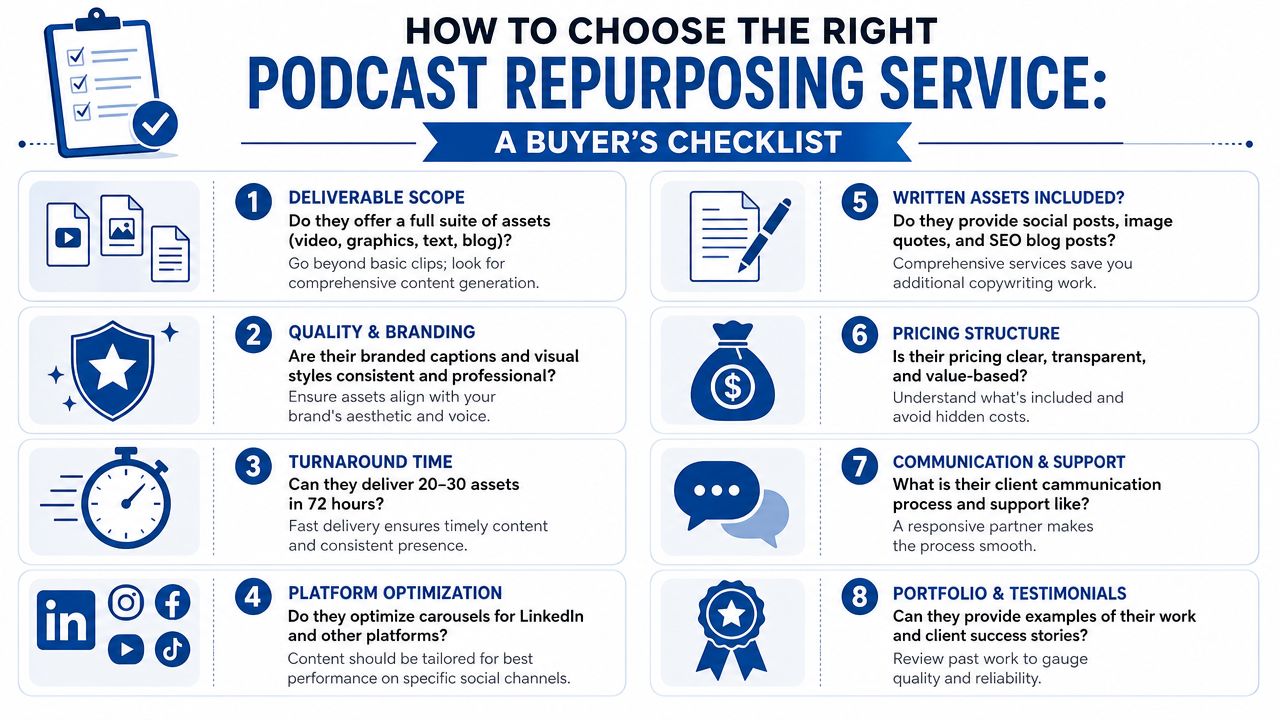
How to Choose the Right Podcast Repurposing Service
Most services look similar at first glance. They aren't.
The biggest mistake buyers make is choosing based on sample clips alone. Clips matter, but they're only one piece of the decision.
Start with judgment, not software
Every provider can say they use AI. That's not a differentiator.
A key question is whether the team can pick the right moments. Clip selection is editorial work. It requires judgment about what will stop a scroll, represent the guest well, and fit the brand.
A buyer should ask:
- How are clips selected: by transcript scanning only, or with human review?
- What makes a moment clip-worthy: insight, tension, story, contrarian take?
- Can they show written assets too: not just video samples
If the provider only talks about software, that's a warning sign.
Check the full deliverable scope
Many services call themselves repurposing providers when they only cut clips. That's partial fulfillment, not a full system.
A stronger partner should include both media and written output. That includes posts, quote graphics, carousels, and a blog article. Buyers looking at broader service models can compare options against this overview of what a content repurposing agency should actually do.
Use this checklist during evaluation:
| Evaluation point | What a strong answer sounds like |
|---|---|
| Deliverables | More than clips. Includes written and visual assets |
| Turnaround | Fast enough to keep weekly publishing on track |
| Brand voice | Can write in the host's tone, not generic marketer copy |
| Revisions | Clear and fair process, not endless upcharges |
| Contract terms | Flexible enough to test without getting trapped |
Look for strategy, not just volume
Most buyers often overlook the significant difference.
Most guides don't answer the critical question of how repurposed assets should align with sales funnel stages and measurable ROI. At the same time, 73% of B2B marketers cite recordings as their top source of leads, while only 1 in 3 have a scalable system, according to this analysis of the strategy gap in podcast repurposing. That's why some providers create lots of assets but still fail to move the business.
A folder full of clips isn't a strategy. A set of assets tied to discovery, nurture, and authority is.
A good provider should be able to explain which assets serve which job. Some should attract attention. Some should deepen trust. Some should support email, sales follow-up, or search.
Watch for red flags
A few buying signals are easy to spot.
- Clip-only offers: useful, but incomplete
- No written layer: means the buyer still has to create posts and blogs
- Vague timelines: usually lead to missed publishing windows
- No voice matching process: creates generic, lifeless copy
- Rigid contracts: bad fit for buyers who want a low-risk test
The provider doesn't need to be huge. It does need process, taste, and reliability.
The 15 Minute Alternative to DIY Content
DIY repurposing fails for one reason more than any other. It keeps asking busy people to do recurring work they don't have time to sustain.
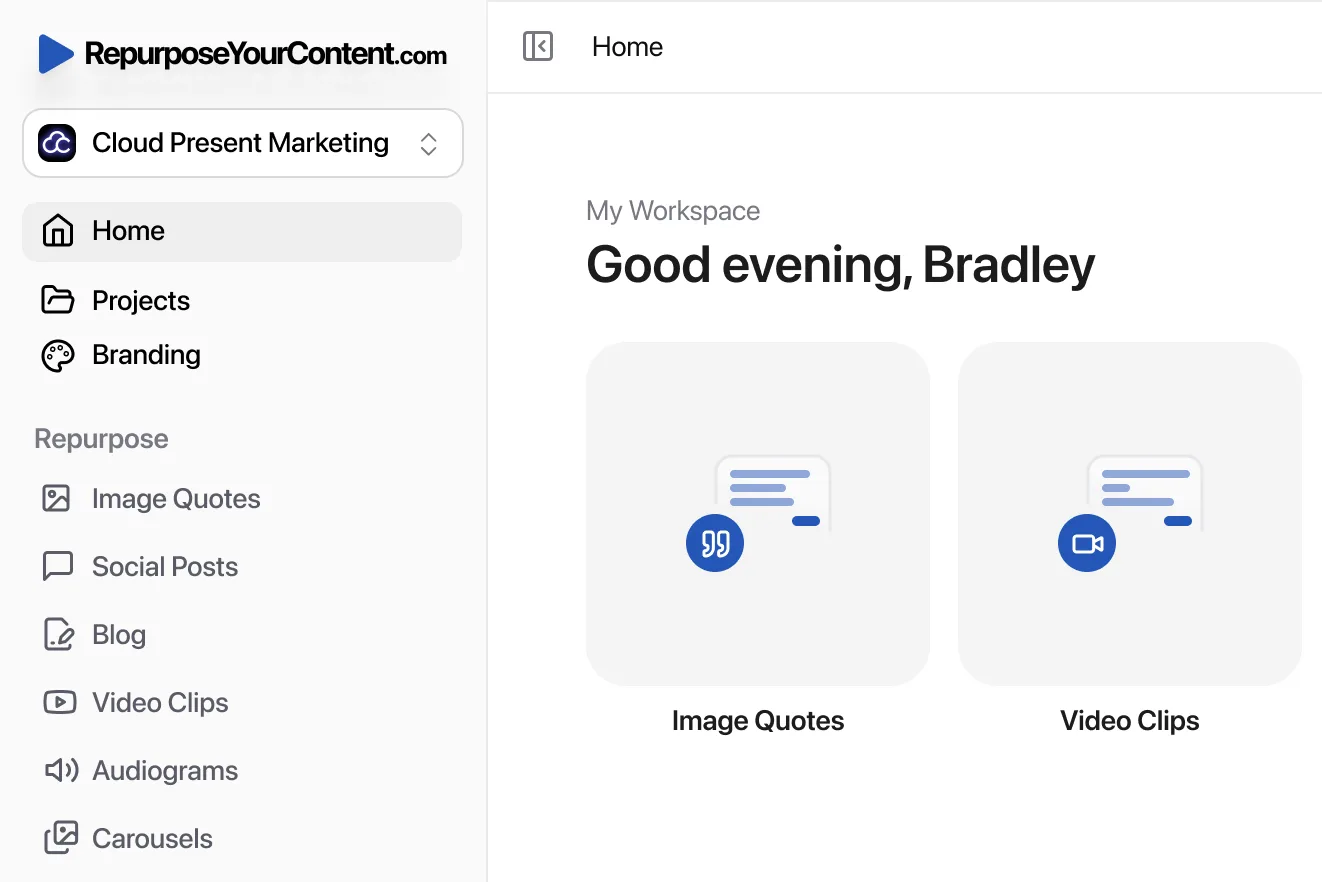
The done-for-you alternative is simpler. Send one recording, whether it's a podcast, webinar, keynote, interview, or meeting recording. In return, receive 20 to 30 ready-to-publish assets in 72 hours. That includes video clips, LinkedIn posts, quote graphics, carousels, audiograms, and a blog post, all in the brand's voice, with unlimited revisions. Total client time is about 15 minutes.
One 45-minute recording can become 30 assets. Pricing starts from $14 per finished asset. There's also a 72-hour turnaround guarantee or the client doesn't pay.
That model removes the weekly tax that causes most podcast promotion to break down after a few episodes. It also solves the most common market gap. Most clipping services stop at video. A complete done-for-you service adds the written layer too, including 6 to 8 social posts, 4 to 6 image quotes, 1 to 3 carousels, an SEO blog post, and a posting playbook. The client owns everything outright, with no watermarks.
For podcasters comparing options, that's the cleaner business decision. Keep spending hours every week on clipping, writing, and design. Or hand off one recording and get a month of content back.
A closer look at that model is available in this guide to a podcast to social media service.
If the goal is to hire a podcast repurposing service that removes work, not just shifts it around, RepurposeYourContent is built for that exact job. Send one recording and get back 20 to 30 on-brand assets in 48 to 72 hours, with unlimited revisions and a full written layer most competitors skip. To see samples or discuss fit, book a call with RepurposeYourContent or request a sample.
Tags: