Podcast to Email Newsletter: Your 2026 Growth Guide
Podcast to email newsletter - Learn how to turn your podcast into an email newsletter people read. This guide shows you how to find highlights, write

Turning a podcast to email newsletter starts with one move: pull out the most useful, forward-worthy idea from the episode and build the email around that single takeaway. The subject line should state the insight directly, so the email works as standalone value instead of a generic episode announcement.
Most podcasters are still renting their audience. They publish in Apple Podcasts, Spotify, YouTube, or social feeds, then hope people come back. Email is the one channel an algorithm can't take away, which makes it the missing layer in a serious content system.
Why Your Podcast Needs an Email Newsletter
Email remains one of the few channels with a clear revenue case. Designmodo's email newsletter statistics roundup cites returns in the roughly $36 to $40 range for every $1 spent. For a podcast, the bigger opportunity is strategic, not just financial.
A show gets attention. An email list gives you repeat access to the people who paid attention.
That matters because a podcast app is a listening platform, not a relationship system. You might earn a download, then lose contact for weeks. Email closes that gap. It gives you a direct line to listeners between episodes, launches, and sales cycles, and it gives non-listeners a way to benefit from your ideas without committing to 45 minutes of audio.
The shift is simple. Stop using email to announce the episode. Use it to make the episode useful in the inbox.
Promotion feed versus relationship asset
Founders often treat the newsletter like a release alert. New episode. Guest name. Link out. That format asks the subscriber to do more work.
A stronger newsletter delivers one idea worth reading, saving, forwarding, or replying to. That changes the job of the email. It stops being a traffic prompt and starts acting like editorial content that builds trust over time.
Practical rule: If the email only works after someone clicks play, it is a notification, not a newsletter.
That difference also changes your metrics. Downloads still matter, but they are not the clearest signal of inbox value. Replies show resonance. Forwards show that the idea traveled inside a team or peer group. Those are stronger indicators that your podcast to email newsletter system is creating relationships, not just squeezing out one more listen.
What a podcast to email newsletter actually does
A good newsletter turns the show into an owned asset with multiple jobs:
- Converts passive listeners into known subscribers
- Delivers useful ideas to people who skipped the episode
- Creates forwardable insights for colleagues and clients
- Supports lead capture and nurture without producing net-new content every week
That last point matters for ROI. Writing a strong newsletter from scratch takes time. Pulling a clear argument from an existing episode is faster, but it still requires judgment. Someone has to choose the right angle, tighten the copy, and shape it for inbox utility instead of social-media-style hooks. A solid podcast content repurposing strategy treats that work as a core editorial process.
Done well, the newsletter becomes the place where your audience hears from you more often, with less friction, and with more intent. That is how a podcast stops being a content asset you publish and starts becoming a relationship asset you can build on.
Four Podcast Newsletter Formats That Work
Most podcast newsletters fail because the format is wrong. They copy the show's structure into the inbox. That usually means bloated summaries, lazy show notes, and links nobody clicks.
This comparison works better.
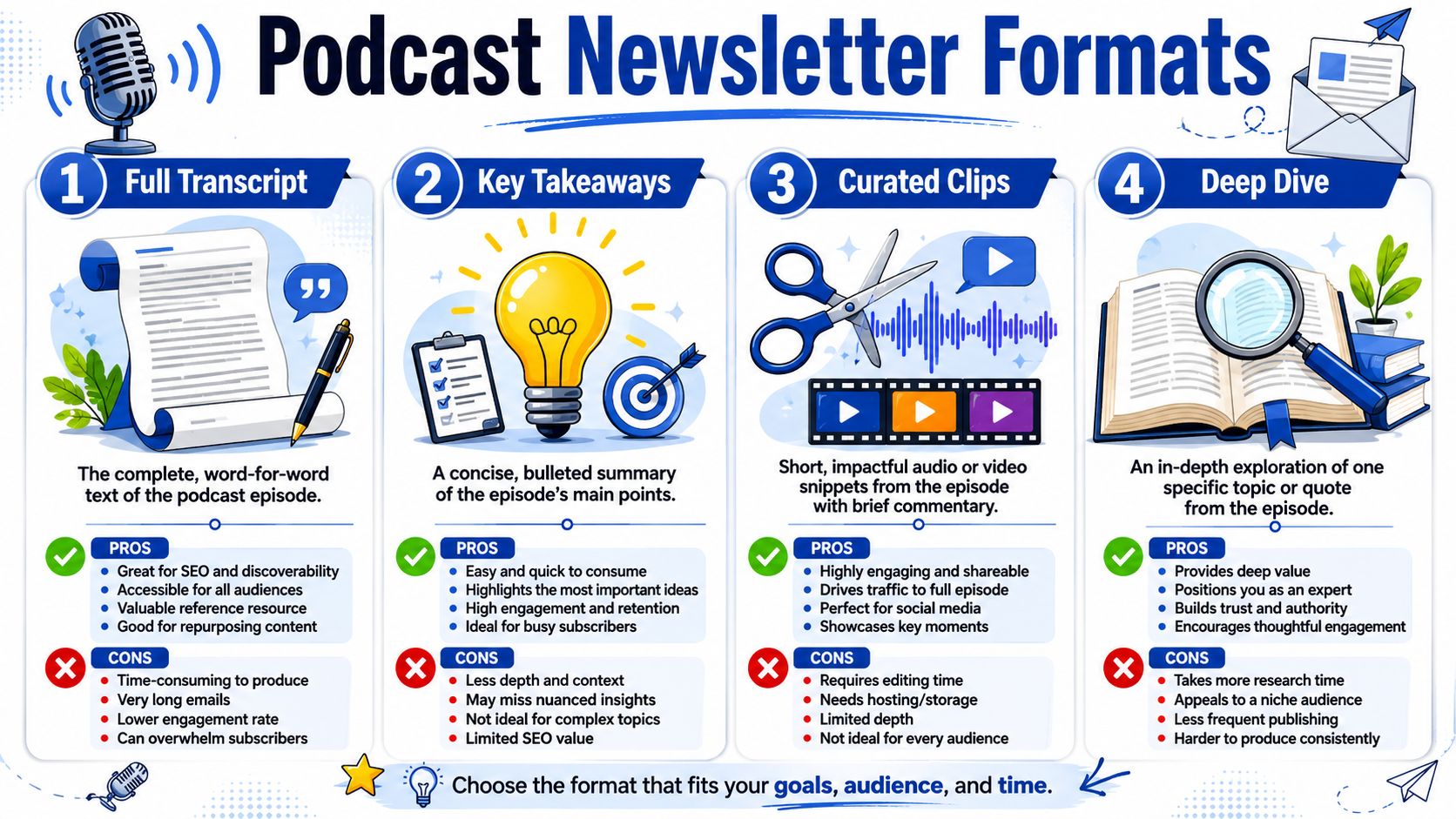
The takeaway digest
This works well for interview shows with several practical points in one episode.
It pulls out three to five sharp takeaways, each written in plain language. Busy readers can skim it in under two minutes. Listeners get a recap. Non-listeners still get value.
Best use case: broad business podcasts, recurring expert interviews, weekly roundups.
What works: short bullets, one sentence of context, one link to the full episode or one timestamped moment.
What doesn't: turning the digest into a transcript with bullet points. The goal is compression, not documentation.
The single-insight deep dive
This is usually the strongest format for B2B shows.
Instead of summarizing the episode, the email takes one insight and expands it. One claim. One framework. One lesson worth forwarding to a colleague. Such an approach enables the podcast to email newsletter model to function as a genuine editorial product.
Social clips reward tension. Inbox content rewards usefulness.
Best use case: founder-led shows, niche B2B topics, episodes with one unusually strong argument.
Trade-off: it takes more editorial judgment. Someone has to choose the right idea, then sharpen it.
The quote-led story
This format opens with one line from the episode, then builds the email around it.
A strong example would be a blunt opinion, a memorable observation, or a sentence that reframes a common belief. The quote acts as the hook. The body explains why it matters, where it applies, and what to do next.
Best use case: interview podcasts with strong guests, personality-led brands, shows with a clear point of view.
Risk: many quotes sound good in audio and flat in text. If the quote needs a full paragraph of setup, it probably isn't the right anchor.
The Q&A excerpt
This one lifts a short exchange from the episode and edits it for readability.
It works when the back-and-forth itself carries the value. A host asks a sharp question. The guest gives a direct answer. The newsletter presents the exchange, trims the filler, and adds a short takeaway below it.
| Format | Best for | Main strength | Main weakness |
|---|---|---|---|
| Takeaway digest | Multi-topic episodes | Fast to skim | Can feel generic |
| Single-insight deep dive | Niche B2B podcasts | Highest standalone value | Needs stronger editing |
| Quote-led story | Personality-led shows | Strong hook | Quote quality matters |
| Q&A excerpt | Interview podcasts | Preserves voice | Needs cleanup for text |
The wrong choice is usually the same every time. Full transcript. It creates work for the reader and almost never earns attention in the inbox.
How to Turn Podcast Audio Into an Email Newsletter
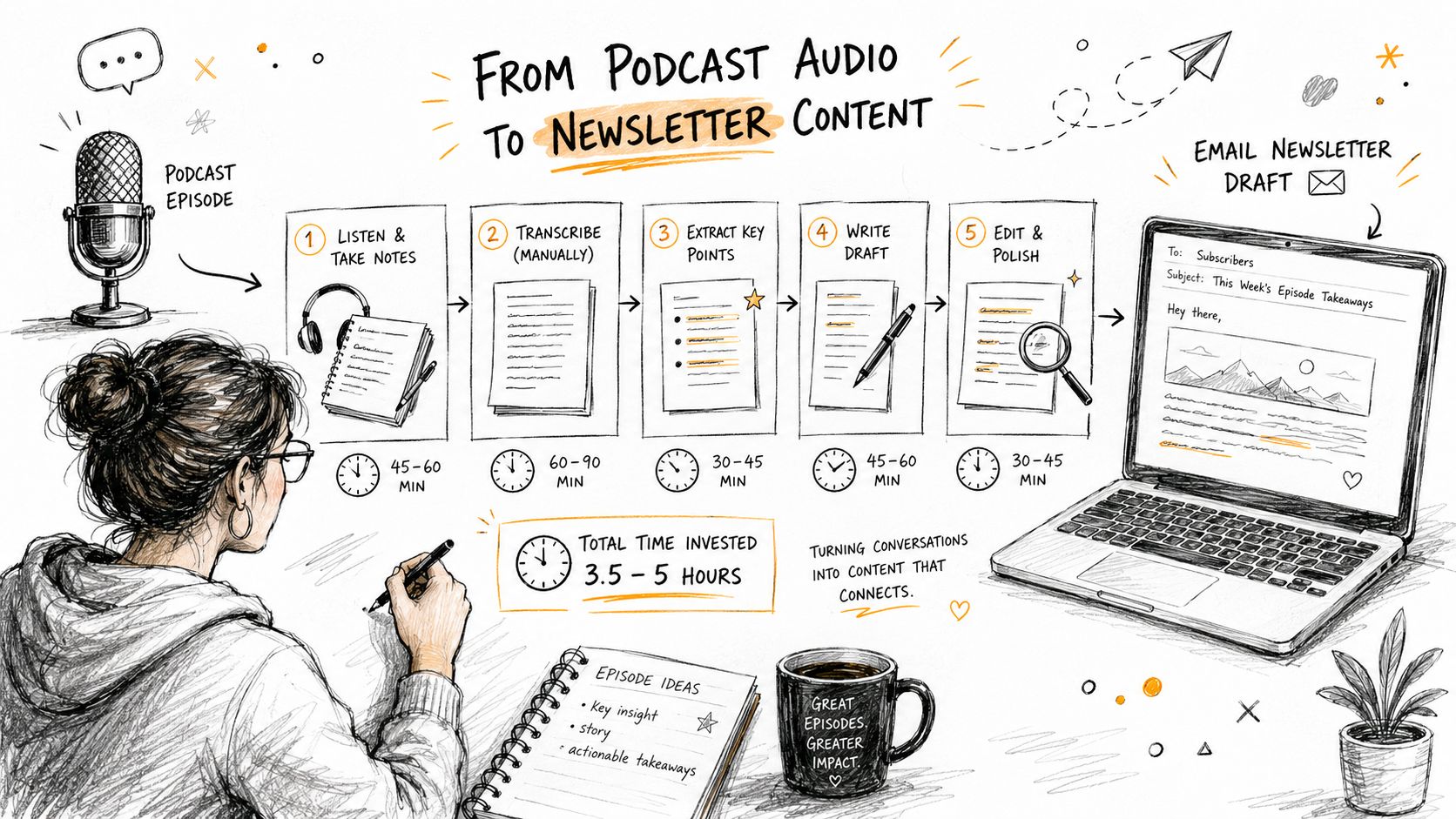
The manual workflow isn't hard. It's just slower than most founders expect. One good email from one episode usually takes 2 to 3 hours of focused work, sometimes longer if the transcript is messy or the episode has too many possible angles.
Step 1. Get the transcript cleaned
Start with the audio file. Generate a transcript, then clean speaker labels, filler words, and obvious transcription errors. That usually takes 20 to 40 minutes for a standard episode, even with decent transcription software.
If the transcript quality is poor, everything downstream gets slower. That's why teams often start by fixing this part of the workflow with a guide like how to transcribe video automatically.
Step 2. Find the forwardable moment
At this point, most podcasters make the wrong choice.
They pick the most dramatic moment because that's what performs on social. But email isn't a feed. It lives or dies on utility. The best email snippet is the moment a subscriber could forward to a colleague with a note that says, "This is relevant to what you're working on."
That selection work usually takes 45 to 60 minutes. Sometimes more.
Look for:
- A useful framework someone can apply today
- A specific decision point that changes how a reader thinks
- A transferable story with a lesson beyond the guest's situation
- A concise answer to a question buyers already ask
Skip the clips that only work because of tone, conflict, or personality.
A forwarded newsletter recruits subscribers the show never had to chase.
Step 3. Pick one format and write for skimmers
Audience behavior is shifting toward shorter, skim-friendly, text-first formats, and the stronger approach is to create email-first assets like original takeaways, checklists, or community prompts rather than straight transcript summaries, as covered in WhisperTranscribe's article on growing a podcast audience with a newsletter.
A practical workflow looks like this:
- Choose one angle: don't cover the whole episode.
- Write a short hook: one or two sentences that frame the problem.
- Deliver the insight: explain the idea in plain language.
- Add one CTA: reply, forward, or click to a specific moment.
Writing and editing usually takes 45 to 75 minutes if the thinking is already clear.
Step 4. Write subject lines like claims, not announcements
The subject line should carry the insight. Not the housekeeping.
Three patterns tend to hold up well:
- Standalone claim: a sharp sentence pulled from the episode's core idea
- Specific number with tension: useful when the number itself carries meaning
- Reader question: the problem the episode answers, phrased like a real concern
Good subject lines don't require knowing the show exists. "Episode 51 is live" only works for loyal fans. "Why most category creation fails in year one" works for anyone in the target market.
Step 5. Serve listeners and non-listeners in the same email
The email should work on its own first.
Then it should give the curious reader a small next step. Not "listen to the full episode." That's too big an ask for most inbox relationships. A more effective CTA points to one useful moment inside the episode.
For example:
- Reply CTA: ask whether the reader agrees
- Forward CTA: suggest sharing with a teammate
- Specific-moment CTA: point to one timestamped section with a clear payoff
That final packaging and send setup usually takes 15 to 30 minutes.
The full DIY process is manageable. It just keeps eating half a day every week.
Turn Your Back Catalog Into a Nurture Sequence
A new subscriber will rarely start with your latest episode. They want the fastest path to your best thinking.
That is why the back catalog matters. Old episodes are not archive material for vanity metrics. They are raw material for trust. A strong nurture sequence uses past episodes to help a subscriber solve a problem, understand your point of view, and start a conversation with you by email.
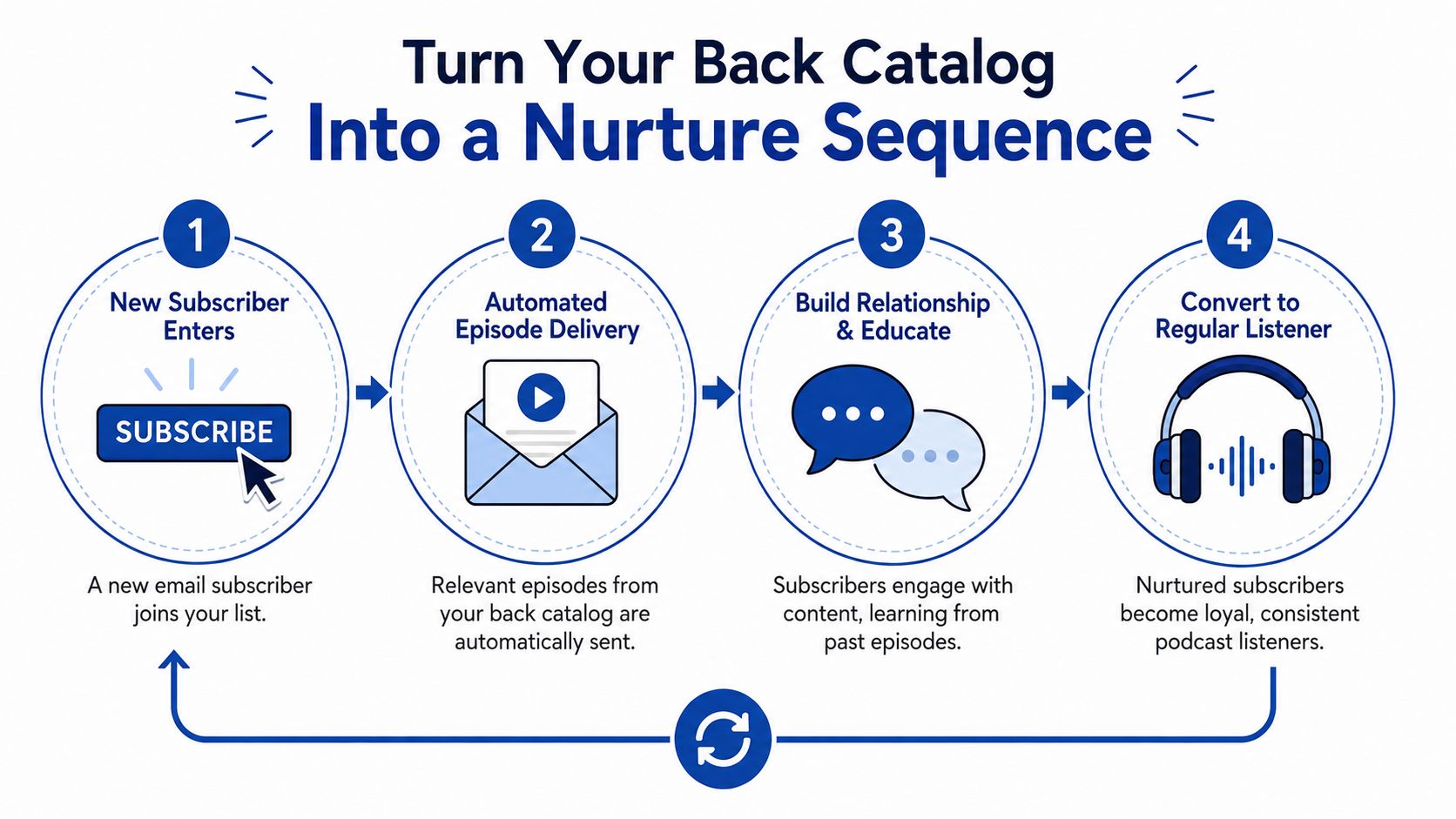
A simple four-email sequence
A practical sequence looks like this:
Welcome and promise
Deliver the signup incentive right away. Then set expectations. Tell subscribers what kind of insights they will get, how often you email, and why staying subscribed will be useful.Start here episode
Send one foundational episode that explains your core argument or method. Do not frame it as "go listen to the show." Frame it as "start with this idea because it will make the rest of my emails more useful."Best lesson from the archive
Pull one durable insight from an older episode and write the email so it stands on its own. The episode link is secondary. The email should still deliver value even if the reader never presses play.Conversation email
Ask for a reply with one specific question tied to the subscriber's current problem. Replies do more for list quality and relationship depth than another passive click.
That last point gets missed. If the sequence only trains people to consume, it behaves like a promotion channel. If it trains people to respond, it starts acting like a relationship asset.
How to choose the episodes
Pick episodes for inbox utility, not social media appeal.
The right choices usually include:
- Cornerstone episodes that explain your framework or point of view
- Evergreen interviews with lessons that still hold up
- Episodes tied to a reader problem you can address in a short email
- Episodes with a natural next step, such as a reply, forward, or resource
Skip episodes that depended on news, trends, or guest popularity. They may have performed well when published and still fail inside a nurture sequence because the context is gone.
A simple filter helps. Ask three questions:
- Will this help a new subscriber make a better decision?
- Can the lesson be understood in under two minutes of reading?
- Does it invite a reply or a forward?
If the answer is no, leave it out.
Teams that do this well usually build the sequence from a repeatable podcast episode repurposing process. One recorded conversation can feed the newsletter, onboarding emails, clips, and blog content. The trade-off is production time. Building that system by hand works, but it turns your archive into another writing project that keeps landing back on the founder's calendar.
The Done-for-You Alternative
Founders rarely struggle with ideas. They struggle with production capacity.
A podcast newsletter sounds efficient until the work starts stacking up. Someone has to review the transcript, find the useful angle for the inbox, write the email, edit it, format it, load it into the ESP, and send it. Then the same episode still needs supporting assets if the team wants the newsletter, the show, and the rest of the content calendar to stay aligned.
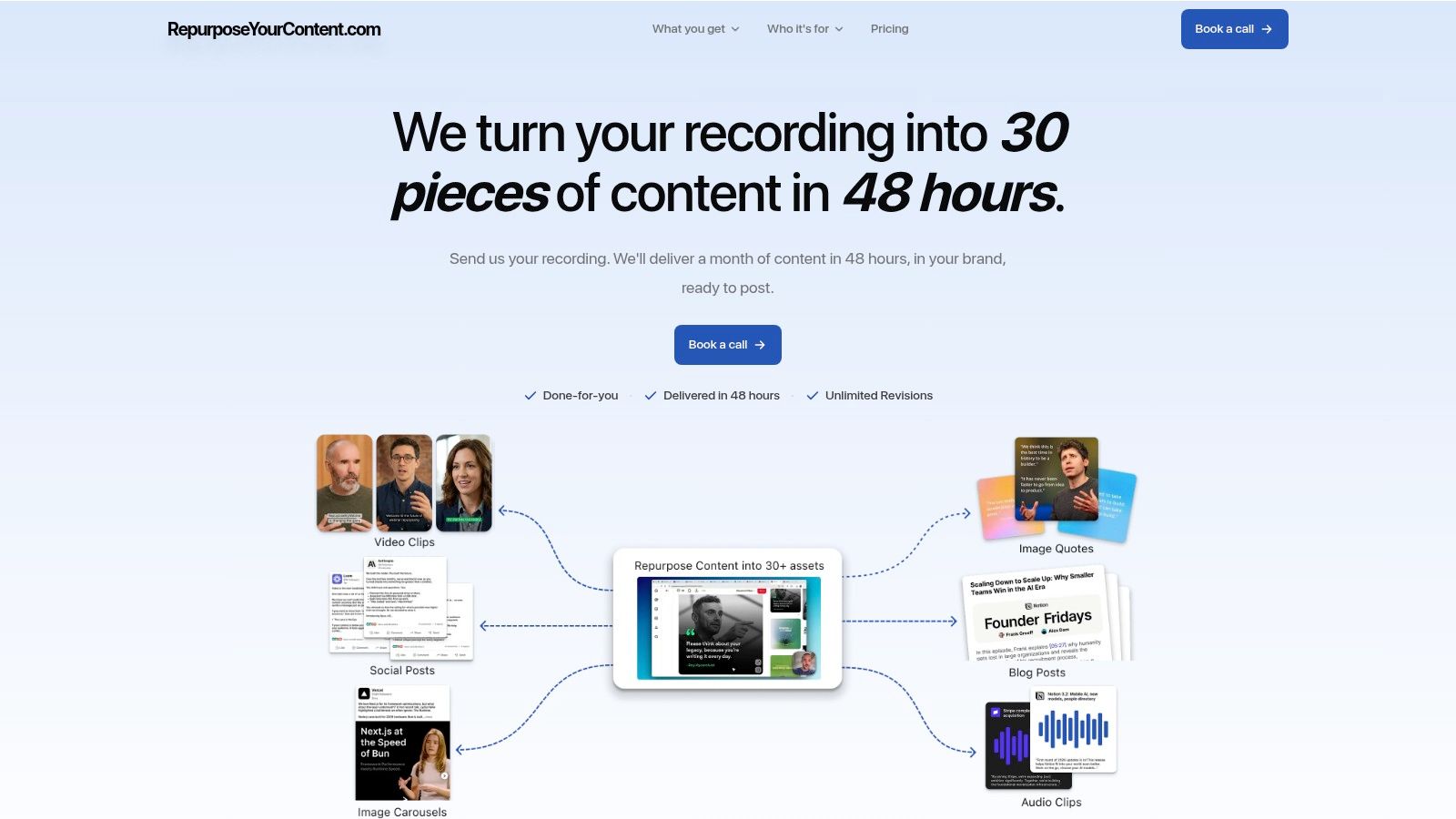
That workload is where a service can make sense. With RepurposeYourContent's email sequences service, the model is simple: the team sends a recording, and the finished email assets come back a few days later. That can include the newsletter itself plus supporting pieces such as clips, social posts, and a blog draft, without pulling the founder back into another round of content production.
A key benefit is operational. A done-for-you setup gives the newsletter an owner, shortens turnaround time, and keeps publishing from depending on spare hours that never appear. That matters if the goal is to turn the email list into a relationship asset, not just another channel for episode promotion.
Decision filter: If the newsletter keeps getting pushed because nobody has time to turn recordings into usable emails, a service is often cheaper than the internal delay.
Some teams should still keep it in-house. If the brand voice is highly specific, the insights are tightly tied to sales conversations, or the volume is low, writing internally may be the better call. But if the choice is between shipping consistently with outside help or letting strong podcast material sit in the archive, the cost of doing it yourself is usually lost momentum, inconsistent follow-up, and fewer chances to earn replies and forwards.
How to Measure Newsletter Performance
Open rate gets too much attention. It isn't useless, but it doesn't tell the full story, and privacy changes made it less reliable. For a podcast newsletter, the better question is simpler: is the email building a relationship that compounds?
The strategic frame matters here. Evidence suggests the newsletter works better as a direct relationship channel for loyalty and repeat listening, rather than a top-of-funnel acquisition tool, as discussed in Growth in Reverse's analysis of podcasts for newsletters.
What to watch instead
A healthier scorecard looks like this:
- Replies: readers trust the sender enough to start a conversation
- Forwards: the content is useful enough to share internally or with peers
- Clicks to specific moments: readers want the next layer of depth
- Qualitative feedback: readers mention which ideas helped them think differently
Those signals are harder to fake than an open.
The best podcast newsletter doesn't just send traffic back to the episode. It gives the audience a reason to stay close to the show between episodes.
A practical reporting lens
A simple review process each month can answer three questions:
| Question | What to look for |
|---|---|
| Are subject lines working? | More replies, forwards, and clicks on insight-led emails |
| Is the content format right? | Stronger engagement on takeaways, deep dives, or Q&A emails |
| Is the CTA too big? | Weak response when the only ask is a full-episode listen |
This is also where broader content marketing ROI measurement helps. A newsletter should be judged by relationship depth, not just raw send metrics.
For teams building from recorded content beyond podcasts, the same principle applies in this guide to creating email newsletters from video content. The asset has to stand on its own first. Distribution comes second.
If the podcast has an email list that's barely used, or no list at all, the fix isn't more episode announcements. It's a better conversion and nurture system built from the ideas already sitting in the archive.
Book a call or request a sample, and get a real example of how one recording can turn into a finished podcast to email newsletter workflow.
Tags: