How to Promote a Podcast Episode After Launch: A Playbook
Learn how to promote a podcast episode after launch with a 30-day playbook. Go beyond a single announcement and use repurposed assets to maximize reach.

To promote a podcast episode after launch, run a 30-day promotion plan instead of a one-post announcement. The first day should activate your audience and your guest, then the next few weeks should spread clips, quote graphics, email mentions, and a blog post across the channels your buyers already use.
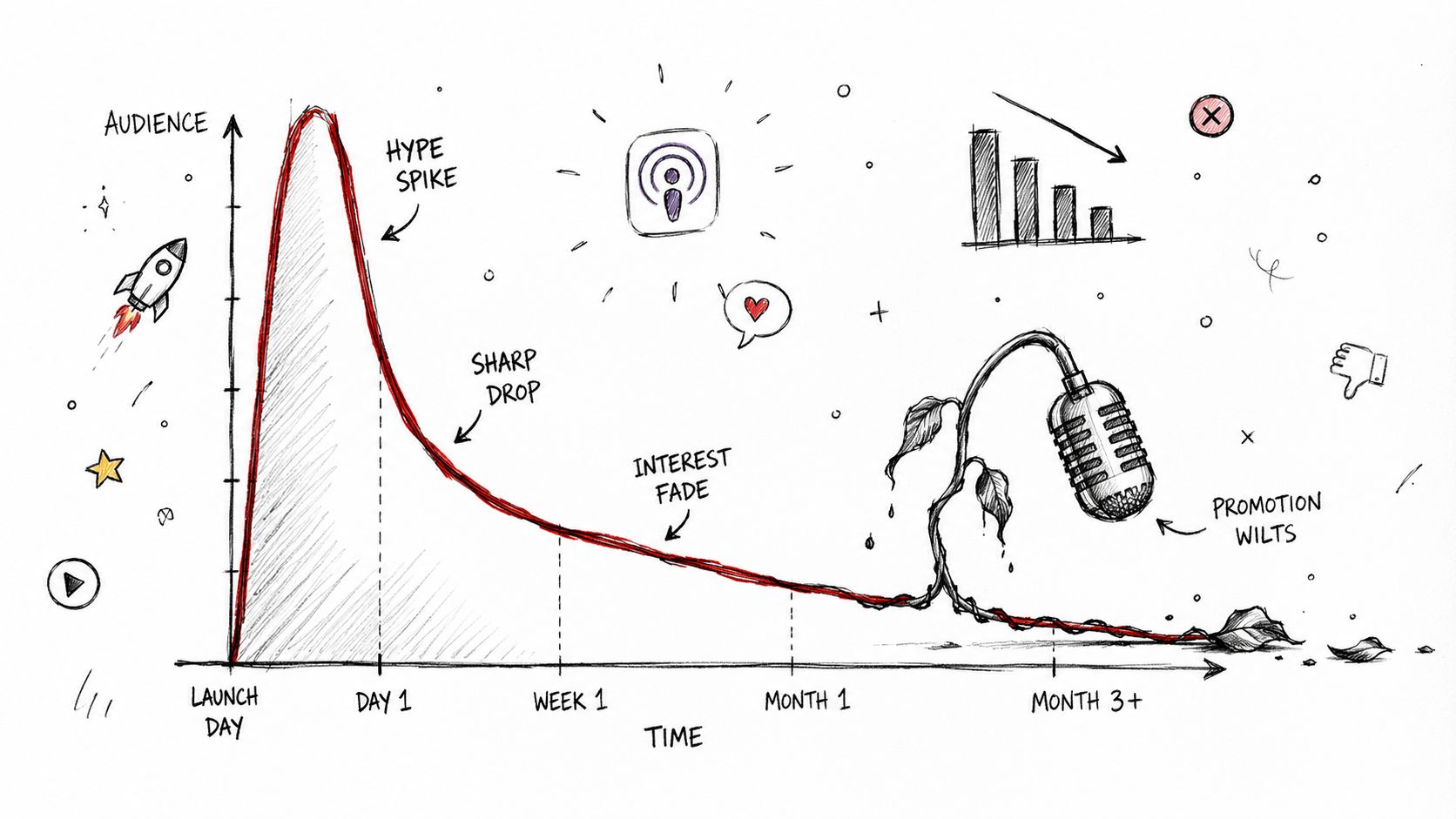
Most podcast promotion fails because it stops too early. The episode isn't dead after launch day. The promotion is. That's the core issue.
A single announcement post is not a distribution strategy. It's a checkbox. If a show promotes each episode for 30 days, it needs only a quarter of the episodes to reach the same audience footprint as a show that posts once and moves on. The content didn't get weaker. The publishing discipline did.
For B2B podcasts, this matters even more. Buyers miss posts. Guests are busy. Brand accounts have uneven reach. Teams record strong conversations, publish them once, then leave most of the value trapped inside the full episode. The fix is simple in principle and hard in practice. Build a calendar first, then create the assets that keep that calendar alive.
Why Most Podcast Promotion Fails After Day One
The expensive part of podcast promotion is rarely media spend. It is the labor. Teams invest hours recording a strong conversation, then treat distribution like a one-time task and burn through the value in a day.
That pattern is common in B2B shows with lean marketing teams. The episode goes live, someone posts the link on LinkedIn, maybe the audience gets one email, and then production shifts to the next recording. The result is predictable. You paid for one asset and used it once.
Attention expires faster than the episode does
A good episode can stay relevant for months. What disappears first is attention. Buyers miss the first post. Guests are in meetings. Brand account reach is uneven. A recording that could have produced a month of demand generation gets reduced to a launch-day spike.
I see the same failure point over and over. Teams confuse publishing with promotion. Publishing is the handoff. Promotion is the operating system that keeps the episode visible long enough to reach the people who were not online at 9:03 AM on launch day.
That is why a one-post approach keeps underperforming. The episode is still useful. The asset production stopped too early.
Podcast episodes need the same treatment as any other high-value marketing asset. They should move through a planned lifecycle with scheduled reuse, format changes, and channel-specific versions. That is the same discipline behind content lifecycle management for marketing teams.
The real failure is asset scarcity
A lot of teams describe this as a promotion problem. In practice, it is an asset problem.
If the only finished asset is the full episode and one cover image, the team has very little to work with after launch. Someone has to pull clips, write post copy, draft guest share text, create quote graphics, and queue email mentions while the rest of the week is already full. DIY promotion looks cheap until the hidden production load lands on the host, marketer, or content lead.
That is why post-launch momentum dies after day one. Not because the team lacks intent. Because the system depends on making new assets from scratch every time.
What stronger shows do differently
The shows that keep getting reach from a single recording usually work from a simple rule. One episode should produce enough finished assets to support a month of distribution.
In practice, that means three things:
- They budget for asset production, not just recording. The recording is the raw material. The clips, quotes, posts, emails, and blog draft create the actual reach.
- They separate the launch event from the promotion window. Launch day starts the cycle. It does not complete it.
- They build once, then distribute repeatedly. One conversation can support many touchpoints without repeating the same message verbatim.
A strong 30-day system turns one recording into a reusable asset engine. That shift matters more than posting more often. It reduces last-minute work, gives the guest something worth sharing, and keeps the episode active long after the initial announcement disappears from the feed.
The 30-Day Episode Promotion Calendar
Launch day gets too much attention.
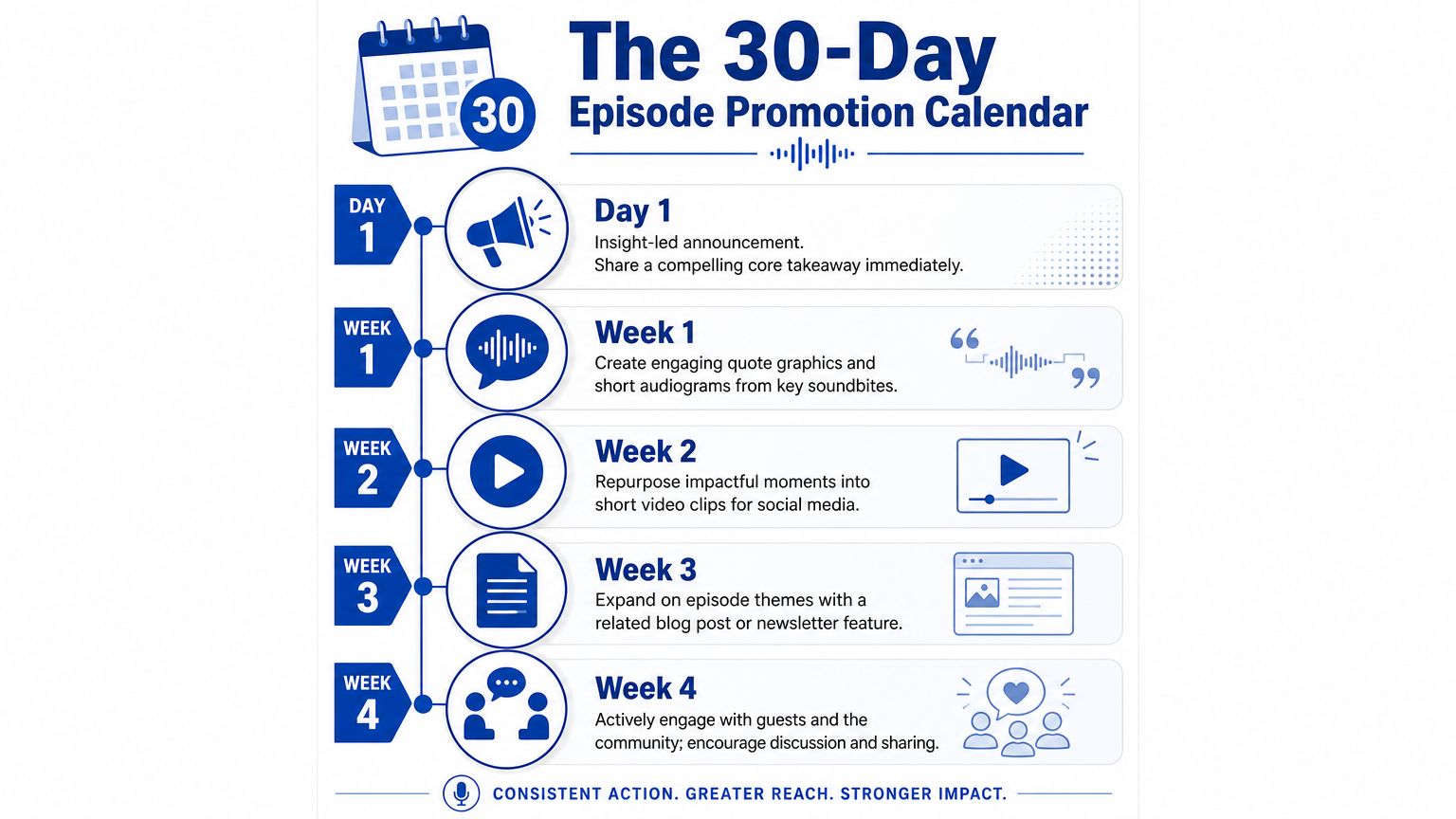
The main job is keeping one episode useful for 30 days without asking the team to make fresh content every morning. A good calendar does that. It turns one recording into a controlled distribution cycle, with a heavier push in week one and narrower, more targeted reuse after that.
Day 1 needs three moves
Day 1 is for warm reach. Existing followers. The guest's audience. The host's network. People already one step away from listening.
Run three actions across the day:
Morning
Publish an insight-led post built around the sharpest moment in the episode. Use the strongest clip, not the episode thumbnail. The post should work even if nobody clicks.
Midday
Send the guest a finished share pack. Include one clip, one quote graphic, and copy they can post with minor edits. If the guest has to build their own assets, sharing usually slips.
Late afternoon
Post from the host's personal account with a specific takeaway or disagreement from the conversation. Personal posts often create better discussion than brand posts because they read like a point of view, not distribution.
A simple day-one schedule looks like this:
- 8:00 AM. Publish the insight post with the primary clip.
- 12:00 PM. Email the guest the share pack.
- 5:00 PM. Publish the host's personal takeaway.
That structure works because each touchpoint does a different job. One introduces the idea. One activates the guest. One adds a more human angle.
Week 1 should feel busy, not chaotic
Week one carries the highest posting volume because that is when the episode has novelty, guest attention, and the best chance of building early traction. The mistake is posting the same link five times. The better move is changing the angle while keeping the destination the same.
Use a week-one mix like this:
- Primary clip to stop the scroll and earn the click
- Quote graphic for a short, opinion-led takeaway
- Text post that expands one lesson without sounding like a recap
- Pinned post so profile visitors still find the episode
- Guest mention post timed after the guest has shared or commented
A clear cadence looks like this:
| Day | Asset | Purpose |
|---|---|---|
| Day 1 | Insight-led announcement + primary clip | Initial visibility |
| Day 2 | Guest quote graphic | Guest amplification |
| Day 3 | Short clip with a distinct claim | Broaden reach |
| Day 5 | Text post breaking down one takeaway | Add context and authority |
| Day 7 | Recap post or standout moment | Catch the audience that missed the launch |
The calendar only works if those assets already exist. A practical workflow for how to repurpose podcast episodes gives the team enough material to post with range instead of repeating the same message all week.
A quick walkthrough of the cadence helps:
Weeks 2 to 4 are where momentum compounds
Weeks 2 through 4 should stop sounding like launch promotion. By then, the episode is no longer news. It is source material.
Week 2 is a good time for derivative assets built around specific pain points or claims. Publish a carousel that explains the guest's framework. Cut a second clip that speaks to a different objection than the first. Write a short post that responds to one line from the interview and turns it into a standalone opinion.
Week 3 works well for slower-burn channels. Publish the blog version of the episode. Feature it in the newsletter. Pull a transcript section into a search-focused article or a founder-style email. These strategies allow B2B shows to get more value from the same recording because the asset stops depending on feed algorithms alone.
Week 4 has two jobs:
- Repost the best-performing asset from earlier in the month
- Publish a bridge post that connects the episode to the next topic in the series
That final week matters because attention is uneven. A strong asset often performs better on its second run, especially if the first post was audience-tested and the second version has a stronger hook.
The 30-day system is not about posting more. It is about reducing waste. One recording should give the team enough finished material to stay visible for a month without rebuilding the campaign from scratch halfway through.
How to Promote a Podcast Episode After Launch Your Asset Engine
A 30-day plan only works if the assets exist before the month starts.
That's the actual bottleneck in how to promote a podcast episode after launch. Not ideas. Production. If the team has one link, one thumbnail, and no repurposed content, the calendar collapses by day three.
What one episode should produce
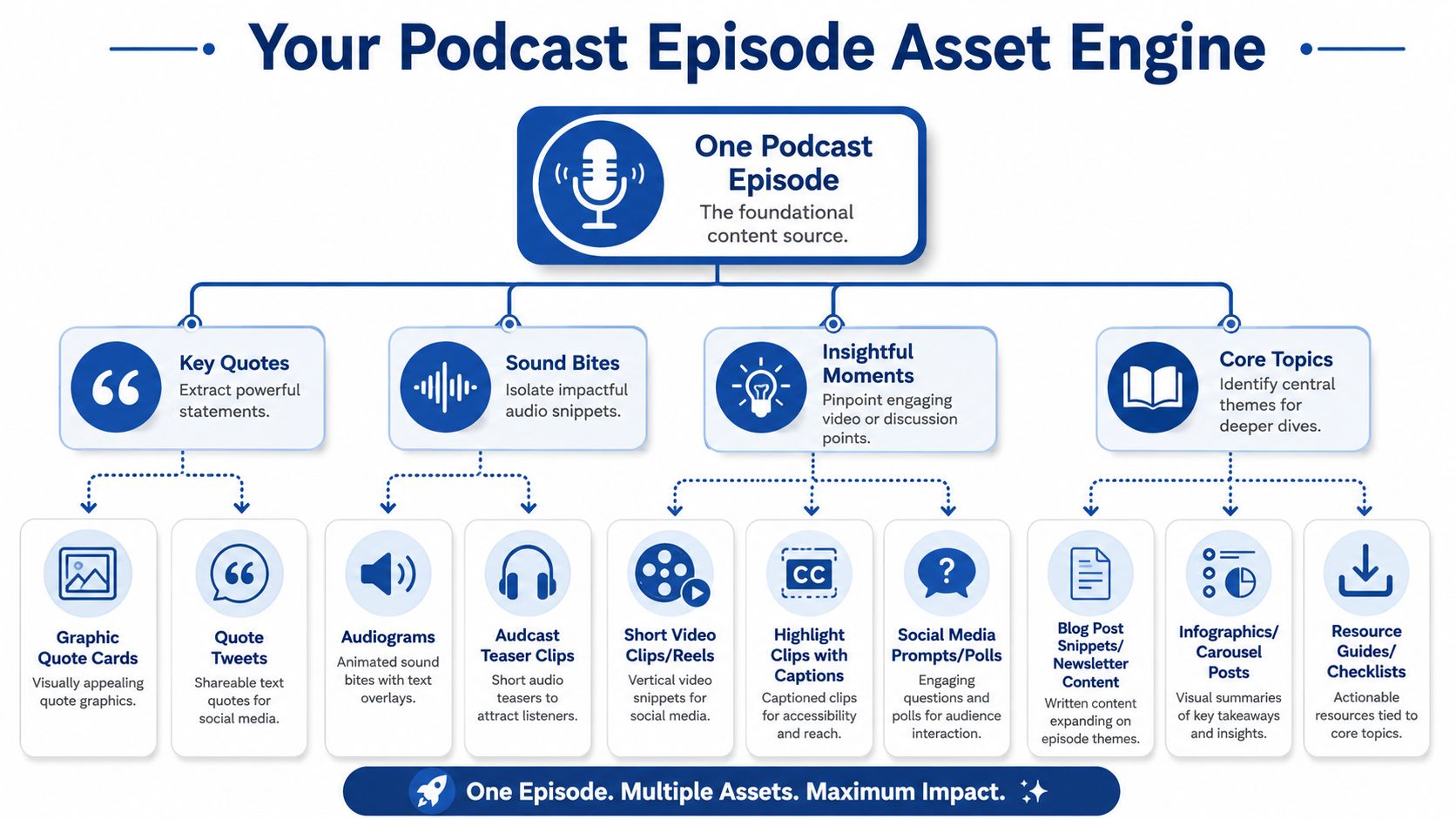
One strong podcast episode can usually become:
- Short video clips for LinkedIn, YouTube Shorts, or other social feeds
- Audiograms for audio-first moments
- Quote graphics built around sharp statements
- Text posts based on the guest's strongest claims
- Carousels that explain a process or framework
- A blog post built from the transcript and main themes
- Newsletter copy that gives the episode a second life in email
That's how one recording becomes a month of promotion. The full episode is the source material. The smaller assets do the distribution work.
The true cost of DIY
Manual repurposing takes more time than often anticipated. A skilled marketer can spend 10–16 hours turning one episode into a full month of usable assets. And that often still produces less than a dedicated workflow.
A realistic manual breakdown looks like this:
- Clip selection and editing: 2 to 3 hours
- Caption cleanup and formatting: 1 to 2 hours
- Writing social posts: 2 to 3 hours
- Designing quote graphics and carousels: 3 to 4 hours
- Drafting the blog post and newsletter copy: 2 to 4 hours
That's why many shows end up with one announcement post. Not because the team lacks ideas. Because every extra asset requires more time, copy, editing, and coordination.
For teams building this internally, a podcast content repurposing strategy needs to answer one question early. Who is making the assets, and when?
A promotion calendar without an asset engine is just a wish list.
What makes the engine work
The useful shift is this: stop treating repurposing as optional bonus content. It is the engine.
When the episode is edited, the team should already know:
- which clips are strongest
- which quote belongs on a graphic
- which topic becomes the blog post
- which angle the guest is most likely to share
- which asset should be held back for week four
That planning turns one recording into 15–20 touchpoints over a month instead of one tired announcement on launch day.
Channel-Specific Tactics for Maximum Reach
Channel reach is usually not the bottleneck. Asset fit is.
Teams post the same episode link to LinkedIn, email, X, and the company page, then assume distribution failed. What failed was the format. One recording can drive a month of promotion, but only if each channel gets the version it can carry.
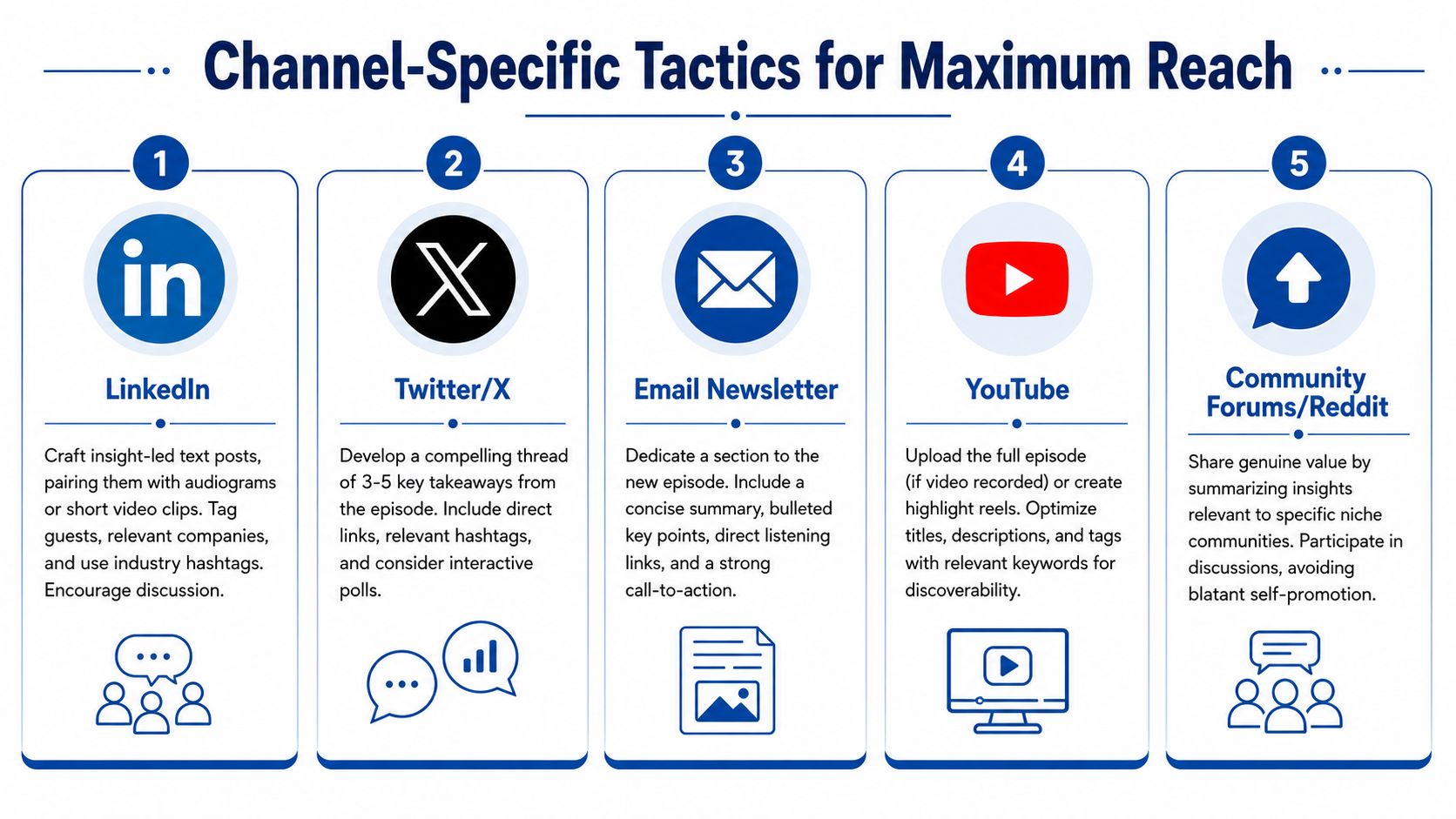
LinkedIn rewards usable ideas
LinkedIn is usually the primary channel for a B2B episode, especially if the guest has industry credibility. The post has to deliver value before the click.
Use the episode as source material, not as the post itself. Strong LinkedIn posts usually do one of four jobs:
- state a clear opinion from the conversation
- pull out a practical lesson with a real example
- turn a framework into a document post or carousel
- pair a short native clip with a sharp written hook
A weak post says the episode is live. A strong post gives the reader one reason to care now.
Carousels are especially effective when the guest explains a process, scorecard, hiring method, or operating principle. Break that idea into 5 to 8 slides, keep the copy tight, and let the full episode handle the nuance.
Email works best as selective distribution
Email should not read like a housekeeping update from the marketing team. It should feel curated.
The simplest version is often the best. Lead with one idea worth forwarding, add one strong line from the guest, then place the episode link after the takeaway has already done its job. If the episode supports a larger theme, segment the send. Prospects, customers, and partners often need different framing even when the underlying audio is the same.
This is also a good place to use transcript-derived copy. A short excerpt, edited for clarity, often outperforms a generic summary because it sounds like a real conversation.
Guest sharing needs a packaged handoff
Guest amplification produces outsized returns because the audience overlap is already qualified. But it only works when the guest can share in under two minutes.
Do not send a thank-you email with a raw link and hope they write the post themselves. Send a ready-to-use pack:
- one short clip with captions
- one quote graphic
- one prewritten social post in the guest's tone
- one clean episode link with tracking if you use it
I have seen the same pattern repeatedly. The more editing the guest has to do, the lower the share rate. The easier the handoff, the faster the episode spreads through a relevant audience in the first week.
Clips usually carry the load here. If your team needs a repeatable format, this guide to podcast clips for social media shows how to choose moments that hold attention outside the full episode.
Short-form social needs a different standard
A clip that works on LinkedIn may fail on Instagram Reels or YouTube Shorts because the viewer context is different. Social clips need to stand alone, even if the viewer never hears the full episode.
That changes the editing brief:
- start with the tension, not the setup
- cut host throat-clearing and long intros
- add captions that are readable on mobile
- keep the clip focused on one claim or story
- end before the point gets diluted
For B2B shows, 20 to 45 seconds is usually enough. Longer clips can work, but only if the speaker gets to the point quickly and the idea has clear stakes.
Paid promotion belongs behind proven assets
Paid spend is rarely the first fix for an underperforming episode. More often, the constraint is that the team only produced one or two weak assets from the recording.
Use paid support after an asset proves it can earn attention organically. That usually means a clip, carousel, or quote-led post that already pulled comments, saves, or shares from the right audience. Then put budget behind that asset, not behind a cold episode link.
For B2B podcast promotion, this is the trade-off that matters. Media spend can increase reach. Asset production determines whether that reach turns into watch time, clicks, replies, and guest shares.
The Done-for-You Alternative 15 Minutes for a Month of Content
DIY podcast promotion is possible. It's just expensive in staff time.
A team can spend 10–16 hours per episode creating clips, posts, quote graphics, carousels, and blog content by hand. In salary terms, that often lands around $500–800 worth of in-house marketing time to produce fewer assets than a dedicated service workflow.
The alternative is straightforward. Send one recording, whether it's a podcast episode, webinar, keynote, interview, or meeting recording, and get 20–30 ready-to-publish assets in 72 hours. That includes video clips, LinkedIn posts, quote graphics, carousels, audiograms, and a blog post. Total client time is about 15 minutes.
A typical done-for-you production range is $416–999 per recording, with pricing starting from $14 per finished asset depending on plan. One 45-minute recording becomes 30 assets. The work arrives in brand voice, and revisions are unlimited. There's also a 72-hour turnaround guarantee or you don't pay.
For teams that want this handled externally, RepurposeYourContent's podcast service turns one long-form recording into finished promotion assets rather than asking a marketer to build them manually.
This is the main practical difference:
- DIY: more control, more internal coordination, much more time
- Done-for-you: less internal lift, faster turnaround, easier consistency
If the current system is “someone will make posts when there's time,” that isn't a system. It's a bottleneck.
Measuring Promotion Success and Your Next Step
Downloads tell you what happened after the fact. To manage a 30-day promotion system, track the signals that show momentum while you can still adjust the campaign.
Start with four indicators:
- clip views to find the ideas and openings that earn attention
- post engagement to see which framing deserves a second or third variation
- newsletter clicks to confirm the topic is strong enough to pull existing audience interest
- blog traffic and on-page engagement to measure whether the episode keeps working outside social feeds
The goal is not a launch-day spike. The goal is sustained distribution from one recording. If an episode gets reasonable reach on day one and nothing after that, the problem is usually not the content. The problem is that the asset engine stopped too early.
I look for two things after release. First, are different assets carrying the episode into different channels over the full month? Second, can the team see which message angle keeps performing well enough to reuse in future episodes? That is how promotion becomes a system instead of a recurring scramble.
If your current process still depends on one announcement post, tracking will expose the waste quickly. A strong episode can underperform because there were not enough assets to keep it in circulation.
For teams that want tighter reporting once distribution is running, this guide to content marketing ROI measurement is a useful next step.
If the goal is a 30-day promotion system without 30 days of internal work, request a sample pack or book a call. One recording is enough to prove whether your team has a promotion plan or just a launch habit.
Tags: