LinkedIn Newsletter from Webinar Content: Your 2026 Playbook
Master the 2026 workflow to create a high-reach linkedin newsletter from webinar content. Get templates and tools to turn recordings into consistent engagement.

A LinkedIn newsletter only works if there's enough substance to publish again next month.
That's where many efforts stall. The setup is easy. The naming is easy. The first issue is easy. The hard part is sustaining a LinkedIn newsletter from webinar content without turning it into a thin recap or a disguised sales email.
For B2B teams, the fix is usually already on the calendar. A monthly webinar programme gives the newsletter a recurring source, a clear theme, and material that already reflects real buyer questions. Instead of inventing a fresh angle from a blank page, the team can turn one strong session into one strong issue and keep the rhythm going. Teams already building event-led content systems can extend that logic into a B2B webinar content strategy.
The Newsletter Problem You Can Solve with Webinars
The bottleneck isn't writing skill. It's editorial supply.
LinkedIn newsletters ask for recurring, thematic, substantive content. Most B2B marketers can produce that once. Fewer can do it every month without draining the team. That's why newsletters are underused in practice. Not because they're hard to publish, but because they're hard to sustain.
A regular post can survive on a quick opinion, a product update, or a short lesson. A newsletter can't. Readers expect a stronger point of view and a clearer reason to subscribe.
Why teams abandon the format
Most newsletters fade for the same reasons:
- The topic is too broad. “Marketing insights” isn't a workable editorial line.
- The source material is weak. Teams try to write from scratch instead of mining existing expertise.
- The issue reads like promotion. Readers won't subscribe to event recaps dressed up as analysis.
- The workflow is fragile. One busy month and publishing slips.
Practical rule: If the newsletter depends on finding a new idea every month, it won't last.
Webinars solve the sourcing problem better than almost any other format. They already contain a point of view, examples, objections, audience questions, and practical detail. They also arrive on a schedule. That matters more than is commonly realised.
A webinar archive shouldn't be treated like storage. It's an editorial backlog. One session can support one issue, plus follow-up assets around the same topic. That makes the newsletter easier to maintain, and usually better, because the issue starts from material that has already been discussed live with a real audience.
Why Webinars Are a Perfect Newsletter Engine
A good newsletter needs three things. Substance, recurrence, and theme. Webinars naturally provide all three.
A webinar has more depth than a standard social post because the speaker has to explain a real problem, defend a recommendation, and answer questions. That creates enough raw material for a proper editorial issue instead of a shallow summary.

Substance beats blank-page writing
When teams try to create a newsletter from nothing, they often default to generic advice. Webinar content avoids that. The session already contains the examples, the framing, and the objections that make the issue worth reading.
That's especially useful on LinkedIn, where attention is limited and thin content gets ignored fast. For UK marketers, the distribution upside is obvious because LinkedIn has 42 million members in the UK, giving newsletter publishers a large built-in professional audience before paid promotion or separate list-building enters the picture, according to UK LinkedIn audience data for B2B marketing.
Recurrence creates editorial discipline
A monthly webinar creates a monthly publishing rhythm. That alone removes a lot of operational friction.
Instead of asking, “What should this month's issue be about?”, the team asks, “What's the strongest argument from this month's session?” That's a much easier editorial decision. It also keeps the newsletter tied to live market conversations instead of random content gaps.
Theme makes the newsletter feel coherent
The strongest webinar programmes already cluster around a clear market problem. That gives the newsletter a natural editorial lane.
A cybersecurity webinar series can produce a newsletter about buyer risks and implementation mistakes. A RevOps webinar series can produce a newsletter about process design and operational decisions. The point isn't to repeat the event. It's to turn the programme into an ongoing publication with a recognisable point of view.
A newsletter should feel like curated analysis from your webinar programme, not a replay channel.
That distinction matters. Promotional recaps rarely earn repeat readers. Editorial adaptation does.
A Repeatable Workflow for LinkedIn Newsletter from Webinar Content
The fastest way to ruin this process is to treat the webinar like a transcript that needs trimming. That creates bloated issues no one wants to read.
The better method is to extract only the parts that carry independent value. One repurposing workflow recommendation is to pull three content primitives from the recording: Q&A moments, statistics or facts, and step-by-step instructions, because those segments translate most cleanly into newsletter sections and related assets, as outlined in this webinar repurposing discussion on YouTube.
Early in the process, a simple visual workflow helps teams keep the handoffs clean.

Stage one, mine the recording properly
Start with the transcript, not the full video. The goal is selection.
Review the session and pull:
- Questions that exposed real confusion. These often become the best hooks.
- Facts or claims worth preserving. Keep only the ones that support the main angle.
- Processes explained clearly on the call. These can anchor the body of the issue.
If the team needs a fast first pass before editing, an AI tool for content efficiency can help condense transcript sections and surface likely highlights. It shouldn't decide the angle, but it can speed up the screening work.
For smaller teams trying to reduce handoff friction, this kind of extraction sits well inside a broader content repurposing workflow for small teams.
Stage two, build one issue around one argument
Don't summarise the whole webinar. Pick a single takeaway and build the issue around it.
A reliable structure looks like this:
Hook
Open with the sharpest question, tension, or misconception from the session.Context
Briefly explain where the insight came from. Mention the webinar only enough to establish relevance.Deeper insight
Expand the strongest point. The issue earns its subscription at this point.Action step
Give the reader something specific to think about or apply.CTA
Send readers to the full recording, a related resource, or the next webinar.
Use the webinar as source material. Don't make the webinar the subject.
That's the difference between an editorial issue and an event follow-up email.
A short walkthrough can help the team visualise how the pieces come together.
Stage three, format for LinkedIn reading
LinkedIn newsletter readers scan first. Dense blocks lose them.
Use:
- Short paragraphs for movement
- Subheads to signal the argument
- Pull quotes only when the line adds clarity
- One image if it supports comprehension
- A restrained CTA at the end, not throughout
A simple monthly example helps. Step one, the team runs a webinar on attribution mistakes. Step two, the marketer spots a strong audience question about over-crediting last-touch data. Step three, the newsletter issue becomes “Why attribution reports mislead teams before they help them”, with the Q&A answer expanded into the main section and a link to the full session at the close.
That's sustainable. Even better, it's readable.
How RepurposeYourContent Automates This Workflow
The manual version works. It just takes time.
Someone has to pull the transcript, review the recording, identify useful moments, draft the issue, and then create supporting assets to promote it. For a busy content team, that's where the process slows down. The newsletter often gets delayed because the production work sits behind campaign tasks.

Where automation helps most
The biggest gain comes from compressing the boring steps.
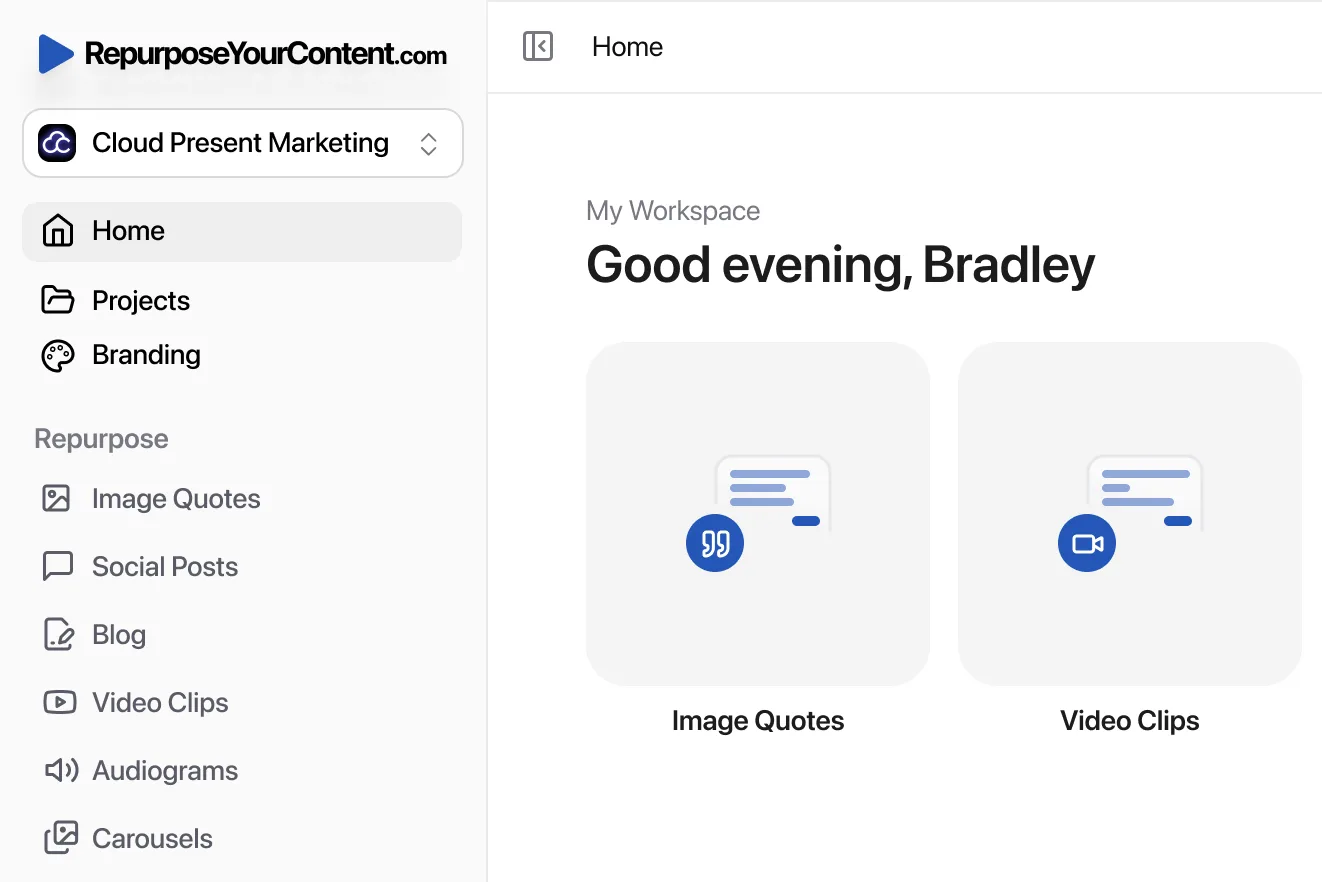
A tool like RepurposeYourContent can take one webinar recording and generate multiple content formats from it, including newsletter drafts, video clips, social posts, audiograms, image quotes, LinkedIn carousels, blog posts, and timestamps. That matters because the newsletter rarely succeeds alone. It usually needs surrounding distribution assets. Teams comparing newsletter drafting with written content workflows may also find its blog post generation feature relevant when a webinar insight deserves both an on-platform issue and a site article.
A practical production setup
A simple operating model looks like this:
- Upload the webinar recording. Use the original session rather than manually copying notes into a document.
- Select the outputs needed. Choose newsletter content plus supporting assets for distribution.
- Review timestamps and summaries. These help identify where the strongest moments sit inside the recording.
- Edit for editorial sharpness. Keep the main point narrow. Remove any sections that read like event promotion.
- Publish the newsletter and promote it with companion assets. A clip can tease the issue. A carousel can restate the framework. An image quote can pull people back to subscribe.
Automation should remove production drag, not replace editorial judgement.
That distinction keeps quality high. AI can surface highlights and draft sections. The marketer still decides whether the issue is centred on a real argument, a useful framework, or a question the audience cares about.
Used properly, automation doesn't make the newsletter generic. It gives the team enough operational slack to keep publishing on time.
Three Newsletter Templates to Start Using Today
Most webinar-derived newsletters fail because they try to cover too much. The issue ends up reading like meeting notes.
A better approach is editorial compression. One undercovered best practice is to turn webinar insight into a newsletter that feels editorial, not promotional, by prioritising a single argument, a contrarian takeaway, or a practical framework rather than a transcript-style recap, as discussed in this LinkedIn newsletter analysis from Content Marketing Institute.
This is the easiest way to keep a LinkedIn newsletter from webinar content useful on its own.

Template one, the single point deep dive
Use this when the webinar contains one idea that deserves expansion.
Sample title Why most webinar follow-up content misses the primary objection
Structure
- Hook
Start with a mistaken assumption raised in the session. - Context
Mention the webinar topic in one sentence. - Insight
Expand the one point that changes how the reader should think. - CTA
Invite the reader to watch the relevant segment or subscribe for the next issue.
This format works because it doesn't ask the reader to care about the whole event. It asks them to care about one sharp idea.
Template two, the Q&A spotlight
Use this when the audience questions were stronger than the prepared slides.
Sample title
The question from our webinar that exposed the genuine buying concern
Structure
| Part | What to include |
|---|---|
| Hook | Lead with the exact problem behind the audience question |
| Context | Briefly frame when the question came up |
| Insight | Give the fuller answer, with one extra layer not covered live |
| CTA | Point to the webinar replay or a related resource |
A strong Q&A issue often feels more human than a polished recap because it starts from real audience tension.
Teams turning video into recurring written touchpoints can extend the same logic into email newsletters from video content.
Template three, the actionable framework
Use this when the speaker shared a process the audience can apply.
Sample title
A practical framework from this month's webinar
Structure
- Open with the problem the framework solves.
- Name the framework in plain language.
- Walk through the steps in order.
- Add one caution about where teams usually get it wrong.
- Close with a low-pressure CTA.
Readers subscribe for interpretation and structure. They don't subscribe for transcripts.
This template is usually the safest option for B2B brands because it keeps the issue concrete and immediately useful.
Growing Subscribers and Measuring Performance
Publishing the issue is only half the job. The newsletter also needs a simple growth loop and a clean measurement setup.
A practical LinkedIn newsletter strategy should be organised around 3 to 5 core pillars and a consistent cadence, while tracking subscriber growth, engagement rate, open rate, and click performance with UTM parameters, according to this LinkedIn newsletter strategy guide for B2B distribution.
Organic subscriber growth that doesn't add busywork
The easiest growth tactics sit inside work the team already does:
- Mention the newsletter at the end of every webinar. Treat it as the written companion to the session.
- Add it to the LinkedIn Featured section. Make subscribing easy from the profile.
- Ask speakers to share the issue. Their posts often provide the most credible distribution.
- Keep the editorial pillars tight. Readers subscribe faster when they know what will recur.
Teams thinking more broadly about distribution mechanics may also find this expert advice on startup distribution useful for adapting organic growth habits across channels.
Measurement that shows whether it's worth continuing
Don't overcomplicate reporting. Track the signals that show repeat value and downstream intent:
- Subscriber growth shows whether the topic has pull.
- Open rate shows whether the issue title and promise are working.
- Engagement rate shows whether readers care enough to interact.
- Click performance with UTM parameters shows whether the issue drives visits to assets, demo pages, or related content.
For teams linking newsletter effort to revenue discussions, this broader guide to content marketing ROI measurement is useful. So is thinking beyond the newsletter itself. A webinar can feed the newsletter, and the same source material can also support email sequence content and a wider LinkedIn content strategy for B2B 2026.
A sustainable LinkedIn newsletter doesn't need more brainstorming. It needs a reliable source. A monthly webinar programme solves that problem cleanly.
If the team wants to turn webinar recordings into newsletter drafts, clips, posts, carousels, and supporting assets without rebuilding the workflow every month, try RepurposeYourContent.
Tags: