Micro Content Strategy from Webinar Recordings: A Playbook
Stop the manual grind. Learn the micro content strategy from webinar recordings that turns 1 event into 40+ social assets in 2026. Practical playbook for B2B

A social media manager can spend half a day producing a single polished short clip, then wake up needing ten more by Friday. That's the trap. Micro content strategy from webinar recordings fixes the output problem by changing the source material, not by asking the team to work faster.
That matters because the audience is already there. Ofcom's 2024 Online Nation reporting, cited in LiveWebinar's summary, says 91% of UK adults use the internet and 83% of those users use YouTube. Video distribution isn't the bottleneck. Production economics are.
The Broken Economics of Micro-Content
Manual micro-content production looks cheap until someone has to do it every day.
A single short clip needs a hook, a transcript cleanup, captions, cropping, resizing, a cover frame, platform copy, approval, export, upload, and scheduling. None of that is hard on its own. The problem is volume. Social teams aren't producing one clip. They're feeding LinkedIn, Shorts, Reels, and internal demand for sales follow-up at the same time.
That's why the old model breaks. It treats every post like a fresh production job.
Manual production burns time twice
First, the team spends time making the asset. Then it spends more time deciding what to make next. That second cost gets ignored, even though it's where content calendars usually stall.
A webinar recording changes that equation. The raw material already exists. The messaging has already been said out loud. The objections, examples, and strongest phrasing are often buried in the recording, waiting to be extracted.
Practical rule: Stop treating short-form content as a series of separate creative acts. Treat it as packaging from one larger source asset.
Webinars are especially useful because they already contain structure. There's a topic, a host, a flow, and usually a Q&A that produces sharper soundbites than a scripted brand video ever does.
The shift is from creator to factory
Social teams need a production system, not a heroic editor.
That means thinking in batches. One webinar becomes a content run. One approval cycle creates a queue of clips, quote cards, carousel slides, and follow-up posts. The team stops chasing tomorrow's post and starts working from inventory.
A lot of marketers still measure content effort loosely. That's part of the problem. Better planning starts with knowing what each source asset can realistically produce and what that output is worth to the business. This is the same discipline used in content marketing ROI measurement.
When that lens is applied, the waste becomes obvious. A webinar that took planning, promotion, speaker time, and production support shouldn't end its life as a replay page and one LinkedIn post.
Why Your Webinar Is a Micro-Content Goldmine
Micro-content is small, fast, in-feed content built for attention that disappears quickly if it isn't earned. In B2B, that usually means expert clips, quote cards, mini carousels, and short text posts that carry one idea cleanly.
A webinar is one of the few source assets that naturally produces all of them.

What counts as micro-content
For a busy social team, the most useful formats are usually:
- Short expert clips: Tight video moments built around one strong point, one objection, or one answer.
- Single-stat quote cards: A visual takeaway that gives a scrolling audience one reason to stop.
- Three-slide carousels: A quick lesson, framework, or mistake-to-fix sequence that works well in-feed.
These aren't watered-down versions of bigger content. They're atomic units. Each one should make sense on its own, even if the viewer never watches the full webinar.
Why webinars outperform blank-page creation
Blank-page creation is slow because every asset starts from zero. Webinar extraction starts with spoken expertise. That's a huge difference.
A good webinar contains:
- Compressed expertise from people who know the subject
- Natural hooks because hosts ask direct questions
- Audience language from live questions and objections
- Clear takeaways because the session has to move forward
That makes webinars unusually dense source material for social distribution. Many teams still treat them as one-and-done events, but a stronger B2B webinar content strategy treats the recording as the actual beginning.
A webinar often contains the most useful copy a brand has published all month. It just isn't formatted for feeds yet.
That last part matters. The value isn't in the raw recording. The value is in turning long-form clarity into short-form assets that match how people consume content on mobile feeds.
Planning Your Micro-Content Output Ratio
Many teams waste webinar recordings by clipping reactively. They watch, spot a nice quote, export a video, and stop. That approach leaves too much behind.
A stronger micro content strategy from webinar recordings starts with an output plan before editing starts. For social teams managing high-volume publishing, a practical target is 40 to 60 micro-assets from a 45-minute webinar. That range works because it forces selective extraction without pretending every sentence deserves a post.

A simple inventory model
A content manager can map one webinar like this:
| Asset type | Typical use |
|---|---|
| Short clips | Reach on Reels, Shorts, LinkedIn video |
| Quote cards | Fast distribution on LinkedIn and email |
| Mini carousels | Education and saves |
| Social text posts | Threads, captions, newsletter snippets |
| Blog summary | Search, replay support, sales follow-up |
The exact mix changes by team and channel. The point is to plan the mix on purpose.
A webinar heavy on tactical teaching may yield more carousels. A panel with sharp opinions may yield more clips and quote graphics. A product-led session may generate stronger follow-up emails than public social assets.
Match each idea to a channel
Not every insight belongs in video.
A sharp contrarian line may work best as a quote card. A step-by-step process often lands better as a carousel. A strong audience question can become a text-led LinkedIn post with a replay CTA.
A basic planning pass can look like this:
- Mark moments of tension. Objections, myths, disagreements, surprising phrasing.
- Mark moments of clarity. Definitions, frameworks, examples, summaries.
- Mark moments of proof. Specific references, useful takeaways, practical advice.
- Assign each moment a native format. Clip, carousel, quote, email, or summary post.
Useful filter: If a point needs too much setup, it isn't micro-content yet. It belongs in a blog post or a longer clip.
UK teams also need to think about localisation at the planning stage. PlayPlay's glossary notes that for UK marketers, generic global snippets can be less persuasive than assets anchored in local proof points and language, which supports a trust-based approach to repurposing in tighter regulatory and budget conditions, as outlined in PlayPlay's micro-content guidance.
That means one webinar can produce multiple versions of the same idea. A broad clip for general reach. A UK-specific carousel for LinkedIn. A regional email angle for prospects who need local relevance. That planning step is where output quality starts. It's also how content multiplication frameworks become operational instead of theoretical.
The Extraction and Editing Workflow That Scales
The fastest way to get stuck is to open a 45-minute webinar and start scrubbing the timeline aimlessly.
The cleaner method is to split first, then extract. CloudPresent recommends a chapter-based workflow, including extracting 3 to 4 short-form clips plus a summary post per chapter, and notes that 85% of social video is watched without sound, which is why captions and transcript-led editing matter, according to CloudPresent's multi-channel content strategy guidance.

Step 1 through Step 3
A repeatable workflow looks like this:
Segment the webinar into chapters
Split the recording into a handful of topic blocks. Each block should hold one clear theme.Pull the strongest moments from each chapter
Look for answers, not introductions. Social clips rarely need the throat-clearing before the main point.Create transcript-first assets
Clean transcript text gives the team captions, quote card copy, carousel headlines, and email pull-quotes in one pass.
Source quality matters. If the webinar audio is muddy, everything downstream gets slower. Captions need more correction. Quotes need more cleanup. Audiograms become less usable. Audio isn't a technical detail. It's the base layer.
A practical reference for adjacent teams working on search-driven content systems is this guide to improve ecommerce revenue with SEO. It's useful because it shows the same operating principle. Strong output comes from process discipline, not last-minute effort.
The clip extraction process is easier to manage when the team keeps a simple naming structure by chapter and theme. That's also where a workflow for extracting video clips from webinar recordings earns its keep.
Step 4 through Step 7
The second half is packaging.
A polished short clip usually needs:
- Burned-in captions so it works muted
- A title card so the viewer gets context immediately
- Tight opening frames because weak openings die in-feed
- Platform-safe framing so key visuals don't get cropped
- A caption written for the channel rather than copied everywhere
Then come the non-video assets. Pull a line for a quote image. Turn a framework into three slides. Convert one chapter into a short newsletter block. The point isn't to make every possible format. The point is to turn each chapter into a cluster of usable assets.
Clean extraction is boring work. That's why it scales. Random clipping feels creative, but it usually produces less and takes longer.
How RepurposeYourContent Is Your Micro-Content Factory
Manual workflow works. It just doesn't scale well when a social team needs a steady pipeline.
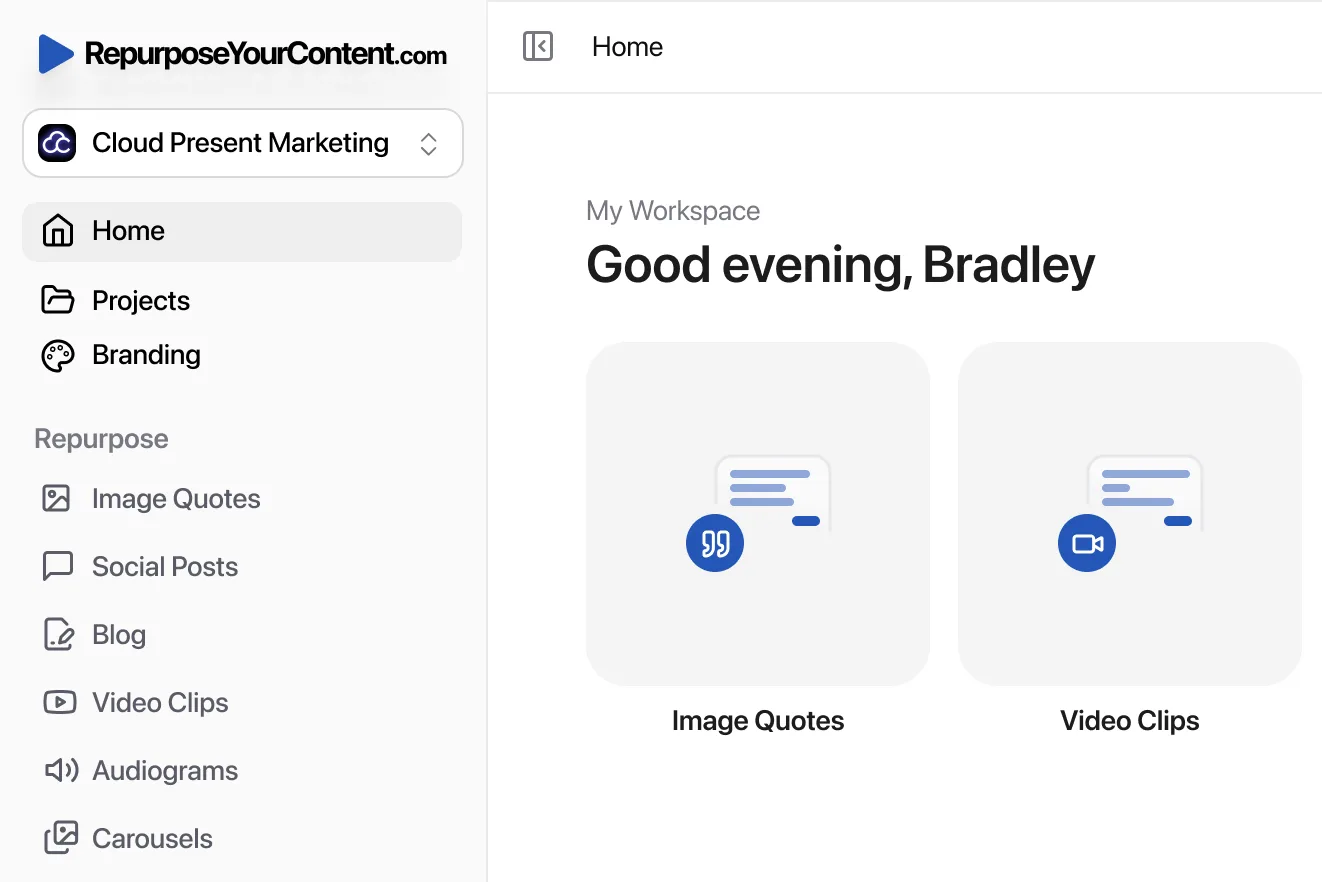
That's where tools start to matter. A platform such as RepurposeYourContent takes a webinar recording and turns it into multiple asset types from one source, including video clips, social posts, blog posts, audiograms, image quotes, newsletters, LinkedIn carousels, and timestamps.

What changes when the workflow is automated
The time sink in manual production isn't only editing. It's repetition.
A team has to transcribe the recording, identify highlights, copy out quotes, draft captions, resize visuals, check brand consistency, and package exports for different channels. Each task is manageable. The stack of them is the problem.
Automation changes the labour mix:
- Less assembly work on captions, clipping, and formatting
- More review work on message quality and channel fit
- Faster batching across asset types from the same source
- Cleaner handoff between content, social, and demand gen teams
This is the factory model. People stop spending most of their time manufacturing raw assets and spend more time deciding which ones deserve distribution.
What still needs human judgement
Automation doesn't remove editorial responsibility.
Someone still needs to decide whether a clip is too generic, whether a quote sounds credible out of context, and whether a carousel deserves UK localisation. A tool can produce volume. A strategist still decides what's worth publishing.
That trade-off is healthy. Teams should automate formatting and extraction first, then keep judgement close to messaging.
Distribution and Measurement for Your Content Engine
Publishing volume without a distribution rhythm creates clutter.
A webinar-based content engine works better when the team treats each recording like a two-week campaign, not a folder of assets waiting for a spare moment. ActualTech Media's webinar strategy guidance recommends using webinars as an always-on content engine, then using post-event analytics to see which repurposed formats drive engagement and conversions, as described in ActualTech Media's webinar strategy article.
A simple two-week pattern
A practical schedule could look like this:
Week 1
- Monday: One strong expert clip on LinkedIn
- Tuesday: A quote card from the same chapter
- Wednesday: A three-slide carousel teaching one takeaway
- Thursday: A Shorts or Reels version of a different clip
- Friday: Email or newsletter excerpt tied to the replay
Week 2
- Monday: A text-led post built from a sharp audience question
- Tuesday: Another short clip with a different hook
- Wednesday: Carousel from a later chapter
- Thursday: Audiogram or image quote
- Friday: Replay CTA with the strongest takeaway from the batch
That keeps variety high without sounding repetitive. It also helps social managers avoid posting five versions of the same idea in a row.
Teams trying to build this into a repeatable operating model can borrow useful thinking from broader guides on streamlining content operations. The overlap is real. Content engines break when distribution stays ad hoc.
Measure signals that inform the next webinar
Likes don't tell the team much.
Better signals are:
- Comments that mention a specific idea
- Shares, because people use them as endorsement
- Watch behaviour on clips
- Clicks on the CTA
- Format performance by channel
The most useful result of this measurement isn't a nice dashboard. It's a better next webinar. If clips about one subtopic attract stronger response, that topic deserves a deeper future session. If one speaker produces stronger soundbites, brief them differently next time. If LinkedIn carousels outperform clips for a certain audience, shift the asset mix.
A documented distribution loop also makes content distribution strategies much easier to manage across teams.
If the goal is to publish more short-form content without turning the social team into a bottleneck, webinar recordings are one of the few source assets that scale. Try RepurposeYourContent to turn one webinar into a practical content pipeline without building every asset by hand.
Tags: