Repurpose Expert Interviews Into Content: Get 30+ Assets
Learn to repurpose expert interviews into content. Transform one 45-min recording into 30+ assets: blog posts, clips, social posts & more with our guide!

A strong way to repurpose expert interviews into content is to record an unscripted 45-minute video conversation, then extract themes, quotes, stories, and specific data points from the transcript. One interview can reliably become 15 or more assets, and with a systematic process it can become 20 to 30 ready-to-publish pieces.
Teams already have the hard part. They have access to expertise. What they don't have is a clean way to turn that expertise into consistent output.
Your Best Content Is Trapped in Recordings
The gap is bigger than often acknowledged. 73% of marketers identify recordings as their primary source of high-quality leads, yet only 1 in 3 marketing teams have a scalable process to extract content from them. That leaves a lot of valuable thinking stuck inside podcasts, interviews, webinars, and sales conversations.
That matters even more now. AI can produce endless generic copy. It can't produce your founder's lived judgment, your product lead's contrarian view, or a customer's exact phrasing from a real conversation. Those are scarce.
Why interviews beat written SME input
Busy subject-matter experts rarely write their best ideas down. They hedge. They postpone. They send bullet points that need heavy rewriting.
In conversation, they do something better. They explain. They react. They tell the story behind the opinion.
A good interviewer gets the line a writer never gets from an async brief. The expert says the thing they'd never type into a document.
Practical rule: The most useful thought leadership usually shows up in spoken follow-up, not in the first prepared answer.
That is why expert interviews are such strong raw material for content. They capture named, attributable expertise on the record. That's exactly the kind of source material that supports thought leadership and aligns with the trust signals buyers and search engines look for.
Why a 45-minute interview is so efficient
A single interview gives a content lead multiple layers at once:
- Verbatim quotes that can become graphics, posts, and article anchors
- Stories that add texture to blogs, emails, and carousels
- Specifics like timeframes and costs that make content credible
- Disagreement that creates strong clips and scroll-stopping social posts
- Language in the expert's own voice instead of committee copy
A systematic repurposing framework can increase content ROI by 75% by turning one live session into 10 or more distinct assets according to content repurposing research from Kopia.
For teams trying to publish more expert-led content without chasing SMEs every week, the interview is the most valuable input. If the goal is to repurpose expert interviews into content that competitors can't copy, a recorded conversation is often the cheapest and fastest way to get there.
How to Run Interviews Designed for Repurposing
The best source format is simple. A one-on-one, unscripted video interview that runs 30 to 60 minutes and includes an interviewer willing to push back.
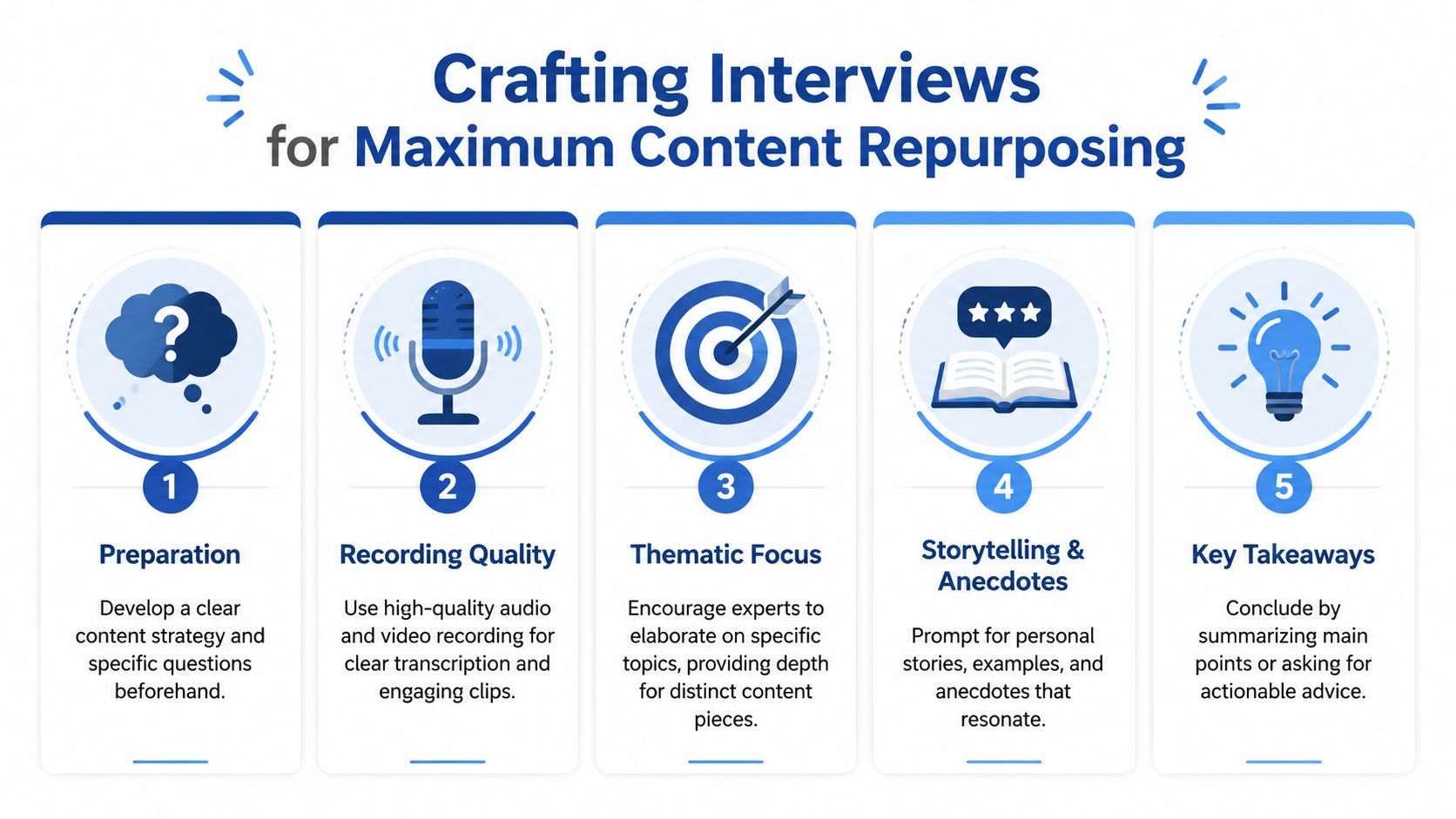
That format does more work than a panel, a written Q&A, or a submitted-questions email exchange.
The format that actually produces usable assets
Each part matters:
- One-on-one: One expert gets room to think past surface-level answers.
- Unscripted: The strongest moments usually appear in follow-up questions.
- Video: The same recording can feed clips, audiograms, quote cards, and long-form text.
- A challenging interviewer: Agreement sounds pleasant. Defended opinions become content.
A submitted-questions format usually produces polished but forgettable answers. Panels create breadth, not depth. For repurposing, depth wins.
Question patterns that produce quotable answers
Most interviewers ask for information. Better interviewers ask for position, contrast, and proof.
Use prompts like these:
Position
- What's a common belief in your industry that you think is wrong?
- What do teams keep overcomplicating?
- What would you stop doing first?
Specificity
- What did that cost in time or effort?
- How long did that take?
- What changed once the team saw the numbers?
Story
- When did you realize the old approach wasn't working?
- What happened next?
- What was the moment the team changed its mind?
Prediction
- What will matter more over the next few years?
- What are people underestimating right now?
- What will stop working first?
A useful interview guide should keep the conversation moving, but it shouldn't trap the speaker inside a script. A flexible structure works better than a rigid list. Teams that need a repeatable template can use a repurposing interview playbook as a planning aid.
Good repurposable moments usually appear right after the expert says something slightly uncomfortable, then has to explain why.
How to identify the top three quotes
After the interview, the transcript matters more than memory. The moments that felt big live often aren't the lines that read best later.
The strongest quote set usually includes three different species:
- The claim: a complete sentence that takes a clear position and works without setup
- The number: any line where experience gets specific through timeframes, costs, or other concrete details
- The story line: the sentence where the anecdote turns and opens the door to a longer narrative
What disqualifies a quote is just as important. Skip anything that needs heavy context, hides behind soft language, or sounds like generic advice.
The Manual Workflow and Its True Cost
The DIY path looks reasonable until the work starts. Then the interview turns into a pile of separate jobs across writing, editing, design, and publishing.
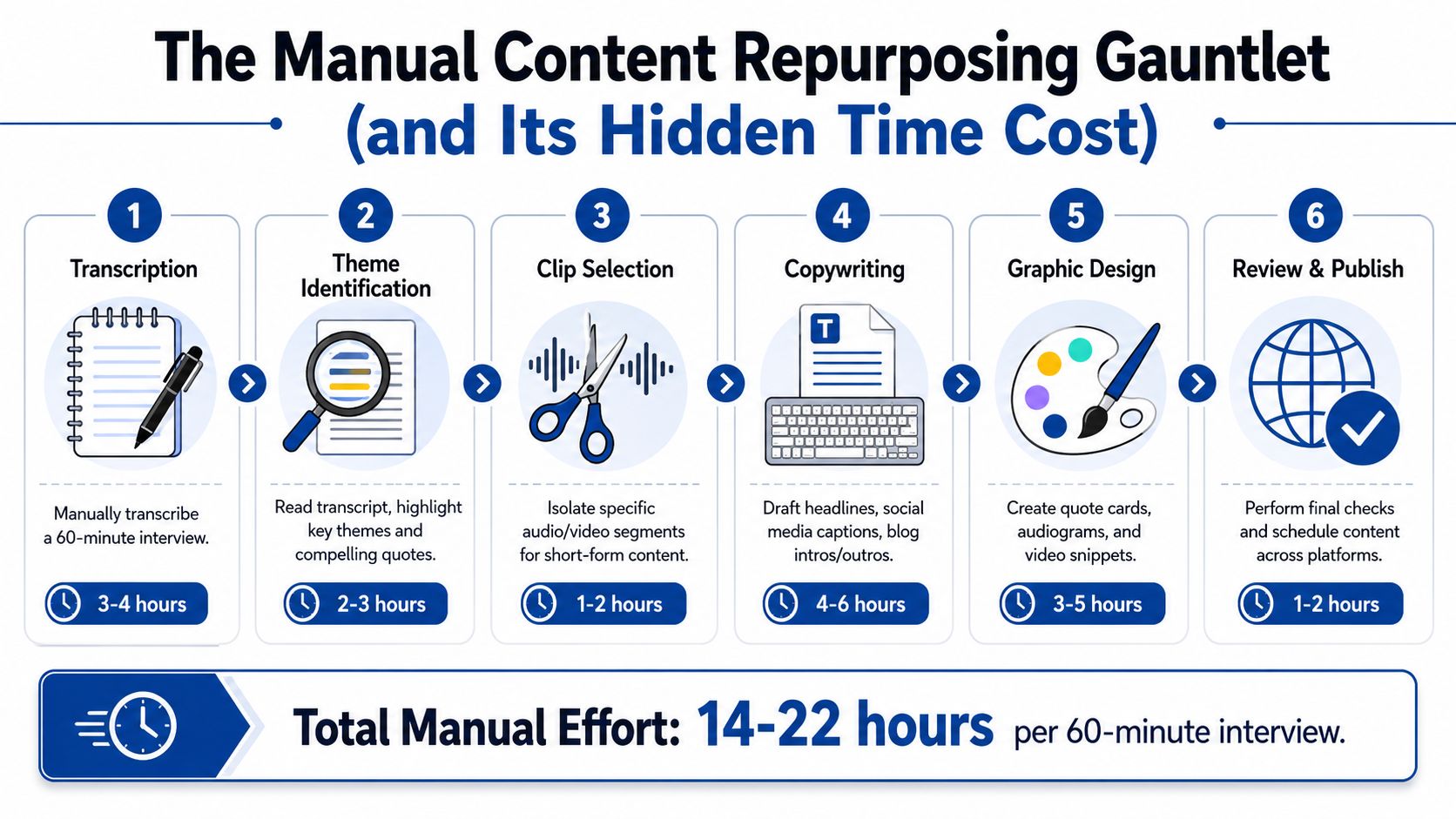
The broad sequence is familiar. Transcript. Cleanup. Theme extraction. Clip selection. Copywriting. Design. Review. Scheduling. The problem isn't knowing the steps. The problem is the cumulative labor.
A realistic DIY timeline
For a single 45-minute expert interview, a manual workflow often looks like this:
| Task | What actually happens | Realistic time |
|---|---|---|
| Transcript cleanup | Remove filler, fix speaker labels, correct errors | 1 to 2 hours |
| Theme mapping | Read the transcript and pull 5 to 7 usable themes | 1 to 2 hours |
| Quote selection | Find the claim, the number, and the story line | 45 to 90 minutes |
| Clip selection | Watch and trim strong moments for short video | 2 to 3 hours |
| Social copywriting | Draft posts, hooks, captions, and CTAs | 2 to 4 hours |
| Graphic planning | Turn quotes into cards, carousels, and audiograms | 2 to 3 hours |
| Blog drafting | Build a theme-first, quote-anchored article | 3 to 5 hours |
| Review and scheduling | Check accuracy, brand fit, formatting, and timing | 1 to 2 hours |
That is a real work block, not a side task.
A structured workflow helps. This repurposing workflow glossary entry captures the operational logic well. But even with a good workflow, someone still has to do the work.
Why the 100-plus-assets claim falls apart
The fundamental issue with most repurposing advice is that it gets unrealistic. It counts possible formats, not finished assets.
The bottleneck isn't idea generation. It's execution speed. As noted in Content10x's guide to expert interviews, guides often promise huge output from one interview, but, in practice, teams realistically produce only 1 to 3 low-quality derivatives before the process stalls.
That happens for a few predictable reasons:
- Different skills are required: clipping, writing, editing, and design rarely sit with one person
- Context switching is expensive: every handoff slows the work
- Review takes longer than expected: experts want factual accuracy and brand-safe phrasing
- The transcript isn't publishable: spoken language needs shaping before it reads well
The hidden cost isn't software
Many teams assume the missing piece is a transcription app or a clipper. Those help at the margins. They don't solve the core issue.
The work still needs human judgment. Someone has to decide which line is the quote card, which answer becomes the blog's central thesis, and which clip is worth posting. Canva, Adobe Express, and AI transcription services can support production, but they don't replace editorial selection or voice control.
The expensive part of interview repurposing isn't access to tools. It's the hours required to turn raw speech into finished assets someone would actually publish.
That is why DIY content repurposing often starts with ambition and ends with a folder full of transcript files.
The 1-to-30 Content Breakdown
A well-run interview does not become "content" in the abstract. It becomes a specific asset mix.
One 45-minute conversation can realistically produce a full publishing run that covers social, blog, and audio-first channels. The exact output depends on the quality of the interview, but a strong package often looks like this:
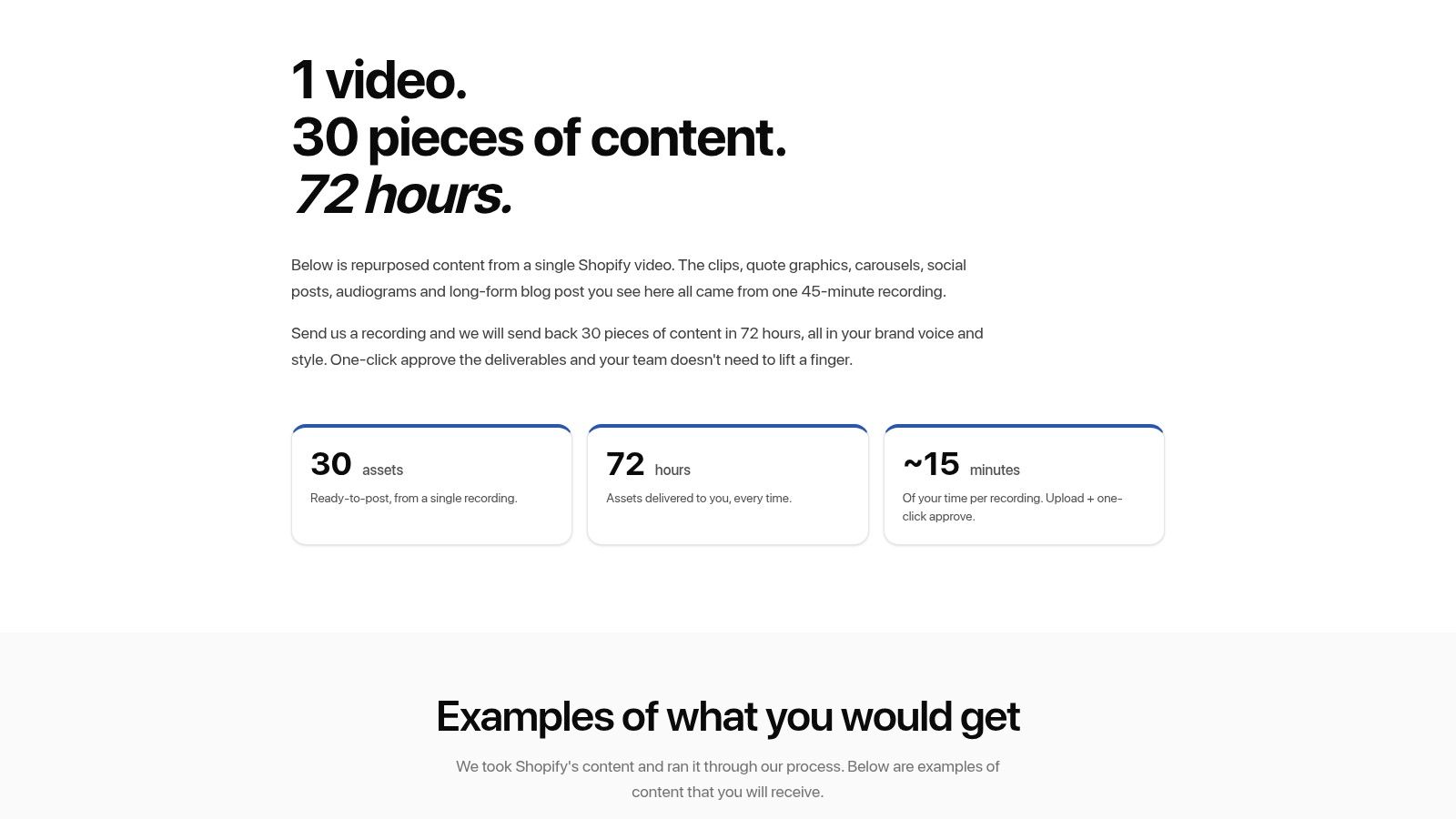
What the asset mix looks like
A practical 1-to-30 breakdown often includes:
- 8 to 12 short-form clips for LinkedIn, YouTube Shorts, or other social placements
- 6 to 8 social posts built from sharp claims, objections, or takeaways
- 4 to 6 quote graphics using verbatim lines from the transcript
- 1 to 3 carousels that turn a framework or story into a swipeable format
- 1 blog post structured around the interview's real themes
- Optional audiograms for audio-led distribution
- Optional email copy pulled from key sections or strongest takeaways
Teams that need more video-first output can bias toward clips. Teams with stronger organic search goals can put more weight on long-form text and quote-led articles. If video is a priority, a done-for-you clip service for long-form recordings usually delivers more consistent output than ad hoc internal editing.
A real quote graphic example
There is a public example worth studying. In the Shopify demonstration, one quote graphic from the conversation between Tobi Lütke and Vanessa Lee uses Lee's line:
"You actually have to just understand your domain really, really well"
That line works because it is complete, opinionated, and unmistakably personal. It doesn't sound like borrowed advice. It sounds like a real operator talking.
The anatomy of the graphic matters too:
- The quote is the hero, with the key phrase emphasized
- The speaker's name and title add authority and context
- The brand styling makes the asset recognizable to the company, not just to the guest
That is the standard a quote card should meet. It should carry a whole idea in one spoken sentence.
A video example shows how the same interview can also become a watchable short-form asset:
How the blog post gets built
The strongest interview articles are theme-first and quote-anchored.
That means the writer reads the full transcript, finds the core themes that emerged, then builds each section around the expert's strongest verbatim quote on that theme. The connective writing adds context and order. The expert supplies the ideas and voice.
A good transcript-to-blog workflow usually looks like this:
- Read the full transcript
- Pull 5 to 7 genuine themes
- Match each theme with its best exact quote
- Arrange the sections in a logical reading order
- Add transitions, framing, and supporting context
- Verify every quote word-for-word
The result reads like the expert thinking clearly in public. Not like a marketer summarizing them from a distance.
The Done-for-You Alternative
Content teams typically don't need another content theory. They need the work done without adding hours to an already overloaded week.
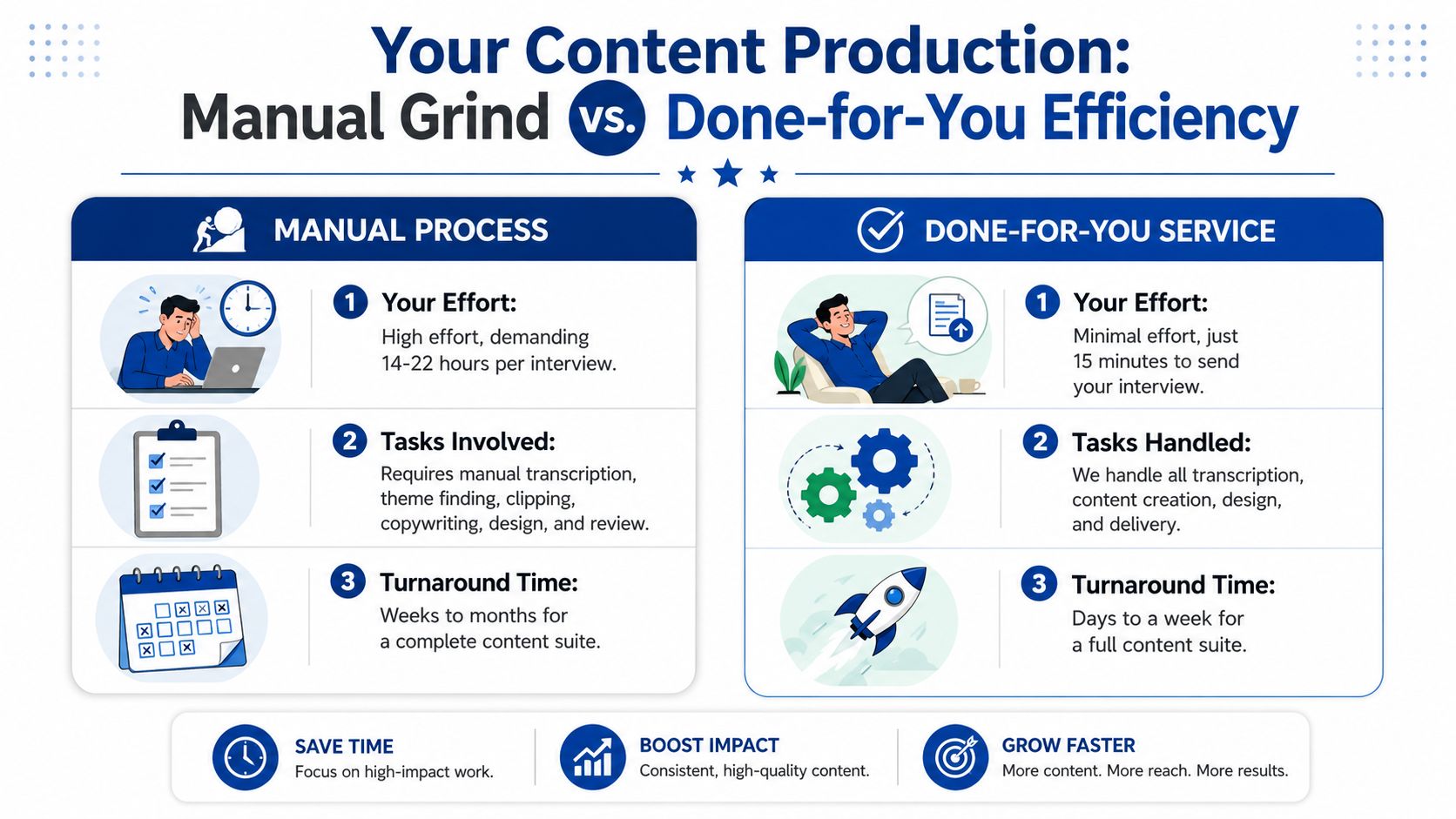
The contrast is straightforward. Manual repurposing requires multi-step coordination and a real production block. A done-for-you service compresses that into one handoff.
What busy teams actually need
The winning offer for a time-poor content lead is simple:
- Send one recording
- Get finished assets back fast
- Keep the expert's voice intact
- Avoid managing freelancers across four disciplines
That voice point is not cosmetic. 54% of marketers say AI-generated content lacks the authenticity needed for thought leadership, and human-reviewed content can increase engagement by 40% over AI-only outputs according to Jasper's repurposing analysis.
If the source material is an expert interview, flattening it into bland AI copy defeats the purpose.
What the service model looks like in practice
The cleanest done-for-you model looks like this:
| Your input | Delivery | Your time |
|---|---|---|
| One podcast, interview, keynote, sales call, webinar, or meeting recording | 20 to 30 ready-to-publish assets in 72 hours | About 15 minutes |
That output can include:
- Video clips
- LinkedIn posts
- Quote graphics
- Carousels
- Audiograms
- A blog post
For teams that care about operational predictability, the strongest service promise is not "more content." It's finished content in brand voice, on a deadline, with revisions handled. A direct next step for teams comparing approaches is to book a content repurposing demo and see how the workflow is handled end to end.
There are other practical advantages too. A done-for-you service can price work from $14 per finished asset, turn one 45-minute recording into 30 assets, and back delivery with a 72-hour turnaround guarantee or you don't pay. That is the kind of output internal teams usually want, but struggle to sustain.
Stop Sitting on a Goldmine
The most defensible content in an AI-heavy market is still authentic expertise. Not summaries. Not polished generic advice. Not another article assembled from the same public talking points as everyone else.
A recorded expert interview gives a team something far more useful. It captures a named person's judgment, phrasing, examples, and point of view in one sitting. That is hard for competitors to replicate and much easier to distribute across formats.
Two paths from the same recording
There are only two realistic options after the interview ends.
The first is the manual route. Someone transcribes, edits, clips, writes, designs, reviews, and schedules. That can work, but it usually slips behind campaign work and deadlines. The recording gets posted once, then buried.
The second is a scaled route. The team treats the interview as raw material for a full content run, then turns it into a content multiplier across channels. The concept is simple, and this content multiplier definition explains the logic well.
Where this fits in a broader content strategy
Interview repurposing works best when it connects to a larger editorial system.
It supports thought leadership because the material comes from real expertise on the record. It works alongside customer proof because the same editorial discipline applies to testimonial extraction. And it fits neatly into multi-format publishing because one source can feed text, video, image, and audio formats.
For related strategy, see:
- thought leadership content strategy
- how to repurpose customer testimonials
- turn one piece of content into many formats
A 45-minute expert interview is often the cheapest way to create content that sounds like a real expert, because it is a real expert.
If the team has the time and staff to run the full process manually, that path is available. If not, the smarter move is to stop letting strong recordings die after one publish.
If there's a backlog of interviews, podcasts, sales calls, or keynote recordings sitting unused, book a call with RepurposeYourContent or request a sample. Send one recording and get 20 to 30 ready-to-publish assets in 72 hours, in brand voice, with unlimited revisions.
Tags: