Snackable Content from Long Form Webinars: Unlock Webinar
Unlock engagement & marketing ROI. Discover how to create snackable content from long form webinars with our 2026 guide.

Most webinar teams still act as if the replay is the asset. It isn't. The replay is the source.
That matters because UK adults spent an average of 4 hours 20 minutes per day on online media in 2024, according to Ofcom data discussed here. Attention is spread across feeds, tabs, and short viewing windows. A sixty-minute recording asks for too much commitment too early.
That's why snackable content from long form webinars works when the replay alone doesn't. The useful unit isn't the whole session. It's the single idea inside it. A sharp answer. A hard truth. A clean explanation. A line worth stopping for.
The operational shift is simple. Stop publishing one long asset and hoping people adapt to it. Start extracting sub-two-minute, self-contained pieces that carry one idea each, then distribute them over time.
Why Your Webinar Replay Is Not Enough
A replay page solves one problem. It gives interested people a place to watch later. It does not solve discovery, distribution, or attention.
Snackable content is short, easy to consume material built for quick understanding. Think short video clips, quote cards, and concise social posts. In practice, for long webinars, that means sub-two-minute assets that stand on their own. They need context, a clear point, and a reason to care within seconds.
The replay asks for too much
A full webinar is valuable. It has depth, nuance, and proof of expertise. But most buyers won't start there. They need a smaller entry point.
That's the gap. Teams spend weeks planning the event, then publish the recording and move on. The strongest moments get buried inside a long timeline.
A thirty-second insight people actually watch beats a thirty-minute replay they never start.
There's also a format issue. Long webinar pages work for warm intent. Social feeds don't. Feed content needs to be immediate, self-contained, and legible on mobile.
Snackable does the distribution job
The point of snackable assets isn't to replace long-form content. It's to earn the next click, the next view, or the next conversation.
A practical definition for content teams looks like this:
- Sub-two-minute: Short enough for feed consumption.
- Self-contained: The asset makes sense without watching the full webinar.
- Single-idea: One takeaway per post, clip, or card.
- Channel-ready: Captions, formatting, and framing fit where it will be published.
Teams that still need a post-event plan can start with this guide on what to do after hosting a webinar.
Your Playbook for Finding Webinar Gold
The common mistake is random slicing. Someone opens the recording, trims a few moments that sound decent, and posts them unchanged. That usually produces clips with weak openings, missing context, and no reason to stop scrolling.
The better rule is one idea equals one snack.

Use source, slice, shape, ship
In B2B workflows, the strongest method is a source-slice-shape-ship pipeline, based on guidance summarised in this webinar repurposing workflow reference.
Source
Start with the full webinar, transcript, chat log, and Q&A. The transcript helps, but the raw video matters because tone and delivery often make the clip.Slice
Pull segments that contain one strong idea. Not a topic. An idea. A clean opinion, a concrete explanation, or a useful objection.Shape
Rework the segment for the destination. Add captions. Tighten the opening. Remove throat-clearing. Add an on-screen title if the clip needs framing.Ship
Publish the asset in a native format for the channel. The pitfall isn't extraction. It's mismatch. A raw webinar excerpt usually feels too effortful in-feed.
What counts as a strong extract
Not every decent sentence deserves a clip. The moments worth pulling tend to have one of these qualities:
- An unscripted truth: A speaker says something sharper than the prepared slides.
- A concise explanation: A complex issue gets reduced to one simple answer.
- A pointed customer question: The audience reveals a pain point in plain language.
- A quotable line: The speaker says something people want to repeat internally.
- A clear disagreement: A speaker pushes back on a lazy industry assumption.
Practical rule: If the segment needs two extra sentences of setup, it isn't one snack yet.
A useful review pass is to label candidate moments by type before editing them. Clip. Quote. Carousel. Stat visual. Audio snippet. That speeds production and stops the team from forcing every moment into video.
For teams building a repeatable extraction process, this guide on how to extract video clips from a webinar is a useful next step.
A simple review workflow
A working editorial pass can be done fast:
- Step 1: Skim the transcript and flag sections where the speaker sounds decisive.
- Step 2: Watch only those flagged moments and mark the exact in and out points.
- Step 3: Name the takeaway in one sentence. If that sentence isn't clear, keep cutting.
- Step 4: Assign each moment its best format before anyone opens a design tool.
That's how teams find webinar gold without turning review into a full-day editing task.
The Essential Snackable Content Formats
Not every insight wants to be a clip. Some ideas work better as text, some as visuals, and some as a short sequence.
The format choice matters more on mobile. UK telecoms evidence for 2025, discussed in this analysis of snackable content and mobile distribution, shows 5G outdoor coverage reached 84% of the UK landmass, while coverage quality still varies. That's why lightweight, purpose-built assets outperform raw cut-downs. People can access content almost everywhere, but they still won't tolerate awkward formats.
A quick visual summary helps teams standardise output.

Five formats worth creating every time
Short video clips
Use these for moments where delivery matters. Tone, confidence, and facial expression carry the point. Add subtitles, speaker name, and role. Keep the opening tight.Quote cards
Best for sharp statements that are stronger as text than video. These work well when the wording is concise and the speaker has authority.Single-stat graphics
Use this when the webinar includes one number or benchmark that deserves focus. Keep the design clean. One data point, one takeaway, one source line if needed.Mini-carousels
Good for ideas that need a little setup. One problem on slide one, one explanation in the middle, one action on the final slide.Image quotes
These sit between a quote card and a speaker post. They work well for founder-led teams and subject matter experts because identity supports credibility.
This example shows how different B2B video formats can be adapted for social use.
Snackable does not mean shallow
The strongest snackable content is concentrated expertise. It isn't simplified fluff. It's a precise point extracted from a substantive conversation.
A short clip of a CEO saying, “Many organizations don't have a lead problem. They have a follow-up problem,” has weight because it comes from context. The webinar gave the speaker space to develop the point. The snack gives the audience the most useful part first.
The value sits in the density, not the duration.
That same principle should shape the supporting copy. Teams that want to boost social media engagement with AI often get better results when they feed AI a specific webinar excerpt, not a generic topic prompt. The quality of the snack starts with the quality of the source.
For more examples of what works on business platforms, this breakdown of B2B video content formats for LinkedIn is useful.
Brand once, reuse often
Templates save time and protect quality. Create fixed layouts for:
- Speaker clips: Name bar, subtitle style, logo placement.
- Quote graphics: Font hierarchy, headshot treatment, brand colour use.
- Mini-carousels: Cover slide, body slide, final CTA slide.
When those templates exist, the team spends time choosing the right idea, not redoing design decisions.
How RepurposeYourContent Automates This Workflow
Manual repurposing breaks down at the boring parts. Transcript review takes time. Clip selection takes longer. Formatting for multiple channels turns a strong strategy into a backlog.
That's where workflow automation matters. Teams don't need more theory. They need a system that turns one source file into usable assets without adding another production sprint.

A practical three-step operating model
Upload the webinar
Start with the recording or a hosted link. The useful input is the full conversation, not a pre-cut edit.Select the outputs
Choose the asset types needed for the campaign. That usually includes video clips, image quotes, social posts, and a longer recap.Review and publish
Approve the strongest cuts, edit wording where needed, then hand off platform-ready assets to the content calendar.
This general approach lines up with broader automation thinking. Teams that want a wider process view can use this expert guide to marketing automation to map handoffs and bottlenecks.
Where automation actually helps
The biggest gains usually come from repeatable tasks:
- Clip identification: Surfacing likely highlight moments from a long recording.
- Transcription and text extraction: Turning spoken content into usable written raw material.
- Format adaptation: Creating assets for clips, carousels, and quote visuals from the same source.
- Brand consistency: Applying the same design rules across outputs.
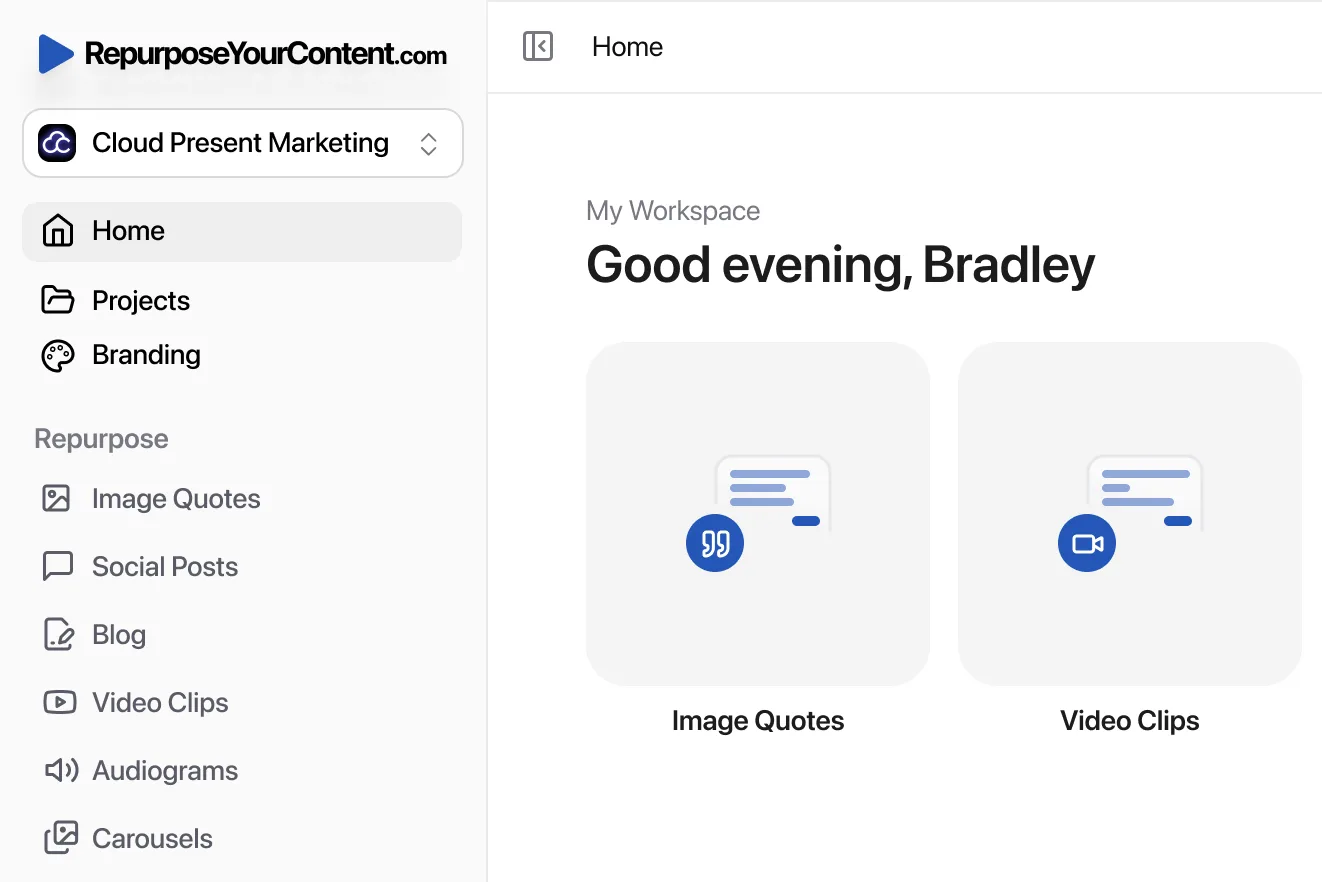
One tool built for this workflow is RepurposeYourContent. It takes a single webinar recording and generates assets such as video clips, image quotes, LinkedIn-style image carousels, blog posts, social posts, audiograms, newsletters, and timestamps. The useful part isn't just speed. It's reducing the production drag that stops teams from shipping the full content set.
Automation shouldn't replace editorial judgement. It should remove the repetitive work around it.
For teams evaluating this route, this article on how to automate webinar repurposing covers the operational side.
One workflow example
A straightforward campaign might look like this:
- Step 1: Upload a one-hour panel discussion.
- Step 2: Pull eight moments where each speaker makes one clear point.
- Step 3: Turn three into clips, two into quote images, two into mini-carousels, and one into an audiogram.
- Step 4: Build a recap article from the transcript and use the snacks to distribute it over the next month.
- Step 5: Track which ideas earn clicks, comments, and replies, then feed that into the next webinar brief.
That's the difference between storing a webinar and operating a content system.
The 30-60-90 Snackable Distribution Cadence
Publishing all the snacks in one week wastes the source material. A webinar should feed distribution long after the event.
The useful model is a 30-60-90 cadence. It gives the team a fixed rhythm, prevents content bunching, and keeps the webinar working beyond launch week.

Days 1 to 30
Use the first month for reach and recall. Publish daily or every other day across the channels that matter most.
That includes a mix of clips, quote visuals, short text posts, and carousels. Keep each post tied to one takeaway from the webinar, not the event as a whole.
Days 31 to 60
This is the echo phase. Repackage the strongest ideas and move them into owned channels.
A practical weekly rhythm looks like this:
- Social reposts: Re-share the posts that sparked comments or saves.
- Newsletter inclusion: Add one snack plus a short editorial note to the weekly email.
- Sales enablement: Hand top-performing clips to the SDR or AE team for follow-up use.
Working rule: Don't create fresh assets too early if the first set hasn't finished travelling.
Days 61 to 90
The final phase is where attention gets routed into depth. That matters because content over 3,000 words has been reported to generate 21% more traffic and 24% more shares than articles in the 901 to 1,200-word range, as summarised in this comparison of snackable and long-form content.
The practical move is a paired model:
| Phase | Asset | Job |
|---|---|---|
| First touch | Short clip or quote | Earn attention |
| Mid journey | Newsletter or carousel | Reinforce the idea |
| Depth layer | Substantial recap article | Build authority and search value |
That's the purpose of snackable content from long form webinars. Short assets pull people in. The deeper recap gives them somewhere useful to go next.
Measuring the ROI of Your Snackable Content
If the team only tracks likes, it will miss the actual outcome. Snackable content is a distribution layer. Its value shows up in movement, not just reactions.
The first thing to measure is engagement per asset type. Not all snacks do the same job. Clips may earn comments. Carousels may earn saves. Quote posts may travel further inside a niche audience. Compare formats against their intended role, not against one flat average.
The metrics that matter
A simple measurement stack works well:
- Engagement quality: Comments, replies, saves, and shares that show the idea landed.
- Click-through to the core asset: Traffic from snacks to the webinar replay, recap article, or landing page.
- Lead actions: Demo requests, form fills, newsletter sign-ups, or content downloads tied to the campaign.
- Question mining: Comments and replies that expose objections or new webinar topics.
Teams should also look at message resonance. Which speaker line triggered discussion? Which pain point kept appearing in comments? That feedback often matters more than broad reach because it sharpens the next webinar brief.
Tie the snacks back to business intent
A clip without a next step is just activity. Every snack should point somewhere. That might be a replay page, a recap article, a newsletter issue, or a related offer.
With this approach, reporting gets cleaner. The team can connect content format, topic, and distribution channel to downstream action. For a practical framework, this guide to content marketing ROI measurement is a useful reference.
The strongest signal is consistency. If certain snack types repeatedly drive clicks, replies, and qualified interest, the webinar is no longer a one-off event. It has become a reusable content engine.
If the replay is still doing all the work, the team is leaving most of the webinar's value untouched. Try RepurposeYourContent to turn one long-form session into ready-to-publish snackable assets, then distribute them over the next 90 days with a system that scales.
Tags: