Webinar Reminder Email Best Practices to Fix Low Attendance
Stop settling for 35% attendance. Use these webinar reminder email best practices, from timing to subject lines, to get more people to show up live.

A small timing change can lift attendance fast. The highest-return fix is usually a stronger reminder sequence, especially the late-stage sends that catch people when they are about to miss you.
If your registrants are skipping the live session, your reminder system is underperforming. Weak attendance usually comes from poor timing, crowded copy, or too much friction between the email and the join link.
The fast win is not a full rebuild. It is tightening the moments closest to showtime. The 3-hour reminder is often overlooked, and it can produce an outsized attendance bump because it reaches people while they are still planning their day. Minimal change. Real impact.
For B2B marketing managers, this is fixable. Sharpen the send timing. Cut the copy. Put the join action first. Then make sure your post-event process is just as disciplined with a webinar follow-up email sequence template, so no registration goes to waste.
The goal is simple. Get more of the people who already said yes into the room.
1. Nail the 4-Part Reminder Cadence
A late reminder can do more work than your first three combined. The highest-yield send is often the one close to showtime, especially the 3-hour or 1-hour email that catches people while they are still shaping their day.
Use a four-part cadence. Send at one week, one day, three hours, and start time. That schedule covers commitment early and attendance late. It also fixes the common gap in B2B webinar programs: teams send the early reminders, then go quiet right before the session.
LiveWebinar recommends an immediate confirmation email after registration, then reminders before the event and at start time in its webinar reminder timing guide. Use that as a baseline. Then tighten the final stretch.
Give each reminder one job
Do not recycle the same email four times. Each send should push one action.
- One week before: Re-sell the session. Restate the problem, the agenda, the speaker, and who should attend.
- One day before: Confirm relevance. Show the outcome they will get and why live attendance matters.
- Three hours before: Clear the path. Put the join link first. Repeat the start time. Add one sharp reason to show up live. This is the low-effort send that often lifts attendance fast.
- At start time: Keep it plain. “We’re live. Join now.”
That last stretch matters most. Your 3-hour email reaches registrants before they disappear into meetings, commutes, and inbox triage. Small copy changes here can produce an outsized attendance gain.
Cadence discipline matters because intent decays. Someone who registered last Tuesday still needs a prompt today.
Build the workflow once
Trigger the confirmation email right after registration. Include the join details and calendar links.
Then queue the full sequence inside your webinar platform or CRM. No manual sends. No day-of scrambling. If you need naming rules for cleaner inbox presentation, follow these email subject line capitalization best practices.
Keep the final two reminders short enough to read on a phone in seconds. One CTA. One link. One value point.
Save your post-event planning for the follow-up stage. Use this webinar follow-up email sequence template after the session, not inside the reminder flow.
2. Write Subject Lines That Get Opened
Open rate decides whether your reminder sequence gets a chance to work at all. Strong reminder emails usually beat standard promo emails because the intent is already there. The job of the subject line is simple. Confirm relevance fast and make the next action obvious.
That matters even more in the final stretch. A weak 3-hour reminder gets buried under meetings and inbox triage. A clear one can pull registrants back in with very little extra work.

Subject line formulas worth using
Write for scanning, not admiration. Mobile inboxes reward clarity.
Use patterns like these:
- Reminder plus topic: [Reminder] B2B demand gen webinar tomorrow
- Name plus action: Sarah, your join link for tomorrow’s session
- Starting now: [Starting Now] Automating webinar follow-up
- Benefit plus timing: Today. How to get more value from webinar no-shows
Match the subject line to the timing of the send. Early reminders should reinforce the topic and outcome. Your 3-hour email should lead with access and urgency. Your start-time email should say exactly what is happening.
Preheaders should finish the thought. Keep them literal. “Join link inside. Starts at 2 PM BST.”
What to write at each reminder stage
The best reminder subjects get more direct as the event gets closer.
A content marketing team could use:
- One day reminder: Subject: Your spot for tomorrow’s webinar on webinar follow-up
- Three hour reminder: Subject: Starts in 3 hours. Your join link is inside
- Start-time reminder: Subject: We’re live now. Join the session
This is a low-effort fix with a high payoff. Teams often spend too much time tweaking the first reminder and not enough time tightening the last two sends. That is backward. The 3-hour email is often the easiest attendance lift in the whole sequence.
Keep formatting clean. Skip all caps. Skip vague teaser copy. Put the important words first. If you want a sharper framework for message framing, use this headline optimisation guide. For cleaner formatting, follow these email subject line capitalization best practices.
3. Make Add to Calendar Effortless
Small setup changes here pay off fast. If a registrant saves the session to their calendar, you get another reminder channel without writing another email. That matters most in the last stretch, especially around the 3-hour send, where small friction cuts attendance.
Put calendar options in the confirmation email first. Repeat them in the first reminder. Do not make people hunt for them later.
Calendar links should remove clicks, not add them
Give people three choices:
- Google Calendar button: Best for speed
- Outlook button: Required for B2B and enterprise lists
- ICS download: Good fallback for everyone else
Your calendar event needs to be useful when it fires later. Include the webinar title, date, time zone, direct join URL, and a short description of what the session covers. Put the join link in the location field too. Mobile users will thank you.

Build the invite for the moment it gets used
The reminder email gets the click. The calendar alert gets the show-up.
That is why the event copy matters. A weak invite says “Webinar” and gives a time. A strong invite gives the exact join link, names the outcome, and makes the alert useful three hours before go time. This is one of the lowest-effort attendance fixes in the whole sequence.
For a Zoom registration flow with HubSpot reminders and an Outlook-heavy audience, keep the setup simple:
- Confirmation email: Include Google, Outlook, and ICS options
- First reminder: Repeat the calendar links for anyone who skipped the confirmation
- Calendar event: Add the join URL in both the description and location field
B2B teams miss this all the time. They spend hours tuning copy and leave the calendar invite half-finished. Fix the invite first. Then review the rest of your sequence.
If you want more practical ways to remove friction across the whole reminder flow, use this guide on how to increase webinar attendance rate.
4. Use Social Proof and Urgency
Reminder emails shouldn’t read like system notifications. They should reinforce that the live session is worth showing up for.
The strongest version of this is simple. Show why the webinar matters now. Mention the live Q&A. Mention what attendees will get that a replay won’t deliver in the same way. Use social proof only when it’s real and current.
Build urgency around the benefit
A day-before reminder works best when it reframes the webinar as a live opportunity, not just a diary entry.
Examples that work:
- Live Q&A angle: Bring your funnel attribution questions and get answers live
- Practical asset angle: Attendees get the worksheet during the session
- Role-specific angle: Built for demand gen managers, not broad marketing teams
If prior attendees have given strong feedback, use a short testimonial or quote card in the reminder. Keep it authentic. Keep it tight.
Field note: If registrant volume isn’t impressive, qualitative proof works better than forcing a number.
Repurpose proof instead of inventing it
A webinar host with a strong archive can pull a 20-second clip from a previous speaker, or turn one strong attendee comment into an image quote for the one-week reminder. That gives the campaign credibility without adding more copy.
For teams collecting customer voice already, this guide on how to repurpose customer testimonials shows how to turn existing proof into reminder assets.
Urgency should stay clean. No fake scarcity. No inflated claims. Just a clear reason to attend live instead of watching later.
5. Focus on Value, Not Just Logistics
Most reminder emails fail because they sound administrative. “Don’t forget.” “See you tomorrow.” “Here’s your link.” That copy doesn’t earn attention.
The better approach is benefit-led. A reminder should tell the registrant what problem gets solved if they show up. The Event Marketing Institute UK Survey, as cited by Univid, found that branded, multi-touch reminder sequences outperformed single-reminder campaigns, and user satisfaction reached 92% for sequences with benefit-focused copy in the Univid webinar reminder glossary.
Rewrite the opening line
Don’t open with logistics unless it’s the final reminder. Open with the payoff.
Weak: Tomorrow’s webinar starts at 2pm. Here is your link.
Better: Tomorrow’s session shows demand gen teams how to turn a single webinar into a repeatable content pipeline.
That shift matters. It reminds the registrant why they cared in the first place.
A few copy patterns that hold up
- Pain-first: Manual webinar follow-up is slow. This session shows a faster system.
- Outcome-first: See how to turn one recording into clips, posts, and email copy.
- Role-first: For B2B marketing managers who need more output without more headcount.
A SaaS team promoting a webinar on content operations should keep the body copy short, then use three bullets for takeaways. One bullet per outcome. No padded agenda blocks.
For broader planning, this piece on B2B webinar content strategy helps shape reminders around outcomes instead of topics.
6. Include an SMS Reminder Supplement
Email should stay the primary channel. SMS is the last-mile backup.
Use it only for registrants who explicitly opted in. Send one message close to the webinar start. Keep it plain. The message should work on a locked phone screen without extra scrolling.
Where SMS fits
A clean setup looks like this:
- Registration form: Optional checkbox for a text reminder
- Workflow logic: Trigger only for opted-in registrants
- Message timing: Near start time, when inbox visibility is weakest
- Message copy: Event name plus short join link
Example: RepurposeYourContent session starts now. Join here: short link
This works well for high-intent audiences, especially when people are away from their desk.
Keep the message narrow and useful
SMS is not the place for persuasion copy. It’s a utility channel.
A B2B team using Twilio, HubSpot, or a webinar platform with SMS support should use the text only as a final prompt. No promo language. No long URLs. No follow-up barrage.
If attendance still disappoints, the answer isn’t more reminders. The answer is better recovery. Segment no-shows, send the replay fast, and move them into a specific nurture path based on the webinar topic.
6-Point Webinar Reminder Best Practices Comparison
| Strategy | Implementation complexity | Resource requirements | Expected outcomes | Ideal use cases | Key advantages |
|---|---|---|---|---|---|
| 1. Nail the 4-Part Reminder Cadence | Medium–High (automation + timezone logic) | Marketing automation, segmented templates, copywriting | Significant attendance lift (studies show ~+40% vs single reminder) | Large or high-value webinars, global audiences | Multiple touchpoints, progressive urgency, reduces forgotten registrations |
| 2. Write Subject Lines That Get Opened | Low–Medium (A/B testing, CRM integration) | Clean CRM data, testing tools, short copywriting cycles | Higher open rates and improved CTR | Crowded inboxes, email-driven registration funnels | Clarity + personalization increases opens and engagement |
| 3. Make "Add to Calendar" Effortless | Medium (calendar integrations, QA) | Calendar integration tools, ICS generation, cross-client testing | Fewer no-shows; better on-time attendance | Time-sensitive events, attendees across timezones | Creates a persistent calendar block; reduces timezone confusion |
| 4. Use Social Proof and Urgency | Low–Medium (data display + creative assets) | Real-time registration data, testimonials, design assets | Increased perceived value and live attendance | Early promotions, persuading undecided registrants | FOMO and credibility that drive live attendance |
| 5. Focus on Value, Not Just Logistics | Medium (audience insight + content creation) | Content strategists, writers, role-specific examples | Higher motivation to attend; better-qualified attendees | B2B education, conversion-focused webinars | Clear outcome framing that answers "Why attend?" |
| 6. Include an SMS Reminder Supplement | Medium–High (regulatory + tech setup) | SMS platform, opt-in handling, short links, compliance resources | Near-immediate attention; strong last-minute attendance lift | Mobile-first audiences; last-minute nudges | Extremely high open rates and immediate action |
Make Every Webinar Valuable, Regardless of Attendance
A sharp reminder sequence can lift live attendance fast. But the highest-return fix often happens after the event. One recorded webinar can fuel your next 3-hour reminder, your no-show follow-up, and your sales enablement content with very little extra work.
Treat every webinar like a content asset, not a one-time event.
The reminder sequence gets people into the room. The post-event system gets more value from the work you already did. If attendance comes in lower than expected, you still have a recording, audience questions, speaker soundbites, and proof that the topic resonated enough to earn registrations.
Use them.
How RepurposeYourContent helps
RepurposeYourContent makes the post-event workflow fast and repeatable.
A simple workflow looks like this:
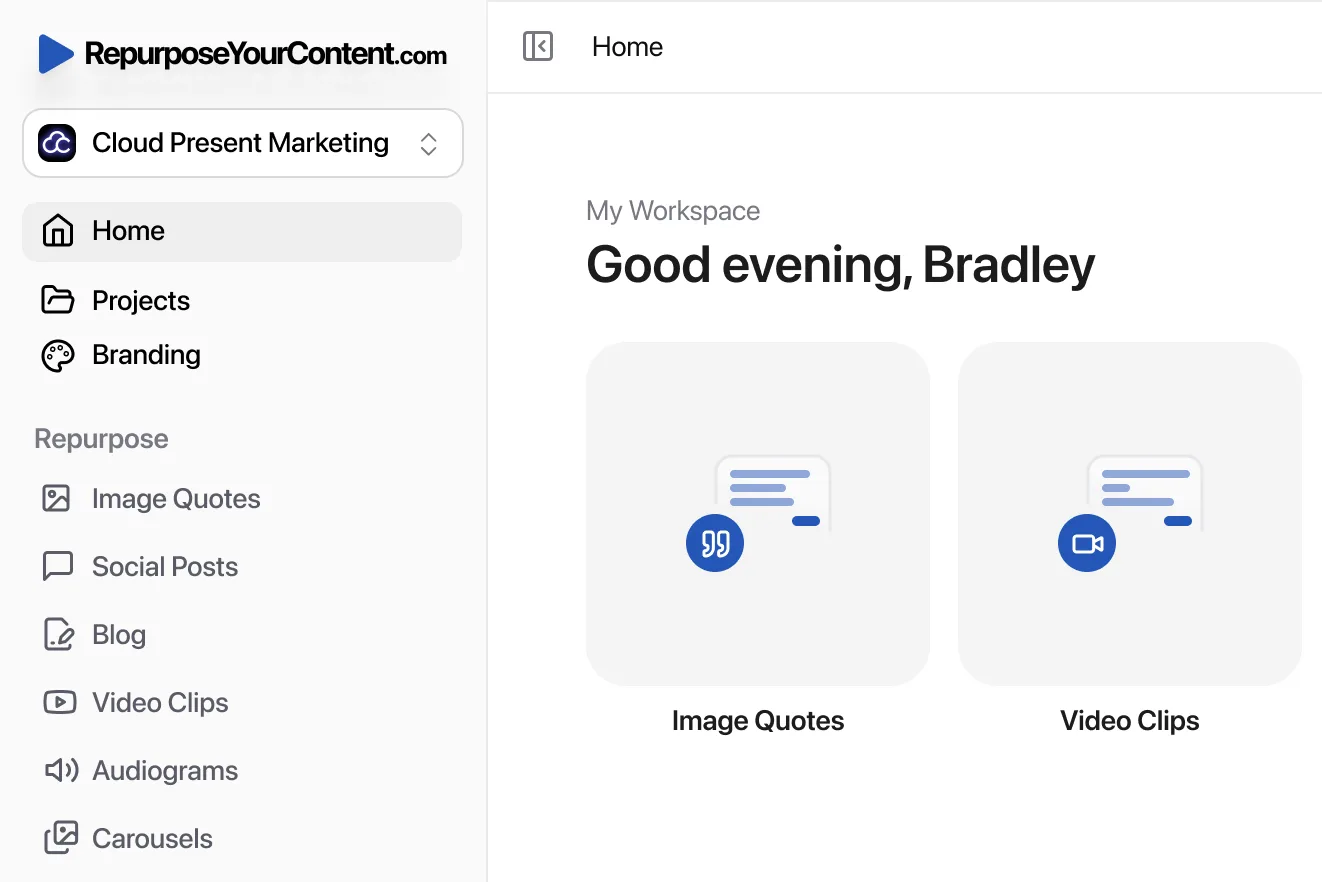
Step 1. Upload the webinar recording from Zoom, YouTube, Vimeo, or another platform.
Step 2. Select the outputs needed, such as video clips, blog posts, social posts, audiograms, image quotes, newsletters, LinkedIn carousels, and timestamps.
Step 3. Generate the assets, review them, and reuse the strongest pieces in future reminder emails, follow-ups, and sales outreach.
That last step is more important than it seems.
A 20-second speaker clip can strengthen a 3-hour reminder with almost no extra work. A quote card can sharpen the promise in a day-before email. Timestamps save your team from scrubbing through a full recording just to build a no-show follow-up or send sales the best moment.
This is the low-effort, high-impact move that many teams miss.
For people who skip the live event, a replay email alone is not enough. Send the replay. Add the top takeaways. Point them to the strongest segment. Give attendees the next CTA. Give no-shows the condensed version first, then the full recording.
A webinar should create value even if the live room is smaller than planned. It should produce follow-up content, stronger future reminders, and useful assets for pipeline teams either way.
Try RepurposeYourContent and turn every webinar into video clips, blog posts, social posts, audiograms, image quotes, newsletters, LinkedIn carousels, and timestamped assets in minutes.
Tags: