What Is Content Repurposing Complete Guide: 2026 Strategy
What is content repurposing complete guide: Discover a 2026 B2B workflow to turn one webinar into 30 assets and scale your marketing results today.

Content repurposing is the strategic process of turning one core asset, such as a webinar, into multiple formats for different channels, and in the UK 94% of marketers already do it. For B2B teams, it's not a shortcut. It's the only practical way to keep content moving without rebuilding everything from zero after every campaign.
The difficulty encountered isn't typically a content problem. It's a distribution problem.
A webinar gets planned, scripted, promoted, hosted, edited, and posted. Then it disappears into the archive. The recording sits on a landing page. A few people watch it on demand. Everyone moves on to the next deadline. That's a waste of a strong source asset.
A single webinar already contains opinions, examples, objections, answers, stories, and language your market uses. That source material can become clips, blog posts, carousels, emails, audiograms, podcast audio, and social posts. That's what this what is content repurposing complete guide is really about. Not recycling for the sake of it, but building a repeatable system that gives every major content investment a longer working life.
Small teams need that system. So do larger teams with too many channels and not enough time.
What is Content Repurposing
Content repurposing means taking one original piece of content and transforming it into several new assets designed for different formats, channels, and audience behaviours.
That's different from reposting the same thing everywhere. A webinar recording uploaded to YouTube and LinkedIn unchanged isn't a repurposing strategy. It's basic distribution. Repurposing starts when the team extracts the useful parts and rebuilds them for where people will consume them.
A simple example makes it clear. One webinar can become:
- Short video clips for LinkedIn or paid social
- A blog post built from the strongest teaching points
- Email follow-up for attendees and no-shows
- Quote graphics for social feeds
- An audio version for podcast listeners
- Carousel slides that summarise a framework
That's the core idea. One source. Many outputs. Different use cases.
In the UK, 94% of UK-based marketers actively repurpose their content, according to UKTI's 2023 content repurposing survey. That matters because it shows repurposing isn't a niche tactic for content-heavy teams. It's standard operating behaviour for marketers trying to protect time and improve returns.
What repurposing is not
A lot of teams confuse repurposing with copy-paste distribution. That's where things break.
| Approach | What it looks like | What happens |
|---|---|---|
| Cross-posting | Same asset, same format, multiple channels | Fast, but usually weak fit |
| Reposting | Same asset, same channel, different date | Useful for resurfacing winners |
| Repurposing | Same idea, rebuilt for a new format | Better fit, better shelf life |
Repurposing isn't lazy content. Lazy repurposing is lazy content.
For a broader introductory explanation, Feather's content repurposing guide is a useful companion read. For teams that want a more operational model after that, this content multiplication framework shows how a single source asset can feed an ongoing publishing cadence.
Why the concept matters now
Marketing teams are expected to show up in more places than before. Website, email, LinkedIn, YouTube, paid social, newsletter, community, podcast feeds. That demand didn't come with unlimited headcount.
Repurposing solves that operational gap. It lets a team create around a strong source asset instead of treating every post, email, and article as a separate production job.
Why Repurposing Is a Non-Negotiable B2B Strategy
The old model was simple. Create one big piece. Publish it. Promote it for a week. Move on.
That model doesn't hold up anymore. Buyers don't all consume the same format. They don't all use the same channel. They don't all show up on the day a webinar goes live. If a team treats a webinar as a one-time event, it throws away most of the useful work already done.
Repurposing improves commercial return
This is the strongest argument for doing it properly. In the UK B2B market, content repurposed from webinars delivers a 4.2x higher lead conversion rate compared to single-use webinar recordings, according to Libril's content repurposing guide.
That finding matches what many B2B teams already feel in practice. A buyer might skip the live webinar, but engage with a short clip. Another might ignore the clip, but read a blog version. Another might only respond to an email takeaway tied to a specific pain point. The original webinar still did the heavy lifting. Repurposing gives the market more ways to consume it.
Buyers prefer different formats
Not everyone wants a full recording. Some want the sharpest point in under a minute. Some want a skimmable article. Some want slides they can save and share internally. Some want audio during a commute.
That's why good repurposing is format adaptation, not duplication.
A practical approach to this concept:
- Video clips suit fast attention and social discovery
- Blog posts suit search, depth, and internal linking
- Carousels suit frameworks and summary content
- Email suits direct follow-up and nurture
- Audio suits passive consumption
- Image quotes suit reach and speaker authority
Teams that publish only the original webinar recording force every prospect into one format. Most won't bother.
Consistency beats sporadic bursts
Algorithms don't reward good intentions. They respond to consistent publishing, clear topic signals, and audience engagement over time.
Repurposing helps teams maintain a steady cadence without treating every day like a fresh production sprint. One webinar can support weeks of posts and follow-up assets. That consistency compounds brand familiarity. It also helps search and social channels understand what the company talks about repeatedly and credibly.
Practical rule: If a team can only publish when it creates something from scratch, publishing will become irregular fast.
A strong webinar often contains enough material for multiple content moments. That changes the planning model from campaign-by-campaign to source-asset-by-source-asset. For teams building a more durable system, this content repurposing strategy for 2026 gives a useful next step.
The trade-off most teams miss
Repurposing isn't free. It still needs judgment. Teams have to pick the best moments, shape them for each channel, and publish with intent.
But the trade-off is obvious. A team can spend its energy adapting proven material, or waste that same energy inventing every post from a blank page. The second option feels creative. It's also how content operations stall.
A Repeatable Content Repurposing Workflow
Good repurposing isn't random. It needs a workflow the whole team can follow.
The simplest version has four stages. Capture, extract, adapt, distribute. If any one of these breaks, the outputs get weaker.
A visual makes it easier to hold.

Capture
Capture means securing the best possible source material. For webinars, that includes a clean recording, clear speaker audio, slides that are readable, and a defined topic with a specific audience.
Weak source content creates weak repurposed content. If the webinar rambles, lacks a point of view, or never gets concrete, no amount of editing will fully fix it.
A capture checklist helps:
- Record clean audio because poor sound ruins clips and audio versions
- Use a focused title because vague topics produce vague cutdowns
- Brief speakers well so examples, objections, and takeaways are easy to extract
- Keep visual assets such as slides and speaker names for later use in carousels and quotes
Extract
Extraction is where the team finds the usable building blocks inside the source. This usually includes key moments, standout quotes, recurring objections, tactical advice, and strong transitions that can stand alone.
This is the stage many teams skip. They jump from full recording straight to publishing snippets. That usually produces random clips with no narrative.
A better extraction pass looks for:
- Teaching moments that answer a clear buyer question
- Strong phrasing that can become quote cards or hooks
- Sections with structure such as lists, frameworks, or comparisons
- Audience questions that reveal intent and objections
UK-specific data shows that implementing a repurposing framework can achieve a 58% reduction in content production costs for B2B teams, with repurposed assets generating 3.7x more pipeline velocity, as noted in Libril's analysis cited earlier.
The best repurposed content usually comes from the clearest original thinking, not the fanciest editing.
Adapt
Adaptation is where repurposing becomes real. The raw material gets rebuilt for a platform instead of being copied across all of them.
A webinar answer that works as a full spoken explanation may need a punchier hook for LinkedIn. A useful framework may work better as a carousel than a paragraph-heavy post. A quote might land as an image card, but only after removing filler words and spoken language clutter.
Here's a practical workflow example.
Step-by-step example
Step 1
Choose one strong webinar segment with a clear takeaway.
Step 2
Turn that segment into three versions:
- a short subtitled clip
- a text post with a strong opening line
- a carousel summary with one idea per slide
Step 3
Write an email follow-up that uses the same core point, but framed as a next step for the reader.
Step 4
Link the fuller blog version on the website for anyone who wants depth.
At this point, repurposing stops feeling chaotic and starts acting like an engine. Teams looking for a visual planning template can use this content repurposing workflow diagram.
A short walkthrough helps show how this process works in practice.
Distribute
Distribution means scheduling and publishing the assets in a sequence that fits audience behaviour. Dumping everything out on the same day usually undercuts the value.
A better rhythm is to space formats by intent. Clips can create awareness first. Carousels can reinforce the framework next. Blog and email assets can support deeper consideration later.
| Stage | Main job | Typical output |
|---|---|---|
| Capture | Secure a strong source | Webinar recording |
| Extract | Identify usable building blocks | Quotes, clips, takeaways |
| Adapt | Rebuild for channel fit | Posts, blogs, carousels |
| Distribute | Publish with timing and intent | Scheduled campaign flow |
From One Webinar to a Month of Content Examples
A lot of repurposing advice stays abstract. The better test is simple. Can one webinar support a month of useful content?
Yes, if the source is strong and the team rebuilds the material properly.
Take a hypothetical webinar on AI in B2B marketing. It covers common mistakes, workflow changes, where human review still matters, and how to brief AI tools without producing generic output. That single session can support a whole content run.

Eight output types from one source
1. Short video clips
Pull the sharpest answers into short clips for LinkedIn or YouTube Shorts. Good clip topics might include “where AI fails in B2B content” or “how to brief AI without sounding generic”.
The clip works because it removes the waiting. A viewer doesn't need to commit to a full webinar to get value.
If the source is hosted on YouTube and the team needs a clipping workflow, Framesurfer's guide to YouTube clipping is a practical reference.
2. Blog post
A webinar often contains enough substance for a strong article. In this example, the blog could become “How B2B teams should use AI in content operations”. The best version isn't a transcript dump. It's a cleaned, structured article built around the clearest arguments from the session.
3. Social posts
Single insights become standalone text posts. One post might challenge a common assumption. Another might summarise a framework. Another might quote a speaker's strongest line.
These are useful because they let the team test which angles resonate most.
More formats that carry the same core idea
4. Audiogram
Some webinar moments work without visuals. A sharp answer can be turned into an audiogram with captions and a branded waveform. That's useful for feeds where static visuals need movement to stop scrolling.
5. LinkedIn carousel
A framework-heavy section can become a carousel. One slide for the problem. One for the mistake. One for the process. One for the action. This suits buyers who want a quick, saveable summary they can pass to colleagues.
6. Email sequence
A webinar shouldn't end with one thank-you email. The same session can feed an attendee follow-up, a no-show recap, and a nurture message built around a key objection raised during the event.
Strong repurposing doesn't just extend reach. It extends relevance across the buying journey.
7. Podcast episode
If the discussion stands on its own in audio, strip the webinar into a clean podcast version. This works especially well for interviews, panels, and conversational sessions where the value sits in the spoken exchange rather than on-screen demos.
8. Image quotes
Every webinar with a competent speaker usually contains a few lines worth isolating. Turn those into branded quote cards for social. The key is choosing lines that carry a real point, not generic inspiration.
A simple month-long rollout
Here's one way to spread that webinar across a few weeks:
Week one
Clip release: publish the strongest short video and a social post tied to itWeek two
Depth asset: publish the blog article and support it with quote graphicsWeek three
Framework asset: post the LinkedIn carousel and recap in emailWeek four
Long-tail asset: publish the podcast version and re-surface the best quote card
This B2B webinar content strategy guide is useful for teams that want to map outputs like this around funnel stages rather than just formats.
How RepurposeYourContent Automates This Workflow
Manual repurposing breaks down in the same place every time. Extraction takes too long. Adaptation gets delayed. Design bottlenecks pile up. Then the webinar becomes “something to revisit later”.
That's why automation matters. Not to remove judgment, but to remove repetitive production work.

How the workflow maps to product features
RepurposeYourContent follows the same operational sequence already covered.
| Workflow stage | What teams need | How the product helps |
|---|---|---|
| Capture | Bring in the source fast | Upload a file or paste a Zoom, YouTube, Vimeo, or webinar link |
| Extract | Find the strongest moments | AI identifies key insights and generates transcripts |
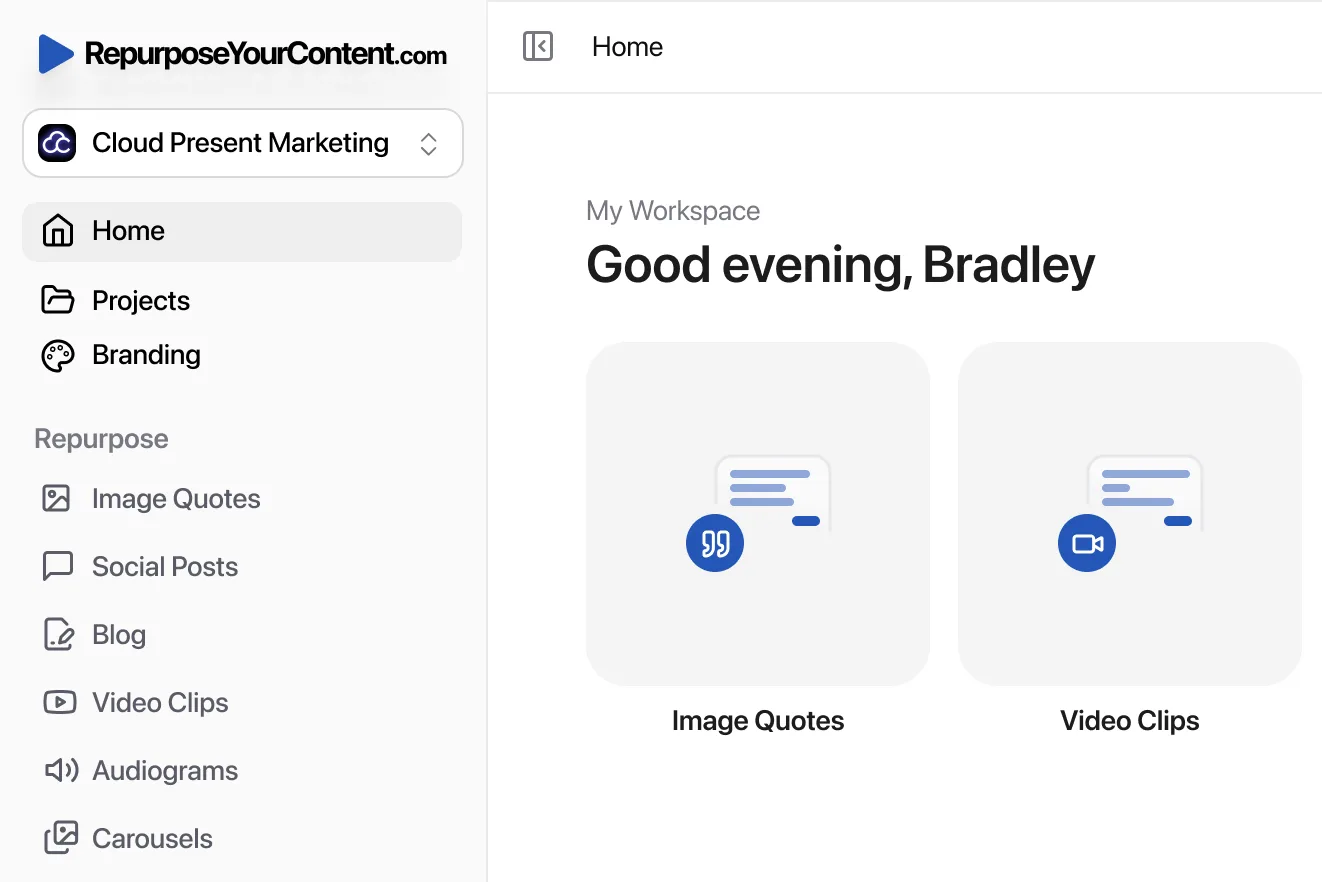
| Adapt | Rebuild in multiple formats | Generate clips, blog posts, social posts, audiograms, image quotes, newsletters, LinkedIn carousels, and podcasts |
| Distribute prep | Get assets ready to publish | Export platform-ready content with timestamps and branding applied |
The product also lets teams choose output volume. That matters because not every webinar deserves the same treatment. Some sessions need a light content pack. Others can support a full campaign run.
What this changes operationally
Without automation, one webinar usually creates a backlog. A marketer has to review the recording, note timestamps, cut clips, write captions, draft the article, pull quotes, brief design, check brand consistency, and prep email copy.
That's why many teams never finish the repurposing cycle. The work gets fragmented across too many tools.
With RepurposeYourContent, the workflow is simpler:
- Upload the webinar
- Select content types
- Choose how many assets to generate
- Apply the brand kit automatically
- Review, download, and publish
For teams also working on visual quality in adjacent video workflows, Glima AI has resources that help generate high-quality videos before those assets enter a wider content system.
What works better than manual DIY
Manual editing still has a place for flagship assets. But manual-by-default usually means delays, inconsistency, and unfinished follow-through.
Automation works best when:
- The source webinar is already strong
- The team needs multiple formats from one recording
- Brand consistency matters across written, visual, and video outputs
- Content ops needs speed more than bespoke handwork on every asset
A more detailed walkthrough of this setup is available in this guide to automate webinar repurposing.
Measuring Your Content Repurposing ROI
Repurposing only gets budget support when the team can show business impact. Likes alone won't do that.
The useful way to measure ROI is to track efficiency, output, engagement quality, and commercial influence together.

Four metrics worth tracking
Content velocity
How many usable assets came from one source?
This shows whether the team is treating webinars as real source material or just archiving them. A simple monthly view by source asset helps. One webinar. Number of clips. Number of posts. Number of emails. Number of deeper assets.
Cost per asset
Take the total cost of the original source content and divide it by the number of strong repurposed assets produced from it.
This doesn't need to be perfect to be useful. It helps leadership see that a webinar isn't a one-off event cost. It's a source investment that can feed multiple channels.
Channel-specific engagement
Measure the response that suits each format:
- Video clips by watch quality and completion signals
- Blog posts by depth of reading and assisted conversion behaviour
- Emails by replies, clicks, and next-step actions
- Carousels by saves, shares, and meaningful comments
Different formats need different success standards. Comparing a podcast episode to a quote graphic using one flat metric creates bad decisions.
Pipeline influence matters most
The strongest reporting links repurposed assets to progression, not just attention.
A useful scorecard can include:
- Which opportunities engaged with repurposed content
- Which webinar-derived assets drove return visits
- Which formats assisted MQL creation
- Which source themes produced the best downstream response
A repurposing programme is healthy when the team can name which source assets influence pipeline, not just which posts got attention.
A simple monthly scorecard
| KPI | What to track | Why it matters |
|---|---|---|
| Assets per source | Total outputs from each webinar | Shows production efficiency |
| Cost per asset | Source investment divided by outputs | Shows return on original effort |
| Engagement by format | Quality signals by channel | Shows format-market fit |
| Pipeline influence | Content touched by leads or opportunities | Shows business value |
The biggest mistake in ROI reporting is isolating repurposed content from the original source. The webinar and its derivative assets should be treated as one content system. That gives a clearer view of what the whole effort produced.
Common Repurposing Mistakes That Waste Your Time
Repurposing works. Bad repurposing doesn't.
Most failures come from three predictable mistakes. They're easy to spot once a team knows what to look for.
The cardboard cut-out mistake
This happens when a team posts the same message in the same shape on every platform.
The symptom is familiar. A webinar clip caption becomes a LinkedIn post, then an email paragraph, then a carousel heading, all with barely any adaptation. Nothing feels native. Performance stalls.
The fix is straightforward:
- Change the opening so it fits the platform's pace
- Change the format so the idea suits the channel
- Change the level of detail based on audience intent
- Keep the core idea but rebuild the packaging
A full webinar explanation can become a clip, a contrarian text post, a checklist carousel, and a direct email. Same source. Different treatment.
Publish and ghost
A team spends time creating derivative assets, schedules them, and then disappears. No comment replies. No follow-up. No sales handoff. No signal that anyone is listening.
That wastes a lot of value because repurposed content often creates smaller but more frequent touchpoints than flagship assets. Those touchpoints need response.
The better habit is to assign ownership after publishing:
- Someone replies to comments
- Someone passes relevant conversations to sales
- Someone notes which angles created useful discussion
- Someone feeds those learnings into the next content cycle
Repurposing the wrong source
Not every webinar deserves a full repurposing run.
A weak session with poor audio, vague ideas, or no clear audience problem usually creates weak outputs. Teams often blame repurposing when the actual issue was source quality.
Use this quick filter before investing more effort:
| Question | If yes | If no |
|---|---|---|
| Was the topic clear and relevant? | Proceed | Reframe or skip |
| Did speakers say anything specific? | Extract and adapt | Don't force it |
| Were there memorable moments or objections? | Build assets around them | Find a better source |
| Is the recording usable? | Repurpose confidently | Repair first or abandon |
Repurpose strong ideas, not just available files.
One more mistake worth mentioning
Some teams treat repurposing as a salvage operation for old content nobody cared about the first time. That's backwards.
Repurposing works best when it starts with content that already contains expertise, clarity, and relevance. Strong source material deserves a second life. Weak source material usually needs a rewrite, not more distribution.
Content repurposing is the operational answer to a simple B2B problem. Teams need to stay visible across multiple channels, but they can't afford to create every asset from scratch. That's why one strong webinar should become clips, blog posts, social posts, audiograms, carousels, emails, podcasts, and quote graphics.
If that process needs to happen faster and with less manual work, try RepurposeYourContent. It's built to turn one recording into ready-to-publish content in minutes. Teams that want a broader fit can also explore solutions for marketing teams and agencies.
Tags: