AI Blog Writing Tools Comparison for B2B Marketers in 2026
A practical AI blog writing tools comparison. See how Jasper, Surfer, and Writer stack up for B2B marketers who need quality content, not just words.

You need more blog posts to drive leads from your webinars. Your writers are at capacity. Hiring more staff is not an option.
This is a common problem for B2B marketing teams. This guide delivers a direct AI blog writing tools comparison for you. It helps you make the right choice quickly. We will examine Jasper, Surfer AI, Writer, ChatGPT, Claude, Koala, Byword, and Outrank. Then, we will show you an alternative approach: repurposing your existing expert content instead of generating new content from scratch.
Your Content Team Is At Its Breaking Point

The content treadmill never stops. To get full value from your webinars, you need blog posts. You need social updates and email campaigns. This is how you generate leads. Your team is already stretched thin. The budget for new hires is not there.
You are considering AI writing tools to handle the workload. This is a smart move. The market is a confusing mess of options. Which tools produce quality content? Which ones understand SEO? What is the real cost after the trial ends?
Pick the wrong tool, and you waste money on a subscription. You will get generic, soulless content that your audience ignores. This guide cuts through the noise. We are putting the top AI blog writing tools head-to-head.
We will analyze their output quality. We will check their SEO features, pricing, and limitations. More importantly, we will show you a different approach. This approach starts with the expertise you already have in your team. It does not start with a blank page.
This is not a guess; it's a clear trend. By 2026, a staggering 78% of UK B2B organizations integrated AI writing tools. ChatGPT alone commands a 77.9% trust rate. The marketers who are winning use AI to turn webinars into blog posts. They have seen organic traffic jump by 120% in just six months.
The goal is not just more content. The goal is a smart decision that grows your content engine. It must do this without dropping quality. You can scale content production without hiring more writers with the right workflow.
By the end of this guide, you will have a clear path. You can choose the right approach for your goals. You can ensure your investment pays off.
An AI Blog Writing Tools Comparison for Busy Marketers

A new AI blog writer appears almost every week. It is easy to feel overwhelmed. We have analyzed eight of the biggest names. This list includes Jasper, Surfer AI, Writer, ChatGPT, Claude, Koala, Byword, and Outrank.
This is your cheat sheet. We get straight to the point. This helps you see which tools are for serious, long-form SEO articles. It also shows which are for quick copy. Many include an AI blog idea generator to start the process.
AI Blog Writing Tools: Quick Comparison Table
| Tool | Primary Focus | Ideal For | Standout Feature |
|---|---|---|---|
| Jasper | Brand-consistent marketing copy at scale | Enterprise marketing teams with strict brand rules | Centralized brand voice and asset repository. |
| Surfer AI | SEO-driven article creation and optimization | SEO managers and content teams | Integrated content editor with real-time SEO scoring. |
| Writer | Full-stack enterprise content governance | Regulated industries and large, complex organizations | Custom style guides and automated compliance checks. |
| ChatGPT | General-purpose text generation and ideation | Anyone needing a versatile, creative assistant | Broad utility for outlines, drafts, and brainstorming. |
| Claude | Sophisticated long-form content creation | Writers who need nuanced, human-like drafts | Large context window for processing long documents. |
| Koala | Fast, one-click SEO article generation | Affiliate marketers and high-volume publishers | Integrates real-time SERP data into drafts. |
| Byword | Bulk generation of SEO-focused articles | Agencies and publishers managing multiple sites | Mass article generation from a list of keywords. |
| Outrank | AI-driven content strategy and execution | SEO strategists planning and writing content | Factual research and strategic content brief creation. |
This table provides a high-level view. The details matter. For a more granular look, our complete feature-by-feature comparison digs deeper.
Now, let's look at the specifics of each tool.
Jasper
Jasper is positioned for large marketing teams. Its main function is creating copy that follows your brand voice. It does more than just generate blog posts.
Its output for short-form copy like ads and emails is solid. For long-form articles, you need good prompts. You must also be prepared for heavy editing to avoid generic text. Its best feature is "Brand Voice." You feed it documents to teach it your company's style.
Jasper's SEO features are basic. It integrates with Surfer, but that is a separate subscription. Without it, you guide the AI with your own keyword research. It lacks the deep, built-in SEO analysis of tools like Surfer AI.
It is also one of the pricier options. Plans start at $49/month for one person. Team plans increase in price quickly. For all brand features and API access, you need custom enterprise pricing.
It has many integrations. These include a Chrome extension and connections to Surfer and Zapier. This helps it fit into an existing marketing setup.
The biggest drawback is cost. For a small team focused on articles, it is hard to justify. You pay a premium for brand control you may not use. The core writing AI is not significantly better than cheaper alternatives.
Surfer AI
Surfer AI is built for one purpose: creating content that ranks on Google. It is a combination of an AI writer and a powerful SEO auditing tool.
The writing can be robotic without editing. Surfer's strength is not its prose. It is its structure. It excels at building comprehensive articles. It covers all the topics and keywords Google expects for a search term. This is based on analyzing top-ranking pages.
SEO is where Surfer shines. Its content editor provides a live optimization score. It gives you a checklist of NLP-friendly keywords. It guides word count and headings. The "Audit" feature is excellent for analyzing existing content. It gives you a to-do list for improvements.
Surfer AI is a premium tool. The AI writing costs extra on top of the main SEO subscription. That subscription starts at $89/month. A single AI-written article can cost around $29. This makes it expensive for high-volume content production.
It connects directly with Google Docs, WordPress, and Jasper. This allows teams to write and optimize without switching platforms.
The main barrier is the cost. Relying on it too heavily can result in content with no personality. It just tries to be a better version of what already exists.
Writer
Writer is like Jasper but for enterprises. It is a generative AI platform for large organizations. It focuses heavily on compliance, security, and detailed style guides.
The output quality is high. It is especially good at adhering to complex rules. You can set it to enforce specific terminology and legal disclaimers. It can follow brand voice with precision. This is a key feature for B2B marketers in regulated fields like finance.
Like Jasper, its SEO functions are basic. Its primary job is to keep content on-brand. SEO is a secondary concern.
Pricing is completely custom and targets enterprise clients. There is no self-service option. You should expect to make a five-figure annual investment.
It offers a wide range of integrations for Google Docs, Chrome, and Figma. It is built to work across an entire organization's content workflow. The price and complexity make it unsuitable for anyone outside a large company. It is overkill for a standard B2B marketing team.
ChatGPT and Claude
These are foundational models. They power many of the other tools on this list.
With the right prompts, both can produce excellent long-form content. Claude is often praised for a more natural writing style. ChatGPT's GPT-4o is a great all-rounder. The quality depends entirely on the user's skill.
Neither has built-in SEO features. You must provide your own keywords and structure. You can use them to help with keyword research or analyze SERPs.
Both offer capable free versions. Their paid plans are around $20/month. This gives you access to the latest models and faster responses. This makes them the most cost-effective options.
Integrations are mostly via APIs. This means you need technical help for custom solutions. Many third-party apps connect to them through services like Zapier. Their main limitation is that they are blank slates. They lack the templates and SEO workflows of specialized tools. You must create your own process.
Koala
Koala is about speed and volume. It is popular with affiliate marketers and SEOs who publish a lot of content quickly.
Its "one-click" blog post generation is a standout feature. It uses real-time Google search data to structure the article. This speed can come at the cost of originality. The first draft quality is decent. It often reads like a summary of the top 10 search results. It requires significant editing to add a unique voice and insight.
SEO is central to its design. It automatically analyzes the SERPs and includes relevant keywords. It can even add internal and external links. It is an effective tool for creating top-of-funnel content based on existing information.
Plans are based on word count, starting around $29/month for 45,000 words. This makes it an affordable way to produce content at scale.
It has few direct integrations. It is designed as a standalone content engine. An API is available for custom workflows. Its main weakness is that the content can feel shallow. It is not the right tool for thought leadership articles that need genuine expertise.
Byword and Outrank
Byword is for bulk article creation. Outrank takes a more strategic approach, combining planning with AI writing.
- Byword: This tool is built for mass production. You give it a list of keywords, and it generates dozens of articles. The quality is similar to Koala—functional but generic. It is best for agencies managing many websites. Pricing starts at $49/month.
- Outrank: This tool acts as a strategist. It helps you research topics and create detailed content briefs. The AI writer then uses that brief to generate a fact-heavy, well-researched article. It is a strong option for SEOs who prefer a data-driven process. Pricing starts at $59/month.
The Alternative Approach: Repurpose Instead of Generate

The tools we've reviewed follow the same script. You provide a keyword. The AI creates an article from information it finds online. This process has a major flaw for B2B marketers. It creates derivative content missing true expertise.
There is a better way. Instead of generating from a blank page, repurpose from your webinars.
Your subject matter expert shares original insights during a webinar. They provide real-world examples and a unique point of view. This is high-value intellectual property you already own. An AI blog writer that starts with this source material creates a far superior article. You can compare these powerful AI tools and their results on blogrecode.com.
How RepurposeYourContent Helps
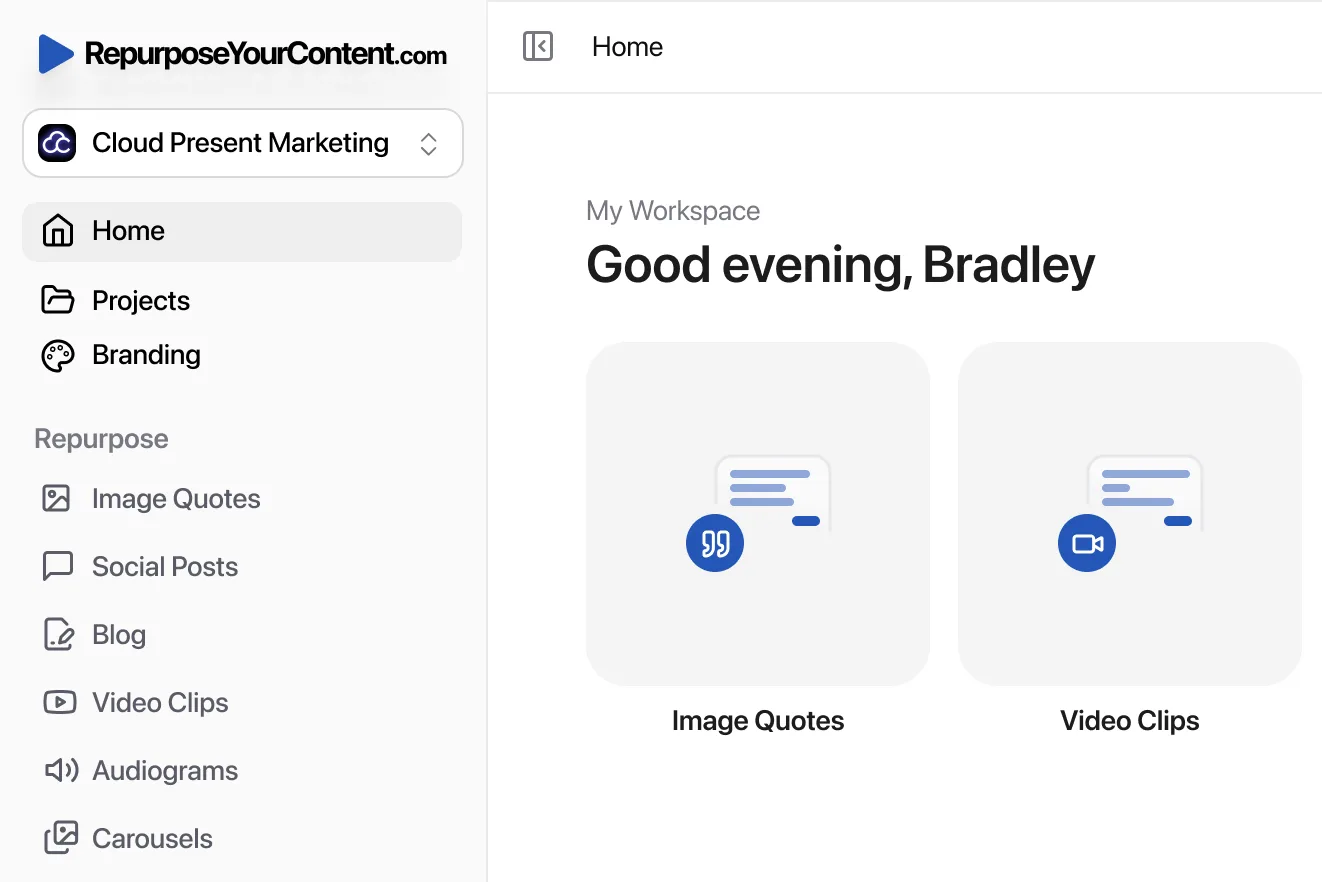
RepurposeYourContent is built on this principle. You upload your webinar recording, and our AI does the rest. It starts with your unique human expertise.
This workflow is much more efficient. One webinar can become dozens of content pieces. From one recording, you can instantly generate:
- A complete, SEO-optimized blog post.
- Short-form video clips for social media.
- Ready-to-publish social posts.
- Branded image quotes.
- Engaging LinkedIn carousels.
- Email sequences for your newsletters.
- Podcast-ready audio with audiograms.
- Timestamps to help viewers navigate the video.
An AI writer starting from scratch is a content creator. An AI that starts from your webinar is a content multiplier. It turns one hour of your team's time into over 30 pieces of content.
A Real-World Repurposing Workflow
Here is a simple, three-step workflow to turn one webinar into a blog post.
- Step 1: Upload Your Webinar Recording. Drop the video file into RepurposeYourContent or paste a link. The AI will transcribe the entire session with high accuracy.
- Step 2: Generate the Blog Post. The AI analyzes the transcript to identify key topics and arguments. It then generates a structured blog post draft, complete with headings, summaries, and quotes.
- Step 3: Review and Publish. Your writer's job changes. They no longer write from scratch. They review the AI-generated draft, polish the language, and add final SEO touches. This cuts editing time by more than 50%.
This process focuses your team on high-value tasks. They refine expert-driven content instead of creating generic articles. This approach builds authority and saves time.
So, Which Path Should You Take?
You have two main paths for creating blog content. The right one depends on one question: are you playing the volume game or the authority game? Answering this is key to choosing the right workflow for your team.

Let's break down what each game means for your content strategy.
The Volume Game
If your goal is a high volume of keyword-focused articles, a pure AI generation tool may suffice. Tools like Koala or Surfer AI are built for this. They create SEO-engineered content quickly. They analyze what is already ranking and create something similar. This is a decent way to fill your content calendar. The output is a commodity. It lacks the specific insights that build real authority.
The Authority Game
If your goal is to establish deep authority, the repurposing approach is superior. Content that comes directly from your own experts is a lasting asset. It captures real-world examples and a unique point of view an AI cannot invent. For B2B marketers, this is what wins over your audience. Starting with a webinar transcript gives you a higher-quality foundation.
This method results in content that stands out. It earns backlinks naturally. It builds a loyal audience that trusts you. For teams focused on creating content that drives engagement, it’s the clear choice.
Your team's expertise becomes a content engine.
Frequently Asked Questions
When evaluating AI blog writing tools, a few key questions always arise. Here are the answers you need.
Can Google Tell if My Blog Is AI-Written?
Yes, Google's systems can often detect AI-generated text. Google has stated they do not penalize content simply for being made with AI. They care about high-quality, helpful content. The source of your AI-assisted content matters. An article created by a generic AI tool rehashes existing web content. It is harder to prove its value. Content repurposed from a human expert's webinar is different. It is built on original thinking and real authority. This is what Google wants to reward. Check out these tips for repurposing blog content for social media to maximize your reach.
How Much Editing Will an AI-Written Blog Need?
The answer depends on your workflow. With a pure generation tool like ChatGPT, expect to edit for 30-60 minutes per article. You must fix factual errors and inject your brand's voice. A repurposing workflow is different. When you start with a webinar transcript, the core information is already there. Your team's job shifts from writing to polishing. This can cut your editing time by over 50%. A detailed look at the webinar-to-blog post process shows how this works.
What’s the Best AI Tool for SEO-Friendly Blogs?
Tools like Surfer AI or Outrank have impressive built-in SEO features. They focus on keyword analysis and on-page optimization. The "best" SEO blog is not just one stuffed with keywords. It provides deep expertise that earns backlinks and satisfies user intent. A repurposing strategy is superior for long-term SEO. Turning an expert webinar into a blog post creates a unique, authoritative asset. Competitors cannot replicate it with their off-the-shelf AI tools. You can learn more about AI content generation in our glossary. This approach builds a competitive moat around your content.
Stop creating commodity content. Start multiplying your team's unique expertise.
Try RepurposeYourContent today.
Tags: