How to Build an AI Content Creation Workflow for B2B in 2026
Stop guessing! Build an effective AI content creation workflow for B2B. Scale your team's expertise to produce high-quality content faster. Learn more.

Your team just spent 40 hours creating a single piece of content. You’ve used AI, followed the guides, and still, the result is generic content that doesn’t drive pipeline. This is the reality for most B2B teams trying to implement an AI content creation workflow for B2B.
The problem isn't the AI. It's your process. You are starting in the wrong place.
Your AI Content Strategy Starts Backwards
You are told AI will solve your content problems. But you're stuck in a frustrating cycle. You use AI to help write an article. You publish it. Nothing happens. It fails to connect with savvy buyers because it's missing genuine insight.
The reason is simple. Your workflow starts with AI, not with your human experts.
This is an input problem. Asking an AI to write about a complex B2B topic is a mistake. It needs a solid foundation of your company's knowledge. Without it, the result is always generic and weak.
The best AI workflow starts with human expertise. It's captured in long-form content like a webinar. AI should not generate from scratch. This makes webinars the ideal AI input format.
The Problem with "AI-First" Content
Starting with a prompt like "write a blog post about cybersecurity" is a dead end. You get a summary of what’s already on the internet. It's a commodity. Your expert buyers have heard it all before.
A truly effective AI content creation workflow for B2B flips this model.
- Human-Led Input: It begins with your subject matter expert delivering a detailed webinar. This becomes the source of truth, rich with your company's distinct point of view.
- AI-Powered Extraction: AI tools deconstruct this core asset. They pull out key themes, memorable quotes, and important data points.
- AI-Assisted Drafting: The AI generates first drafts for blogs, social posts, and more. It uses the webinar's specific context.
- Human-Led Refinement: Your team reviews, edits, and adds expertise. They ensure every piece has your unique voice and perspective.
- AI-Powered Formatting & Scheduling: AI helps format content for different channels and assists with scheduling.
This human-led approach ensures your content is not bland. It roots everything you publish in your company’s unique perspective. For a deeper look at organizing this process, read our guide on building a B2B content operations playbook.
From Manual Labor to Strategic Output
Let's look at the numbers. Recent data for 2026 shows 85% of UK B2B marketers now use AI for content creation. This is a huge jump from just 61% two years ago.
But only 6% have fully embedded it into their workflows. This shows the gap between using AI and operationalizing it. The top benefits are efficiency (45%) and speed (39%). A human-led workflow delivers both.
Your team should not spend days transcribing webinars. They should focus on strategy, refinement, and quality control.
Here is how the hours stack up:
Manual Workflow vs. Human-Led AI Workflow
| Stage | Manual Workflow (Hours) | Human-Led AI Workflow (Minutes) |
|---|---|---|
| Webinar Transcription | 2-4 hours | 5-10 minutes |
| Identifying Key Themes/Quotes | 2-3 hours | 10-15 minutes |
| Drafting First Blog Post | 4-6 hours | 30-45 minutes (AI draft) |
| Creating Social Media Snippets (10-15) | 3-5 hours | 20-30 minutes (AI draft) |
| Creating Video Clips (5-7) | 2-4 hours | 15-25 minutes |
| Total | 13-22 hours | ~2 hours |
The difference is staggering. This isn't about replacing people with robots. It’s about elevating their roles. Let your experts create brilliant anchor content. Let your marketers polish AI-generated derivatives to perfection.
The Human-Led AI Content Creation Workflow
A winning AI content creation workflow for B2B does not start with a blank AI prompt. A workflow that gets results starts with real human expertise. It uses AI as an assistant to scale that expertise, not to invent it.
The process is straightforward. Your subject matter expert creates one great webinar. Then, you let AI do the heavy lifting of repurposing that gold. A human editor adds the final polish.
This diagram breaks down the flow. It starts with your human-led webinar and ends with a suite of new content assets.

You get scale without sacrificing what made the original piece great.
Step 1: Human Creates Anchor Content
Everything hinges on capturing your team’s unique point of view. A webinar is perfect for this. It captures the nuance, tone, and spontaneous insights that make your expert an expert. This anchor content is the most crucial part of the process.
- Plan for Repurposing: Outline the webinar in chapters. Break your talk into 3-5 distinct subtopics. This makes it easy for AI to pull out key themes later.
- Encourage Candid Q&A: The Q&A session is often where the real magic happens. Questions show what your audience is thinking. Your expert's off-the-cuff answers are pure content gold.
Start with a well-structured webinar. You give the AI high-quality, organized source material to work with.
Step 2: AI Extracts and Repurposes
This is where you trade manual work for smart automation. Your team shouldn’t waste hours transcribing audio. They should not hunt for shareable quotes. Let AI handle the grunt work.
The point isn't to replace your writers. It's to give them superpowers. You're turning creators into editors and strategists.
When building this workflow, it's vital to understand how AI can help us be more creative by amplifying your team's best work.
Step 3: AI Assists with Drafting Derivative Content
Armed with the transcript, you use AI to generate first drafts. Use specific, contextual prompts. Don’t just ask for “social posts.” Ask for “a 5-part LinkedIn thread based on the 'biggest mistakes' section of the transcript, with a compelling hook for each part.”
This gives your writer a massive head start. They get an AI-drafted blog post, social captions, and video clip ideas. All are rooted in the expert's own words.
Step 4: Human Reviews, Edits, and Adds Expertise
An AI draft is a starting point, not a finished product. This stage is non-negotiable. It’s where your team guarantees quality and authenticity. A human must always have the final say.
The review process is about high-value activities:
- Adding Nuance and Voice: An editor polishes the AI draft. They inject your brand's voice and add personal anecdotes.
- Fact-Checking and Validation: Your team double-checks every stat, name, and detail. Trust, but verify.
- Optimizing for the Channel: The social media manager adapts AI suggestions for each platform. They tweak formats and calls-to-action.
This human touch turns good drafts into great content. For smaller teams, our guide on a content repurposing workflow breaks it down.
Step 5: AI Helps with Formatting and Scheduling
Once the content is polished, AI can help with final production steps. Use AI tools to quickly format a blog post with correct H2s and H3s. Ask it to generate meta descriptions. Use scheduling tools with AI-powered "best time to post" features. This saves your team from more tedious tasks.
Automating Your AI Content Extraction and Repurposing
Even with AI help, the process can become a bottleneck. If your team still manually digs through transcripts or clips videos, you lose momentum. Your expert content gets stuck in a recording.
Smart automation is the solution. A basic grasp of workflow automation is key to making AI work for you. Proper automation connects the whole process. You move from a raw webinar file to a folder of ready-to-publish assets with few clicks. This is how you build an AI content creation workflow for B2B that scales.
The goal is simple. Turn a 90-minute manual task into a 5-minute automated job. You need a system that can take your webinar and create all your on-brand assets.
The Power of One-Click Repurposing
This is the point where you bring in a purpose-built platform. Do not juggle five different tools. That’s a recipe for chaos.
Use one integrated system designed to break down expert-led content. This single step provides the biggest jump in time savings.
- You upload your webinar recording or a link.
- The AI analyzes the conversation and pinpoints key topics and timestamps.
- You tick the boxes for the content formats you want.
- The system generates everything for you, applying your brand kit automatically.
Your team can now skip the tedious work. They can jump straight to refining the final assets.
How RepurposeYourContent Helps
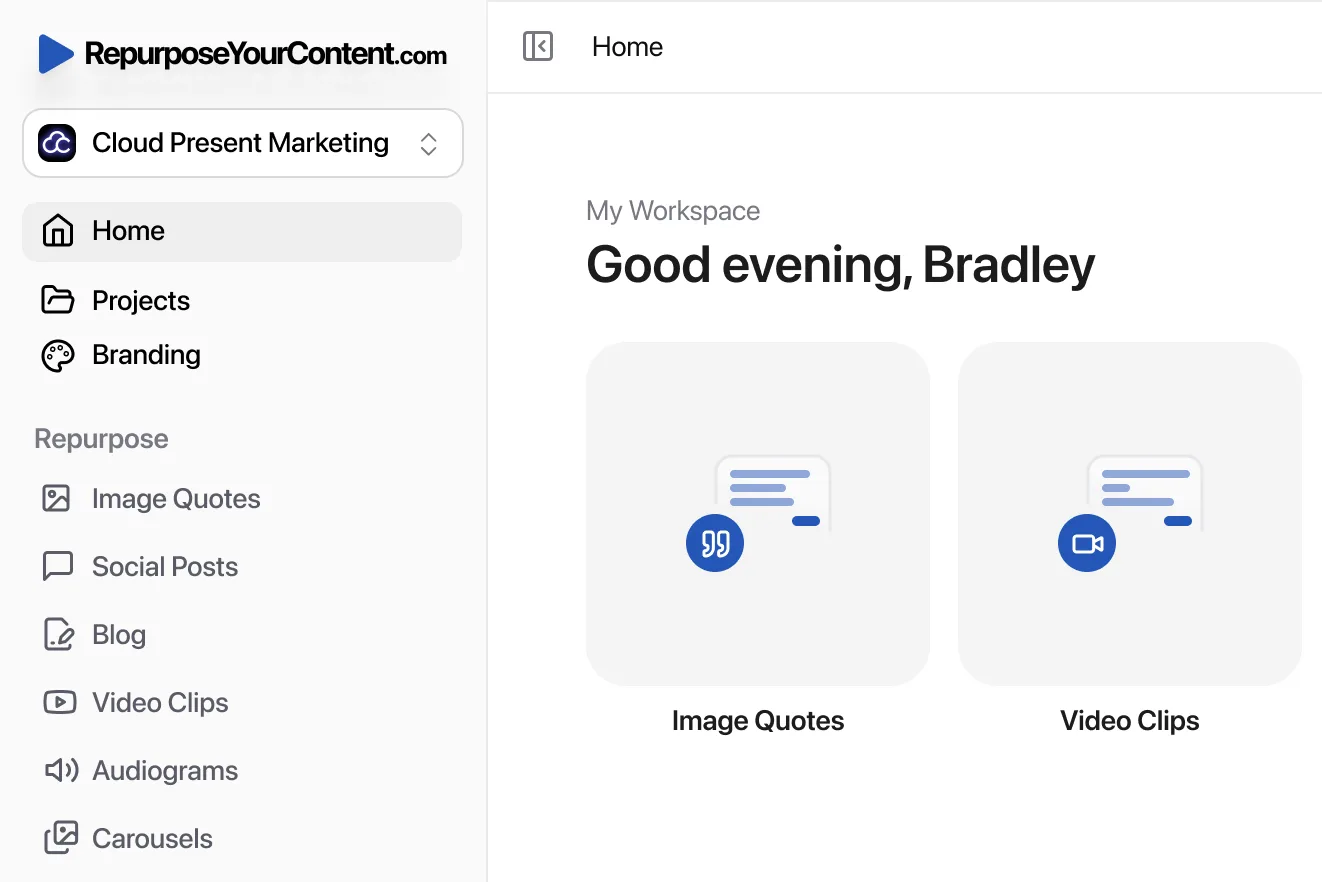
RepurposeYourContent is the engine for Step 2 of your workflow. Once you feed it your webinar, the platform turns that one recording into a complete campaign. It generates video clips, blog posts, social posts, audiograms, image quotes, newsletters, and LinkedIn carousels from the original timestamps.
This diagram shows what happens. Your single webinar transforms into a range of content, saving your team hours.

This is how you scale your expert-led content across all channels without scaling your team.
A team can upload a Zoom recording and have branded assets ready in minutes. This speaks to the 45% of B2B marketers who say efficiency is AI's top benefit. It’s vital when 73% see webinars as a top source of leads but struggle to repurpose them.
A real workflow example:
- A product manager hosts a 45-minute webinar on a new feature.
- The recording is uploaded to RepurposeYourContent. The marketing manager selects: 1 blog post, 5 video clips, 10 social posts, and 1 LinkedIn carousel.
- Within minutes, the platform delivers all 17 assets, branded and ready for a final human check.
- The writer refines the blog post. The social manager schedules the posts. You turn 1 webinar into 47 pieces of content (including all social variations).
This automated step replaces more than a full day of manual work. To see how this fits into a wider strategy, check out the best content workflow automation tools.
Defining Roles for Your AI-Powered Content Team
You have the tools and a workflow. But what happens on Monday morning? Without clear ownership, the best system becomes chaos. You end up with missed deadlines and half-finished assets.
This is the most common pitfall. A team gets excited about AI, but nobody knows who does what. You have to define the 'who' behind the 'how'.
It's not about a massive reorganization. It's about assigning clear responsibilities for each stage. Handoffs become seamless.

Without this clarity, AI-generated drafts just sit there. Your content engine grinds to a halt.
The Four Core Roles You Need
On smaller teams, one person often wears a few hats. That's fine. What matters is that these four functions are covered.
Subject Matter Expert (SME): The Brains This is your product guru or senior exec. Their job is to deliver the webinar, answer questions, and provide the raw expertise. They are the essential human spark.
Content Strategist: The Quarterback This person owns the game plan. They work with the SME to shape the webinar for repurposing. Afterwards, they run the webinar through a tool like RepurposeYourContent to extract the first assets.
Content Writer/Editor: The Human Touch The writer takes AI-generated drafts and breathes life into them. This role is about refining, editing, and enhancing. They inject your brand’s voice, add nuance, and double-check facts.
Social Media/Channel Manager: The Distributor This person gets the finished content out into the world. They schedule posts, trim videos, and pull insights for the newsletter. They are the final link in the chain.
Defining these responsibilities is how you build a team that excels with AI. Learn more about structuring your content teams for success.
Who Does What? Use a RACI Chart
A simple RACI chart is your best friend. It stands for Responsible, Accountable, Consulted, and Informed. It’s the fastest way to kill confusion.
Don't dismiss this as corporate fluff. A RACI chart is a practical tool for a busy team. It stops tasks from falling through the cracks.
Mapping this out takes less than 30 minutes. It will save you hours of headaches.
Here’s a sample RACI chart you can adapt.
RACI Chart for an AI-Augmented Content Workflow
| Task | Content Strategist | Subject Matter Expert | Content Marketer | Social Media Manager |
|---|---|---|---|---|
| Plan Webinar Content | R | A | C | I |
| Deliver Webinar | C | R/A | I | I |
| Generate Assets with AI | R/A | I | C | C |
| Refine Blog Post Draft | C | C | R/A | I |
| Review & Approve Video Clips | A | C | I | R |
| Schedule Social Content | C | I | C | R/A |
| Analyse Performance Data | R/A | I | I | C |
Key: R = Responsible, A = Accountable, C = Consulted, I = Informed
This division of labor turns an AI tool into a predictable, scalable content engine.
Measuring the Success of Your AI Workflow
Your AI workflow is humming. The calendar is packed. But is any of it moving the needle?
Stop tracking post counts. Start tracking numbers that matter to the business.
A well-oiled AI content creation workflow for B2B must deliver tangible results. This means higher-quality leads, a healthier pipeline, and shorter sales cycles. You need to track content performance and process efficiency.
Without data, you’re just guessing. You don't know if your AI system is a cost center or a revenue driver.
A workflow is only as good as its results. If you aren't tracking the right numbers, you're flying blind. You need to prove this new content creates pipeline.
Look past vanity metrics. Likes and shares are nice, but they don't pay the bills. Focus on how your repurposed content influences the customer journey.
Tying Content Performance to Business Goals
Your primary goal is to generate pipeline. Your metrics must connect to that outcome.
Start tracking these performance KPIs:
- Lead Quality from Repurposed Assets: Use your CRM to tag leads based on the content they converted on. Are leads from AI-generated blog posts or video clips turning into qualified opportunities?
- Pipeline Influence: How many open opportunities have engaged with one of your repurposed assets? Most marketing automation platforms can track this.
- Sales Cycle Velocity: Are deals closing faster when prospects engage with your repurposed content? Track the average days from opportunity creation to close.
This requires tight integration between marketing and sales data. It’s the only way to prove true ROI. Dig deeper by exploring webinar metrics and KPIs to track.
Measuring Workflow Efficiency and Output
You also need to measure how the workflow itself is performing. This helps justify the investment in tools and process changes.
Focus on these efficiency indicators:
- Time Saved Per Asset: Calculate the hours your team used to spend creating a blog post or video clips. Compare that to the time with your new AI workflow.
- Total Content Output: Measure the volume of assets you produce from a single webinar. Turning one webinar into 47 pieces of content is a compelling story.
- Cost Per Asset: Divide the total cost of your workflow by the number of assets produced. You’ll find the cost per piece of content plummets.
Creating Your Feedback Loop
Measurement is not a one-time task. The data you collect should feed back into your strategy. This creates a cycle of continuous improvement.
Set up a simple dashboard. Visualize your performance and efficiency metrics. Review it weekly.
You might notice video clips featuring a specific expert get 3x more engagement. That’s your feedback loop. This data tells you what your audience wants. Use that insight to plan your next webinar.
This is how you move from using AI to building a learning system.
Common Questions (And Honest Answers)
When talking to B2B marketers about an AI workflow, a few questions always come up.
"But Won't AI Just Make My B2B Content Sound Generic?"
This is a valid concern. It comes from a misunderstanding of the workflow. The AI isn't the source of ideas; your human expert is. The process starts with your webinar. The AI’s job is to extract and scale those original thoughts.
A human editor always has the final say. They ensure every piece is insightful and sounds like your brand.
"How Much Human Oversight Do We Really Need?"
A lot less than you'd think, but it's focused on the right things. Your team's time is shifted away from manual labor to high-value tasks. No more chopping up videos or transcribing audio.
Human touchpoints become more meaningful:
- The Spark of Expertise: Your SME delivers the webinar.
- The Strategic Polish: A writer takes AI drafts and refines them.
- The Performance Review: Your team analyzes data to improve future content.
All the heavy lifting gets automated. Strategic thinking stays in human hands.
"Can a Small B2B Team Realistically Pull This Off?"
Absolutely. This workflow is a secret weapon for smaller, time-poor teams. It's a force multiplier.
When you can turn one webinar into a month's worth of content, you can compete with larger organizations. A tool like RepurposeYourContent automates the most brutal part of the process.
This workflow isn't about having more resources. It's about getting more from the resources you have. Turn one webinar into over 40 pieces of content.
"How Is This Different From Just Using ChatGPT?"
It's night and day. Asking a generic AI to write an article is a recipe for derivative content. You get a mash-up of what’s already out there.
Our human-first workflow is different. It’s anchored in your company's proprietary knowledge. The AI is a hyper-efficient assistant to mine and repackage those unique insights.
This means your content is:
- Genuinely Original: Born from your team's specific knowledge.
- Truly Authoritative: Rooted in real-world experience.
- Incredibly Valuable: Gives your audience something they can't find anywhere else.
You’re not asking AI to create content for you. You’re using it to scale your own brilliance.
Try RepurposeYourContent and see how quickly you can scale your expert-led content across every channel.
Tags: