Best Content Repurposing Tools 2026: Top Software
Discover the best content repurposing tools 2026. Compare AI video clippers, writers, and distributors to optimize your marketing workflow.

A significant majority of mid-sized UK B2B marketing teams now use content repurposing tools. If your webinar still ends as a single recording page, your content process is behind.
The problem is not tool access. It is tool fit.
A clipping tool can make short videos. A transcription tool can turn speech into text. A design tool can produce visuals. Busy B2B teams do not need three separate point solutions if one webinar needs to become clips, blog posts, quote graphics, audiograms, newsletter copy, and social posts on a deadline.
That is the standard this guide uses. It does not rank tools by social clipping alone. It compares them on whether they can support a full content system across video, text, images, and audio, with a clear focus on webinar repurposing for B2B teams.
If webinars, roundtables, demos, and virtual events drive your pipeline, start with software built to turn one recording into many usable assets. If your use case is narrow, such as vertical video clipping only, a specialist tool will do the job.
If you need a practical starting point for a webinar repurposing workflow that turns one session into multiple content formats, use that model as your benchmark while reading. The strongest tools in this list save time because they reduce handoffs, not because they generate one more clip type.
1. RepurposeYourContent

B2B teams do not need another clipping tool. They need a system that turns one webinar into video, text, images, and audio without adding more handoffs.
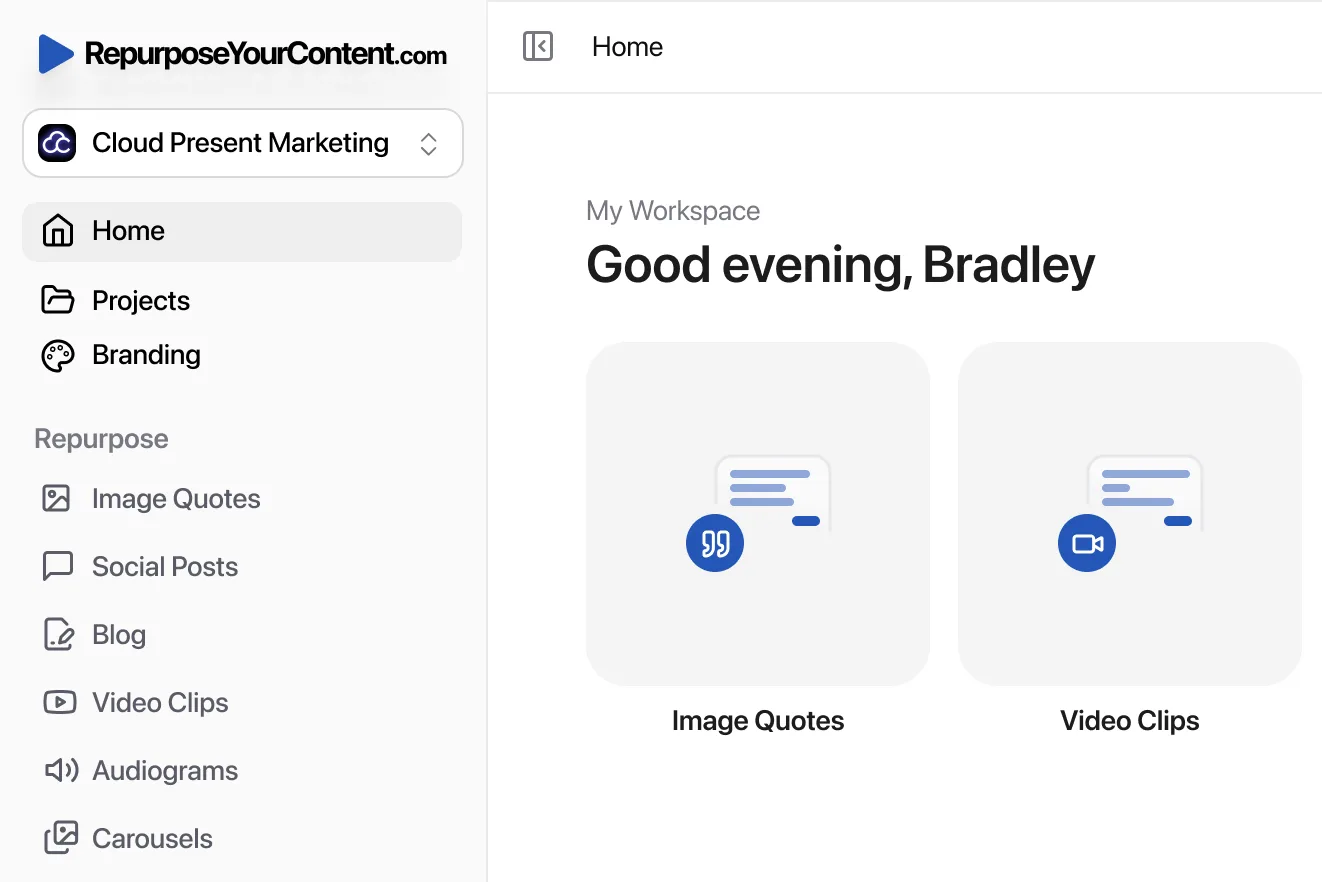
RepurposeYourContent is the strongest fit in this list for that job. It is built for webinar repurposing first, not adapted from a social video editor or a transcript app. You upload a recording or paste a link, choose the asset types you need, set the output volume, and generate a full batch in one workflow.
That difference matters because many tools here handle one layer well, then force your team into extra tools for the rest. RepurposeYourContent covers the full post-webinar stack in one place.
What it does best
The platform is built to turn a single webinar into usable campaign assets, not rough fragments your team has to rebuild.
You can generate:
- Video clips: Short-form edits for LinkedIn, YouTube, and paid campaigns
- Blog posts: Long-form written drafts based on the main ideas in the session
- Social posts: Ready-to-edit copy for ongoing promotion
- Audiograms: Audio-led assets for social distribution and podcast promotion
- Image quotes: Branded visuals pulled from speaker soundbites
- Newsletters: Email copy based on key takeaways
- LinkedIn carousels: Slide-style posts built from teaching points or frameworks
- Timestamps: Clear chapter markers for review, publishing, and reuse
It also applies your brand kit across formats. That cuts down editing time and keeps output consistent across channels.
If your team also needs a repeatable clipping workflow, this guide on how to repurpose long form video into short clips is a useful reference point.
Practical rule: If one upload does not give you video, text, image, and audio outputs, you do not have a full repurposing system.
Pricing and limits
Pricing is credit-based. There is a free Basic tier for testing. Paid plans start at $99/month, with enterprise pricing available on request.
The tradeoff is straightforward. Long webinars and high output volume can push you into a higher plan. You still need human review before publishing, especially for brand voice, compliance, and product accuracy. That is normal for any AI-assisted workflow.
Why it ranks first
RepurposeYourContent stands out because it supports the whole webinar content system. It does not stop at clips. It does not stop at transcripts. It gives B2B teams a practical way to turn one event into assets for distribution, nurture, and follow-up.
If webinars, demos, and virtual events feed pipeline, start here.
2. Opus Clip

Short-form video wins attention fast. Opus Clip is built to turn long webinars, interviews, and podcasts into social-ready clips with less manual editing.
Use it if your team needs volume from video. Opus Clip finds highlight moments, reformats them for vertical or square layouts, adds captions, and speeds up production for LinkedIn, YouTube Shorts, and TikTok.
Where it fits
Opus Clip is strongest as a clipping tool inside a broader repurposing stack.
Its Virality Score helps marketers choose moments worth publishing. Auto-reframing and animated captions cut repetitive editing work. Team workspaces and templates also make it easier to manage output across clients or business units. If your repurposing plan starts with social video and your writers already handle blog, email, and sales follow-up, Opus Clip makes sense.
If you are mapping that wider workflow, this content repurposing strategy for 2026 gives the bigger picture.
Pricing and limitations
Opus Clip offers a free tier and paid plans based on credits. Review current usage limits before you buy. Export caps and processing allowances matter more than a long feature list.
The limitation is clear. Opus Clip does not give you a full content system across video, text, images, and audio. You will still need other tools for blog drafts, newsletter copy, quote graphics, and broader webinar follow-up assets.
That creates extra handoffs. Your team clips in one tool, writes in another, designs in a third, and publishes elsewhere. For B2B webinar programs, that slows production and makes consistency harder to maintain.
Pick Opus Clip for fast social clips. Do not pick it as your main webinar repurposing platform.
Direct site: Opus Clip
3. Repurpose.io

Repurpose.io is built for distribution, not creation.
That makes it useful for a specific job. If your team already has finished videos, podcasts, or livestream clips and keeps losing time to uploads, renaming, reposting, and channel-by-channel publishing, Repurpose.io cuts that admin work fast.
Best use case
Choose Repurpose.io when distribution is the bottleneck.
It handles automated publishing across connected platforms well. You set source channels, choose destinations, define the workflow, and let it run. For agencies, media teams, and B2B marketers managing repeated publishing across multiple brands, that saves real operating time.
It also fits teams building a repeatable AI content creation workflow for B2B where content production and content distribution are handled in separate tools.
Where it falls short
Repurpose.io does not give you a full content system.
It will not turn one webinar into a blog post, newsletter draft, quote graphics, sales follow-up copy, and audio assets from the same source. If that is your goal, this category matters more than connector count. B2B webinar teams need one system that creates video, text, images, and audio together. Repurpose.io solves the last mile of publishing. It does not solve the upstream creation workflow.
This distinction is important because webinar repurposing usually breaks long before publishing. The slow part is turning one recording into all the formats marketing, sales, and social teams need.
So the recommendation is simple. Buy Repurpose.io if you already have content creation covered and want automated distribution. Skip it if you need an all-in-one platform for webinar repurposing.
Direct site: Repurpose.io
4. quso.ai

quso.ai is for teams producing lots of social video and wanting clipping plus scheduling in one place.
It sits between a pure clipper and a broader social workflow tool. You get AI-selected clips, captions, resizing, scheduling, templates, and brand controls. That makes it practical for agencies and social teams moving high volumes of vertical content.
Why teams pick it
The strongest reason to choose quso.ai is consolidation. Instead of clipping in one tool and scheduling in another, you can keep more of the workflow in one stack.
Its minutes and credits model gives operations teams a clear way to plan output, even if the language can be a bit confusing at first. Brand kit support also helps if you manage multiple client identities.
If your team is formalising an AI content creation workflow for B2B, quso.ai can cover the video side efficiently.
Limitations and recommendation
quso.ai is still video-centric. It won't replace a platform that turns one webinar into a blog, a newsletter, and branded quote graphics.
So the recommendation is narrow but clear. Choose quso.ai when social video is the core output and your team wants scheduling included. Skip it if you need a true multi-format repurposing platform.
Direct site: quso.ai
5. Castmagic

Castmagic is the writing-first option for spoken content.
If your source material is webinars, podcasts, interviews, or internal recordings, Castmagic does a good job turning speech into usable written drafts. That includes summaries, show notes, blog drafts, email copy, and social text.
Where Castmagic wins
Castmagic is strong when your bottleneck is blank-page syndrome after a recording ends.
Its transcript-driven workflow and Magic Chat make it easier to pull themes, quotes, and angles from a session without rereading the whole transcript. For content marketers who care more about thought leadership text than video edits, that's useful.
A practical example:
- Step 1: Upload your webinar recording.
- Step 2: Generate transcript, summary, and blog draft.
- Step 3: Pull newsletter copy and social post variations from the same source.
- Step 4: Hand the file to a separate clip tool if you also need short video.
That's a solid workflow for content teams with established editors.
Limitations and pricing note
The trade-off is obvious. Castmagic isn't a deep video editor and isn't built to create the full visual layer. You'll likely pair it with another tool for clips, carousels, or image assets.
Pricing is usage-based. Check the current plan structure before rollout, especially if your team processes long sessions regularly.
Castmagic is one of the better choices when your webinar needs to become words first, not videos first.
Direct site: Castmagic
6. Parmonic

Parmonic is one of the few tools here that understands B2B webinar workflows properly.
That gives it a key advantage over creator-focused video tools. It can take webinar recordings and turn them into clips, summaries, and longer written assets, then package content for marketing and enablement use cases.
Best fit
Parmonic fits teams that want webinar repurposing with enterprise guardrails.
If procurement, legal review, multi-user access, and internal enablement matter, Parmonic is a serious contender. It also makes sense if you want webinar content to serve both external marketing and internal sales or training teams. Parmonic differentiates itself from simpler clipping tools on this point. It isn't just helping social media managers. It's built to support wider business workflows.
Limitations
The main drawback is cost positioning. Parmonic is generally aimed above creator-grade tools, and annual billing is more prominent on bigger plans.
It's also not as broad across output formats as RepurposeYourContent. If your team wants clips, blogs, social posts, audiograms, image quotes, newsletters, and carousels from one workflow, RepurposeYourContent still covers more ground.
Direct site: Parmonic
7. VEED.io

VEED.io is the easiest recommendation for teams that want browser-based video editing with modern AI features.
It combines recording, editing, subtitles, translation, hosting, and clipping in one place. If your team creates lots of video and wants fewer production tools in the stack, VEED.io is practical.
What it does well
VEED.io is strongest on editing convenience.
Auto-subtitles, translations, resizing, eye-contact correction, and noise removal make it useful for fast post-production. It's also helpful for teams that want one environment from recording through export.
For social-heavy workflows, the guide on how to repurpose video content for social media is a good complement. If you're comparing platforms directly, these alternatives to VEED.io are also worth scanning.
Limitation to keep in mind
VEED.io is still a video platform first. It won't replace a multi-format content engine for webinar-derived text, email, and image assets.
So use VEED.io when video production is your main workload. Don't use it as your only repurposing tool if your team needs written and visual campaign assets from the same source.
Direct site: VEED.io
8. ContentFries
ContentFries is the budget-conscious multi-format pick.
This tool tries to do more than video clipping without becoming overly complicated. You feed in a long-form video and get clips, blog drafts, thumbnails, quote visuals, and basic repurposed assets out the other side.
Where it stands out
ContentFries is a sensible option for smaller teams that want breadth without a big setup burden.
The interface is built around simple throughput. One long-form source in, a week of derivative content out. Unlimited regenerations on plans also help when you need to keep iterating without worrying about every small tweak.
That makes it a practical middle ground between pure clipping tools and more enterprise-focused webinar platforms.
Where it doesn't
Its scheduling and distribution features aren't as strong as specialist social tools. Its visual outputs also aren't as polished as a dedicated design platform.
That means ContentFries works best for lean teams that want decent output across several formats and are happy to do some finishing work. It doesn't beat RepurposeYourContent on webinar-specific depth, but it's a fair lower-complexity option.
Direct site: ContentFries
9. Klap

Klap does one job fast. It turns long video into short clips.
Paste a YouTube link or upload a file, and Klap produces captioned, reframed clips built for social. That's the pitch. It works.
Best use case
Klap is a good fit when your team values speed and simplicity over workflow depth.
It also helps if you want clear monthly quotas, higher-resolution exports on upper plans, dubbing options, or API access for integration. Those features make it more useful for operational teams than some lightweight clip tools.
Why it doesn't rank higher
Klap is still video-only. No blog drafts. No newsletters. No image carousels. No quote cards.
That keeps it from being a top-tier content repurposing platform for B2B marketers. It's a production utility, not a full repurposing system.
If all you need is clips, it's a valid buy. If you need campaign assets from one webinar, look elsewhere.
Direct site: Klap
10. Chopcast

Chopcast is the practical option for teams that want simple, minute-based clipping.
Its AI finds highlights, creates clips, adds subtitles, and handles resizing. It also offers a done-for-you service, which is useful if your team wants output without running the workflow internally.
Why some teams will like it
Chopcast is easier to budget than many credit-heavy tools. Minute-based plans make forecasting simpler. Unlimited captions and exports are also attractive if your team clips often.
Being based in Ireland may also help UK and EU buyers who care about procurement and privacy conversations.
Why most B2B marketers shouldn't stop here
Chopcast focuses on clips. That's useful, but narrow.
If your webinar needs to feed social, blog, email, podcast, and visual channels, Chopcast won't cover enough ground by itself. It's best as a specialist add-on or service option, not your core repurposing platform.
Direct site: Chopcast
Top 10 Content Repurposing Tools 2026
| Product | Core Formats & Features | Speed / User Experience | Target Audience | Key Differentiator / Pricing |
|---|---|---|---|---|
| RepurposeYourContent | 8 formats: video clips, blogs, social posts, carousels, emails, audiograms, podcasts, image quotes; auto brand kit; team roles; platform-agnostic | ~5 minutes from upload to ready assets; slider-based quantity controls; near-final AI drafts | B2B marketing teams, agencies, demand gen, content ops | True multi-format output in one workflow; auto-brand across all assets; Free Basic → paid from $99/mo; enterprise quotes |
| Opus Clip | Short-form clips with Virality Score, animated captions, auto-reframe, brand templates, scheduler, XML export | Fast shorts pipeline; credit model; free tier has watermark | Social teams and creators focused on short-form video | Deep social clipping features and virality ranking; credits-based capacity; free tier limited |
| Repurpose.io | Automated multi-destination publishing, story-to-story repurposing, approved platform integrations, high posting limits | Hands-off automation for distribution at scale | Teams needing multi-page/brand cross-posting and high-volume publishing | Best-in-class distribution automation; free starter allowance; template-based branding |
| quso.ai (vidyo.ai) | Intelliclips AI, captions, resizing, scheduling, brand kit, 1080p exports, minutes/credits tiers | Fast clipping + scheduling; predictable minutes/credits | Agencies/creators producing TikToks/Reels/Shorts at scale | Combined clipping + scheduler; minutes/credit model for agencies; video-first |
| Castmagic | Transcription, Magic Chat querying, auto-draft blogs/emails/show notes, multi-language support | Strong written outputs from audio/video; usage-based pricing | Teams prioritizing written content from webinars/podcasts | Best for transcript-to-longform workflows; pairs well with clip tools; usage-based pricing |
| Parmonic | Webinar-to-clips, summaries, AI long-form articles, packaging for enablement, SSO & legal review | Enterprise-friendly workflow with review/packaging modules | B2B marketing teams and enterprises with compliance needs | Purpose-built for webinar marketing + enterprise controls; higher price, annual billing emphasis |
| VEED.io | Recorder, editor, hosting, AI clips, auto-subtitles/translations, eye-contact correction, noise removal | All-in-one record→edit→publish flow; strong subtitling/translation UX | Teams wanting a full browser-based video toolchain; UK/EU buyers | End-to-end video stack with strong translation/subtitles; dynamic pricing at checkout |
| ContentFries | Auto clip generation, blog drafts, quote graphics, thumbnails; unlimited regenerations on plans | Budget-friendly multi-format repurposing; simple monthly caps | Teams needing multi-format outputs on a budget | Affordable entry pricing and breadth of formats; simpler visual templates |
| Klap | YouTube/link-based clip generation, captions, virality indicator, 4K exports, AI dubbing, API | Very fast clip pipelines; clear monthly quotas; annual discounts available | Teams needing speedy shorts + API integration | 4K + dubbing + API for automation; transparent quotas; video-only |
| Chopcast | AI highlight finder, trimming, resizing, subtitling, unlimited captions/exports, minute-based plans, D2Y service | Clear minute-based billing; unlimited exports without watermark on paid tiers; EU-based | Teams preferring minute-tier pricing or EU vendor for compliance | Minute-based pricing and unlimited exports; optional done-for-you service; video-first |
How full-format repurposing helps
Many B2B buyers consume multiple content formats before they act. Your team needs a system that can turn one webinar into a coordinated follow-up campaign, not a pile of disconnected drafts.
This is the primary value of full-format repurposing. It gives demand gen teams one recording they can turn into assets for different channels, buying stages, and time horizons. One webinar can support this week's promotion, next week's nurture, and next month's search traffic.
This matters most for webinar-led marketing.
A clipping tool helps with reach. A full-format platform helps you keep the whole post-webinar engine running. Sales gets follow-up material. Content gets source material. Paid teams get more creative to test. Brand and compliance reviews stay tighter because the work starts from one approved source, not five separate production workflows.
RepurposeYourContent fits that model because it is built around webinar reuse across video, text, image, and audio. The point is not volume. The point is repeatability. Your team can build a process it uses after every event without adding more manual production steps.
If you run B2B marketing in the UK, that operational control matters. You need faster turnaround, cleaner approvals, and consistent output across channels. Full-format repurposing gives you that.
Final Thoughts
Most tools in this list are good at one thing.
Opus Clip is good for short-form video. Castmagic is good for written outputs from spoken content. Repurpose.io is good for automated distribution. Canva is useful for visuals. VEED.io is a solid browser editor. Parmonic is a credible B2B webinar platform. Klap and Chopcast are fast clipping tools. ContentFries gives smaller teams decent multi-format coverage.
But if you're choosing one platform to build an actual content system around, the answer is RepurposeYourContent.
That's the clear recommendation.
Why? Because busy B2B teams don't need another specialist tool that solves one step and creates three new ones. You need one source recording to become publishable assets across video, text, image, and audio. You need speed. You need brand consistency. You need a workflow your team can repeat every week without hiring more people.
RepurposeYourContent is the only tool here purpose-built around that requirement.
A simple workflow shows the difference:
- Step 1: Upload your webinar file or paste a link from Zoom, YouTube, Vimeo, or your webinar platform.
- Step 2: Choose outputs like clips, blog posts, social posts, audiograms, image quotes, newsletters, and LinkedIn carousels.
- Step 3: Set quantity with sliders, then generate.
- Step 4: Review the drafts, approve what you want, and export platform-ready assets.
- Step 5: Publish across your channels over the following weeks.
That turns one webinar into a repeatable campaign engine.
The broader market trend backs this up. Webinar-driven demand gen still matters. The verified source notes that 73% webinar lead generation reliance is part of what's driving adoption of repurposing tools in UK B2B marketing, and London and Southeast demand gen teams using webinar-to-podcast and audiogram pipelines reported strong ROI uplift in user data referenced by the verified source summary. You don't need to memorise every benchmark. You just need to respond to the operational reality. Teams that repurpose systematically publish more, move faster, and get more value from the webinars they already run.
One more point matters if you're deciding between a stack of specialist tools and one broader platform. The verified source cites 92% user satisfaction for RepurposeYourContent-like multi-format output platforms and references 10,000+ user logs showing fast TAM validation for content scaling in this category, as summarised in the same verified source. That tracks with a common desire among teams: Fewer tools. Faster turnaround. More usable assets.
If your needs are narrow, buy the specialist.
If your goal is a full post-event content system, don't overcomplicate it.
Use RepurposeYourContent.
Try RepurposeYourContent and turn your next webinar into clips, blogs, social posts, audiograms, image quotes, newsletters, and LinkedIn carousels in minutes.
Tags: