Best Video Repurposing Tools for Agencies 2026
Discover the best video repurposing tools for agencies 2026. Compare top platforms for multi-client workflows, white-labeling, and scaling content production.

Webinars keep generating pipeline, which is exactly why repurposing has become an agency operations problem, not just a content task. The volume is there. The margin disappears when your team still turns one recording into clips, captions, carousels, blog drafts, and follow-up emails by hand.
That process holds up for a few accounts. It breaks fast at 10 clients and becomes expensive at 20. Editors become the constraint. Account managers spend their week chasing approvals. Brand standards drift across deliverables. What should be a profitable retainer turns into 30 hours of manual production just to deliver assets the client expects every month.
This guide looks at the best video repurposing tools for agencies 2026 through the lens that matters to owners and ops leads. Multi-client management. White-label delivery. Per-client brand controls. Team permissions. Review speed. Margin.
For agencies building wider AI automation workflows for agencies, video repurposing is usually the first production workflow to standardise because the ROI is easy to spot. Compress 30 hours of repetitive editing and formatting into a 1-hour review pass, and you get capacity back without hiring another editor.
Many tools on this list are good at cutting short clips. Far fewer fit an agency workflow, where you need client-safe outputs, repeatable SOPs, and a system your team can run across multiple brands without adding admin every time a new account signs. That is the standard used in this comparison.
1. RepurposeYourContent

Agencies lose margin fast when a single webinar turns into a dozen client deliverables and your team builds each one by hand. If your offer includes clips, blog drafts, social posts, emails, quotes, and carousels, you need a system that handles the full package across multiple accounts without adding project management overhead.
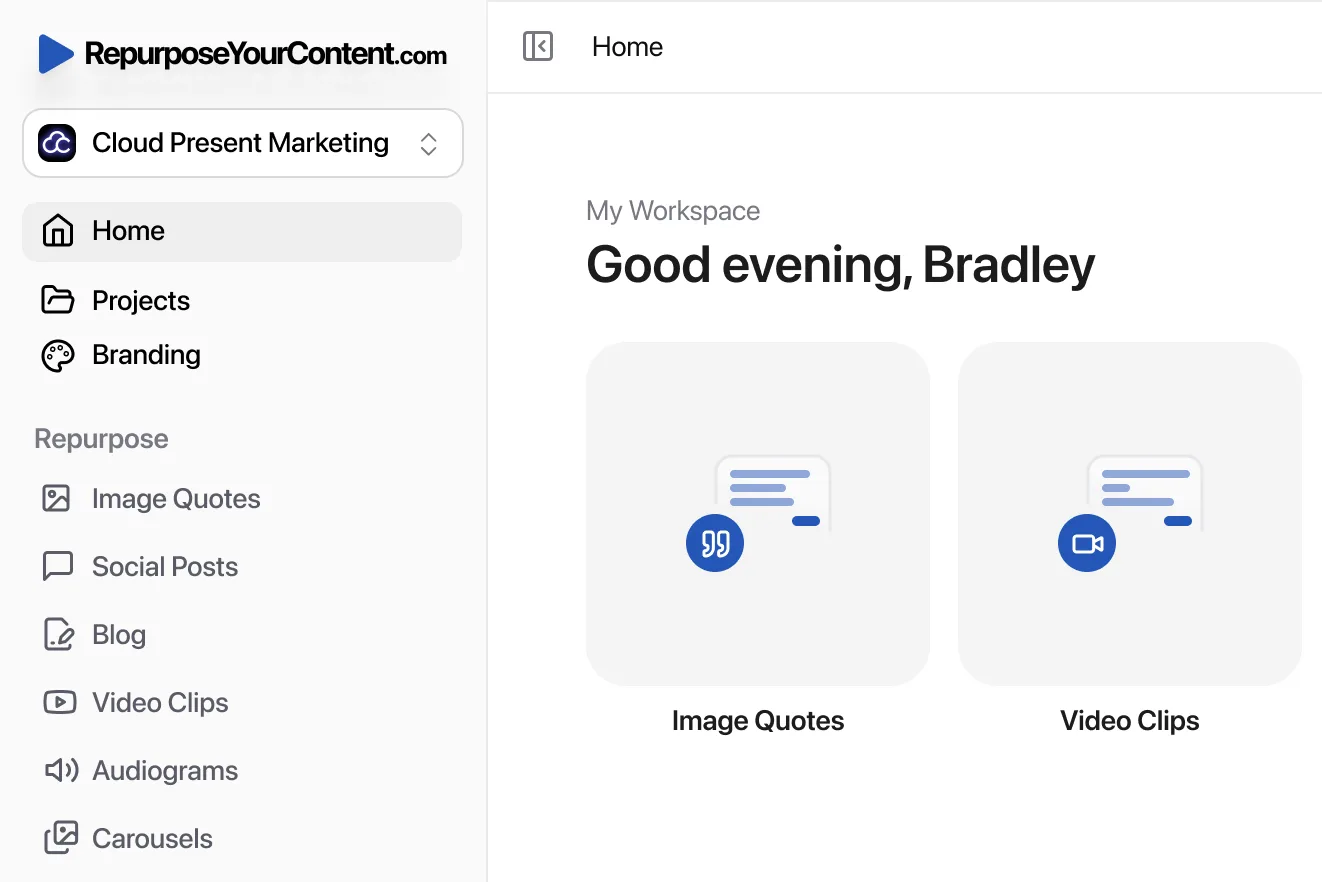
RepurposeYourContent fits that agency model better than clip-first tools. Its value is not just speed. It gives ops teams a repeatable production workflow with client-specific brand controls, broad output types, and a review process that turns hours of manual formatting into one approval pass.
That matters for agencies selling webinar-based retainers.
Where it fits in an agency workflow
This tool is a stronger choice for webinar and virtual event accounts than for general social clipping. You upload one long-form recording, choose the asset mix for that client, apply brand settings, generate the package, and review the outputs before handoff. That is the core difference between a tool that helps an editor and a tool that helps an agency standardise delivery.
The output range is also wider than most alternatives in this category. You are not limited to vertical clips. Teams can generate blog posts, social copy, audiograms, image quotes, newsletters, LinkedIn carousels, timestamps, and short video assets from the same source file. For agency owners, that breadth matters because it supports a higher-value monthly package without stitching together three or four separate tools.
Agency test: If the platform only solves clipping, your team still carries the rest of the production load.
Why it can improve margin
ROI here is operational. A producer can run the first pass, an account manager can check brand fit, and a strategist can approve the final set. That compresses production into review instead of editing from scratch for every client. If your agency handles recurring webinars for SaaS, coaching, education, or B2B service clients, that workflow is far easier to scale than a clip-only stack.
It also suits white-label delivery better than many consumer-style tools. Brand kits help keep fonts, colours, and logos consistent by client, which reduces revision churn and makes outputs safer to send under your agency name.
Pricing starts at $99 per month, with a free Basic tier and trials on paid plans. Enterprise plans add the controls larger teams usually ask for, including SSO, support, and volume pricing.
If you are comparing agency-fit platforms against clip generators, this Opus Clip alternative for webinar marketers gives a useful side-by-side lens on where webinar workflows need more than highlight extraction.
2. Opus Clip

Opus Clip is built for one job: turning long videos into short clips fast. If your agency sells monthly clip packs across multiple client accounts, that focus can save serious production time. A team member uploads the source file, the platform identifies likely highlights, reframes for vertical formats, adds captions, and gives you a review queue instead of a blank editing timeline.
That matters if you are trying to compress 30 hours of manual clipping across client retainers into a 1-hour approval pass.
Where it fits, and where it starts to break
Opus Clip works best for agencies with a clear, repeatable short-form offer. If the deliverable is weekly reels, Shorts, and LinkedIn video cutdowns, it does the job well and cuts editor hours. Team features and faster processing also help when several client videos hit your pipeline at once.
The limitation is just as clear. Opus Clip serves the clipping stage, not the full agency workflow. It does not carry much weight if your retainer also includes blog drafts, email follow-up, sales assets, or white-label content packages by client. You still need other tools and more handoffs to finish the work.
That is the essential buying decision for agencies. Do you need a clip generator, or do you need a multi-client repurposing system?
Choose Opus Clip if short-form output is the product you sell. Skip it as your main stack if clients expect broader post-webinar deliverables.
Teams assessing that gap should read this comparison of an Opus Clip alternative for webinar marketers.
The platform itself is available on the Opus website.
3. Munch

Munch is a practical option for agencies that care about social distribution as much as editing. It pulls out contextually strong moments from long videos and pairs them with suggested social copy. That’s helpful for content teams that want a faster route from source video to scheduled post.
Speech-heavy webinar content suits Munch well. Panels, founder interviews, and educational sessions tend to produce stronger results than highly visual footage. Agencies running thought-leadership programmes can use it to speed up editorial packaging.
Best fit for distribution-focused teams
Munch makes sense when the agency needs clips plus copy support for social managers. Suggested post text can trim some of the writing time after clip selection. That’s a useful gain for lean teams.
The limitation is agency breadth. Munch is still more social-first than campaign-first. If a client retainer includes blogs, email nurture, downloadable assets, and sales enablement content, the agency will still need extra workflow steps.
A broader comparison for webinar-led content teams appears in this guide to a Munch alternative for webinar content.
- Good use case: Agencies posting frequent social cut-downs from webinars and interviews.
- Less ideal use case: Agencies selling end-to-end webinar repurposing packages.
- Operational note: Visual review still matters because not every extracted moment will match client messaging.
The product site is Munch.
4. Vizard

Vizard sits in the middle ground between automation and control. That makes it attractive for agencies that want AI clipping, captions, and templates, but still need enough editing flexibility to serve different client styles.
The API is the interesting part for ops leads. Agencies trying to standardise workflows across many clients often care less about “cool AI” and more about reducing repetitive steps. Vizard supports that better than many creator-focused tools.
Why ops teams like it
Vizard handles long uploads and supports high-quality source files, which helps when enterprise clients hand over full event recordings. Team workspaces and brand templates also make it easier to separate account-level output. For agencies working with internal project management systems, API access opens the door to tighter production handoffs.
That said, advanced AI actions consume credits. Agencies with mixed client demand need to size usage carefully. Otherwise, the economics become harder to predict.
Agencies scaling past 10 active clients need workflow reliability more than flashy editing features.
Vizard is a strong shortlist option for agencies that want process control and some automation plumbing. It is less compelling for firms that want broad written outputs from webinars. The platform is available at Vizard.
5. Quso

Quso, previously known as Vidyo.ai, is the all-in-one option for agencies that want clip creation, editing, scheduling, and analytics in one place. That all-in-one model can reduce stack sprawl. It can also simplify training for junior team members.
For agencies with social management retainers, the scheduling layer is a real selling point. One platform handling creation and publishing reduces handoffs between editors and social specialists. That’s useful when the agency promises quick turnarounds.
Where it helps and where it falls short
Quso is most useful when the agency’s offer is social-first and cross-platform. A team can generate clips, resize them, remove filler words, apply brand settings, and move into publishing without switching tools. That lowers friction.
The weakness is that “all-in-one” rarely means “best at every stage”. Agencies doing high-touch B2B webinar repurposing may still want stronger written outputs, deeper QA controls, or a more specialised review flow. Some teams also still know the product by its old name, which creates minor documentation friction.
For agencies that want fewer moving parts and can live with a social-centric workflow, Quso is a sensible option. The official site is Quso.
6. Descript

Descript is the editor-first choice. Agencies that already have strong production teams often prefer it because it combines transcript editing, multicam support, dubbing, cleanup tools, and collaborative review in one environment. It’s more production suite than turnkey repurposing engine.
That distinction matters. Descript is powerful when an agency wants polish and control. It is less useful when the priority is mass output from many webinar recordings with minimal handling.
Best for agencies with in-house editors
Descript suits teams that sell premium editing, podcast production, or multilingual content adaptation. Text-based editing is still one of its biggest operational strengths. Junior editors can move faster because they’re working from transcript and scene structure, not just timeline complexity.
For agencies comparing production stacks, this overview of AI video editing tools for marketers helps frame where Descript fits. It’s a strong companion tool for post-production. It’s usually not the best single system for complete agency-scale webinar repurposing.
- Strong fit: Agencies with editors who need control over final quality.
- Weak fit: Agencies trying to automate broad multi-format output from webinar content.
- Watch-out: Seat-based pricing and usage limits need close planning.
Descript’s platform is at Descript.
7. VEED.io

Agencies lose margin fast when simple edit requests pile up across 10 or 20 client accounts. VEED.io helps cut that drag because it is easy to use, browser-based, and fast for branded social edits.
Its strength is speed, not workflow depth. You get subtitles, translations, dubbing, templates, and team collaboration in an interface that account managers and producers can directly operate without handing every change to a senior editor. For agencies selling recurring short-form content, that matters. You can turn raw footage into review-ready assets quickly and keep client feedback cycles moving.
Agency use case
VEED.io fits agencies that need lots of client-safe edits with low training overhead. It is a practical choice for teams handling multiple brands, frequent revision requests, and shared review responsibility across producers, editors, and client leads. VEED also publishes its GDPR and data processing terms, which matters if your agency needs a clear compliance paper trail before putting client footage into an editing platform.
The tradeoff is operational. VEED.io is good at producing polished assets fast, but it does not compress webinar repurposing work the way a true agency repurposing system does. If your goal is to turn one long recording into clips, captions, derivatives, and client-specific outputs with only a 1-hour review pass, VEED will still leave more manual decisions on your team than tools built specifically for that workflow.
Pricing needs scrutiny. VEED’s pricing page makes it clear that agencies should model seat count, usage, and client volume before committing. If you run broad creative services, the spend can be justified. If your core offer is high-volume webinar and event repurposing across many client accounts, VEED.io is better as a supporting editor than your main production engine.
The product site is VEED.io.
8. Repurpose.io

Manual publishing is where agency margin disappears. Repurpose.io earns its place on this list because it cuts the repeat work after editing. If your team already has approved clips and spends hours pushing them to the same channels for multiple clients, this tool can compress that admin load fast.
That agency angle matters. Repurpose.io is not your clip selector, script writer, or creative editor. It is a distribution system for agencies that need repeatable output across a stack of client accounts without assigning a producer to babysit every publish step.
Best for repetitive channel workflows
Repurpose.io works best when your workflow is already standardized. You have the assets. You know the destinations. You need them routed reliably, on schedule, across podcasts, webinars, livestreams, and short-form channels. For an agency running multi-client content operations, that is useful because it turns a messy handoff into a controlled process your account team can review in one pass.
It is weaker as an end-to-end repurposing engine. If your offer depends on taking one long recording and turning it into clips, captions, written derivatives, and client-ready deliverables with only a 1-hour review window, Repurpose.io handles only part of that chain. Agencies often get better results by using it after another tool has already done the creative extraction and packaging work.
UK agencies should also check the compliance and billing details before rollout. Repurpose.io publishes its terms of service and privacy policy, and those documents are the right place to verify data handling, account responsibilities, and tax treatment for your setup before you put client distribution into production.
The platform sits at Repurpose.io.
9. Castmagic

Castmagic is one of the better picks for agencies that care about written collateral from recorded content. It turns long-form audio or video into transcripts, summaries, posts, emails, and long-form written drafts. For webinar-led content programmes, that’s useful.
A lot of agency stacks fail here. They can create clips, but the written follow-up still has to be built manually. Castmagic reduces that burden.
Strong written asset support
Castmagic is a good fit for agencies that package webinar content into thought leadership. Teams can move from recorded session to post-event follow-up assets without opening a blank document. That helps strategists and content managers deliver faster.
It’s weaker for visual clip production than specialist clipping tools. Agencies that need polished short-form video at scale will often pair it with another tool. That pairing can work, but it increases workflow complexity.
For agencies that need one system to generate clips, blog posts, carousels, newsletters, and quote assets in one pass, a purpose-built webinar engine will usually be cleaner. Castmagic itself is available at Castmagic.
10. Parmonic

Parmonic is built for agencies serving enterprise clients, where one webinar is not just a content source. It is a governed asset with approvals, hosting, analytics, lead capture, and reporting tied to revenue.
That matters if your agency manages multiple stakeholders, strict brand controls, and long client review cycles.
Better for enterprise client operations
Parmonic works well for agencies that need more than clip generation. You get chapters, reels, landing pages, galleries, analytics, and admin controls in one system. For accounts with legal review, regional teams, or complex handoffs between marketing and sales, that setup can reduce tool sprawl and make client delivery easier to manage.
It is less convincing if your core job is compressing 30 hours of manual repurposing into a 1-hour review. Parmonic supports broader video operations, but it is not the cleanest agency workflow for turning one webinar into a full batch of white-label deliverables across many client accounts. Smaller agencies will feel the weight fast. More setup, more process, and usually more spend.
Agency owners should be blunt about the trade-off. If you need a controlled client portal and stronger governance, Parmonic deserves a look. If you need fast multi-format output at scale, including clips, written assets, and branded social deliverables your team can review quickly, a more focused repurposing tool will usually produce better margins.
That gap matters because B2B teams keep asking for more value from each recorded event. The Content Marketing Institute's webinar strategy guidance highlights the need to turn a single webinar into multiple post-event assets instead of letting it sit as a one-and-done recording, as explained in Content Marketing Institute's webinar repurposing guidance.
Parmonic’s website is Parmonic.
2026 Comparison: Top 10 Video Repurposing Tools for Agencies
| Tool | Core formats & features | Target audience | Speed & ease | Unique selling point | Pricing (starter) |
|---|---|---|---|---|---|
| RepurposeYourContent | 8 formats: clips, blogs, social posts, carousels, emails, audiograms, podcasts, image quotes; auto brand kit | B2B marketing, demand-gen teams, agencies, content teams | ~5 minutes from upload to publish-ready assets; platform-agnostic uploads | Built specifically for B2B webinars; full written + visual outputs with brand kit across all assets | $99/mo start; free Basic tier; 7-day trial; enterprise plans |
| Opus Clip (Agent Opus) | Auto highlight detection, captions, reframing for 9:16/1:1/16:9, templates | Agencies and creators needing fast short-form clips | Very fast, mostly hands-off clip selection and export | Predictive hook scoring and rapid reframing for shorts | Credit-based model; free tier / paid credits |
| Munch | NLP-driven clip selection, auto captions, platform-specific formatting, suggested post text | Agencies focused on social distribution and speech-heavy content | Automated clip + caption generation; good for interviews/webinars | Context-aware clip selection + social-copy suggestions | Free tier / paid plans (some plan details opaque) |
| Vizard | Auto-clipping, auto-subtitles & translation, brand templates, API, long uploads (up to 600 min) | Agencies needing automation + fine control; developers integrating via API | Scales to long/4K uploads; API for workflow automation | API access bundled; supports long uploads and 4K sources | Free plan; paid tiers with minutes/credits |
| Quso (formerly Vidyo.ai) | AI clip generator, subtitles, filler-word removal, brand kit, bulk publishing, scheduler | Agencies wanting end-to-end create-to-publish workflow | Creation-to-publish with bulk scheduling and analytics | Built-in bulk publishing + content planner | Free credits; tiered paid plans |
| Descript | Text-based editing, transcription, Create Clips, dubbing/translate, Brand Studio | Teams needing deep post-production + repurposing | Good for repurposing plus full-edit polish; collaborative | Production-grade editor with text-based workflow and dubbing | Free tier; seat-based paid plans and credits |
| VEED.io | Auto-subtitles/translations/dubbing, AI avatars, templates, brand controls, team workspaces | UK/EU agencies and teams wanting a smooth browser editor | Fast browser workflows; AI features often credit-limited | Strong EU presence and easy browser-based UX | Free tier; paid plans with quotas |
| Repurpose.io | Connects to 40+ destinations, templates, bulk automations, publish workflows | Agencies managing multi-brand, multi-channel cross-posting | Automation-first: set once, publish repeatedly at scale | Best for repetitive cross-posting and pipeline automation | Paid plans; agency tiers with high monthly publish allowances |
| Castmagic | Fast transcription, content packs for posts/summaries/emails, longform pages, media clipping | Teams needing multi-format written assets from audio/video | Quick transcription and content pack generation; pairs with clippers | Strong at converting talks into on-brand written collateral | Usage-based tiers; free trial available |
| Parmonic | Moments/chapters, reels, landing pages, email/blog outputs, hosting, analytics, lead capture | Enterprise B2B marketing teams and agencies needing governance | End-to-end platform from event→assets→hosting/analytics | Combines hosting, governance, analytics and content ops | Enterprise pricing; higher entry point |
Final Thoughts
Agencies that turn one recorded webinar into a full client content package in a single review cycle have a real margin advantage. The gap is no longer about who can edit faster. It is about who can standardise delivery across 10, 20, or 50 client accounts without adding more coordinators, editors, and QA time.
That is the right lens for choosing a video repurposing tool in 2026. Pick based on workflow fit, approval speed, brand control, and how cleanly the platform handles multi-client operations.
The shortlist breaks down cleanly:
- RepurposeYourContent fits agencies built around webinar, virtual event, and long-form client content packages that need clips, written assets, and image outputs from one source file.
- Opus Clip and Munch make sense for agencies selling short-form volume first and treating written outputs as secondary.
- Vizard is the better pick for teams that care about process control, collaboration, and API-driven operations.
- Quso suits agencies that want production and publishing close together in one workflow.
- Descript works best when your team still wants strong hands-on editing control after the AI pass.
- VEED.io is a practical choice for browser-based editing, branded templates, and distributed team access.
- Repurpose.io solves a different problem. It is strongest when cross-posting and channel automation create the bottleneck.
- Castmagic earns its place when clients expect transcripts, summaries, emails, and written follow-up assets alongside video.
- Parmonic is built for agencies serving larger B2B or enterprise accounts that need governance, hosting, analytics, and tighter content operations.
The ROI calculation is still simple:
time saved per client x internal hourly rate x number of clients
For agencies, the key win is not the formula. It is what happens after the formula. If a platform turns 30 hours of manual clipping, rewriting, formatting, and packaging into a 1-hour review, your team gets capacity back immediately. You can protect margins, shorten turnaround times, or increase account volume without hiring at the same pace.
A workable operating model for 10-plus clients is straightforward:
- Step 1: Standardise intake for source recordings, brand rules, asset selections, and approval requirements.
- Step 2: Generate first-pass outputs inside the chosen platform.
- Step 3: Run a reviewer check for claims, visual consistency, captions, and client-specific compliance points.
- Step 4: Export into client-specific folders or publishing queues.
- Step 5: Track delivered asset volume, turnaround time, and revision rate in monthly reporting.
That process gives agencies something more valuable than more content. It gives them a repeatable service line.
Final selection comes down to one question. Where does your agency lose time today? If the pain sits in clipping, choose a tool built for short-form extraction. If the pain sits in turning webinars into complete campaign assets, choose a platform that covers more than video. If the pain sits in approvals, publishing, or client-by-client coordination, choose the product that reduces operational drag there first.
That is how agencies should buy repurposing software in 2026. Match the tool to the service model, keep the workflow review-led, and choose software that handles scale without creating a second layer of admin.
Tags: