Discover The Best Munch Alternative For Webinar Content
Need a Munch alternative for webinar content? Munch suits creators, not B2B. Explore 8 powerful tools designed for B2B webinars & find your perfect fit.

Munch is a good tool for short video clipping. It just isn’t built around how B2B webinars create value.
A webinar rarely wins because of a loud hook. It wins because a speaker explains a painful problem clearly, handles objections well, and lands one sharp insight that moves a buyer. Munch often catches the energetic moments. It can miss the commercial ones. That’s the reason teams start searching for a better munch alternative for webinar content.
The gap gets bigger with slower pacing, multiple speakers, screen shares, and dense product or ROI discussion. Creator-first AI looks for punchy peaks. Webinar teams need context, clean attribution, and usable outputs beyond clips. That’s why many marketers move from clipping tools to repurposing stacks built for post-event campaigns, not social snippets alone. Teams still trying to maximise content reuse for social media usually hit the same wall. Clips alone don’t fill the calendar.
1. RepurposeYourContent

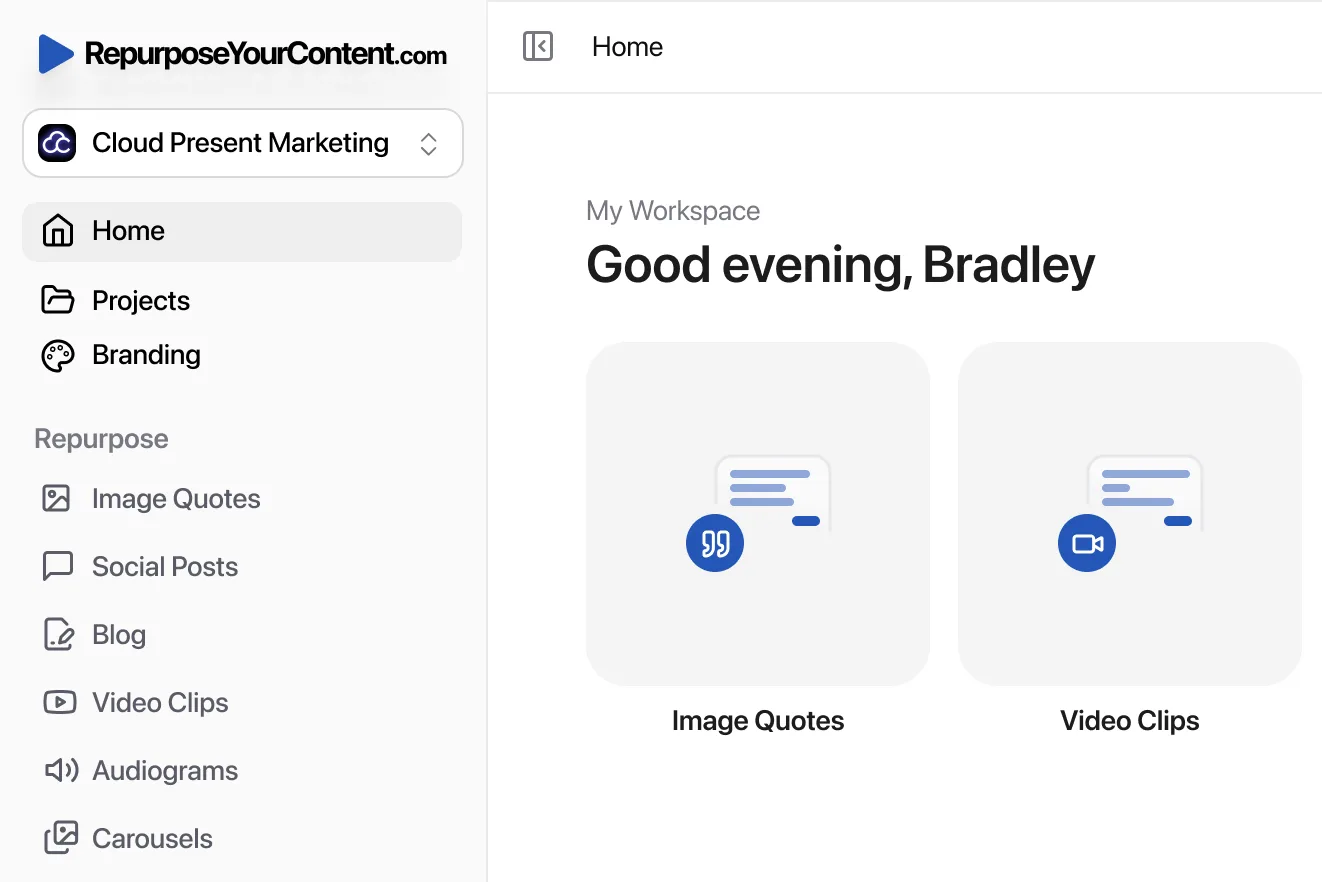
RepurposeYourContent is the strongest option here for B2B teams that need business content from a webinar, not just highlight clips. That distinction matters. A webinar usually contains the main value in explanations, objections, product detail, and speaker nuance. Creator-first tools often flatten that into short moments built for reach. This platform is built for post-webinar output across an actual campaign.
The core benefit is simple. You start with one recording and get multiple finished assets for distribution, follow-up, and reuse. It supports webinar files and links from common hosts such as Zoom, YouTube, and Vimeo, then turns that source into written, video, audio, and visual formats.
How RepurposeYourContent helps
RepurposeYourContent covers the outputs B2B marketers usually have to create by hand after an event:
- Video clips: Short segments for LinkedIn, YouTube, and paid social
- Blog posts: Long-form written content built from the transcript and key talking points
- Social posts: Post copy and variations for distribution
- Audiograms: Audio-led assets for feeds and podcast promotion
- Image quotes: Branded quote cards from speakers or guests
- Newsletters: Email-ready recap content for nurture and follow-up
- LinkedIn carousels: Slide summaries based on the main points
- Timestamps: Chapters for replay pages and sales follow-up
That output mix is the reason it stands out. Munch is useful for clipping. RepurposeYourContent is better suited to turning one webinar into a usable content package.
Practical rule: If your webinar tool stops at clips, your team still has to build the rest of the campaign manually.
The workflow is also clear enough for lean teams. Upload the recording or paste the webinar link. Pick the asset types you want. Set the quantity, generate the assets, review them, and publish.
Where it beats Munch for webinar content
RepurposeYourContent makes more sense when the source material has multiple speakers, slower pacing, product walkthroughs, or dense discussion that needs context to stay useful. Those are common traits in B2B webinars. They are also the exact conditions where creator-focused AI starts to look thin.
It is especially strong if written outputs matter as much as video. Many webinar teams do not need another tool that finds energetic soundbites. They need a draft blog post, email recap, carousel, and clean replay structure fast. RepurposeYourContent is closer to that use case.
The trade-off is pricing transparency. Public pricing is not listed, so buyers need to contact sales to assess fit, security requirements, and budget. For teams running webinars as a repeatable demand gen channel, that is a reasonable trade.
2. Parmonic

Parmonic is one of the few platforms that clearly starts from the webinar workflow, not the creator workflow. That changes everything. The platform is designed for long sessions, follow-up campaigns, and enterprise approval chains.
For teams running repeat webinar programmes, Parmonic makes more sense than Munch. It handles clips, transcripts, chapters, blogs, emails, landing pages, and analytics in one place. That means less stitching together across tools after every event.
Best fit
Parmonic suits larger B2B teams with ops support and a proper event engine. It also fits regulated teams that care about SSO, legal review, and enterprise procurement.
Useful strengths include:
- Deep integrations: Zoom, HubSpot, Marketo, Pardot, Eloqua, Salesloft, Outreach, and Seismic.
- Campaign outputs: Clips, blogs, emails, galleries, chapters, and landing pages.
- Enterprise controls: SSO, InfoSec review, and contract-friendly setup.
Parmonic is a workflow platform first. Munch is a clipping tool first.
That’s the practical trade-off. Parmonic is likely heavier and more expensive than creator-focused options. It’s also less useful if the team only wants social clips from occasional webinars.
Public pricing isn’t clearly available on the site. Buyers should expect a sales-led process. For enterprise webinar teams, that’s normal. For smaller teams, it may feel slow.
Website: Parmonic
3. Opus Clip

Opus Clip is what you pick if you want a better clip machine, not a better webinar repurposing system. That distinction matters. B2B webinar teams rarely struggle to find short moments. They struggle to turn a 45-minute discussion with multiple speakers into usable follow-up content that sales and demand gen can use.
Opus does the first part well. It generates short clips fast, adds captions, reframes for vertical formats, and gives teams enough editing help to publish quickly. If your KPI is more social video from existing recordings, it can do the job.
Where Opus Clip works well
Opus Clip fits teams that need speed and volume in short-form output:
- Fast clip production: Converts long recordings into short social clips quickly.
- Flexible imports: Pulls from Zoom, YouTube, Vimeo, and cloud storage.
- Publishing support: Brand templates and scheduling help teams keep content moving.
That puts it in the same category as Munch. Both are built around finding punchy moments and packaging them for distribution. For webinar marketers, that means the ceiling shows up fast. Clip-first tools are weak at extracting business insight, handling speaker handoffs cleanly, and turning a serious webinar into long-form written assets.
Where it falls short
Opus Clip is a poor fit for teams that need more than social output. If your post-webinar workflow includes recap emails, blog drafts, sales follow-up content, quote cards, or structured summaries by topic, you will hit its limits quickly. It helps you publish clips. It does not give you a full repurposing engine.
The trade-off is simple. Opus is stronger for short-form speed than broader webinar content operations. Credit-based pricing can also become annoying for teams running frequent webinars and testing lots of clip variations.
If your shortlist is still focused on clipping tools, review this comparison of the best AI video clipping tools for 2026. Another relevant benchmark is Satura AI Autoclip, which also sits in the short-form category.
Website: Opus Clip
4. Vizard

Vizard is a practical option for teams that want clip automation without locking into a heavy platform. It’s especially useful for webinar programmes that need repeated highlight extraction and simple publishing.
The appeal is straightforward. Vizard turns long videos into multiple clips, adds subtitles, reframes the video, and supports templates and brand kits. It also offers API access on paid tiers, which matters for teams building repeatable workflows.
Why webinar teams pick it
Vizard is a better fit than Munch when the team needs more process control around clip generation. The API gives developers and ops teams room to automate webinar-to-clip pipelines.
Key strengths include:
- Clip generation: AI highlights, subtitles, and reframing.
- Workflow support: Brand kits, templates, and publishing tools.
- Automation potential: API access on paid plans.
That said, Vizard still sits in the clip-first camp. It helps produce short-form video assets. It doesn’t fully solve long-form written repurposing for webinar teams.
Multi-speaker webinars expose weak clipping AI fast. Attribution, speaker changes, and slower transitions confuse tools built around creator pacing.
That’s where Vizard and Munch share the same ceiling. Both can help. Neither replaces a complete repurposing workflow.
Pricing is usage-led rather than simple and flat, so teams should check how credits and minutes are handled before committing.
Website: Vizard
5. Pictory

Pictory is stronger than Munch when the team wants to create polished promo videos from webinar content, slides, or scripts. It isn’t just a clipping engine. It’s closer to a flexible video creation platform.
That makes it useful for webinar teams that don’t always start with a perfect recording. If the event deck is stronger than the delivery, Pictory can still help create usable social video.
Best use case
Pictory works well for:
- Slide-led webinars: Turning presentations into shorter branded videos.
- Promo assets: Creating social snippets and teaser videos.
- Brand control: Applying brand kits across recurring output.
The trade-off is control versus speed. Pictory usually offers more ways to shape the output, but that can slow the process compared with a pure clipper. It’s also still mainly a video tool. Blogs, emails, and text-heavy post-event assets need another system.
For teams replacing Munch, Pictory is the better pick if the bottleneck is video creation quality. It isn’t the best pick if the bottleneck is turning one webinar into a full campaign pack.
Public pricing is available on the site, with multiple tiers. That makes buying easier than with some enterprise-focused alternatives.
Website: Pictory
6. Riverside

Riverside only makes sense in one clear scenario. The team already records webinars or virtual sessions inside Riverside. If that’s true, Magic Clips is convenient.
The workflow is low friction because clipping happens close to the recording layer. Teams can generate short clips, captions, and show notes without moving files between platforms first.
What it gets right
Riverside is strong on recording quality and basic post-production speed. Multi-track capture helps when sessions include guests, and the built-in AI editing tools reduce handoff time.
It’s a sensible option for:
- Platform-native workflows: Record and repurpose inside one tool.
- Quick previews: Social clips and simple show notes after recording.
- Speaker separation: Better raw capture for later editing.
Its weakness is obvious. Riverside is not a dedicated webinar repurposing platform. It doesn’t produce the wider written and image assets B2B teams often need. Importing recordings from outside Riverside also adds friction.
For a team already committed to Riverside, Magic Clips is a useful add-on. For a team replacing Munch specifically for webinar campaigns, it’s too narrow.
Website: Riverside
7. Goldcast

Goldcast is a strong option for companies that already host webinars and virtual events on Goldcast. In that setup, Content Lab gives a more complete path from event to post-event campaign than Munch.
It can generate clips, social posts, blogs, emails, transcripts, and takeaways from hosted recordings. That moves it beyond clipping and closer to campaign repurposing.
Where it fits best
Goldcast suits demand gen teams standardising webinar operations inside one stack. Hosting, repurposing, and event analysis stay connected.
That integrated setup is helpful for:
- Event-led teams: One vendor for webinar hosting and repurposing.
- Post-event output: Clips, blogs, emails, and takeaways from recordings.
- Enterprise processes: CRM and marketing automation alignment.
A practical reference point for clip extraction from longer assets is this guide on repurposing long-form video into short clips. Goldcast sits one layer above that. It’s not just about clips. It’s about event workflows.
The main catch is platform lock-in. Goldcast is most valuable when the team already uses Goldcast for hosting. If recordings live across Zoom, Vimeo, YouTube, and webinar platforms from different departments, the setup loses some appeal.
Website: Goldcast
8. VEED

VEED is the best choice on this list for teams that still want to edit by hand, but faster. It’s a browser-based editor with AI Clips, subtitles, translation, templates, hosting, and publishing tools.
For webinar teams, VEED is useful when the AI gets close but a marketer still wants direct control over the final cut. It gives more editing freedom than Munch without forcing a full desktop editing workflow.
Trade-offs
VEED is a broad toolset, not a webinar-first engine. That’s both its strength and its weakness.
Reasons teams choose it:
- Browser editing: No heavy install, easy team access.
- Broader toolkit: Noise removal, eye contact correction, hosting, publishing.
- UK relevance: Useful for teams that prefer a UK-based vendor footprint.
Reasons teams move past it:
- More manual work: It doesn’t auto-build campaign assets like landing pages or emails.
- Less webinar-specific logic: The team still has to decide what matters in the recording.
VEED works best for content teams with a hands-on editor mindset. It’s less suited to lean demand gen teams that need one webinar turned into many assets quickly.
Website: VEED
9. Repurpose.io

Repurpose.io solves a different problem from Munch. It’s strongest after the clips already exist.
That makes it a good companion tool, not a direct replacement for webinar insight extraction. If a team already has edited clips and wants to distribute them across Shorts, Reels, TikTok, and other channels with repeatable workflows, Repurpose.io is useful.
Best role in the stack
Repurpose.io is good for:
- Distribution automation: Publishing assets across multiple social channels.
- Format conversion: Turning wide clips into native platform shapes.
- Bulk workflows: Scheduling and recurring content pipelines.
It isn’t a full editor and it won’t understand webinar context thoroughly. It won’t write the blog recap or identify the most commercially important buyer insight on its own. Teams that choose it should pair it with another tool for content creation.
For marketers using Munch today, Repurpose.io is not the replacement if the complaint is “the AI keeps missing the key point.” It is the replacement if the complaint is “publishing these finished clips everywhere is eating time.”
Pricing is publicly available and easier to compare than many enterprise tools.
Website: Repurpose.io
10. Chopcast

Chopcast is the best option here for teams that want less software and more service. It focuses on B2B content, especially webinars, virtual events, and podcasts, and combines tooling with managed support.
That matters when the team doesn’t just need outputs. It needs someone to help keep the machine running.
Why it stands out
Chopcast is built around B2B content types. That’s a better starting point than Munch for webinar-heavy teams.
Strong points include:
- B2B orientation: Webinar, event, and podcast content are core inputs.
- Multi-format output: Video, audio, image, and written deliverables.
- Managed service: Guidance from an account team, not just software.
The downside is cost and speed control. Managed service often costs more than self-serve SaaS. Turnaround can also depend on production queues and service capacity.
A team with one webinar per month can live with manual cleanup. A team with a webinar programme needs a repeatable system or outside help.
Chopcast is a strong fit for smaller internal teams with budget but limited production capacity. It’s less attractive for operators who want full control inside a self-serve platform.
Website: Chopcast
Top 10 Munch Alternatives for Webinar Content, Comparison
| Product | Core outputs & formats | Speed & workflow | Best for / Target audience | Unique strengths / Differentiator | Pricing / Notes |
|---|---|---|---|---|---|
| RepurposeYourContent | 8+ formats: video clips, blog posts, social posts, carousels, emails, audiograms, podcasts, quote images | ~5 minutes from upload to downloadable assets; one-click generate; auto-applies brand kit | B2B marketing teams, agencies, demand gen, content teams | Breadth of formats in one pass; platform-agnostic; brand kit across all outputs, Recommended | Contact sales (no public pricing) |
| Parmonic | Clips, blogs, emails, landing pages, transcripts, chapters | End‑to‑end post‑webinar workflow with deep integrations | Enterprise & compliance‑heavy teams, marketing ops | Strong MAP/CRM integrations, SSO, legal/InfoSec controls | Higher entry price; quote-based |
| Opus Clip (Opus.pro) | Auto‑clips with captions, reframing, B‑roll, speech enhancement | Very fast clipping pipeline; viral‑scoring & auto‑reframe | Creators and teams focusing on social shorts | Virality scoring, auto‑reframe, scheduling | Credit system; plan sizing matters |
| Vizard | AI clips with subtitles, auto‑reframe, highlight keywords, brand kits, API | Quick clip generation; API for automation on paid tiers | Teams & developers automating clip pipelines | API access for scale; high minute ceilings | Credit model; tiered plans |
| Pictory | Webinar/script‑to‑video, resizing, stock media, voiceover options | Fast promo/snippet creation; easy onboarding | Teams needing quick branded social videos from slides/text/video | Stock library, AI voiceovers, simple workflow | Tiered plans; some voice options cost extra |
| Riverside (Magic Clips) | Vertical clips with captions, show notes; multi‑track recording | Low friction when recorded in Riverside; auto clip detection | Teams already recording on Riverside | Integrated capture→clips; reliable base quality | Works best within Riverside; plan limits apply |
| Goldcast (Content Lab) | Clips, social posts, blogs, emails, takeaways, transcripts | Host‑to‑repurpose within Goldcast ecosystem | Teams hosting webinars on Goldcast; demand‑gen programs | End‑to‑end hosting + repurposing, MAP/CRM integrations | Enterprise focused; quote-based pricing |
| VEED | AI clips, auto‑subtitles/translations, browser editor, templates | Browser‑based editing + publishing; team collaboration | UK/EU teams and general web editors needing hosting | Full web editor + hosting; strong regional support | Tiered plans; dynamic/credit elements |
| Repurpose.io | Auto conversion + distribution to Shorts/Reels/TikTok, templates, scheduling | Bulk pipelines for distribution once clips exist | Teams scaling repeat distribution and scheduling | Excellent multi‑platform automation & bulk publishing | Clear plan tiers; high connection limits |
| Chopcast | Video, audio, image & written outputs with managed service options | Managed, done‑for‑you production with account manager | Smaller teams wanting outsourced repurposing | Full-service model reduces internal workload | Higher cost; production queues may apply |
Stop Clipping, Start Repurposing
B2B webinar teams keep buying clip generators, then wonder why the output feels disposable.
That happens because Munch and similar creator-first tools optimize for short-video momentum, not business substance. Webinars do not succeed on flashy moments alone. The parts that drive pipeline are often the nuanced explanation from a subject matter expert, the objection a panelist answers cleanly, or the back-and-forth between multiple speakers that gives a buyer real context. Clip-first AI usually strips that value out.
Choose based on the asset mix you need. Opus Clip and Vizard are stronger if your target is social distribution. Pictory is better for script-led video production and slide-heavy content. Goldcast and Riverside are sensible if your webinar program already lives inside those platforms. Chopcast fits teams that want more production support. Parmonic is the stronger choice for larger teams with approval steps and stricter operating requirements.
The test is simpler. Can the tool pull usable business insights from a long webinar, keep speakers straight, and turn one recording into written assets your sales and demand gen teams will use?
That is why creator-style AI misses the mark for B2B webinars. Your team does not need six captioned clips and a vague claim that the job is done. Your team needs blog drafts, follow-up emails, social copy, summaries, quote selections, timestamps, and content that still makes sense when the webinar had a moderator, a customer, and two internal speakers talking over 45 minutes.
RepurposeYourContent is the clearest fit if that is your goal. It is built for turning webinars into a campaign package, not a pile of clips. The workflow is straightforward. Upload the session, pick the outputs, review the drafts, and publish what matters.
Broader interest in tools such as an AI short video generator makes sense. Speed matters. But short-video speed is not the same as webinar repurposing quality, and B2B marketers pay for that mistake with weak follow-up content and extra manual cleanup.
Use a platform that treats webinars as a source of insight, not raw material for social snippets. Compare the options on the Munch alternative page and the detailed Munch comparison page.
Try RepurposeYourContent for your next webinar if you want outputs your team can publish and use.
Tags: