Done for You Content Marketing: How It Works in 2026
Learn how done for you content marketing works. See realistic costs, timelines, deliverables, and proof points for podcasters, founders, and B2B teams.

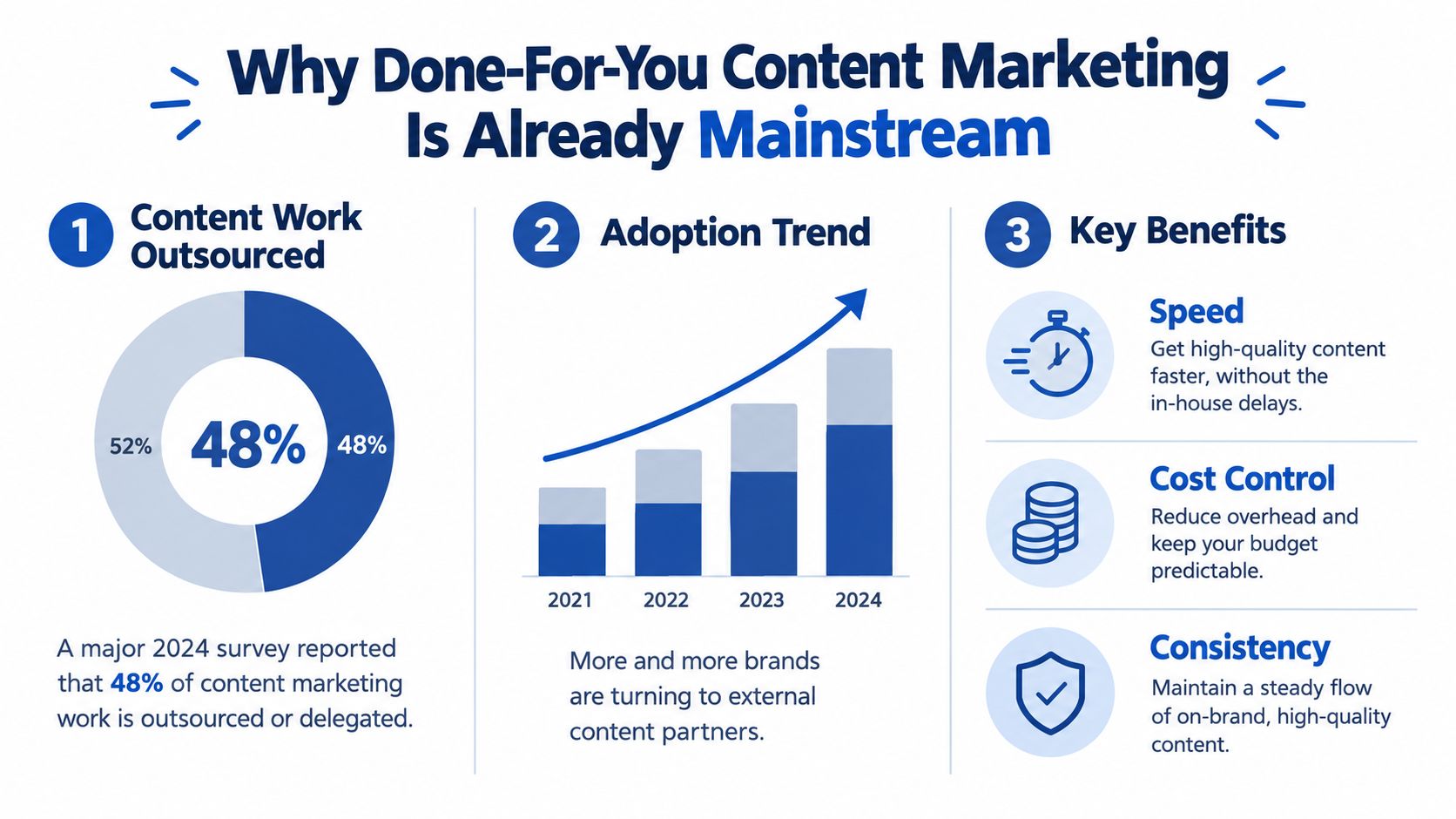
A major 2024 survey found that 48% of content marketing work is outsourced to agencies or third-party companies. The reported outsourcing benchmark changes the question. Done-for-you content marketing isn't a niche shortcut. It's a normal way to produce more content without building every capability in-house.
The practical issue is time. One 45-minute recording can require a full working day to turn into clips, posts, graphics, and an article. A managed service moves that production burden away from the marketing team while keeping strategy, brand voice, and approval control with the client.
Why Done-For-You Content Marketing Is Already Mainstream
External content production became standard because marketing teams need more output than their headcount can comfortably support. A specialist partner can handle repetitive editing, writing, design, formatting, and distribution preparation. The internal team can then focus on positioning, campaign priorities, subject-matter expertise, and final approval.
The 48% outsourcing figure isn't evidence of a temporary experiment. It reflects a mature operating model in which content marketing combines internal direction with external execution. The client still owns the message. The partner turns that message into finished assets.
The shift from campaigns to systems
Traditional content production often starts with a blank page. A marketer chooses a topic, conducts research, writes a draft, commissions design, requests edits, and schedules publication. That process works for occasional flagship pieces, but it becomes expensive when every social post or video starts from zero.
A stronger model begins with material the business already created. A podcast interview, keynote, sales conversation, livestream, customer discussion, or internal presentation contains ideas that can support several channels. A guide to content repurposing statistics describes this shift toward repeatable reuse and adaptation.
What clients retain
Outsourcing production doesn't mean outsourcing judgment. Strong arrangements leave four decisions with the client:
- Positioning: The client decides which audience and business priority matter.
- Voice: Brand guidance controls vocabulary, tone, claims, and point of view.
- Approval: The client reviews the finished set before publication.
- Ownership: The client retains the completed assets and can use them across channels.
Done-for-you content marketing works when the partner acts like a production team, not an anonymous content mill. The buyer should receive a clear scope, defined deliverables, an approval process, and a predictable handoff.
The Hidden Cost of Doing It Yourself
DIY content repurposing looks free because no invoice arrives. The production time still appears somewhere, usually in a founder's evening, an editor's backlog, or a marketer's campaign schedule.
For one 45-minute podcast episode, a manual workflow typically includes about one hour to review the recording and mark useful moments. Clipping and captioning then takes two to three hours, writing posts and show notes takes one to two hours, graphics take about one hour, and blog formatting takes another one to two hours. That produces a total of roughly six to nine hours per episode, before approvals and scheduling, according to this manual podcast repurposing workflow breakdown.
The production calculation
The basic internal cost formula is simple:
Total DIY cost = production hours × loaded hourly cost
A marketer with a loaded internal rate of £50 per hour would spend the equivalent of £300 to £450 in production time across six to nine hours. That example is a calculation, not a market benchmark. The actual rate should include salary, benefits, management time, and the opportunity cost of delayed work.
The calculation changes for video podcasts. A separate in-house video podcast workflow analysis places manual production at eight to twelve hours per episode. The extra time comes from reviewing footage, selecting usable frames, managing captions, correcting edits, and checking exports.
Practical rule: If a recording takes most of a working day to repurpose, it belongs in the production plan, not in the “quick admin” category.
The cost also includes work that never reaches publication. A marketer may spend hours selecting clips, then abandon the project during a busy launch. A founder may approve the first draft weeks later, after the original conversation has lost relevance. A team may create posts but skip the blog because formatting takes too long.
The cost of content repurposing should therefore be judged against recovered capacity, not editing time alone. The right comparison is the service fee versus the internal hours, management burden, missed distribution, and delayed campaign work.
How a Done-For-You Content Service Actually Works
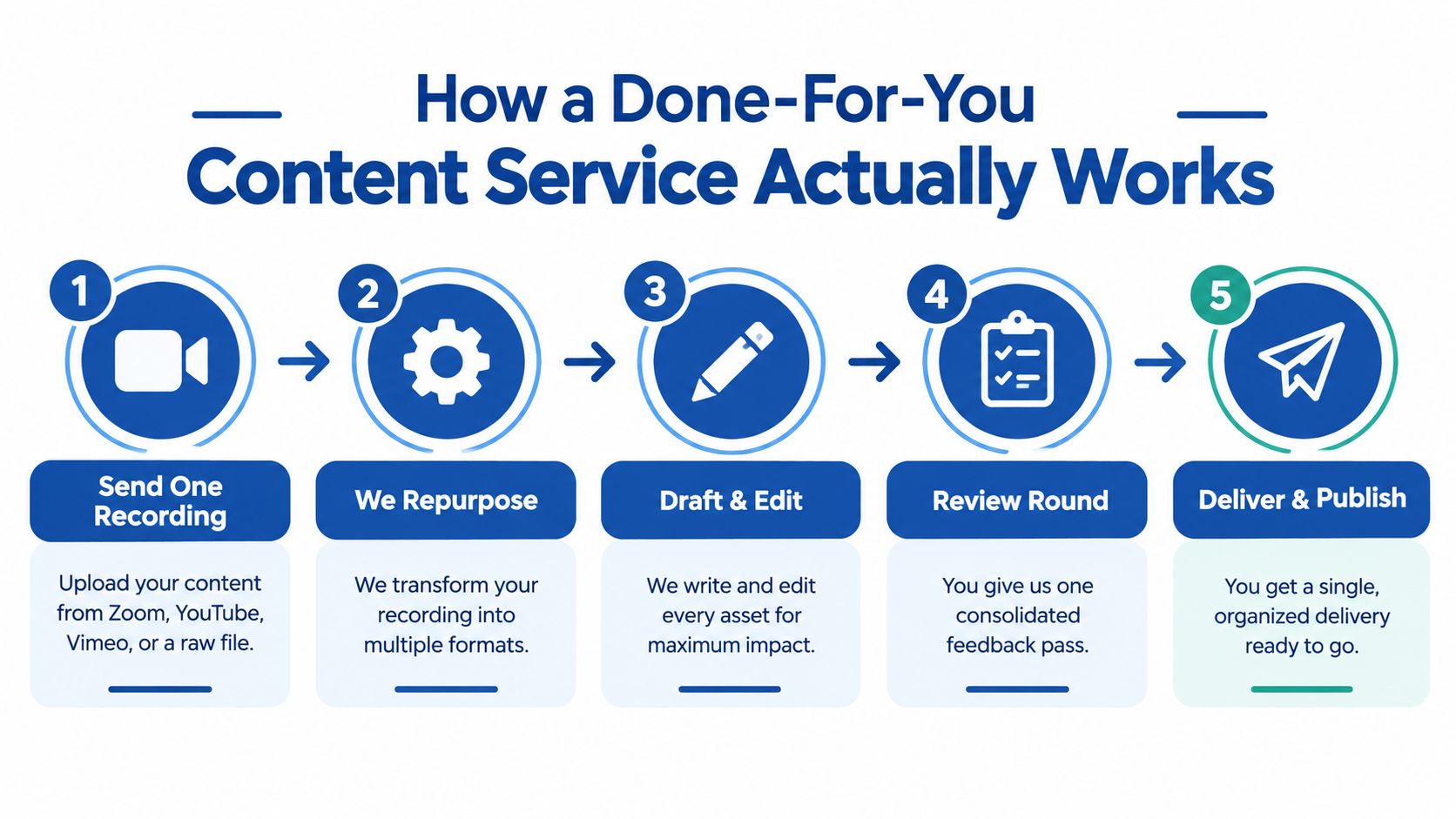
A professional service should be easy to explain. Clients send one recording. The production team extracts the strongest ideas, adapts them for different channels, and returns finished assets for review.
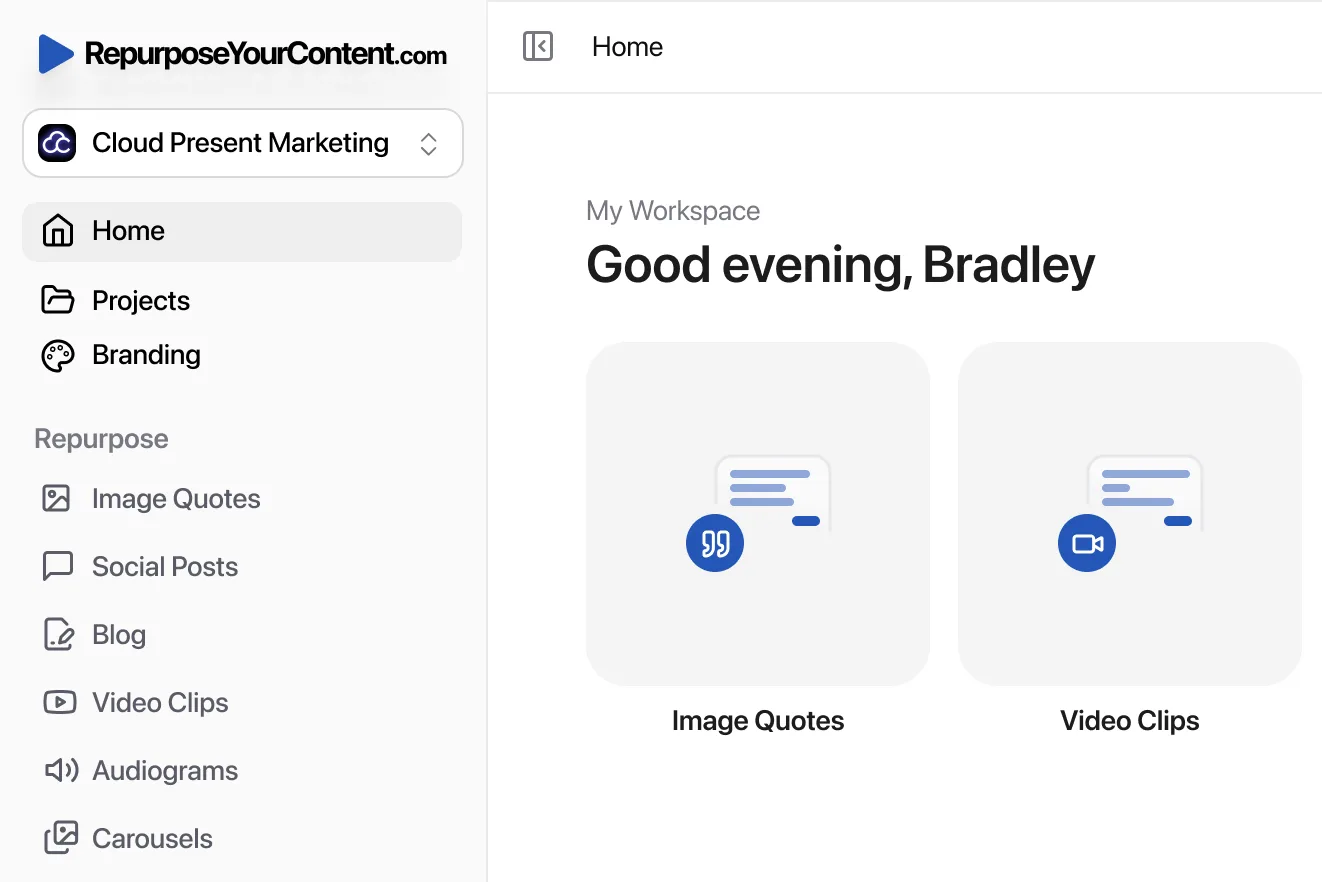
The process below keeps the client's involvement close to 15 minutes per recording. A managed delivery can return 20 to 30 ready-to-publish assets within 72 hours, including clips, posts, graphics, carousels, audiograms, and a blog post. The service information and delivery model are described by RepurposeYourContent.
Five steps from recording to delivery
Send one recording. The source can come from Zoom, YouTube, Vimeo, or a raw file. It can be a podcast, interview, keynote, sales call, livestream, course lesson, or meeting recording.
The production team finds the material. Editors review the recording, mark useful moments, identify connected themes, and separate strong insights from repetition. This editorial pass matters because automated transcripts rarely understand the difference between a complete idea and an interesting sentence without context.
The team builds the asset set. One recording becomes short video clips, quote graphics, carousels, social posts, audiograms, and an SEO-ready blog post. Each format needs a different opening, length, visual treatment, and call to action.
The client reviews one organized delivery. Feedback stays consolidated instead of arriving across email threads, chat messages, and separate design files. The service includes unlimited revisions, so the client can correct terminology, compliance details, or brand preferences.
The client publishes from a prepared plan. A posting playbook identifies what to publish, where to publish it, and when to use each asset. The client's team can schedule the content internally or pass the package to a social media manager.
The workflow only works when the production team understands the business. A transcript can identify a phrase, but a human editor must decide whether that phrase reflects the client's position, supports the campaign, and makes sense without the surrounding conversation.
The relationship between AI and human review is covered in how AI content repurposing works. Automation can accelerate transcription, sorting, captioning, and first drafts. It shouldn't replace editorial decisions.
The buyer should also check the guarantee. A 72-hour turnaround guarantee, or the client doesn't pay, creates a clearer service obligation than an open-ended promise to deliver “soon.”
DIY vs Hiring Staff vs Done-For-You Content Marketing
Three production paths cover most B2B teams.
DIY gives the client maximum control but consumes internal hours. Hiring staff adds a dedicated capability, yet also adds recruitment, management, benefits, equipment, and training. Done-for-you content marketing turns production into a defined service cost with a specified output.
The correct choice depends on recording frequency, internal expertise, approval speed, and the value of the marketer's time. The table below provides a practical comparison.
| Option | Time per 45-minute recording | Estimated monthly cost | Typical turnaround | Quality control |
|---|---|---|---|---|
| DIY | 6 to 12 hours, depending on format and workflow | Internal labour cost, calculated from hours used | Often several working days | Depends on available skills and review time |
| Hiring staff | Internal production time plus management overhead | Salary, benefits, equipment, and management cost | Depends on workload and team capacity | Controlled internally, after ramp-up |
| Done-for-you service | About 15 minutes of client time | $999 per month for one recording, with premium plans reaching $2,499 per month | 72 hours | Human editing, brand review, and unlimited revisions |
The DIY range reflects the podcast and video workflow estimates cited in this comparison of content repurposing agency services and DIY tools. It doesn't mean every recording requires the same effort. A clean interview with one speaker is easier than a multi-camera panel with poor audio.
How to convert the options into a decision
DIY fits when content volume is low, someone already has editing and writing skills, and the production work won't displace higher-value responsibilities.
Staff hiring fits when content production is a core internal function. A full-time employee can develop deep brand knowledge and coordinate closely with other departments. The trade-off is fixed capacity. Quiet months still carry payroll, and busy months can overwhelm one specialist.
Done-for-you production fits when the source material already exists but the team lacks the time or specialist coverage to process it. The service supplies editing, writing, design, and formatting without requiring the client to manage several freelancers.
The publisher's package structure states that the entry plan begins at $999 per month for one recording, while a premium plan reaches $2,499 per month for a weekly content engine. Based on the stated package economics, the cost can reach $14 per finished asset. Buyers should verify current pricing, scope, and turnaround before purchasing because service details can change.
The strongest procurement question isn't “Is this cheaper than a tool?” It's “Which option produces publishable work without blocking the team's core responsibilities?”
What Clients Actually Receive in One Delivery
A useful delivery has enough variety to support several channels without forcing the same message into every format. One recording can produce eight to twelve short-form video or audio clips, six to eight social posts with visuals, four to six quote graphics, one to three image carousels, and one SEO-ready blog post, according to the content repurposing services delivery model.
The volume matters less than the connection between assets. A clip should introduce an idea. A LinkedIn post can develop it. A quote graphic can reinforce the central phrase. The blog post can provide the searchable, structured version for readers who need more context.

A practical delivery checklist
- Short clips: Each clip should have a clear hook, readable captions, clean audio, and a useful ending.
- Social posts: Posts should preserve the speaker's idea while adapting the opening and length for the target channel.
- Quote graphics: Selected statements need enough context to remain accurate when viewed alone.
- Carousels: Slides should guide the reader through one argument instead of compressing an entire recording into tiny text.
- Blog content: The article should be edited for search intent, structure, readability, and brand terminology.
Human writing matters because spoken language and publishing language aren't identical. A transcript can contain repeated phrases, unfinished sentences, private references, and informal wording that makes sense only during the conversation. A person must decide what to preserve, what to rewrite, and what to remove.
Every asset should use the client's brand kit, including approved colours, fonts, logos, and visual rules. A person should review the complete package before delivery. The client should also receive a posting playbook that explains the recommended sequence.
Ownership needs equal clarity. The finished assets should belong to the client, with no watermarks, gating, or republishing restrictions. If a provider retains control of the files, limits revisions, or hides the production scope, the buyer should treat that as a contract risk.
Why This Model Beats Generic Repurposing Tools
AI can reduce production time by 40% to 70% and costs by up to 60%, according to the tension described in research on multi-platform B2B content repurposing. That efficiency is useful, but cheap production doesn't automatically create useful marketing.
Generic automation often produces the same failure pattern. It selects obvious sentences, applies a standard caption style, rewrites the transcript into a bland post, and publishes similar wording across every channel. The team gets more files but not necessarily more reasons for a buyer to pay attention.
Volume needs editorial judgment
The same research reports that 48% of social media marketers share similar or repurposed content across platforms with only minor adaptations, while 94% of marketers in one cited study say repurposing increases ROI. Those figures show both sides of the issue. Repurposing can perform well, but minor cross-posting isn't the same as channel-native adaptation.
Strong production changes the treatment, not the underlying expertise:
- LinkedIn needs a clear business implication.
- Short video needs a fast opening and visual rhythm.
- A carousel needs progressive information.
- An audiogram needs readable text and strong audio.
- A blog post needs search structure and sufficient context.
Teams that consistently adapt one video into multiple formats report “very good” performance at 56.6%, compared with 9.8% among teams that rarely do so, according to this repurposing performance benchmark. The result supports a practical conclusion. Consistency helps, but adaptation quality determines whether the output feels useful or duplicated.
AI can speed up the first pass. Human editors decide what deserves publication.
The buyer should compare services by editorial controls, not by asset count alone. A lower-priced provider may create more automatic variations, while a managed service may create fewer but more relevant pieces. Buyers evaluating distribution workflows can also review comparing Linkboost and Buffer for a broader look at how publishing and link-focused processes differ.
The best model combines automation for repetitive work with human judgment for voice, context, accuracy, and channel fit. That approach avoids both extremes, manual production that consumes the week and generic automation that fills feeds with interchangeable content.
Who Should Use Done-For-You Content Marketing Now
Done-for-you content marketing fits businesses that already create substantial spoken material but don't process it consistently.
Podcasters can turn regular episodes into clips, posts, graphics, and articles instead of relying on the original episode page. Founders and personal brands can reuse interviews, keynote talks, sales conversations, and internal presentations. B2B teams can extract customer language, product education, and expert commentary from recorded conversations.
Agencies and demand-generation teams also benefit when client work requires steady production across several channels. A managed partner provides capacity without forcing the agency to hire separate editors, designers, and writers for every account.
It isn't the right fit for every buyer. A team that requires complete script-to-publish control for every sentence may need an internal editor or a more collaborative service scope. A company that needs deep original research should add a dedicated research layer rather than expecting a recording alone to supply every fact.
The three-question filter
- Does the business create useful long-form recordings? If the answer is no, a recording-based service won't solve the content source problem.
- Does the current team have enough time to repurpose each recording? If the work repeatedly waits in a backlog, external production may fit.
- Can a client-side owner approve the assets quickly? If nobody can review the work, even a fast service will struggle to publish consistently.
The clearest buying signal is simple. The recordings already exist, the ideas are valuable, and the content still isn't reaching the audience.
Next Steps and Sample Call Request
A sensible evaluation starts with one recording, not a long contract. A podcast episode, interview, keynote, sales call, livestream, course lesson, or meeting can reveal whether the production team understands the subject, voice, and audience.
Clients can send one source recording and request a custom sample. The service model described above promises 20 to 30 finished assets in 72 hours, with a 72-hour turnaround guarantee and pricing that can reach $14 per finished asset under the stated package economics. Current scope and pricing should be confirmed during the sales conversation.
The buyer should compare that cost with the internal alternative: an editor, a designer, a writer, approval time, and the hours removed from campaign work. A useful sample should make that comparison concrete.
Book a call to request a sample from one existing recording. The conversation can focus on asset scope, brand requirements, revision terms, ownership, turnaround, and the actual production cost for the business.
Tags: