Content Repurposing Services: A Buyer's What-To-Expect Guide
Learn what content repurposing services include, how to vet vendors, and what you should pay. A buyer's guide to turning 1 recording into 30+ marketing assets.

Content repurposing services are done-for-you offers that take one long-form recording and turn it into 20 to 30 ready-to-publish assets. For a time-poor B2B marketer, founder, or podcaster, that means one recording session can become a month of content without burning internal hours on editing, writing, design, and formatting.
That matters because many teams already know the model works. 94% of marketers repurpose content for different mediums and channels, according to Geekly Media's write-up of 2025 Referral Rock survey data. The issue isn't whether repurposing is smart. The issue is whether the service removes work, or just moves the cleanup work back onto your team.
What Content Repurposing Services Actually Deliver
A proper content repurposing services package starts with a source recording. That can be a podcast episode, sales call, customer interview, keynote, panel, livestream, course lesson, internal training, or a simple Zoom recording.
The service then breaks that source into a full content set. Not raw exports. Not rough drafts. Publish-ready assets.
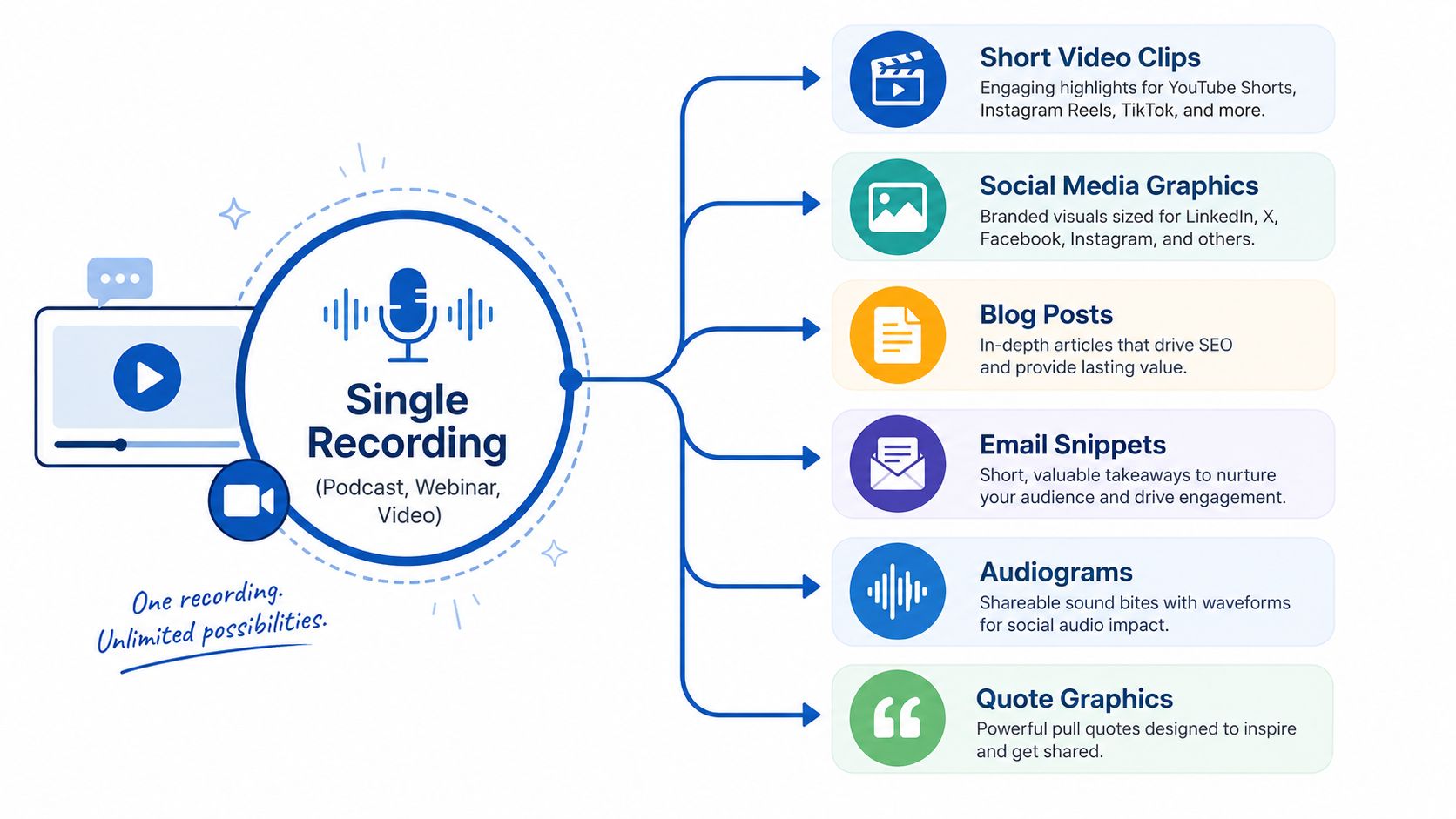
What should be included per recording
A complete package usually includes:
- Short video clips: 8 to 12 clips cut from the strongest moments, with captions and platform-ready formatting.
- Social posts with visuals: 6 to 8 posts written for channels like LinkedIn, with matched graphics.
- Quote graphics: 4 to 6 image quotes pulled from sharp soundbites.
- Carousels: 1 to 3 carousels built around a framework, argument, or lesson from the recording.
- Blog content: 1 SEO blog post drafted from the recording transcript and reshaped for search intent.
- Distribution guidance: a posting playbook, suggested order, and channel recommendations.
That's the baseline buyers should expect. If a vendor only ships clips, that's video editing. It's not a full repurposing service.
What inputs a good service should accept
The best services don't force a narrow format. Buyers should expect them to handle:
- Podcasts: audio or video episodes
- Interviews: founder interviews, customer interviews, media appearances
- Keynotes and talks: conferences, summits, workshops
- Sales and discovery calls: if the content can be shared and reused
- Courses and trainings: recorded lessons, modules, office hours
- Livestreams and meetings: webinars are only one input, not the whole category
That flexibility matters because recordings already drive pipeline. 73% of B2B teams rely on recordings as their primary source of quality leads, yet only 33% have a scalable method to turn them into new assets, according to Your Creative Content.
A service becomes useful when it turns existing expertise into assets the marketing team can actually publish this week.
What publish-ready really means
“Done” is often where services cut corners.
A weak vendor delivers transcript chunks, AI captions, and design files that still need internal cleanup. A strong vendor delivers assets that can go straight into the queue.
That means:
- Correct aspect ratios for each platform
- Captions that are edited, not auto-generated and ignored
- Copy that sounds like the speaker
- Brand kit applied correctly
- No watermarking or ownership issues
- Files organized for posting
Some buyers only need clips. Others need the full stack. The difference should be explicit before purchase. Anyone comparing offers should look closely at the vendor's video clip deliverables and then check what else is included beyond the cuts.
The Two Paths The Manual Way vs The Service Way
A single 45-minute recording can easily turn into half a day of production work before anything is ready to publish.
There are two ways to cover that work. Keep it in-house, or buy a service that absorbs it for you.
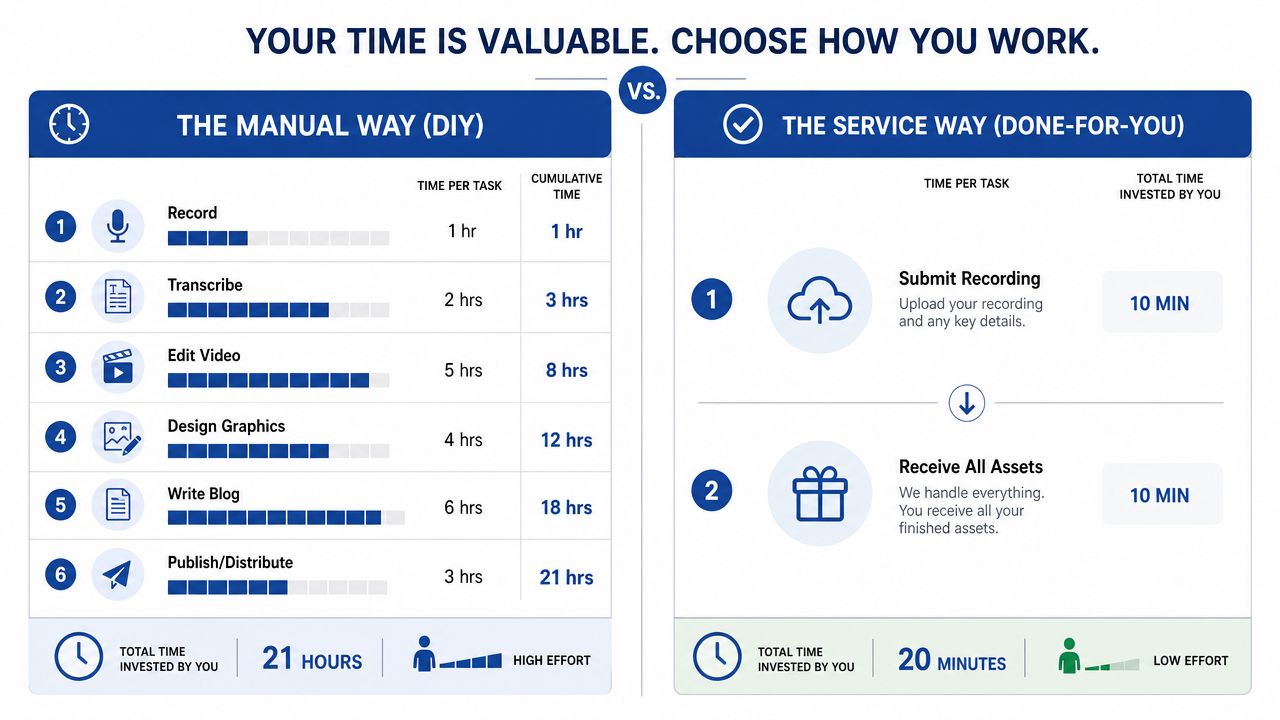
The manual path
DIY looks cheaper because the invoice is smaller. The actual cost shows up in labor, context switching, and review time.
For one recording, an internal team usually has to handle all of the following:
Review the recording
Someone has to watch or listen to the full session, flag useful moments, mark timestamps, and pull out themes worth turning into standalone assets.Prepare the source material
Before any writing starts, there is setup work. Transcript cleanup, note sorting, topic clustering, and asset planning often take several hours. Valchanova's analysis of repurposing workflows notes that prep alone can take 3 to 5 hours, and clipping can add another 2 to 3 hours per file in a manual process (Valchanova).Clip the recording
Raw cuts are only the start. Editors still need to trim pacing, tighten openings, check framing, and make sure each clip stands on its own.Write posts and hooks
Good repurposing is editorial work, not transcription. Each asset needs a clear angle, a platform-fit hook, and copy that sounds like the speaker.Design visuals
Quote cards and carousels need layout, hierarchy, spacing, brand colors, and export settings that match the channel.Create the blog post
A transcript gives you source material. It does not give you a publishable article. Someone still has to build the argument, cut spoken filler, organize the sections, and rewrite for readability.Format and publish
File naming, dimensions, captions, thumbnails, alt text, scheduling, approvals, and handoff all still need attention.
That workload compounds fast.
For a single founder interview, the output target often looks like 8 to 12 clips, 6 to 8 social posts, 4 to 6 quote graphics, 1 to 3 carousels, and one blog post. If a founder, marketer, and editor are all touching that package, the company is paying for more than creation. It is paying for coordination.
What the buyer is paying to remove
A repurposing service is not just buying edited clips. It is buying back hours from the founder, the marketer, and whoever would have been pulled into production cleanup.
That matters because DIY usually breaks in the same place. The founder records the source material, then still has to review timestamps. The marketer rewrites captions because the draft sounds generic. The designer fixes spacing, brand errors, and export issues. The content exists, but the internal team still carries the production burden.
A good service changes that division of labor. The client sends the recording, gives brand guidance once, reviews a draft set, and approves. The vendor handles selection, editing, writing, packaging, and channel formatting.
That is the practical difference between software and service, too. Software can speed up clipping or drafting, but someone on your team still has to operate it, judge the output, and finish the job. Teams comparing those options should read this breakdown of content repurposing software for marketing teams with one question in mind: are you buying tools, or are you buying labor removal?
The manual route can work. It makes sense for teams with spare editorial capacity, strong operators, and a low content volume.
The service route makes sense when expert time is expensive, publishing consistency matters, and the bottleneck is execution rather than ideas.
How to Judge Output Quality Before You Buy
The biggest divide in this market is simple. Some vendors sell volume. Better vendors sell publish-ready quality.
That's where many buyers get burned. They receive dozens of assets that technically exist, but still need rewriting, redesign, or reformatting before anyone can post them.
Four things that separate strong output from weak output
Clip selection
The first test is whether the service found the right moments.
Good clip selection means the editor spotted tension, insight, story, contrast, or a strong opinion. Bad clip selection means they chopped the recording at arbitrary intervals and called it a day.
A useful sample should show clips with a clear beginning, a payoff, and a reason to stop scrolling.
Brand voice
Weak AI output quickly becomes evident.
If every post sounds polished but interchangeable, the service is shipping generic content. Founders and experts don't need that. They need copy that sounds like their actual phrasing, worldview, and rhythm.
One fast way to test this is to read the post aloud. If the speaker wouldn't say it that way, the service hasn't captured the voice.
Brand accuracy
Visual quality isn't just taste. It's execution.
Buyers should check whether the service uses the brand kit correctly. That includes fonts, colors, caption style, logo treatment, spacing, and layout consistency. Sloppy visual handling creates more internal review time and makes the output look outsourced.
Platform readiness
A real service should understand the difference between a LinkedIn carousel, a quote graphic, a vertical short, and an audiogram.
If the output still needs aspect ratio fixes, caption repair, or copy trimming to fit the channel, it isn't finished. It's a draft.
Paying for volume without voice is the fastest way to save editing time and lose it again in rewrites.
What “good” looks like in practice
A good delivery set should feel boring in the best way. The files are named properly. The formats match the channels. The copy sounds natural. The designs fit the brand. The team can publish without opening a rescue project.
That's also why fully automated output often falls short. The problem isn't AI itself. The problem is unreviewed AI. Buyers who want to understand where automation helps and where it creates cleanup work should read this practical guide to how AI content repurposing works.
A simple quality test
Before buying, ask for a sample from a real recording and check four things:
- Does the clip earn attention?
- Does the copy sound like the speaker?
- Does the design match the brand?
- Could the team post it today without fixing it?
If any answer is no, the service is incomplete.
Your Vendor Vetting Checklist
Buyers don't need more promises. They need a short list of questions that expose weak offers fast.
A proper vetting process should happen before the first recording is sent over.
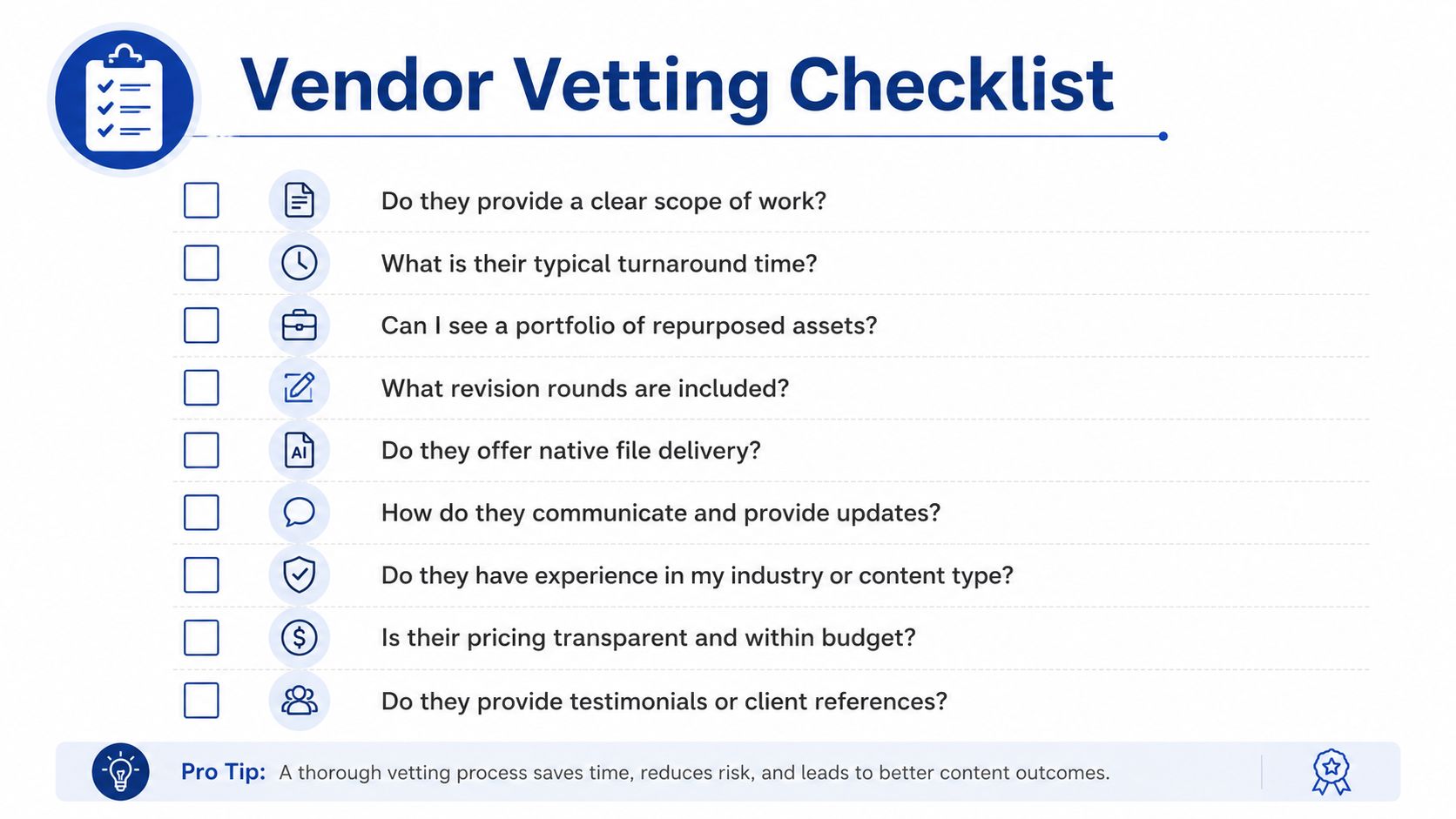
Ask for a real sample
Don't accept polished mockups built from ideal footage. Ask for samples created from an actual client recording.
That shows how the vendor handles messy intros, filler words, uneven lighting, long tangents, and real-world speech patterns. That's the actual job.
Confirm the exact scope per recording
Get the deliverables in writing.
A serious service should be able to state exactly what one recording includes. A clear package might include 8 to 12 clips, 6 to 8 posts with visuals, 4 to 6 image quotes, 1 to 3 carousels, 1 SEO blog post, and a posting playbook. If the answer is vague, expect scope drift later.
Get turnaround in writing
A sensible service level is 48 to 72 hours for a full content set. Longer than a week usually kills timeliness. Same-day promises often suggest the assets aren't being reviewed carefully.
Slow delivery weakens the point of repurposing. Fast delivery without review creates rework.
Check revision policy and ownership
Two questions matter here:
- How many revision rounds are included?
- Who owns the final assets?
The client should own everything. Always. No watermarks. No gated source files. No republishing rights hidden in the small print.
Ask whether humans review every asset
This sounds obvious. It isn't.
A vendor may use AI in the workflow, but buyers should ask whether a human checks every clip, post, graphic, and blog article before delivery. If no one is reviewing the output, the client becomes the quality control team.
Compare service models, not just portfolios
Portfolios can look similar. Operating models usually don't.
One service may deliver only clips. Another may include strategy, copywriting, design, posting, and scheduling. Buyers comparing providers should look beyond visuals and review what a full content repurposing agency model covers.
A quick checklist for calls:
- Samples: Ask for output from a real recording, not staged examples.
- Scope: Get the exact deliverables per recording in writing.
- Turnaround: Confirm the delivery window before paying.
- Revisions: Make sure the policy removes risk, not adds it.
- Ownership: The client should own every finished asset.
- Human review: Confirm a person checks every item before delivery.
That short list catches most problems early.
Understanding Pricing Models and Calculating ROI
Pricing in this category usually follows one of two models. Buyers either pay for a productized monthly service, or they assemble freelancers to do the work piece by piece.
The second route looks flexible. It usually gets expensive fast.
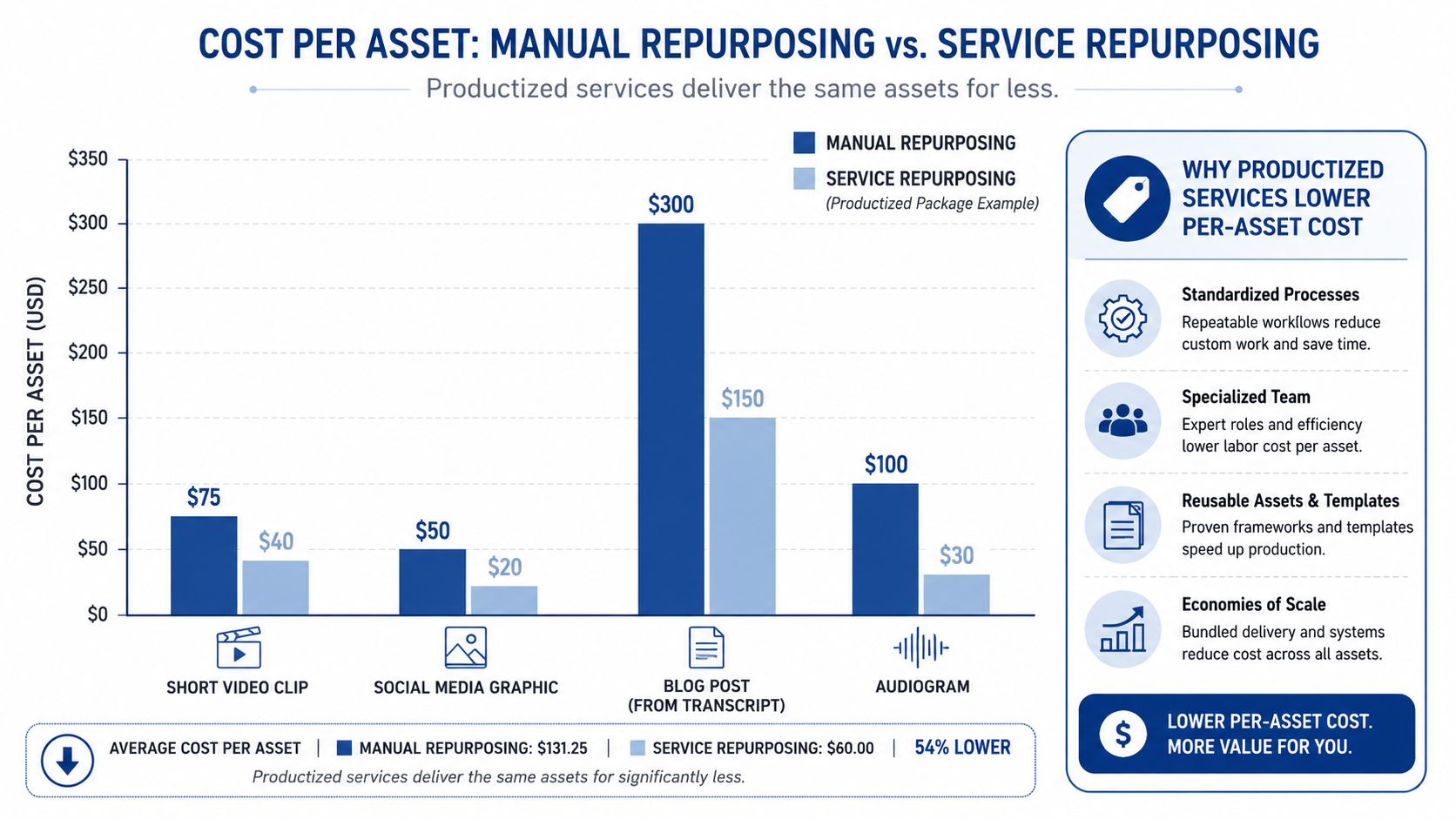
What the market pricing usually means
For productized services, per-asset economics can land around $14 to $33 per finished asset when the package is structured well. By contrast, freelance-assembled equivalents often exceed $100 per asset once editing, copywriting, design, and coordination are separated across specialists.
That difference exists because productized services bundle the workflow. The buyer isn't paying four people to hand work off in sequence.
Real tier examples
A straightforward pricing ladder looks like this:
| Plan | Monthly price | What it covers |
|---|---|---|
| Basic | $999 per month | One recording, 20 to 30 assets |
| Core | $1,499 per month | Two recordings |
| Growth | $2,499 per month | 4 to 6 recordings, with posting and scheduling included |
These tiers matter because they show what buyers are purchasing. Not software seats. Not editing time. A repeated content output tied to recording volume.
How to think about ROI
The direct return usually comes from two places.
First, there's labor saved. A working repurposing system can save 10 to 20+ hours weekly according to Cloud Present's guide to repurposing workflows.
Second, there's distribution. Teams that repurpose systematically can expand reach significantly. Research cited by Digital Applied says these teams multiply distribution reach by 3 to 5 times compared with teams that don't repurpose systematically, which means more audience reached per hour of production work (Digital Applied).
A simple ROI lens
Buyers should ask four questions:
- How many internal hours disappear each month?
- How many postable assets come back per recording?
- How much freelance coordination gets removed?
- How much more often can the team publish from work already recorded?
If the service reduces internal post-production and increases output consistency, the ROI case gets stronger quickly.
Cheap per month isn't the same as cheap per usable asset. The only cost that matters is the cost of something the team can publish without fixing.
For teams already measuring pipeline and output efficiency, this broader content marketing ROI measurement guide helps frame repurposing as a production and distribution investment, not just a creative expense.
The Done-For-You Alternative A Simple Workflow
The best done-for-you model is simple because the client shouldn't be managing production.
One recording goes in. A complete content set comes back.
How the workflow should feel
The input can be a podcast, keynote, interview, livestream, sales call, or meeting recording. The client sends the file or link, shares the brand kit and voice guidance, and that's most of the work done.
Total client time should be about 15 minutes.
From there, the service should handle:
- Reviewing the source recording
- Selecting strong moments
- Editing clips
- Writing posts
- Designing visuals
- Drafting the blog post
- Packaging the content for publishing
What comes back
A full delivery from one 45-minute recording should turn into 30 assets. A practical deliverables set looks like this:
- 8 to 12 video clips
- 6 to 8 LinkedIn posts with visuals
- 4 to 6 quote graphics
- 1 to 3 carousels
- Audiograms
- 1 blog post
- A posting playbook
That's the difference between a service and a clip shop. The buyer gets a content engine, not just cut footage.
What turnaround and revisions should look like
A reasonable service standard is 48 to 72 hours for full delivery. That window is fast enough to keep content relevant and slow enough to allow real review.
Unlimited revisions also matter more than buyers think. Without them, the team starts compromising on voice, visuals, or wording because each fix creates friction. With them, the quality burden stays with the service where it belongs.
What a buyer is actually purchasing
At its best, a repurposing service sells four things:
- Time removal: the team stops spending hours on post-production.
- Editorial judgment: someone finds the moments worth publishing.
- Brand consistency: the output sounds and looks right.
- Operational reliability: content keeps shipping on schedule.
That's why same-day, ultra-cheap offers often disappoint. They can produce volume, but they rarely carry the editing and brand burden all the way through.
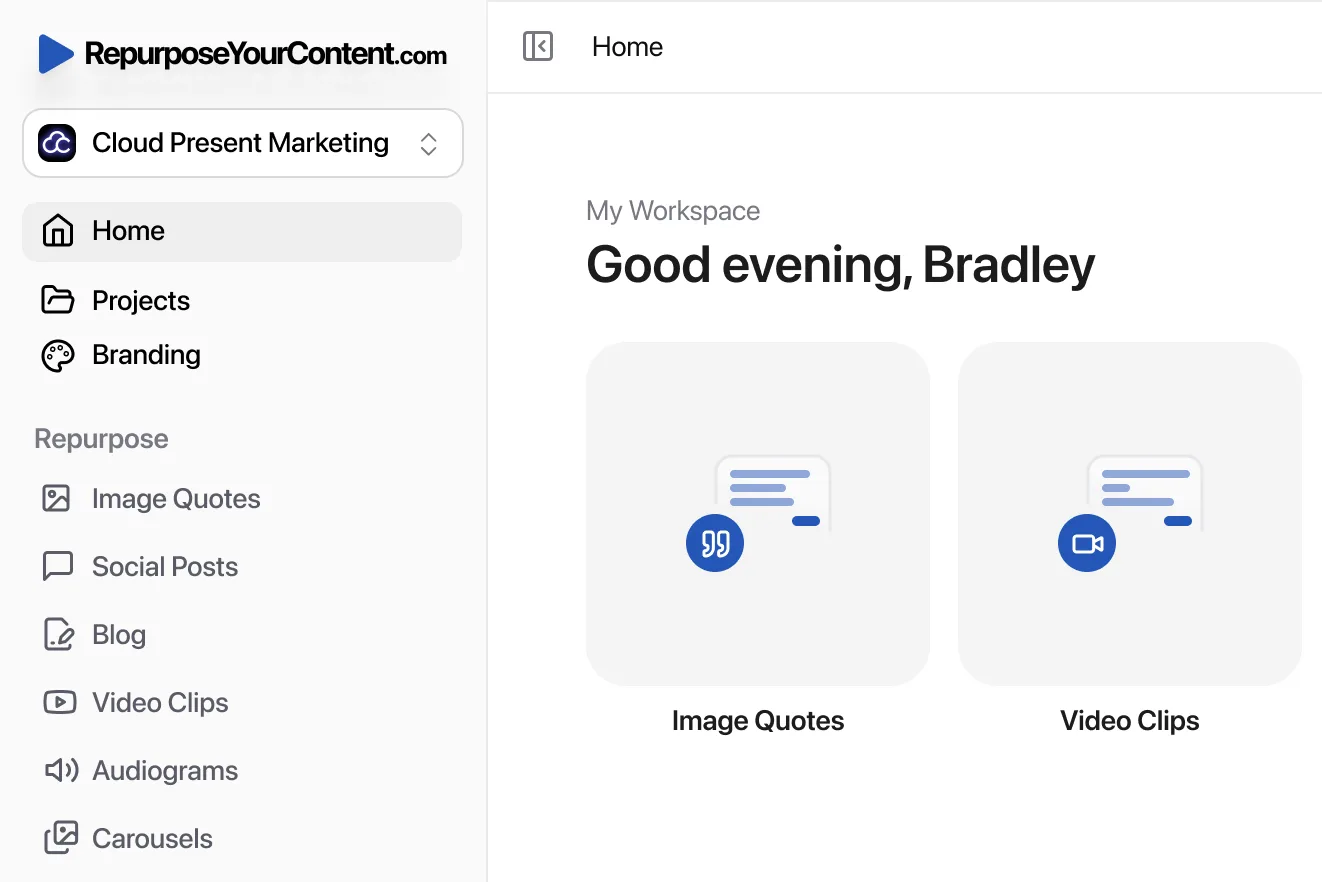
For buyers who want a hands-off model, RepurposeYourContent offers a simple version of this. Send one recording and get 20 to 30 ready-to-publish assets in 72 hours. That includes video clips, LinkedIn posts, quote graphics, carousels, audiograms, and a blog post, all in your brand voice, with unlimited revisions. Plans start at $999 per month for one recording, move to $1,499 per month for two recordings, and $2,499 per month for 4 to 6 recordings with posting and scheduling included. There's also a 72-hour turnaround guarantee or you don't pay, with pricing from $14 per finished asset.
Buyers who want to compare scope can review the pricing options or see a public sample in the Shopify example library.
If a team wants content repurposing services that effectively remove work, the standard is simple. One recording in, publish-ready assets out, with no rewriting, redesign, or cleanup left behind. To see how that looks in practice, book a call with RepurposeYourContent or review the public Shopify example.
Tags: