Outsource Content Repurposing: A B2B Playbook
A step-by-step guide to outsource content repurposing. Learn the build vs. buy math, how to vet partners, and how to get 30+ assets from one recording.

To outsource content repurposing, a team needs a clear playbook. Calculate the actual cost of manual post-production, often $500 to $800 per recording, vet partners on quality and guaranteed turnaround, and build a handoff that takes about 15 minutes per recording.
Organizations frequently delay outsourcing. They wait until the content manager is buried, the founder stops publishing, and the podcast backlog becomes a graveyard of unused recordings. That's backwards. If a marketer is spending 10 to 16 hours turning one recording into publishable assets, that marketer has become the company's most expensive editor.
That's the key decision. Not whether outsourcing feels convenient. Whether keeping post-production in-house is a smart use of expensive talent.
For B2B teams, the gap is already obvious. 73% of marketers identify recorded content as their #1 source of quality leads, yet only 1 in 3 teams have a scalable way to create content from these recordings according to HubSpot's marketing statistics. The recordings are valuable. The operating model is broken.
When to Outsource Content Repurposing
The trigger isn't burnout. The trigger is math.
A team should outsource content repurposing the moment skilled marketers are spending double-digit hours on editing, clipping, formatting, and rewriting transcript fragments into usable content. That work matters. It just shouldn't sit with the highest-cost people in the department.
The break-even point arrives earlier than most teams think
The internal argument usually sounds sensible. Keep it in-house for now. Have the content lead clean up clips. Let the social manager draft the posts. Ask design to turn a few quotes into carousels.
That sounds lean. It isn't. It's fragmented production hidden inside salaried roles.
A simple build-versus-buy view fixes this:
- In-house time cost: One recording often eats 10 to 16 hours of internal post-production work.
- Internal salary cost: That lands at roughly $500 to $800 per recording based on the provided loaded cost range.
- Done-for-you starting cost: Outsourced delivery starts from $416 per recording.
- Decision rule: If internal staff are spending ten-plus hours a month on post-production, the company is using its most expensive editor for low-value work.
Practical rule: If the person doing the work also owns strategy, demand gen, brand, or pipeline goals, post-production should be handed off.
This is why teams outsource too late. They make the decision emotionally. They wait until the work feels painful. A better operator makes the decision financially.
The real bottleneck isn't ideas
Most B2B teams don't have an idea problem. They have a production bottleneck.
A podcast episode, founder interview, sales call, customer conversation, keynote, or livestream already contains usable insights. The issue is turning that raw material into a repeatable publishing system. That's where the work stacks up and consistency falls apart.
The smarter move is to keep the high-judgment work in-house and move the mechanical work out. Strategy should stay with the internal team. So should final approval and channel priorities. Production, editing, formatting, and asset assembly can go elsewhere.
Teams that need more output without adding headcount should start with an operating model, not another hire. That's the same logic behind scaling content production without hiring.
The True Cost of Your DIY Content Engine
Most internal teams underestimate the work because they remember the recording, not the cleanup.
The recording might take 45 minutes. The repurposing takes the rest of the day. Sometimes more.
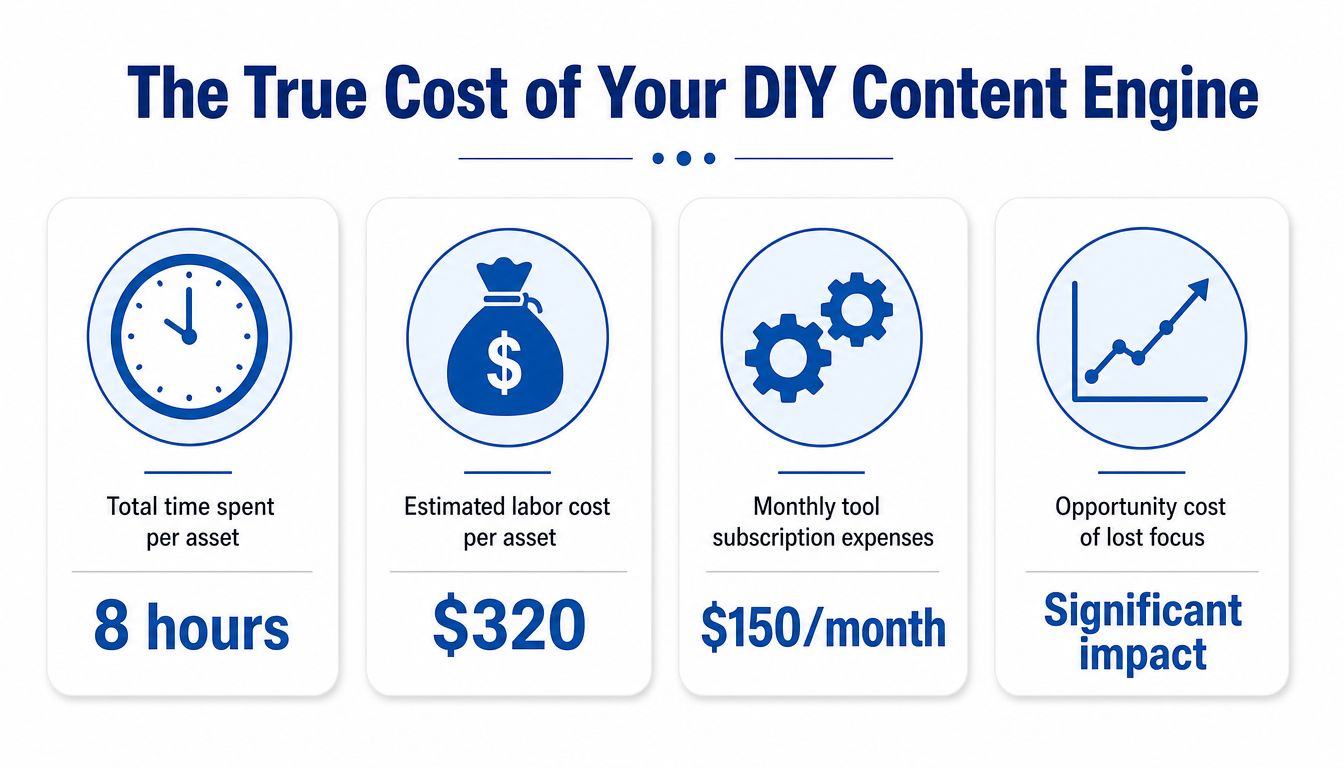
According to the cited YouTube workflow reference, the full process of creating a blog post, formatting it, and exporting clips and a podcast from a single recording can take approximately 3 hours, with some estimates putting the full asset suite creation at over 10 hours in this manual repurposing breakdown. In practice, most B2B teams land well above the lower estimate once review, design, and rewrites are included.
What manual repurposing actually looks like
A realistic in-house workflow for one recording often looks like this:
Download and organize files
Pull the source file, rename it, move it into the right folder, and prep the project. About 30 minutes.Generate and clean the transcript
The transcript needs speaker cleanup, filler removal, and sectioning before anyone can use it. About 1 hour.Find usable moments
Someone watches or scans for strong clips, quotes, hooks, and story beats. About 1 to 2 hours.Edit clips and add captions
Resize, trim, subtitle, export, and quality check each video asset. About 3 to 4 hours.Design quote graphics and carousels
Pull lines, format slides, apply the brand kit, and export variations. About 2 to 3 hours.Write the blog and social copy
Draft the article, LinkedIn posts, captions, titles, and supporting copy. About 2 to 3 hours.
That's how a single recording turns into 10 to 16 hours fast.
A team doesn't notice the cost because the work is spread across people, tabs, and approval loops.
The hidden cost isn't just payroll
The obvious cost is salary. The less obvious cost is focus.
When a content lead spends half a day editing clips, that person isn't working on messaging, campaign planning, interviews, partner content, or distribution. The team pays twice. Once in labor. Again in lost momentum.
A useful discipline is to track internal time for a month. Not estimated time. Real time. The total often comes as a surprise. That's when the decision gets easier, especially when compared against a clear content marketing ROI measurement process.
Choosing Your Outsourcing Model SaaS vs Freelancer vs Agency
Once the internal math stops making sense, the next question is operational. Who should handle the work?
There are three common models. Each solves a different problem. Only one usually reduces management load for a time-poor team.
A quick visual helps frame the trade-offs.
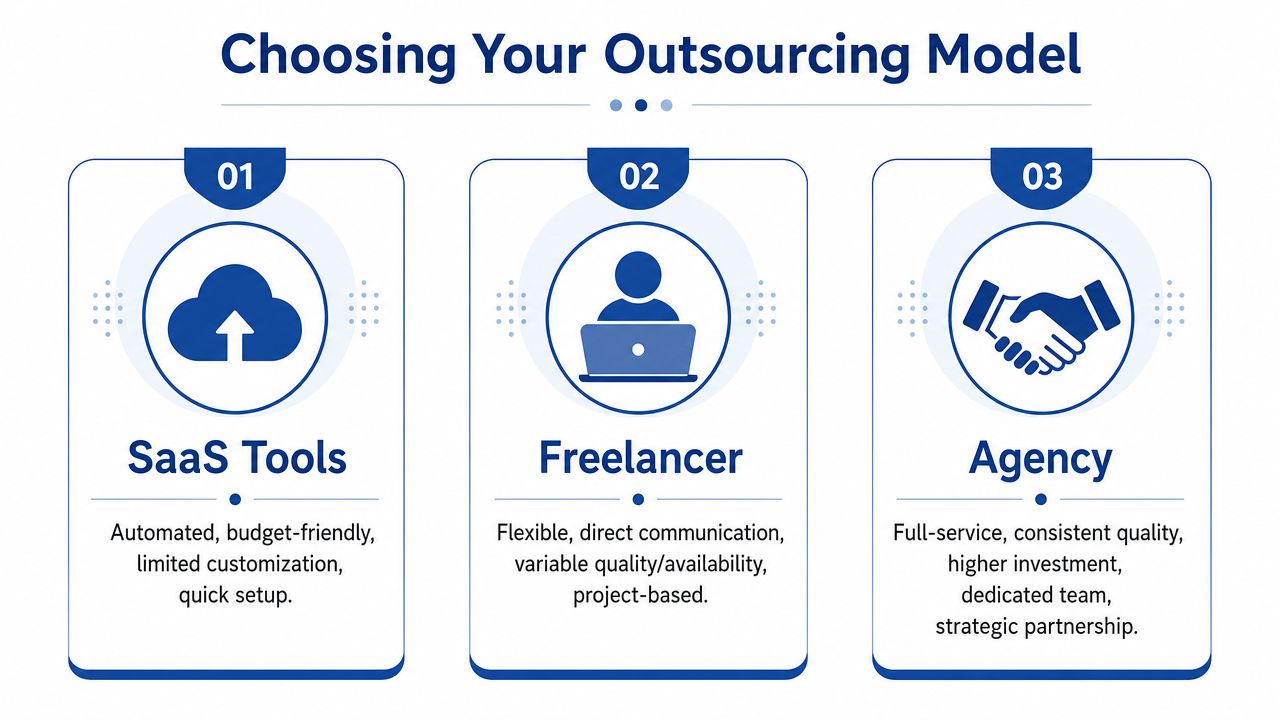
The shift is already happening. Nearly 50% of marketers now outsource at least one part of their content marketing work, and the content repurposing market alone reached $44.09 billion in 2023, according to this content marketing statistics report. Teams are buying external capacity because hiring full internal production teams is expensive and slow.
The three models
| Criteria | SaaS Tools | Freelancers | Done-for-You Service |
|---|---|---|---|
| Best for | Fast first drafts | Specific production tasks | End-to-end execution |
| Strength | Speed | Flexibility | Consistency |
| Main weakness | Weak voice judgment | High management overhead | Higher upfront commitment than DIY |
| Who manages workflow | Internal team | Internal team | Provider-led |
| Voice match | Usually rough | Depends on the individual | Built through onboarding and revision |
| Turnaround reliability | Fast output, mixed quality | Variable | Should be guaranteed in writing |
| Fit for busy B2B teams | Limited | Sometimes | Strongest option |
SaaS is fast, but it can sound generic
Software can cut the first-pass labor. It can transcribe, draft summaries, and suggest clips. That's useful. But it still leaves the team managing quality, voice, formatting, and publishing decisions.
For brands where trust matters, AI-only output often misses cadence, nuance, and clip judgment. A transcript can identify words. It can't reliably identify the moment that sounds like a real person the audience wants to hear from.
A model guide like this overview of what a content repurposing agency handles becomes useful here, because the decision isn't just about output volume. It's about how much management burden stays on the client side.
Here's a walkthrough worth watching before choosing a model:
Freelancers can work, but someone still has to run production
A freelance editor or writer can be a good fit for narrow tasks. One person cuts clips. Another writes posts. Another handles graphics.
That often creates a coordination problem. Someone internal still has to brief, chase, review, consolidate, and push work across the finish line. If the team already feels stretched, adding vendor management won't help much.
Done-for-you is usually the best choice for thin teams
The strongest model for most B2B operators is a done-for-you service with human review, clear SLAs, and a repeatable handoff. It costs more than a single freelancer. It costs less than burning strategic team time every week.
The key benefit isn't just output. It's reduced management overhead.
The 15-Minute Handoff Runbook Your Partner Needs
Good outsourcing should feel light. If it feels like another project to manage, the setup is wrong.
A strong partner doesn't need long meetings every week. That partner needs a clean handoff package once, then a simple review loop.
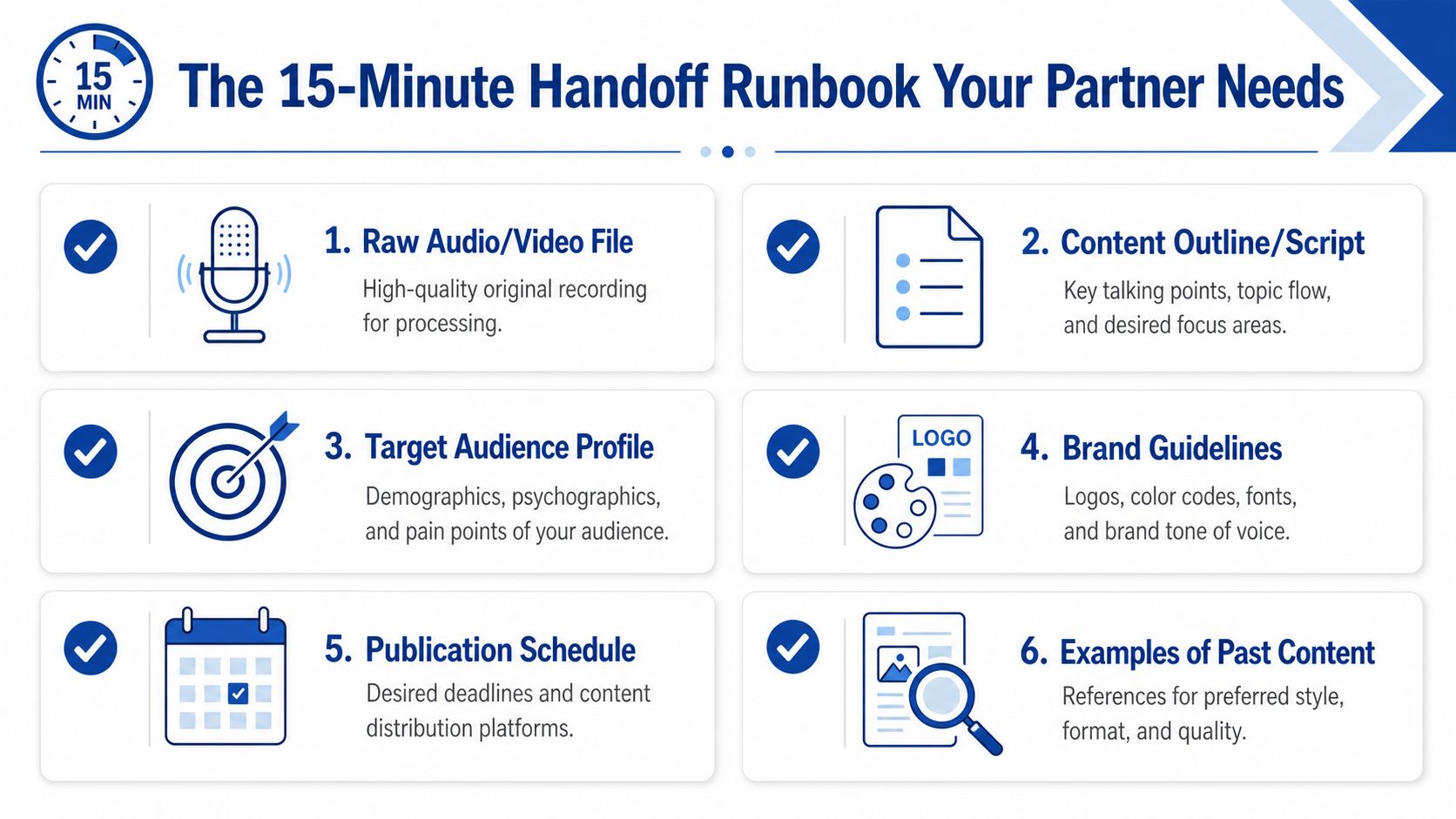
What the partner needs on day one
A solid onboarding package should include:
Brand kit
Logos, colors, fonts, and any visual rules that prevent off-brand assets.Voice guidance
Sample posts the brand loves. Sample posts the brand hates. Clear notes on what sounds sharp, flat, salesy, or too polished.Audience and channel priorities
Who the content is for, which platforms matter most, and where the team wants depth versus reach.Publishing cadence and goals
Weekly output expectations, campaign windows, and what success should look like.Examples of strong moments
Define what deserves a clip. Sharp opinion, story, stat, objection handling, punchy teaching, contrarian take.Approval workflow
Who reviews first, who signs off, and where revision notes live.
A practical handoff workflow
A simple runbook can look like this:
Step 1
Send one raw recording. Podcast episode, keynote, customer interview, sales call, course module, or livestream.Step 2
Include the brand kit, audience notes, platform priorities, and a few examples of past posts that match the desired tone.Step 3
Review the first batch, leave one round of notes, and tighten the voice rules.Step 4
Keep future approvals light. Spot-check assets, approve what works, flag patterns early.
Operational benchmark: The handoff should take about 15 minutes per recording, not an hour of back-and-forth.
The first delivery always does the heaviest learning. After that, the process should become repetitive in the best sense of the word. Predictable inputs. Predictable outputs.
A team that wants cleaner approvals should document the workflow once and keep refining it. A planning aid like this content repurposing workflow diagram template helps remove ambiguity before the first batch is sent.
Four Non-Negotiable Criteria for Vetting a Partner
Teams often shop on price first. That's the wrong filter.
If the clips are weak, the copy sounds generic, and every round needs heavy rewrites, the cheaper option becomes expensive fast. Quality and reliability decide whether outsourced content compounds or creates extra work.
According to the cited benchmark, repurposed content can generate more leads than original content for 60% of marketers, but only if it maintains brand voice and quality, based on this repurposing analysis from Hannon Hill. That's why vendor vetting can't stop at rate cards.
1. Real samples beat promises
Ask for real sample output. Not a polished sales deck.
The review should focus on two things:
Clip selection judgment
Did the editor find the moments that create curiosity, authority, or trust?Copy voice-match
Do the posts sound like the speaker, or like a cleaned-up transcript written by a stranger?
If a partner can't show strong judgment on a real recording, volume won't save the engagement.
2. Turnaround must be written down
A vague turnaround promise is useless.
A provider should commit to delivery in writing. For this model, 48 to 72 hours is the right benchmark. The strongest standard is simple: 72-hour turnaround guarantee, or the client doesn't pay.
That matters because consistency beats bursts. If output arrives late, the publishing schedule collapses.
Fast matters. Predictable matters more.
3. Compare total cost against internal hours
The right comparison isn't vendor price versus zero. It's vendor price versus internal labor.
A content person often spends hours per recording doing this internally. Once that time is multiplied across a month, the business is paying strategic staff to do production work. That's the wrong cost structure for most B2B teams.
4. Contract terms should protect the client
The cleanest agreements share a few terms:
- Month-to-month structure so the team isn't trapped in a long lock-in
- Unlimited revisions written into the agreement
- Full ownership of every deliverable
- No watermarks or reuse rights
- Defined turnaround SLA
- Ability to scale volume up or down as recording cadence changes
Volume is a vanity metric. Voice-match and consistency are actual compounding assets.
The Done-for-You Alternative From Recording to 30 Assets
This is what outsourcing should look like when it's built properly.
One recording goes in. Ready-to-publish content comes back. No tool wrangling. No freelancer coordination. No internal editor losing half a week to post-production.
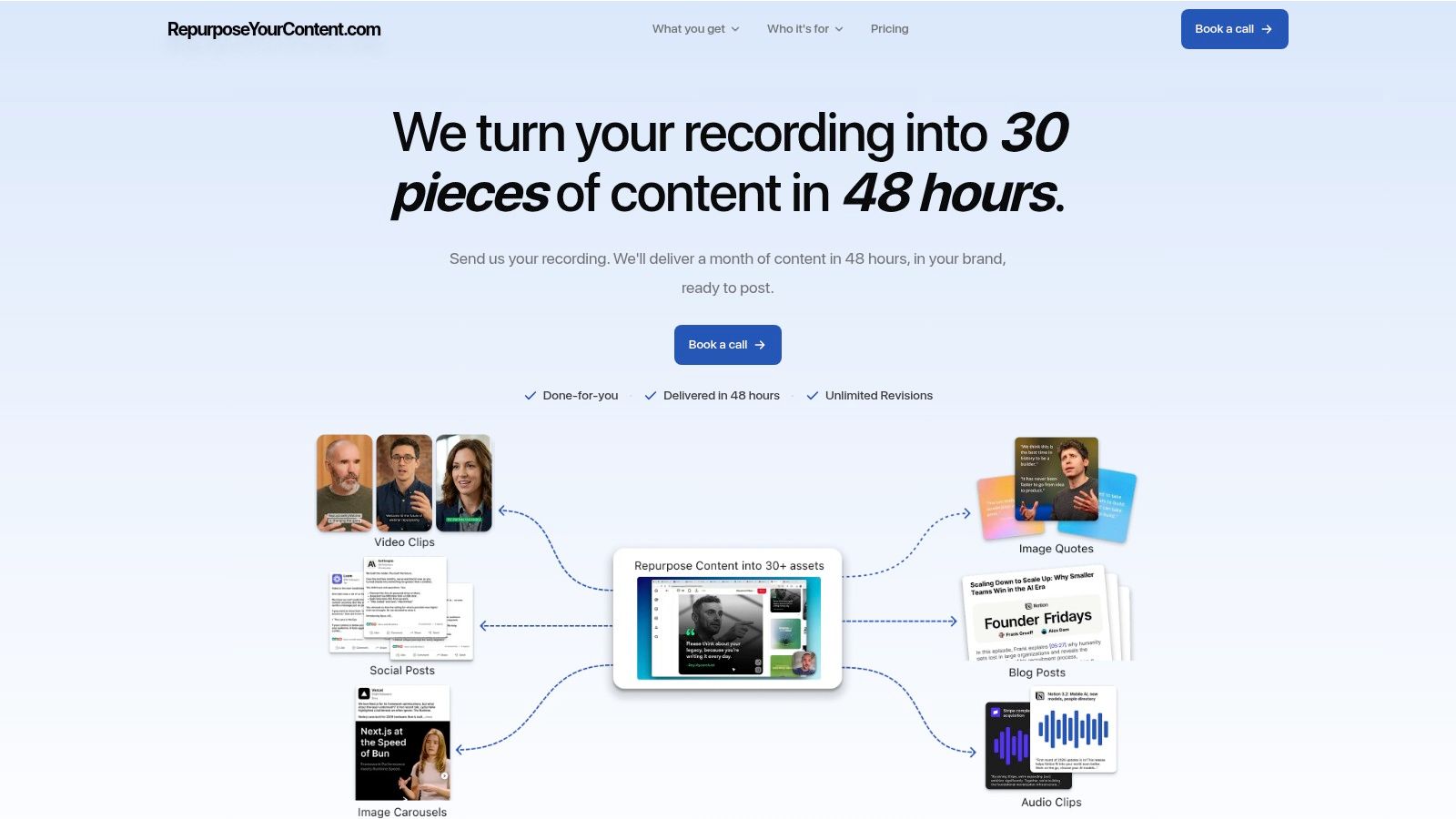
What the workflow looks like
Send one recording. That can be a podcast, webinar, keynote, interview, or meeting recording.
Within 72 hours, the delivery includes 20 to 30 ready-to-publish assets:
- Video clips
- LinkedIn posts
- Quote graphics
- Carousels
- Audiograms
- A blog post
Everything comes back in the brand's voice, with unlimited revisions. Client time stays around 15 minutes. That's the benchmark for what outsourced content repurposing should feel like.
Why the economics work
The simple math is the reason this model wins.
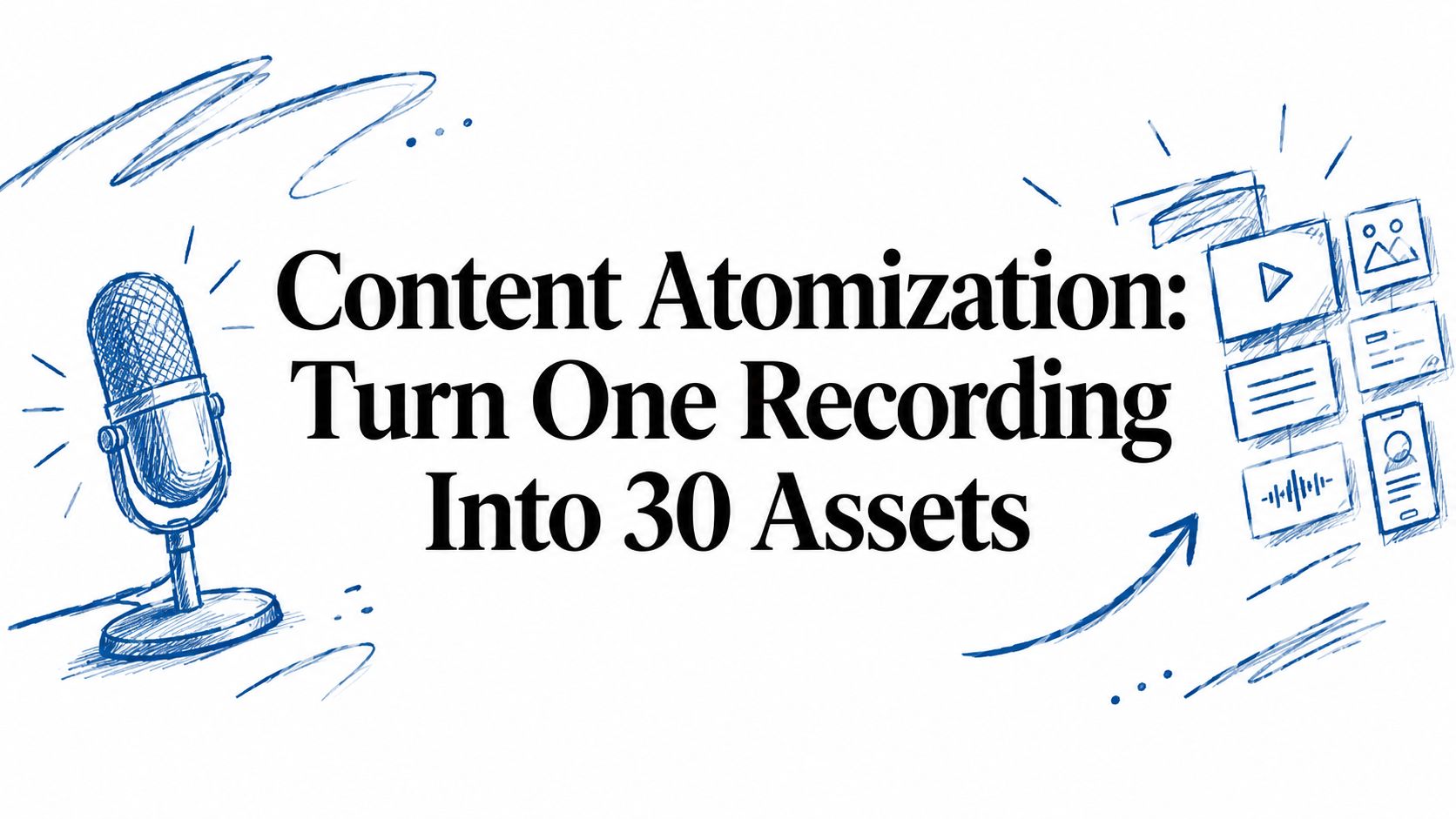
One 45-minute recording becomes 30 assets. Pricing starts from $14 per finished asset. For teams comparing internal cost to outsourced cost, that's usually more efficient than asking salaried marketers to edit, caption, format, and package every deliverable by hand.
The strategic upside is bigger than the labor savings. Internal staff can go back to higher-value work. Messaging. Campaign planning. Distribution choices. Partnerships. Lead generation.
For teams that need the numbers laid out clearly, the best next step is to review pricing for done-for-you repurposing and compare it against current internal hours. Teams that need more output without expanding headcount should also look at how to scale content production without hiring.
How to Manage Quality and Measure Success
Outsourcing doesn't remove accountability. It changes where the team spends attention.
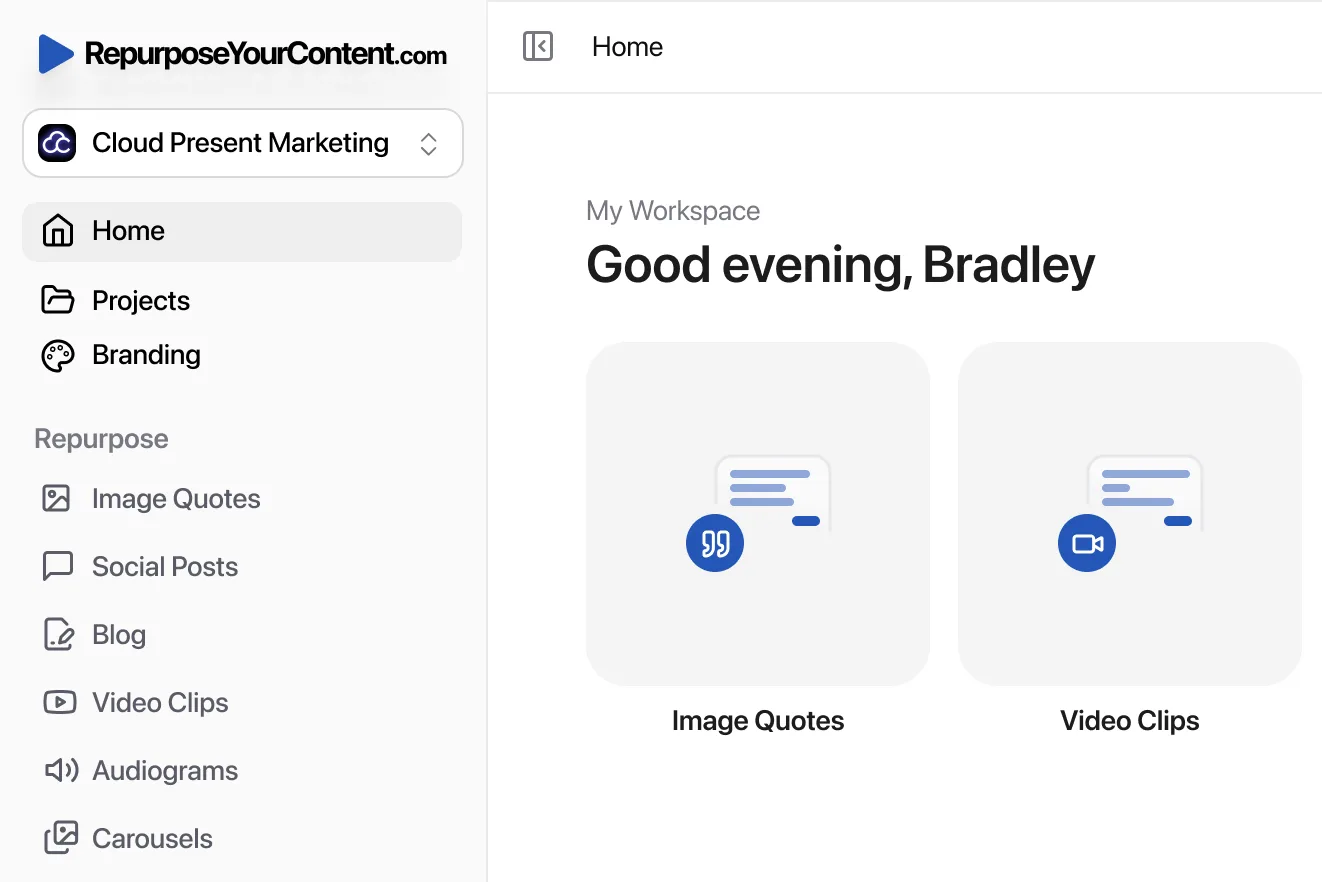
The smartest setup uses a review-and-approve dashboard. Each asset lands in one place. The client can approve with one click or leave revision notes before anything gets published. That keeps quality control tight without turning approvals into a side job.
How to keep remote quality stable
The first few deliveries need active review. Not forever. Just until the voice, formatting, and clip judgment are calibrated.
A simple quality loop works well:
- Spot-check the first batches against the brand kit and voice examples
- Flag repeat issues early so the provider can codify the fixes
- Use the revision loop instead of rewriting assets internally
- Reduce approval effort over time once consistency is stable
Human review on the provider side matters here. It's what keeps output from drifting into generic phrasing or flat storytelling.
What success should look like
Success isn't “more assets.” Success is measurable performance from derivative content.
According to Cloud Present's repurposing benchmark guide, systematic content repurposing can boost overall content reach by 300% and should target 3% to 7% social engagement rates and 25% to 40% organic traffic growth for derivative pieces. Those are useful operating targets when evaluating whether an outsourced content engine is doing its job.
A team should track:
- Engagement rates on priority channels
- Organic traffic growth from repurposed blog content
- Lead generation tied to content offers or inbound inquiries
- Publishing consistency across the monthly calendar
For teams already tracking event or long-form content performance, these webinar metrics and KPIs to track can also help structure reporting for repurposed assets, even when the source material is a podcast, interview, or keynote.
Outsourcing works when the team measures outcomes, not asset counts.
A team doesn't need more raw recordings. It needs a system that turns recordings into publishable content without draining the people responsible for growth.
If the current process is eating 10 to 16 hours per recording, the math is already settled. Book a call with RepurposeYourContent or request a sample to see what one recording looks like when it comes back as 20 to 30 finished assets in 72 hours.
Tags: