Content Repurposing for Marketing Agencies: 2026 Guide
Content repurposing for marketing agencies - A complete guide to content repurposing for marketing agencies. Systemise workflows, price services, & prove ROI to

Agencies do not hit a growth ceiling because clients stop buying. They hit it because delivery breaks first.
That is why content repurposing for marketing agencies matters. It is not a creative nice-to-have. It is an operating model. In a 2024 survey, 36% of marketers cited lack of time and resources as a major repurposing challenge, and 38% said adapting content for different platforms was a major challenge, according to MarketingProfs. That sounds familiar to any agency owner running multiple retainers with a lean team.
The usual response is hiring. More writers. More editors. More designers. More PM overhead. Margins thin out fast. A better response is to build a system where one strong client webinar, interview, roundtable, or expert call becomes a month of deliverables across social, email, blog, and sales enablement. That is how you increase output without turning every retainer into a staffing problem.
Stop the Content Treadmill and Start Scaling
Most agencies still treat content demand as a production problem. It is usually a packaging problem.
Clients want more assets than your team can create from scratch each month. They want LinkedIn posts, blogs, short video, newsletter copy, quote cards, carousels, and sales follow-up content. If you produce each asset as a separate project, the account becomes hard to scale and hard to profit from.
The fix is simple in theory. Build around anchor content. Then extract and adapt.
That is why repurposing works so well inside agencies. You start with something the client already values, usually a webinar, interview, panel discussion, or founder Q&A. Then you turn that into a structured deliverable set for every channel in the retainer.
The bad assumption agencies keep making
The wrong assumption is this. More client content demand means more net-new production.
It does not. It means better asset planning.
A useful framing is this guide on a content repurposing strategy that grows your reach. The practical takeaway is not “post the same thing everywhere.” It is “rebuild one strong idea into native formats that suit each channel.”
That distinction matters. Clients do not pay for duplication. They pay for reach, consistency, and useful distribution.
What changes when you systemise it
When an agency treats repurposing as a service line, a few things happen fast:
- Account managers sell more clearly: The offer becomes easy to explain in an SOW.
- Production gets cleaner: Teams work from repeatable templates instead of one-off requests.
- Clients see more value: One recorded conversation now fuels a visible content calendar.
- Capacity improves: The same team can support more client accounts.
Tip: If your team is always “busy” but retainers still feel fragile, your bottleneck is usually workflow design, not effort.
A lot of agencies already know they need this shift. If you want a practical companion to that thinking, this guide on how to scale content production without hiring maps the operational side well.
The point is not to create more work from the same recording. The point is to create more client value from the same strategy effort.
Designing Your Content Repurposing Service for Retainers
Clients buy clarity. They do not buy vague promises about “more content from existing assets.”
If you want content repurposing for marketing agencies to become a real revenue line, productise it. Name it. Define it. Put boundaries around it. Then attach it to an existing retainer or sell it as a standalone add-on.
In the UK, 94% of marketers actively repurpose their content across channels, according to UKTI’s summary of industry data. You are not selling a novel idea. You are selling a better execution model.

Build one offer, not ten custom versions
Start with one standard package. Keep it narrow enough to deliver well.
A strong agency offer often looks like this:
Monthly Content Multiplier
- Anchor input: One client webinar, interview, or expert session each month
- Core outputs: Blog draft, short video clips, LinkedIn posts, email copy, quote graphics, carousel copy
- Agency layer: Strategy, editing, approvals, scheduling, reporting
- Delivery model: Monthly retainer add-on with a defined turnaround window
That package does two useful things. It simplifies sales, and it reduces delivery variance across accounts.
If every account manager invents a new version, your margins disappear in operations.
Put the right terms in the SOW
Agencies lose money on repurposing when the SOW is fuzzy. Fix that upfront.
Include these points in plain English:
- Source asset definition: What qualifies as the monthly anchor content
- Output scope: Which formats are included and which are optional
- Revision policy: How many revision rounds apply to written, visual, and video outputs
- Approval workflow: Who signs off and by when
- Publishing responsibility: Whether your team schedules content or only hands over assets
- Brand ownership: Whether assets are white-labelled under your agency delivery
A repurposing service works best when it feels operationally boring. Predictable inputs. Predictable outputs. Predictable review process.
Your onboarding checklist needs to be tighter than usual
Repurposing fails when teams start generating assets before the account is properly set up.
Use an onboarding list that collects the minimum viable operating data:
- Brand kit: Logos, colours, fonts, tone rules, content examples
- Channel priorities: Which channels matter now, and which do not
- Audience detail: Buyer roles, common objections, industry language
- Compliance notes: Any legal or approval restrictions
- Access: Webinar recordings, past decks, transcripts, publishing tools
- Success definition: What the client expects from the service
That final point matters most. Some clients want visibility. Others want sales follow-up assets. Others want a larger social footprint for leadership.
Do not sell the same promise to all of them.
Standardise internal templates
A scalable service needs internal structure before it needs more creative talent.
Build these templates first:
| Template | Why it matters |
|---|---|
| Kick-off brief | Keeps account managers from missing key setup details |
| Source review sheet | Helps strategists pull themes, quotes, objections, and clips |
| Format matrix | Maps one anchor asset into platform-specific deliverables |
| Approval tracker | Prevents revision chaos across multiple client accounts |
| Monthly report shell | Makes reporting faster and more consistent |
If you manage several client brands, use a dedicated system built for agency workflows. The agency solution here is positioned around multi-client delivery, which is exactly where most content ops stacks start to creak.
Key takeaway: Productised services are easier to sell, easier to fulfil, and easier to keep profitable.
White-labelling is part of the offer
Agency clients do not want to feel like they bought software output. They want your process.
So white-label the workflow. Your team should define the strategy, choose the angles, set channel priorities, and quality-check every asset before delivery. The tooling can support fulfilment, but the client experience must still feel agency-led.
That is what protects pricing. Not the file format. The judgement layered on top.
Building the Engine for High-Volume Content Repurposing
Agencies often become efficient or stay stuck at this point.
The problem is not creating one good blog post from a webinar. Anyone can do that. The hard part is managing several clients at once, each with their own voice, review chain, and channel mix, without turning your team into a patchwork of copy-paste tasks.
A structured six-step repurposing workflow has been linked with 10+ hours of weekly time savings and a 20% engagement surge when teams focus on quality over volume, according to The Insight Collective.

A workable monthly agency workflow
Use one anchor session per client per month. A webinar is ideal. So is a founder interview, product walkthrough, customer panel, or expert roundtable.
Then run it through a fixed production flow.
Step 1
Collect the source files fast. Do not wait for a “perfect” transcript pack. Pull the recording, deck, speaker names, and any supporting notes into one client folder.
Step 2
Review for angles before generating assets. Find the strongest claims, objections, examples, and moments where the speaker said something useful in plain language.
Step 3
Choose a channel mix based on the client retainer. One client may need more LinkedIn. Another may need blog and email first.
Step 4
Create derivative assets in batches. Batch copy together. Batch clip review together. Batch design edits together.
Step 5
Send approvals as grouped sets, not random one-offs. Clients are far more likely to review “Week 1-2 social pack” than twelve separate files.
Step 6
Schedule reporting tags before publishing. If you skip this, your reporting later becomes guesswork.
One anchor, many outputs
For a typical B2B client, one recorded session can generate a full month of useful content if you plan outputs by purpose, not by format.
A simple format map might look like this:
| Purpose | Example output |
|---|---|
| Thought leadership | LinkedIn post series from key speaker points |
| Demand capture | Blog article answering a recurring buyer question |
| Engagement | Short clips with a clear takeaway |
| Nurture | Newsletter section or follow-up email |
| Sales enablement | Quote graphics and summary bullets for SDR follow-up |
Agencies often overcomplicate things at this point. You do not need endless formats. You need the right mix for the account.
How product features help
The reason repurposing becomes viable at agency scale is that some tasks should stop being manual.
Useful features are the ones that reduce production drag across multiple client accounts:
- Video clips: Pull highlight moments without manually scrubbing every minute.
- Blog posts: Turn spoken expertise into a strong first draft your strategist can refine.
- Social posts: Generate channel-ready copy from the same source material.
- Audiograms: Give podcast-style moments a second life on social.
- Image quotes: Turn strong speaker lines into branded assets fast.
- Newsletters: Build nurture content without opening a blank doc.
- LinkedIn carousels: Reframe the same insight in a visual, swipeable format.
- Timestamps: Help editors and account managers jump straight to usable moments.
That stack matters more when you have several clients live at once. One workspace per account. Clear brand separation. Consistent naming. Fast review.
Quality control is where agencies keep the margin
The common mistake is assuming generation is the job. It is not. Selection is the job.
You still need a human to answer these questions:
- Is this clip strong enough to stand alone?
- Does this quote sound sharp out of context?
- Is this blog angle too broad?
- Will this carousel make sense without the full webinar?
- Is this post written in the client’s tone?
That is why many agencies use specialist tools for one task and compare them. If you want a view into short-form clipping workflows specifically, this breakdown of Opus Clip AI is useful context.
A practical content ops model for B2B teams also helps. This content operations playbook for B2B is worth bookmarking if your team needs clearer handoffs and production discipline.
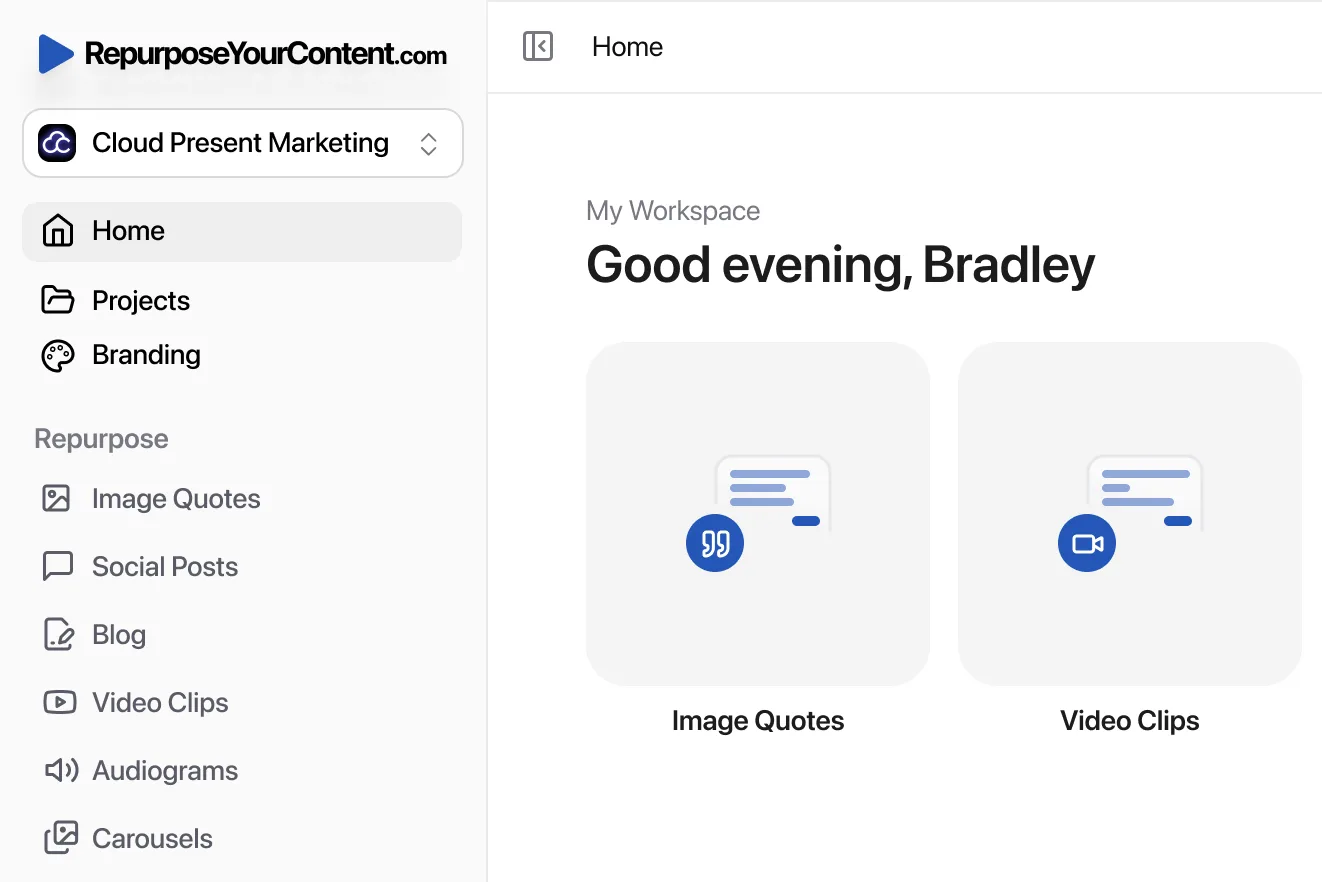
After the process is set, show the team the workflow visually before rolling it out wider:
Tip: Do not let every client choose every format every month. Standard options protect delivery speed and review sanity.
What works and what does not
What works:
- A single monthly source asset
- Predefined output bundles
- Shared approval windows
- Brand kits per client
- One account owner responsible for final sign-off
What does not:
- Ad hoc asset requests across the month
- Unclear ownership between strategist, editor, and designer
- Separate production methods for each client
- Publishing before tracking links and tags are in place
- Giving clients too many custom content choices
The agencies that scale this service well treat it like an engine. Inputs go in cleanly. Outputs come out predictably. The team spends its time improving the signal, not rebuilding the machine every month.
How to Price and Package Repurposing for Profit
A repurposing service can look busy and still lose money.
That usually happens when agencies price it like production labour. They estimate hours, add a margin, and hope the client sees value. The client rarely does. They compare your fee to the visible deliverables, not the hidden process.
A stronger pricing position starts with outcomes. According to Scopic Studios, content repurposing strategies improve ROI by 32% on average. That gives you a credible commercial frame. You are not selling “some clips and posts.” You are selling better return from content the client has already paid to create.

Three pricing models that hold up
Flat-rate add-on
This works best when the client already has a retainer with you.
You attach a fixed monthly fee for repurposing one anchor asset into a defined deliverable bundle. It is easy for procurement. It is easy for account managers to sell. It also keeps approval simple.
Use this when the client wants predictable output and minimal scope discussion.
Tiered package model
This is the best option for most agencies.
Create three service levels. Keep the differences obvious. More formats, more channels, deeper editing, and more strategic support as the package goes up.
A simple structure:
| Package | Best for | Included | |---|---| | Bronze | Clients testing the service | Core written and social derivatives from one source asset | | Silver | Standard retainer clients | Written, social, clip, and email outputs with agency edits | | Gold | Multi-channel growth accounts | Full monthly repurposing program with strategic planning and reporting |
Do not over-specify every line item in the sales conversation. Sell the business result first. Then confirm the exact output mix in the SOW.
Value-based pricing
The best margins usually sit here.
If the repurposed content supports pipeline, lead nurture, executive visibility, or sales follow-up, price it around strategic value, not production effort. You still need clear delivery boundaries, but your commercial framing changes.
You are no longer asking the client to pay for content pieces. You are asking them to fund a more efficient distribution model.
A good package includes more than assets
Repurposing for agencies is profitable when the offer includes the agency layer.
That means you price for:
- Strategy: Deciding what should be made
- Editorial judgement: Choosing the strongest angles
- Channel adaptation: Rewriting for platform fit
- Brand alignment: Making outputs look and sound right
- Account management: Handling approvals and deadlines
- Reporting: Showing the client what worked
If you price only the visible outputs, you train the client to compare you with freelancers and generic tools.
Protect margin before you present pricing
Run every package through a margin check.
Look at:
- Team touch time: Strategy, review, edits, PM
- Revision exposure: Clients with slow or messy approvals cost more
- Tool stack cost: Include software in your delivery model
- Account complexity: One legal reviewer is different from four
- White-labelling requirement: More polish usually means more internal time
Key takeaway: The highest-margin repurposing services are tightly scoped and clearly positioned as strategic distribution, not low-cost content production.
White-labelling should raise value, not hide process
White-labelling is useful when it makes the service feel integrated into your agency retainer. It is a mistake when it turns the service into invisible labour.
Show the client your thinking. Present the editorial logic behind the outputs. Explain why certain clips, posts, and articles were prioritised. That keeps the service premium.
If you want to sanity-check software cost against your package design, review the platform options on the pricing page and build your margin model from there.
One warning on discounting
Agencies often discount repurposing because the source asset already exists. That is backwards.
The fact that the webinar already happened is exactly why the client should pay. You are helping them recover more value from sunk production effort. That is commercially useful. Price it like it matters.
Proving ROI with Quality Checks and Client Reports
Clients renew when they can see the result. Not just the work.
Many agencies fall short here. They send a list of completed deliverables, a few social metrics, and a note saying the content is “performing well.” That does not hold up in budget reviews.
There is a reason this becomes a problem. UK agencies report that 68% of content efforts fail to track multi-channel attribution post-repurposing, according to YodelPop. If you cannot connect distributed content to downstream impact, the service looks optional.

Start with quality control, not reporting
If the assets are inconsistent, reporting does not matter. Clients will question the service before they get to the metrics.
Create a QA pass that checks every output against channel fit and brand standards.
A practical internal checklist:
- Accuracy: Names, titles, claims, and product references are correct
- Brand voice: The copy sounds like the client, not your default style
- Channel fit: A LinkedIn post reads like LinkedIn, not like a blog excerpt
- Visual consistency: Fonts, colours, logos, and layout match the account
- Context: Clips and quote cards still make sense outside the original webinar
- CTA alignment: The asset points to the right next step
One person should own the final QA decision. Shared ownership usually means missed errors.
Report on movement, not just activity
Your monthly client report should answer four questions:
| Client question | What your report should show |
|---|---|
| What did you publish? | Delivered assets by format and channel |
| What got attention? | Strongest topics, clips, posts, and themes |
| What influenced action? | Which assets supported visits, leads, replies, or follow-up conversations |
| What should change next month? | Clear recommendation based on signal, not opinion |
This makes the report commercial. Not administrative.
Use a simple attribution structure
You do not need a perfect model to improve reporting. You need a consistent one.
A practical agency setup:
- Tag every derivative asset: Keep naming conventions clean from day one
- Group outputs by source event: One webinar, one reporting cluster
- Track by role in the funnel: Awareness, engagement, nurture, sales support
- Report at theme level: Which topics keep producing useful responses
That final point matters. Clients care less about whether Post 7 outperformed Post 8. They care whether the “cost control” webinar theme produced useful buyer response across channels.
If you need a sharper framework for measurement, this guide on webinar metrics and KPIs to track is a practical starting point.
What clients want to see
Agency teams often over-report because they are trying to prove effort.
Instead, show:
- Best-performing topic angles
- Which content formats got traction
- How repurposed assets supported the broader campaign
- What should be repeated
- What should be dropped
That creates confidence. It shows judgement.
Tip: Include one slide called “What we learned this month.” Clients remember insight more than dashboards.
Reporting language that keeps the retainer healthy
Avoid vague language such as “strong engagement” or “good visibility.”
Use direct language:
- This topic produced the clearest response.
- Short clips worked better than quote graphics for this audience.
- The client’s founder voice performed better than product-led posts.
- Email follow-up extended the life of the webinar theme.
- The long-form article became the best source document for sales reuse.
That kind of reporting makes your team sound like operators, not content factories.
The agencies that keep this service line profitable do one thing consistently. They report what changed because the content existed, not just that the content was delivered.
Your Next Step to a More Profitable Agency
The agency model breaks when output depends on adding people faster than you add clients.
That is why content repurposing for marketing agencies is such a strong service line. It helps you increase deliverables, strengthen retainers, and protect margin from the same source asset. One client webinar or interview each month can become a full editorial system instead of a single recording buried in a resources page.
The shift is operational. Productise the offer. Tighten the SOW. Standardise onboarding. Build one production engine your team can run across accounts. Then report on business impact, not just asset count.
This is also one of the few agency services that supports scaling without making every new client feel like a staffing event. The more disciplined your workflow, the more stable your delivery becomes. That is good for revenue. It is also good for client confidence.
If you want multi-client workflows, white-label friendly outputs, and fast generation across video clips, blog posts, social posts, audiograms, image quotes, newsletters, LinkedIn carousels, and timestamps, try RepurposeYourContent. Start with one client account and see how quickly you can turn a single recording into a month of deliverables.
Tags: