Content Strategy for Small Marketing Teams: A Realistic Plan
Tired of content chaos? Get a realistic content strategy for small marketing teams. This step-by-step guide focuses on one anchor format to maximise ROI.

Your CEO forwards a competitor’s LinkedIn post at 08:12.
“Why aren’t we doing more of this?”
Meanwhile, you are one person. Or two. Maybe three on a good day. You need blog posts, LinkedIn content, email nurture, webinar follow-up, sales enablement, short video, website updates, and campaign support. All at once. Across more channels than your team can realistically manage.
That is why many small teams feel busy but not effective.
A proper content strategy for small marketing teams is not a bigger calendar. It is not another spreadsheet full of topic ideas. It is a way to stop creating everything from scratch and start building from one reliable source.
The gap is obvious in the data. In the UK, only 47% of B2B marketers have a documented content strategy, despite it generating 3x more leads at 62% lower cost than traditional methods according to Salesgenie’s content marketing statistics roundup. Small teams usually do not lack intent. They lack time, production capacity, and a system that matches reality.
That is the part much advice skips.
You do not need a perfect publishing machine. You need a repeatable one. For many B2B teams, that starts by treating one monthly webinar as the source for everything else. If you need a wider view of that operating model, this guide on how to build a content engine for B 2 B is a useful companion.
Introduction
The problem is rarely ideas.
Sales has ideas. Founders have ideas. Customer success has ideas. Your inbox has ideas. Slack definitely has ideas. What you do not have is enough time to turn all of that into useful content across six or more channels.
Small B2B teams get trapped in reactive production. You write a post because someone asked for one. You cut a clip because an event just happened. You push out a newsletter because the month is ending. The work gets done, but nothing compounds.
That is why content strategy for small marketing teams has to start with one question.
What can your team produce consistently without burning out?
For many teams of one to three people, the answer is not “native content everywhere”. It is one strong source asset, created on purpose, then repurposed hard.
If your team cannot publish consistently on every channel, stop planning as if it can.
The pressure to “be everywhere” sounds strategic. In practice, it creates weak output everywhere. Thin blog posts. Generic social posts. Emails written too late. Webinar recordings uploaded and forgotten.
A realistic system looks different. You choose one format that captures expertise properly. You schedule it monthly. You build your other channels from that asset. You measure output and response from one clear production rhythm, instead of hoping random bursts of content add up.
That approach is less exciting than a big content vision deck. It works better.
The One-Format Strategy Your Small Team Needs
Many small teams do not have a planning problem. They have an execution problem.
That distinction matters. Advice about personas, content pillars, and channel mix helps up to a point. It does not solve the daily reality of one marketer trying to support pipeline, social, email, and SEO before lunch.
According to SCORE’s small business content marketing infographic, a significant underserved challenge for small teams is execution. While 32-37% of marketers have a documented strategy, they often fail on production capacity. That is the bottleneck.

Why “be everywhere” fails
The usual plan looks sensible on paper.
- Write weekly blogs
- Post on LinkedIn daily
- Send regular email
- Cut video for social
- Support paid campaigns
- Keep the website fresh
A team of one to three people can attempt that. It usually turns into context switching all week.
Monday becomes blog drafting. Tuesday gets hijacked by webinar prep. Wednesday disappears into approvals. Thursday goes into social scheduling. Friday is reporting and firefighting. Then leadership asks why content does not feel strategic.
It does not feel strategic because the team is creating every asset separately.
Why webinars work as the anchor
For a small B2B team, a webinar is one of the few formats worth the effort.
It pulls expert insight out of your business. It captures the exact questions prospects ask. It gives you spoken language that often mirrors how buyers describe the problem. That is far more useful than staring at a blank document and trying to “come up with content”.
A webinar also creates material for different stages of the buying journey.
- Awareness content can come from problem framing.
- Consideration content can come from methods, comparisons, and trade-offs.
- Decision content can come from objections, use cases, and implementation detail.
That is why the anchor model works. You do not create six channels of content. You create one rich source, then distribute its parts.
A more detailed version of this operating model sits inside this content multiplication framework.
The practical shift
Stop asking, “What should we post this week?”
Ask this instead.
“What webinar are we running this month, and how will we break it into channel-specific assets?”
That shift changes the workload.
| Old model | Better model |
|---|---|
| Separate ideas for each channel | One topic, many outputs |
| Constant context switching | Batched production |
| Shallow content across platforms | Deeper expertise from one source |
| High effort to stay visible | Lower effort to stay consistent |
Small teams do better when they reduce asset creation points, not when they add more channels.
This is the part many leaders miss. Focus does not mean doing less valuable work. It means producing fewer raw materials and getting more finished content from each one.
Building Your Minimal Viable Content Plan
A small team does not need a giant annual editorial plan. It needs a plan that survives contact with a busy quarter.
The simplest version is this. Run 12 monthly webinars. Treat each webinar as the content source for that month. Build your publishing around it.
That gives you a yearly structure without forcing weekly reinvention.

Start with business goals, not content ideas
Many weak content plans begin with format first.
“We need more posts.” “We should do more video.” “We should publish more often.”
That is backwards.
Start with the commercial question your business needs content to support. Then assign webinar topics from there.
Use inputs you already have:
Sales calls: Pull recurring objections, stalled deal questions, and comparison points.
Support tickets: Find repeated setup issues, misunderstandings, and product education gaps.
Customer interviews: Listen for the phrases buyers use before and after purchase.
Search behaviour: Use keyword research qualitatively to spot themes and recurring pain points.
Leadership priorities: Tie topics to product adoption, category education, or demand generation priorities.
Map topics to the buyer journey
You do not need a complex framework. Three buckets are enough.
| Buyer stage | Webinar topic style | Example angle |
|---|---|---|
| Awareness | Problem definition | Why webinar follow-up content breaks down in small teams |
| Consideration | Approach comparison | Manual repurposing vs structured repurposing workflows |
| Decision | Practical execution | How to run a monthly webinar-led content system with one marketer |
This point is important; many teams overproduce top-of-funnel content and underproduce content that helps buyers move closer to action.
A webinar can cover all three if you design it properly.
Set one success measure per webinar
A documented strategy only helps if it is tied to something measurable. According to Genesys Growth’s content marketing ROI analysis, only 29% of organisations with documented content strategies rate them as highly effective. A common issue is weak ROI targets.
So keep the target simple.
For each webinar, choose one main outcome:
- Lead generation
- Pipeline support
- Sales follow-up content
- SEO content creation
- Customer education
- Partner co-marketing
One webinar can help several areas. But your team should know the main job before production starts.
If the webinar topic does not support a business priority, it will not save your content plan.
A workable annual planning method
A simple planning session is enough.
Step 1
List the twelve most common commercial conversations your company expects to have this year.
Step 2
Group them by awareness, consideration, and decision.
Step 3
Assign one webinar topic to each month. Keep seasonal events, product launches, and campaign timing in mind.
Step 4
Choose the speaker early. Founders, product leads, customer success, and sales engineers usually carry stronger webinars than marketers alone.
Step 5
Write one line on why this webinar matters now. That line becomes your positioning for promo copy, landing pages, and follow-up.
If you need a practical planning template, this editorial calendar template for marketing teams is a solid starting point.
How to get leadership buy-in
Executives often ask for more channels because they want more market presence. Fair enough. Your job is to translate focus into coverage.
Frame the plan like this:
Consistency over bursts One anchor webinar gives the team a repeatable monthly output.
Efficiency over duplication The same core insight feeds blog, email, social, and video.
Clearer reporting You can trace content production back to a specific event or topic.
Stronger subject matter Webinar content comes from experts, not from generic desk research.
That is easier to defend than promising daily content everywhere and missing half of it.
The Webinar-to-Content Repurposing Workflow
A webinar only becomes useful content if you process it fast.
That is where many teams fail. They run the event, export the recording, send the follow-up email, then move on. A week later the recording is still sitting in a folder with no clips, no article, no social, and no real afterlife.
That waste is avoidable.

According to The B2B Mix on content strategy for small content teams, webinars can create awareness, consideration, and decision-stage content from a single recording, representing a 50-70% efficiency gain for small teams.
The manual version
If you have done this by hand, you know the process.
First, someone watches the full recording again. They note timestamps. They pull quotes. They identify sections worth clipping.
Then they clean the transcript. They turn spoken content into a draft article. They reshape parts of it into social posts. They design visuals. They build follow-up emails. They create thumbnails and upload assets.
None of this work is difficult. It is just slow.
The manual process usually breaks down in one of three places:
- The transcript never becomes a proper article
- Clips get created, but written assets do not
- The team ships one or two outputs and abandons the rest
A realistic output set from one webinar
You do not need a heroic amount of content. You need enough assets to stay visible for the month.
A sensible target looks like this:
- One blog post based on the full theme
- Several short video clips built around key moments
- A batch of social posts pulled from the strongest points
- One LinkedIn carousel summarising key lessons
- A short email sequence for registrants and non-attendees
- Quote graphics or image posts from the speaker
- Audiograms if the conversation has strong verbal moments
- Timestamps for the full recording so viewers can jump to useful sections
That gives your team a publishing rhythm without forcing new ideation every day.
A broader example of this model appears in this guide to B 2 B webinar content strategy.
A step-by-step workflow
Here is a straightforward operational version.
Step 1
Run the webinar with repurposing in mind.
Ask clear questions. Pause between sections. State takeaways plainly. Spoken clarity makes every later asset easier to create.
Step 2
Review the recording within a day.
Fresh context matters. Mark the moments with the strongest opinion, clearest explanation, and most practical advice.
Step 3
Pull the pillar article first.
The blog post becomes the reference asset. It usually holds the clearest full argument from the webinar.
Step 4
Cut short clips around tension points.
Good clip moments often include:
- objections
- mistakes
- trade-offs
- blunt advice
- surprising observations
Step 5
Build channel-specific derivatives.
Turn one strong point into:
- a LinkedIn post
- a carousel slide
- an email paragraph
- an image quote
- a newsletter section
Step 6
Schedule distribution over several weeks.
Do not publish everything in three days. Spread it based on channel behaviour and campaign timing.
The goal is not to produce more assets. The goal is to remove the blank page from much of your week.
A quick walkthrough helps if you want to see this process in action:
What works and what does not
Teams usually overcomplicate the system here.
What works:
- Opinionated webinar topics that create memorable quotes
- Tight moderation that keeps the session structured
- Fast post-event processing while the topic is still live internally
- Batched scheduling instead of ad hoc publishing
- One owner responsible for the repurposing workflow
What does not:
- Treating the webinar as a standalone event
- Picking broad topics with no practical angle
- Waiting two weeks to process the recording
- Expecting every asset to be handcrafted from scratch
- Publishing the full recording and calling that distribution
If your current process depends on spare time after the event, it is not a process. It is a hope.
How RepurposeYourContent Acts as Your Force Multiplier
A one-person team does not need more theory. It needs compression.
According to Neil Patel’s content marketing statistics roundup, 85% of UK marketers now use AI, and manually creating one repurposed asset can take over 90 minutes, while automation can reduce that to about 5 minutes for 8+ formats. That changes the standard. Manual repurposing is no longer the default benchmark.
What the tool does
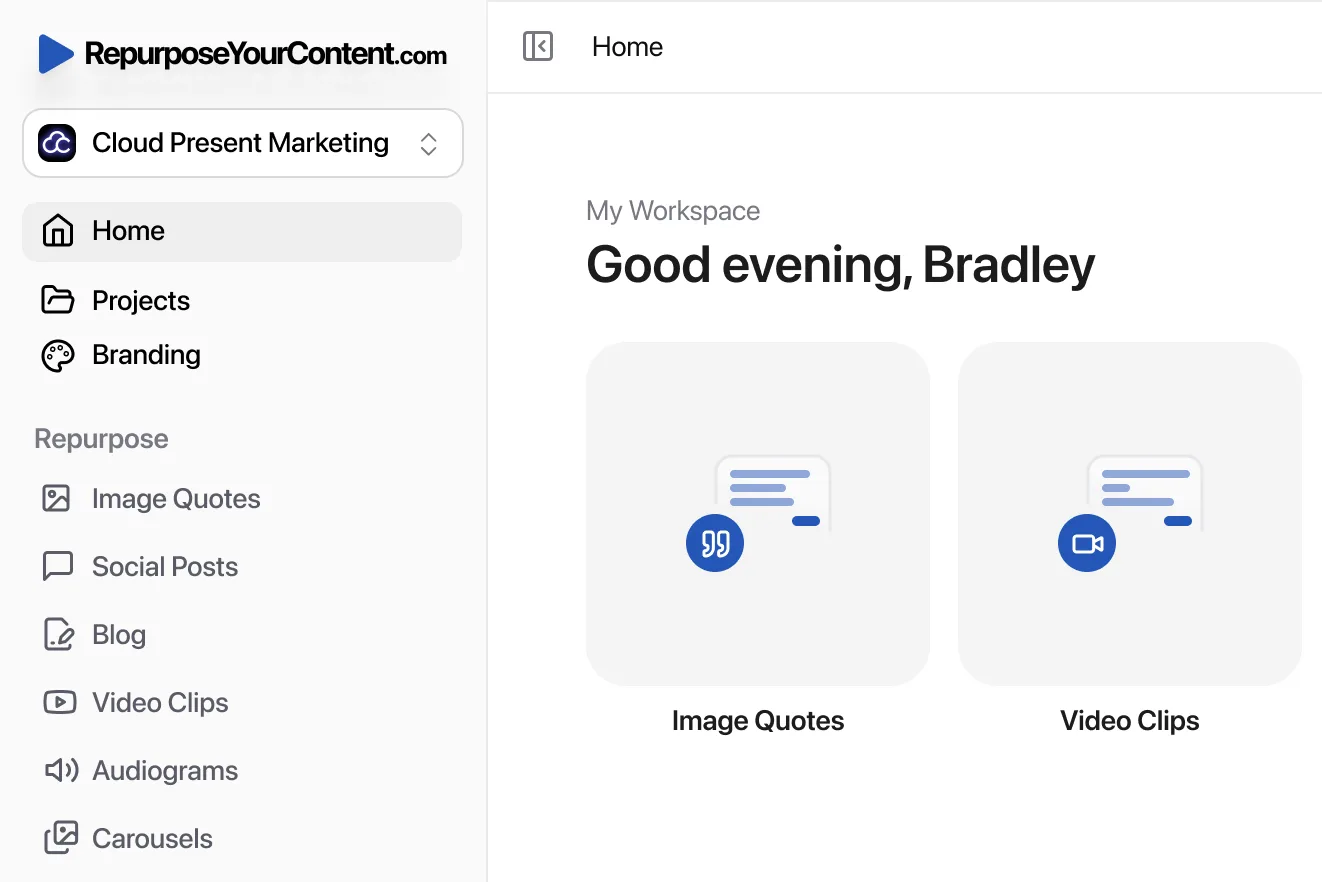
RepurposeYourContent takes one webinar recording, then generates multiple content formats from it. That includes video clips, blog posts, social posts, audiograms, image quotes, newsletters, LinkedIn carousels, and timestamps. You upload the recording or link, choose the content types, select quantities, and generate the assets.
That matters for small teams because the bottleneck is not just writing. It is switching between tasks.
You are not only drafting copy. You are also:
- selecting moments
- cleaning transcript language
- formatting for channels
- keeping branding consistent
- turning one event into a month of outputs
A tool that removes those repeated production steps gives a tiny team room to think again.
Where it fits in a real workflow
Use it after the webinar, not as a replacement for strategy.
The webinar still needs a clear topic, a strong speaker, and a business goal. But once the recording exists, the tool handles the boring middle that usually kills momentum.
That is useful for teams trying to maintain presence across LinkedIn, blog, email, and sales follow-up without spending the rest of the week rebuilding the same idea in different formats.
If you want additional inspiration for formats outside your usual mix, these content repurposing ideas are worth skimming.
Why this matters for content teams
The value is not “more content” in the abstract.
It is:
- Faster turnaround from event to distribution
- Better consistency across written, visual, and audio outputs
- Less admin work for the only marketer on the team
- More realistic publishing cadence without adding headcount
For teams working this way already, the natural next page is the marketing teams solution.
A Realistic Weekly Schedule for a One-Person Content Team
A content strategy only helps if it fits inside an actual week.
Many one-person teams fail because the week gets fragmented. You start the blog, jump to webinar slides, answer a sales request, edit a social post, then end the day with nothing fully shipped.
Batching fixes that.

Monday for strategy and planning
Protect Monday morning for thinking.
Review business priorities. Check campaign timing. Confirm the webinar topic, CTA, speaker, and audience angle. Then map what this week needs from the current anchor asset.
Monday works best for:
- Topic planning for upcoming webinars
- Messaging alignment with sales or leadership
- Editorial decisions on which clips, posts, and emails matter most
- Calendar updates so the week has fixed deliverables
Keep meetings tight. If Monday turns into status theatre, the rest of the week falls apart.
Tuesday for core content creation
Tuesday is for first drafts and webinar prep.
Write the landing page copy. Build the promo email. Draft the post-event article structure if the webinar has already happened. If the webinar is still upcoming, finalise the host script, questions, and CTA.
This is also the day to prep any supporting visuals or speaker notes.
The one-person team wins by reducing context switching, not by working faster on everything.
Wednesday for webinar execution
Wednesday is the event day in this model.
That means you are not trying to write, design, report, and host all at once. Your only job is to run a clean session and capture good raw material.
A simple Wednesday checklist helps:
Before the session Confirm links, slides, speaker order, and follow-up CTA.
During the session Note standout moments, objections, and quotable lines.
After the session Save the recording, collect chat questions, and record immediate observations while they are fresh.
Thursday for repurposing and optimisation
Thursday is where the monthly anchor model starts paying off.
Instead of inventing content from nothing, you turn the webinar into your week’s outputs. Pull the article draft together. Create the clips. Turn the best points into social posts. Build the email follow-up. Add timestamps to the full recording.
This is also the right day for SEO clean-up. Tighten the article title, headings, metadata, and internal links. Improve captions and thumbnail copy on short-form assets.
Friday for distribution and review
Friday is for publishing and learning.
Schedule the posts. Queue the newsletter. Share the article internally so sales and customer success can use it. Then review what landed well from the previous week.
A practical Friday block usually includes:
| Time block | Main task |
|---|---|
| Morning | Schedule blog, social, and email assets |
| Midday | Respond to comments, attendee replies, and internal requests |
| Afternoon | Review performance signals and note improvements for next week |
Do not overbuild reporting. A one-person team does not need a dashboard maze. It needs a short view of what was published, what got response, and what should change next time.
What this weekly rhythm protects
This schedule is not rigid for the sake of it. It protects your attention.
Without a weekly operating rhythm, every request feels urgent. With one, you know where things go.
- Monday decides
- Tuesday creates
- Wednesday captures
- Thursday repurposes
- Friday distributes
That is how one marketer maintains a visible presence across channels without pretending to be a department of ten.
Your Next Step Towards a Calmer Content Calendar
If your team feels behind all the time, the answer is usually not more effort.
It is a narrower system.
The strongest content strategy for small marketing teams is often the least glamorous one. One anchor webinar each month. Clear business angle. Strong speaker. Fast repurposing. Planned distribution. Repeat.
That model works because it respects the primary constraint: production capacity.
You are not failing because you lack ideas. You are failing if the system expects your team to create every asset separately, across every channel, every week. That is not a strategy problem. It is a workload design problem.
A calmer content calendar comes from three decisions:
- Pick one anchor format
- Batch production around it
- Repurpose it systematically
Do that well and your channels stop competing with each other. They start supporting the same message from different angles.
You also get a better internal story. Leadership sees consistency. Sales gets usable follow-up content. Prospects see a clearer point of view. Your team gets a process that can survive a normal month.
That is the ultimate win. Not just more output. A way of working you can keep.
If you want to try this model in practice, start with your next webinar and run it through RepurposeYourContent. It is the fastest way to turn one recording into a workable month of content without adding more chaos.
Tags: