Cross-Platform Content Repurposing: The Native Playbook
Master cross-platform content repurposing with native adaptation per channel. Includes specs, hub-and-spoke workflows, and a done-for-you option.

Teams don't have a content problem. They have a cross-platform content repurposing problem. One recording gets posted once, then copied everywhere, and the result is usually a weak fit on every channel.
Cross-platform content repurposing means taking one core recording and remaking it for each destination, so the same idea feels native on LinkedIn, TikTok, X, Instagram, email, and YouTube. That matters because platforms reward native formatting, not identical reposts, and the best workflows treat one source asset as the hub for many channel-specific versions, rather than a one-and-done upload as described in the COPE model.
The mistake is expensive. DIY clipping, captioning, designing, and scheduling can eat 6 to 10 hours per long-form recording for many teams, and that's before revisions and QA. Most operators can handle the first batch. They usually stall when every channel needs a different hook, visual, length, and CTA.
Why Most Cross-Platform Posting Fails
B2B teams managing four or more channels usually run into the same problem. A podcast, keynote, interview, or sales call gets cut into a few similar clips, posted once, then ignored because nothing feels specific enough to work twice. That's not repurposing; it's barely distribution.
Cross-platform content repurposing means taking one master recording and translating it into native assets for each channel. The core idea stays intact, but the format, hook, caption, and visual treatment change for the platform. The first 2-3 seconds matter, because each channel reads the opening differently and punishes anything that feels imported.
Practical rule: if the post still looks like it came from somewhere else, the platform will usually treat it like it did.
The hidden cost is not just creative fatigue; it's operational drag. Once a team tries to do everything manually, clipping takes time, captioning takes more time, and design adds another layer. The work starts to look simple from the outside, then becomes a weekly bottleneck.
The better mental model is editorial, not mechanical. A single source recording is raw material. Each channel gets a different cut, because each audience scrolls differently and expects a different level of polish. That means the same idea must be remade, not reposted.
For a useful framing on why a native approach usually beats direct syndication, see the comparison in native content versus repurposed content. The point is simple: cross-posting saves seconds, but native repurposing saves the asset from going to waste.
What breaks first
- Hooks: what works in a podcast intro often falls flat in a feed clip.
- Length: a strong long-form argument can feel bloated when forced into a short post.
- Tone: a founder's casual explanation often needs professional reframing on LinkedIn.
- Visuals: a horizontal frame rarely survives untouched on vertical-first platforms.
That first month usually looks promising, then falls apart. The output does not match the channel, so engagement drops, and the team stops cutting as many assets. Repurposing only scales when each post is built for its destination from the start.
Cross-Posting vs Cross-Platform Repurposing
Cross-posting is a syndication setting. The same file, same caption, same thumbnail, same link, pushed everywhere with almost no change. It's fast, but it rarely respects how different channels work.
Cross-platform repurposing is an editorial craft. One source idea gets rewritten, re-cut, and re-designed for each platform, so the output feels native. That's the difference between sending the same message to every audience and translating that message properly.
Translation is the key here. A literal English caption pasted into a Spanish audience isn't translation. A horizontal YouTube clip dumped into TikTok isn't repurposing either. The content may be recognizable, but the delivery is wrong.
The same logic applies to a hub-and-spoke model. The hub is the master asset, which can be a podcast, keynote, interview, livestream, sales call, or course recording. The spokes are the native derivatives, usually six to eight strong variations when the source is worth it, though some workflows can support more before returns weaken as noted in the 2026 guide on multi-platform repurposing.
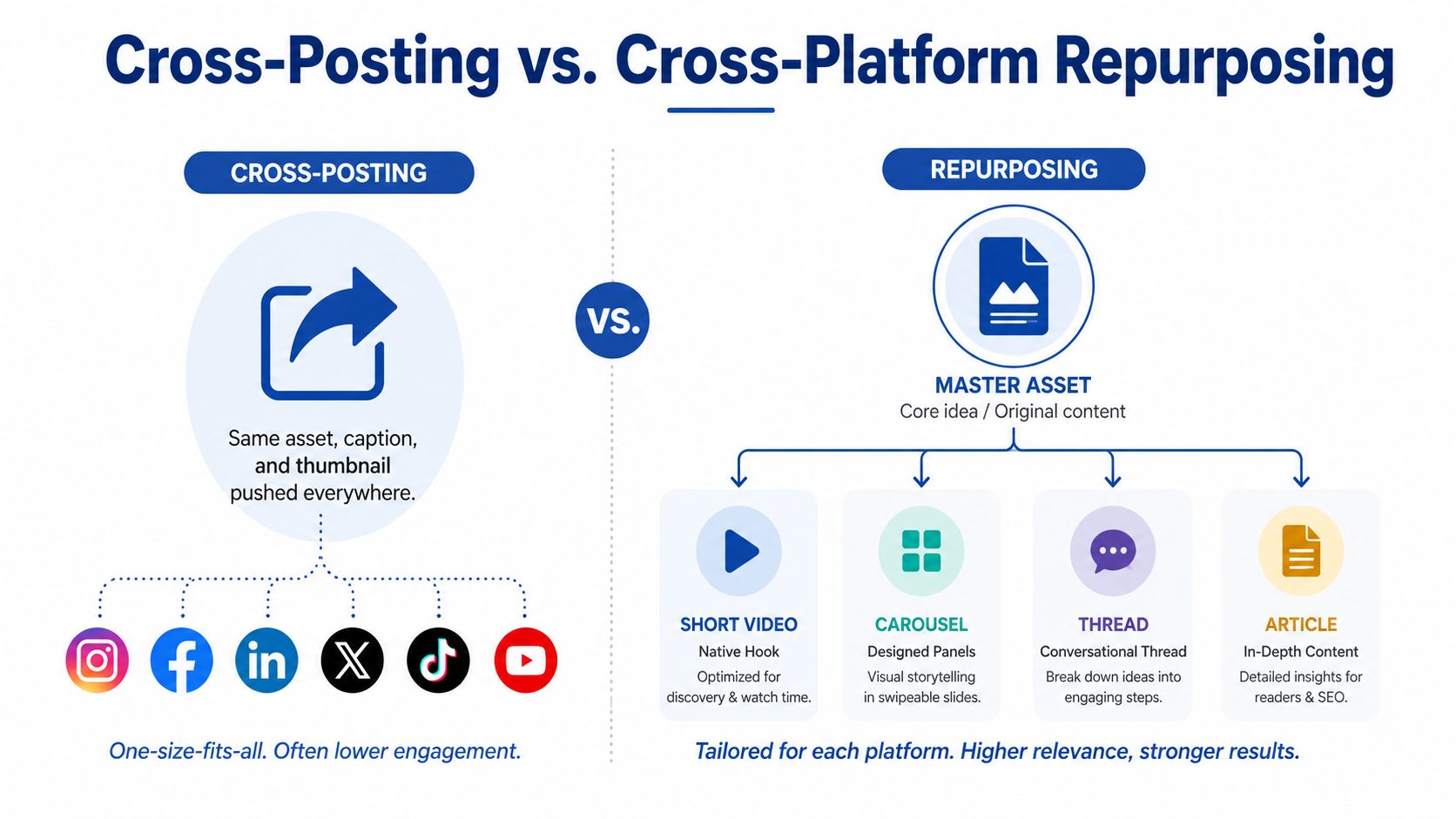
A clean hub-and-spoke system gives teams a real editorial center. It keeps the strongest information in one master file, then lets each downstream asset fit its channel without rewriting the entire idea from scratch. That lowers chaos and keeps the message aligned across platforms.
The workflow is easier to govern. Instead of asking whether a post exists, the team asks whether the post is native enough for the destination. That's the question most content systems never answer.
For another angle on why this distinction matters in practice, review this explanation of native content versus repurposed content. The useful takeaway is that the same thought can travel far, but it can't travel unchanged.
Platform-by-Platform Adaptation Specs
Every channel has its own grammar. LinkedIn wants professional reframing. TikTok wants speed. Instagram wants visual rhythm. YouTube Shorts wants a quick arc. X wants crisp text. Email wants a personal note and one clear next step.
Native format specs per platform
| Platform | Best length | Aspect ratio | Tone | Primary asset |
|---|---|---|---|---|
| 60 to 90 seconds for clips, or a short text post | 1:1 or 4:5 for visuals, 9:16 for clips | Professional, reflective, insight-led | Insight clip, text post, carousel | |
| 15 to 45 seconds for Reels, or a 5 to 7 slide carousel | 9:16 for video, 4:5 or 1:1 for carousels | Visual, concise, personality-forward | Reel, carousel, quote graphic | |
| TikTok | 15 to 45 seconds | 9:16 | Fast, direct, conversational | Fast-cut vertical clip |
| YouTube Shorts | Up to 60 seconds | 9:16 | Clear arc, sharp payoff | Short-form video |
| X | Short thread or quote line | 1:1 for image cards, text-native for posts | Sharp, plainspoken, opinionated | Thread, quote graphic |
| Short intro with one CTA | N/A | Personal, practical, low-friction | Newsletter recap |
On LinkedIn, a raw clip often needs a stronger opening sentence and a cleaner takeaway. The platform rewards context, not just motion. A founder's comment becomes more useful when framed as a leadership lesson or a buyer insight as the B2B LinkedIn format guide notes.
Instagram needs visual structure. Carousels should be built slide by slide, not copied from a blog paragraph. Reels need motion and a hook that lands quickly. TikTok is even less forgiving. The clip has to earn attention fast, and the first line usually carries the whole post.
YouTube Shorts can hold a little more structure than TikTok, but not much. The best versions still open cleanly and move toward one clear payoff. X works best when the idea is stripped down into a thread or a quote line that feels easy to react to. Email is different again. It should sound like a useful note from a person, not a recycled social caption.
Keep one brand kit across everything, then layer channel rules on top. Colors, fonts, logo placement, and caption styling stay consistent. Hook conventions, emoji use, hashtag policy, and CTA phrasing change by platform.
A practical workflow for this usually looks like a brand-level template set plus per-channel copy rules. Teams that skip this step end up redesigning the same asset every week. That's where the hours disappear.
One Moment Adapted Five Different Ways
A strong repurposing system starts with a single moment that can carry its own weight. Say a founder interview includes a 25-second section where the guest says the team killed a feature that drove 30% of signups. That line has tension, surprise, and business relevance.
On TikTok, that moment becomes a 20-second vertical clip with a bold written hook over the first frame. The caption stays short and direct. The edit focuses on speed, not context. That usually takes about 30 to 45 minutes once the source moment is marked.
On LinkedIn, the same moment becomes a 60-second insight clip with a text intro that reframes the decision as a leadership lesson. The copy can talk about trade-offs, product discipline, or buyer fit. That version often takes 45 to 60 minutes because the framing matters as much as the cut.
On X, the idea becomes a quote graphic or a short thread. The line, “we killed the feature that drove 30% of signups,” does the heavy lifting. The design is simple, and the post works because the sentence creates its own tension. That asset can usually be built in 20 to 30 minutes.
Instagram asks for more structure. A 6-slide carousel can walk through the decision, the risk, the reason, and the lesson. It takes longer because the narrative has to breathe. Expect 60 to 90 minutes when the slides are written cleanly and designed from scratch. For a fuller breakdown of this format logic, the example in turning one piece of content into many formats is useful.
Email gets the simplest treatment. A subject line and short preview paragraph can send readers to the full episode. The tone should feel personal and useful, not promotional. That usually adds another 20 to 30 minutes.
The point is not that every version should look busy. The point is that each one should feel inevitable on its own channel.
The same moment, five native assets
- TikTok clip: fast cut, hook first, no extra setup.
- LinkedIn post: leadership framing, one insight, one takeaway.
- X quote card: sharp line, minimal design.
- Instagram carousel: narrative sequence, one idea per slide.
- Email teaser: direct subject line, short summary, one link.
That's how editorial craft looks in practice. The source moment stays the same, but each destination gets a different shape.
A Repeatable Cross-Platform Workflow
The workflow only works when the team treats it like production, not inspiration. First, ingest the master recording. That might be a podcast, keynote, interview, sales call, livestream, or course session. The goal is to keep the highest-information version intact.
Next comes moment selection. Reviewing a 45-minute recording takes 60 to 90 minutes when someone is looking for clips, quotes, and usable angles. That's where most DIY teams underestimate the labor. The source file is only valuable if someone spots what can survive outside the full context.
Clipping is the next cost center. It typically takes 2 to 3 hours per recording when the goal is to create multiple native assets, not just one or two rough cuts. Captioning and asset design add another 3 to 5 hours once the per-platform versions start stacking up. That's before QA.
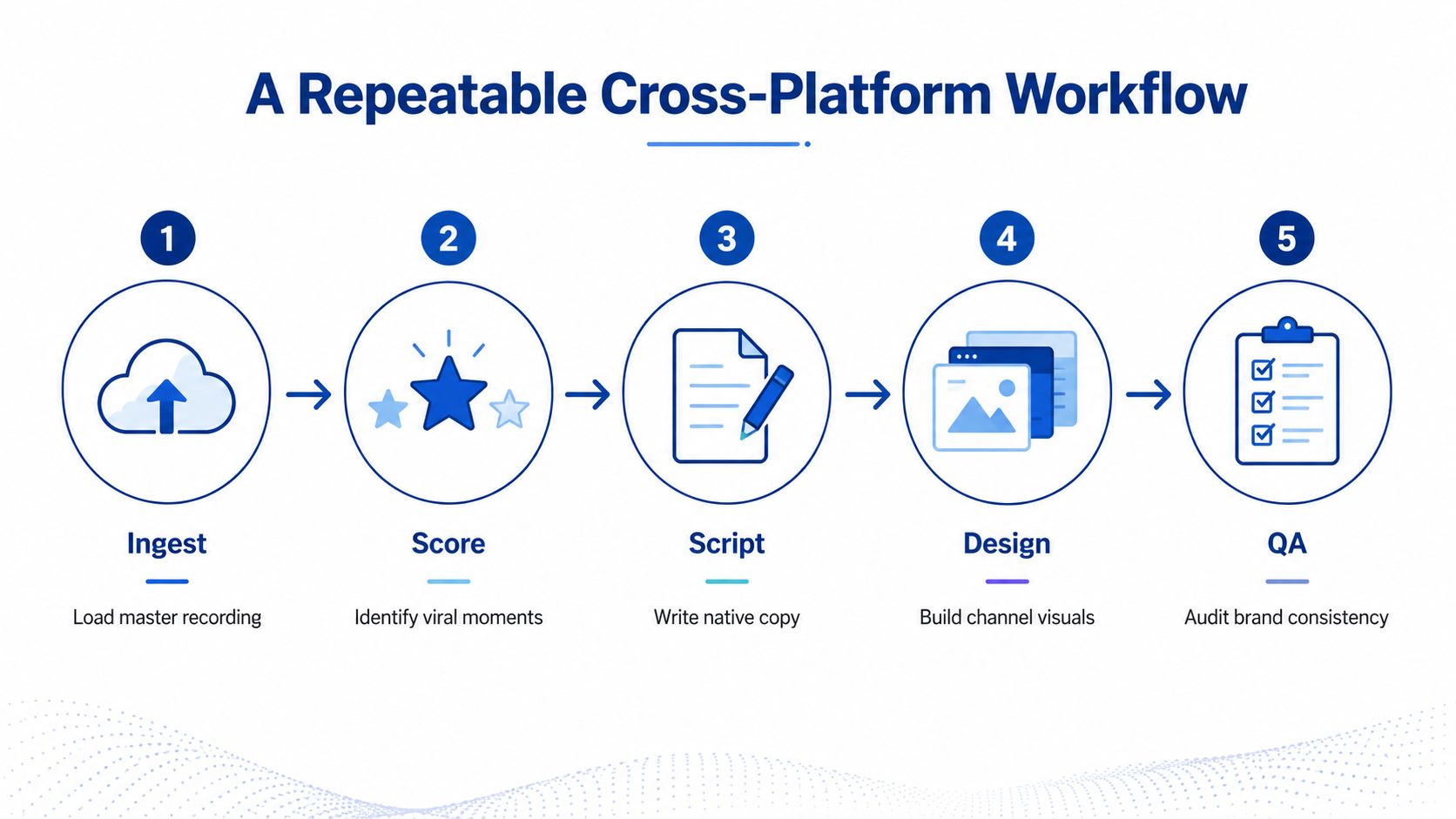
The best teams use five stages:
- Ingest: load the master recording and keep the clean source.
- Score: identify moments worth cutting based on clarity and reuse potential.
- Script: write native copy, hooks, and captions for each channel.
- Design: build platform-specific visuals and layouts.
- QA: audit the brand kit, the CTA, and the channel fit.
A useful monthly cadence is two recordings per month, which can feed a large portion of a social calendar when the derivatives are handled well. The point is not to flood every channel. It's to keep a steady publishing rhythm without rebuilding everything from scratch.
Operational rule: a master asset that can't survive QA across channels isn't a master asset yet.
For smaller teams, a structured workflow matters even more. The content repurposing workflow for small teams is usually the difference between a system and a pile of half-finished drafts. Without the process, the work drifts into random clipping and late-night formatting.
If a team already has a solid recording cadence, the monthly repurposing system becomes the content engine. The recording is the input. The channel-native assets are the product.
What to Measure Per Platform
The wrong metrics make repurposing look better than it is. Likes are easy to collect. They're not always useful. The better approach is to measure the signal each platform gives.
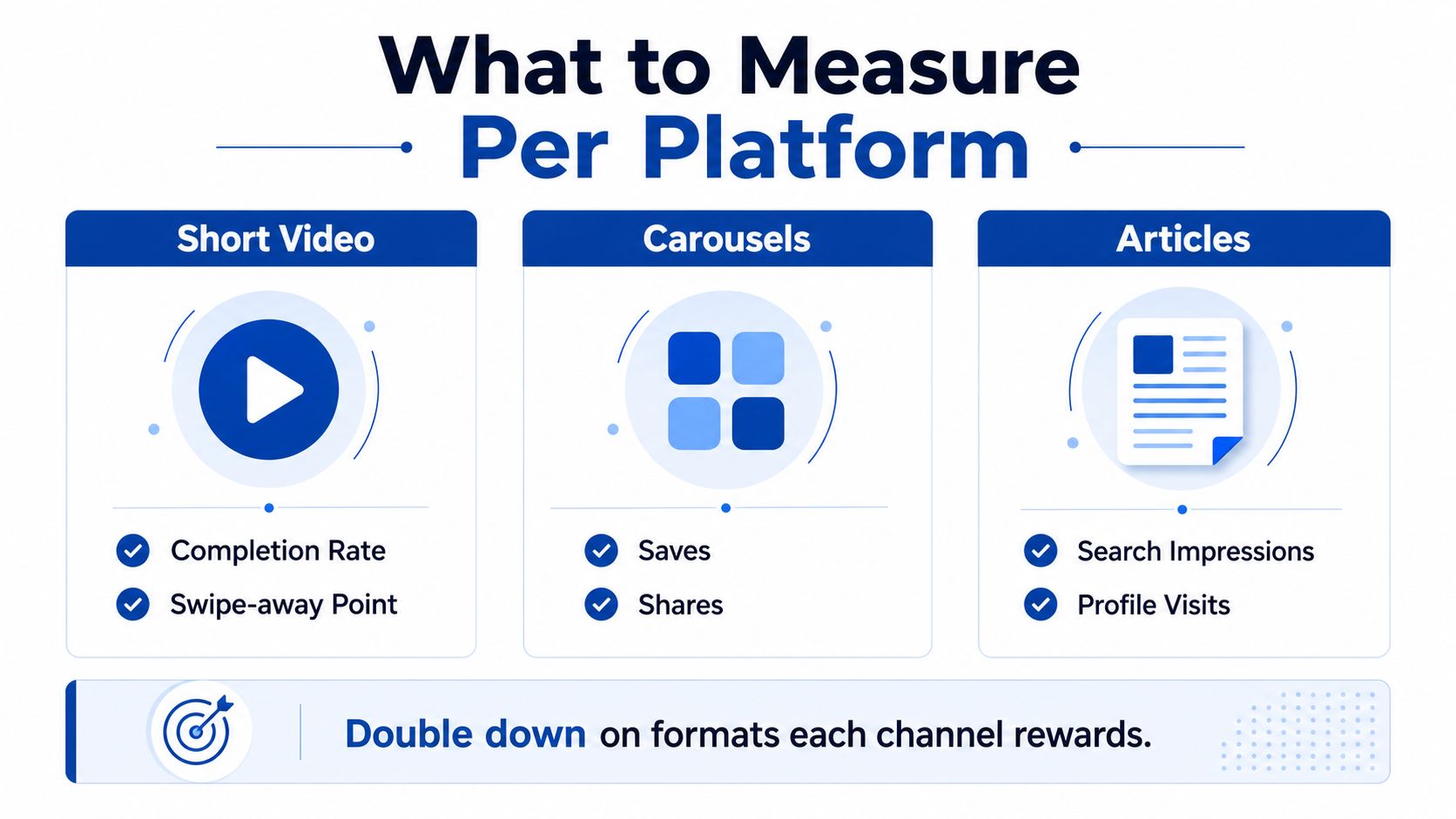
For short video, the most useful indicators are watch completion rate and the swipe-away point. Those two metrics tell you whether the hook is working and whether the clip is too long or too slow. If viewers leave before the point lands, the problem is usually the opening, not the topic.
Carousels need a different read. Saves and shares matter more because they show depth and usefulness. A carousel that gets saved is doing a different job than a clip that gets watched. It's helping the audience keep the idea, not just notice it.
For social posts tied to thought leadership, profile visits and follows per post reveal audience fit. They show whether the content attracts the right people, not just more people. For blog and SEO layers, search impressions and assisted conversions matter more than raw traffic, because the article is doing a longer job inside the funnel.
The monthly tuning rhythm should stay simple.
- Trim clip length when completion drops and the idea drags.
- Reorder hooks when viewers leave too early.
- Double down on the two or three formats each channel rewards.
That's where the repurposing system becomes sharper over time. The team stops guessing and starts refining the assets that already fit the audience. The result is not just more content. It's better channel fit.
The Done-For-You Alternative
A lot of teams can learn the method. Fewer can absorb the labor. That's why a done-for-you repurposing service exists in the first place. One recording goes in, and a production team sends back finished assets that already fit the channel.
The practical offer is straightforward. Send one podcast, webinar, keynote, interview, sales call, livestream, or course recording, and receive 20 to 30 ready-to-publish assets in 72 hours. That bundle can include video clips, LinkedIn posts, quote graphics, carousels, audiograms, and a blog post, all written in the client's voice and aligned to the brand kit.
Clients usually spend about 15 minutes on their side. They send the recording and any brand basics. The rest gets handled in production, including revisions and QA. For teams that need proof points, plans run from $999 per recording, which works out to roughly $14 per finished asset, and the turnaround comes with a 72-hour guarantee or the work is free.
That's why this model is useful for marketers juggling multiple channels. It removes the most painful part of the workflow, which is the editing and adaptation burden. It also keeps output consistent when the internal team is already stretched thin.
RepurposeYourContent is one option built around that model, with finished assets delivered from a single master recording and service details explained here. The right question isn't whether repurposing matters. It's whether the team wants to spend hours remaking every asset in-house.
Book a call if the goal is to turn one recording into a real cross-platform bundle, not a pile of reposts. If a sample would help, request one and judge the output against the channels that matter most.
Tags: