Native Content vs Repurposed Content Which Performs Better
Native content vs repurposed content which performs better? Data-driven B2B comparison for 2026. Learn why substance, not origin, drives results.

The usual advice says native content wins because it feels more natural on the platform. That sounds sensible. It also leads teams to spend too much time making fresh assets that say very little.
For most B2B teams, the better question isn't native or repurposed. It's whether the content carries actual expertise and whether the final asset fits the channel. That matters more.
If leadership is asking about native content vs repurposed content which performs better, the practical answer is simple. Generic native content often loses to repurposed content built from a strong source, then adapted properly for each platform. Substance comes first. Format still matters, but it comes second.
Early on, that difference is easy to miss because teams often compare clicks, likes, and surface engagement. That's useful, but incomplete. The UK pressure to prove return is growing as IAB UK reported digital ad spend reached £29.6bn in 2024. That shifts the conversation away from vanity metrics and towards actual business impact.
| Content type | What it is | Usually wins when | Usually loses when | Best use |
|---|---|---|---|---|
| Native content | Created specifically for one channel | The platform rewards speed, trend fit, or a very specific interaction style | The idea is thin, generic, or forgettable | Trend-led social, reactive posts, platform-specific creative |
| Repurposed content | Adapted from a stronger source asset such as a webinar | The source contains expertise, proof, strong opinions, or useful explanation | The team just reposts the same asset unchanged everywhere | Authority building, multi-channel distribution, efficient content ops |
| Hybrid approach | Repurpose the substance, native the format | The team has one strong source and needs channel-ready outputs fast | There is no editing for context, audience, or placement | Most B2B content programmes |
The Native vs Repurposed Debate Is a False Choice
The debate starts in the wrong place. Origin is not the main performance driver. Substance is.

A mediocre LinkedIn post written natively for LinkedIn is still mediocre. A sharp webinar clip, edited for silence removal, captions, pacing, and a stronger opening line, can beat it because the underlying idea carries more weight. That is the part teams focused on production speed often skip when they argue about native versus repurposed.
What teams usually get wrong
The underlying split is not native versus repurposed. It is adapted versus lazy.
Lazy repurposing means posting the full webinar replay, dropping the same transcript into a blog, or uploading one video cut everywhere unchanged. Adapted repurposing means extracting one strong argument, rebuilding the hook, choosing the right format, and editing for the way people consume content on that channel.
The bad comparisons are predictable:
- Comparing a polished native social post against a raw webinar recording
- Judging success on click-through rate alone, even when the asset is meant to build trust or explain a complex problem
- Ignoring whether the content created qualified conversations, influenced pipeline, or helped a buyer move closer to a decision
Practical rule: Compare native content to repurposed content that has been fully rebuilt for the platform, not to untouched source material.
This matters even more now because repurposing quality has changed. AI tools can turn a strong source asset into multiple channel-specific outputs fast. That does not remove the need for editorial judgement. It does remove a lot of the production drag that used to make native creation look like the only serious option.
The compliance side supports the same point. The ASA position on native-style and branded content is that ads must be clearly identifiable and not mislead readers. Format fit matters. Clear disclosure matters too. The audience for in-feed content is also large, with 91% of UK adults using the internet and 89% using social media in 2024, as cited in the FTC guide referencing UK ONS figures.
The metric problem behind the debate
Many popular marketing blogs on this topic stop at engagement metrics such as clicks, likes, and shares. That is a weak standard for B2B teams defending budget.
A native post can win on click rate and still lose on business impact. A repurposed webinar sequence can generate fewer clicks, but better sales calls, stronger retargeting audiences, and more useful follow-up conversations. If the team never defined the outcome, the format debate goes nowhere.
The useful way to evaluate this is with two variables:
- Substance quality. Does the content include expertise, evidence, specificity, or a real point of view?
- Format fit. Does the final version match the audience behaviour and expectations of the channel?
That framing clears up a lot of confusion. Content can start as repurposed and still end up native in execution. The right definition appears in this native content glossary entry. That distinction matters because low-value native content loses all the time, while strong source material, rebuilt properly, often wins across multiple channels.
Native and Repurposed Content Redefined
The terms need cleaning up because outdated definitions are still widely used by teams.
Native content is content created specifically for one channel's format, audience behaviour, and distribution context.
Repurposed content is content adapted from a source asset into new formats for other channels.
That sounds straightforward. The confusion starts when people assume repurposed means copy-pasted.
Native is about destination, not origin
A webinar clip can become native content if the final version is built for the destination platform. A long, horizontal recording posted without edits isn't native for a scrolling social feed. A short vertical cut with captions, a strong opening line, and tight pacing can be.
The same rule applies to written content:
- A webinar transcript dumped onto a blog isn't a blog article.
- A rewritten article structured for search intent is.
- Speaker notes pasted into LinkedIn aren't a feed post.
- A carousel or concise point-of-view post built from those ideas is.
Repurposing works when the team preserves the insight and rebuilds the packaging.
That's why the old “native always wins” logic doesn't hold up anymore. High-quality repurposing no longer means resizing an asset. It means translating expertise into the language of each platform.
What good repurposing actually looks like
UK guidance is useful here because it points to execution, not theory. IAB UK guidance, as summarised here, recommends platform-native executions because users are more likely to engage with content that matches the surrounding format. That supports a practical rule many content teams already know. Repurposed content performs better when it arrives as a native-format variant, not as a reused original.
A clean modern definition looks like this:
| Term | Old view | Better view |
|---|---|---|
| Native content | Made from scratch for one channel | Designed for the platform where it appears |
| Repurposed content | Reused content | Rebuilt content adapted from a source |
| Bad repurposing | Minor edits | Same asset posted everywhere |
| Good repurposing | Not clearly defined | Same core idea, different expression by channel |
A practical guide to that process sits in this content repurposing overview, but the short version is simple. Don't ask where the content started. Ask whether the final asset belongs where it was published.
Native Content vs Repurposed Content Which Performs Better
The answer changes by channel. That's why blanket claims usually fall apart in real planning meetings.
In UK B2B, channel context matters a lot. LinkedIn alone had ad reach of about 34.7 million adults in the UK in 2025. That makes it a serious decision point for content strategists choosing between native-first production and a repurposing-led model.

On LinkedIn, native content wins when it captures platform rhythm. That usually means a sharp opinion, a clean hook, short structure, and easy scanability.
But a repurposed webinar clip often beats a generic native text post when the speaker clearly knows the topic. The reason isn't mysterious. Buyers can tell the difference between recycled advice and real expertise.
A practical comparison:
Generic native post
“Three trends shaping RevOps this year.”Repurposed native-form clip
A 45-second speaker moment where the host explains why attribution breaks when teams measure channels instead of buying committees.
The second asset often carries more authority because it came from a real explanation, not a brainstormed content prompt.
Blogs and SEO content
Native blog writing still matters. Search needs structure, clear intent matching, and readable formatting.
Still, repurposed content from webinars has a hidden advantage. It usually starts with strong raw material: objections, examples, terminology, and direct answers. That gives the article more specificity than a generic list post written from a blank page.
What works:
- Pulling a blog angle from a focused webinar section
- Rewriting the transcript into an argument, not a transcript
- Using the speaker's phrasing where it adds clarity
- Breaking the piece into search-friendly headings and examples
What doesn't:
- Publishing a verbatim transcript
- Padding the article with generic intros
- Ignoring search intent because “the webinar already covered it”
Email and nurture
Email is where repurposed content often becomes more useful than native-first writing. Webinar Q&A, objections, and speaker explanations tend to create stronger nurture material than promotional copy written in isolation.
That doesn't mean every email should sound like a transcript. It means the substance should come from real customer questions and informed answers.
A good nurture email often starts with a sentence a prospect would actually say.
The performance lens that matters
This comparison only makes sense if the team measures the right thing. Clicks help, but they don't tell the whole story for educational or consideration-stage assets. A stronger framework for content teams is covered in this guide to content marketing ROI measurement.
When leadership asks which performs better, the most accurate answer is this:
- Native-first often wins on speed and platform immediacy
- Repurposed content often wins on authority and efficiency
- Repurposed content adapted into native formats usually gives the best balance
How to Decide Between Native and Repurposed Content
This decision should come from constraints, not ideology. Resources such as budget, time, or a writer for every channel are typically finite. The format choice has to reflect that.

Choose native-first when the platform itself is the opportunity
Native-first creation makes sense when speed and context matter more than depth.
Examples include:
- Trend response where timing decides whether the post lands at all
- Interactive platform units such as polls, short reactive videos, or platform-specific story formats
- Campaign creative where the hook, visual, and placement are tightly linked
In these cases, starting from a webinar usually slows the team down. The source asset isn't the point. The context is.
If the team is running a scheduled social operation with recurring posts, a dedicated planning system helps. For Instagram-heavy workflows, this Mifu guide to Instagram scheduling is useful because it focuses on the operational side teams often neglect.
Choose repurposing when expertise is the scarce asset
Repurposing is the stronger play when the team already has a rich source of insight but lacks production capacity. That's common in B2B. The company has product marketers, subject matter experts, sales leaders, or customers saying useful things. The team just doesn't have time to turn those moments into enough channel-ready assets.
Repurposing usually wins when you need:
- Authority built from real expertise
- Consistency across several channels
- Efficiency without adding headcount
- Message repetition in multiple formats
Often, many content teams get more output from one strong source than from several lightweight native posts.
Use attention metrics, not just clicks
The performance decision also depends on how the team evaluates content. Brand Metrics argues that native measurement should move beyond page views to dwell time, completion rates, and attention metrics. That matters because repurposed assets often work as consumed content, not just clicked content.
A practical checklist helps:
| If this is true | Prioritise |
|---|---|
| The topic is fast-moving and platform-specific | Native-first |
| The message needs depth and credibility | Repurposed |
| The team is small and channel count is high | Repurposed |
| The asset needs strong completion or watch-time performance | Repurposed, then native-format it |
| The idea only works inside one platform mechanic | Native-first |
A fuller planning approach is covered in this content repurposing strategy for 2026, but the practical rule is simpler. Use native-first for channel-specific moments. Use repurposing for repeatable authority.
A Practical Workflow to Create Native-Ready Content
Teams do not run into trouble because they lack ideas. They run into trouble because every channel asks for a different version of the same idea, and rebuilding each one by hand burns time fast.

The practical fix is to treat one strong source as the operating system. Then rebuild each asset so it feels like it belongs on the channel where it appears. That means changing the hook, format, pacing, dimensions, copy length, and CTA. Good repurposing is editorial work, not export work.
A simple five-step workflow
Start with a source worth using
Record a webinar, customer interview, panel, sales call teardown, or expert discussion. If the source has no sharp point of view, the derivative assets will sound generic.Pull the moments with substance
Look for sections that answer a buyer question, challenge a common assumption, explain a process clearly, or give a usable example. Skip filler, scene-setting, and long intros.Match each moment to a channel job
A short opinion clip can work on LinkedIn. A structured explanation can become a blog post. A strong line from a customer can fit a newsletter or quote card. The goal is not to post everywhere. The goal is to place each idea where that format helps it land.Rewrite for the platform, not just the file type
Add captions to video. Tighten the first five seconds. Split long blog sections with useful subheads. Turn spoken language into readable copy. Change the CTA based on buyer intent. This step decides whether the asset feels native or recycled.Review performance based on consumption
Track watch time, completion, time-in-view, replies, saves, and assisted conversions. Impressions tell you distribution happened. Consumption tells you the asset held attention.
Video makes this difference obvious. AI Digital recommends quality native video inventory with viewability around 70%+ and prioritising in-feed placements, while tracking CPCV and average watch time. Format and placement affect outcomes, but the source material still does most of the work. Strong substance in the right format usually beats weak content that was made natively for the feed.
A visual walkthrough helps if the team needs a repeatable production model.
One real workflow example
A B2B content team records a 60-minute webinar with a product leader and one customer. Inside that recording, there are usually only a handful of moments worth turning into standalone assets. That is normal. The job is to find the parts with authority and rebuild them well.
From one session, the team can produce:
- Three short video clips for LinkedIn and paid social
- One blog post built from the strongest teaching segment
- A LinkedIn carousel based on the customer's framework or process
- An email newsletter built around the clearest takeaway
- Image quotes and audiograms from concise speaker moments
- Timestamps so useful sections are easy to find and reuse later
This approach works because the source carries the expertise. The adaptation makes it feel native.
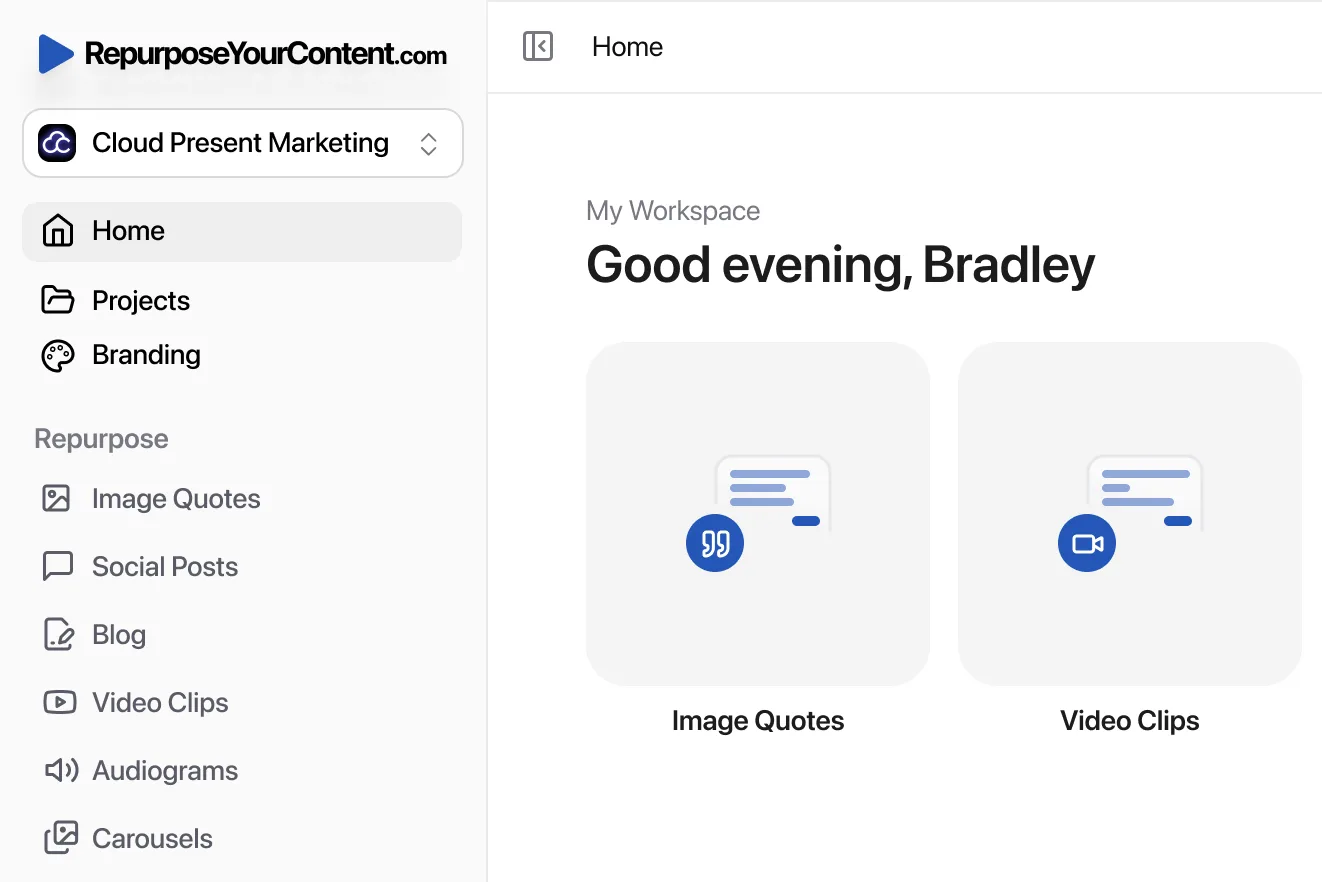
RepurposeYourContent is one option for teams that want help turning a webinar recording into assets such as video clips, blog posts, social posts, audiograms, image quotes, newsletters, LinkedIn carousels, and timestamps. The practical value is speed with editorial structure, not content volume for its own sake.
For teams planning handoffs, review cycles, and channel outputs, this content repurposing workflow diagram template gives a clear production map.
The fastest way to publish native-ready content is to start with something worth paying attention to, then adapt it with enough care that each asset feels built for its destination.
Stop Debating and Start Creating
The native versus repurposed argument wastes time because it treats origin as the main variable. It isn't.
The content that performs usually has two things. It says something useful, and it fits the channel where buyers see it. Teams that focus only on “native” often produce more assets but less substance. Teams that focus only on “repurposing” often publish resized leftovers that don't belong anywhere.
The effective middle ground is clear. Build one authoritative source. Then adapt it aggressively for each channel.
That's the model most B2B teams can sustain. It protects quality, reduces production drag, and gives leadership a more defensible answer when they ask where budget should go. Native-first content still has a place. Repurposed content still has a place. But the strongest programme usually combines them by repurposing the insight and making the final output feel native.
If the team needs more content without lowering quality, try RepurposeYourContent.
Tags: