Evergreen Content Strategy for B2B: A Webinar Playbook
Build a winning evergreen content strategy for B2B. This guide shows you how to turn one webinar into a perpetual lead-gen engine. Practical, no-fluff playbook.

A small slice of content often carries the whole programme. Top-performing B2B websites get 38% of their total traffic from just 10% of their content, and that 10% is the evergreen layer according to Arfadia’s evergreen content glossary. That should change how a team plans its calendar.
Most B2B teams still publish as if every week starts from zero. They chase launches, news, commentary, event promos, and campaign assets that fade almost immediately. Then they wonder why traffic stays volatile and content production feels endless.
An evergreen content strategy for B2B fixes that. It replaces one-off output with assets that keep answering buyer questions, ranking in search, and supporting pipeline months after publication. The strongest version of that strategy starts with webinars. Not because webinars are trendy, but because a good webinar captures expertise in a format that can be broken into guides, comparison pages, social posts, clips, newsletters, and carousels.
When the topic is right, webinar recordings are evergreen. A session on implementation mistakes, buying criteria, or process design can keep producing derivative assets long after the live date. That’s the shift that matters. The webinar stops being an event. It becomes the raw material for a perpetual content engine.
Why Your Content Engine Needs Evergreen Fuel
Top-performing B2B websites get 38% of their traffic from just 10% of their content, and that small set is usually evergreen, according to Arfadia’s evergreen content glossary. For a content lead, that is a planning signal, not a trivia point.
Many B2B marketing teams still run on launch cycles. They publish around product releases, events, partner campaigns, and industry news. That work has a place, but it rarely builds a content asset base that keeps producing pipeline after the campaign window closes.
Evergreen content does. It keeps answering buyer questions that come up every quarter, not just this quarter. In B2B, those questions stay remarkably stable: how to solve the problem, how to compare options, what implementation looks like, what can go wrong, and how to measure success.
What evergreen actually means
Evergreen content stays useful without depending on a date, announcement, or short-lived debate. In practice, it usually shows up as:
- How-to guides that teach a repeatable process
- Frameworks that help buyers assess a problem
- Comparison pages that support vendor evaluation
- Best-practice articles that answer recurring operational questions
- Glossaries and explainers that teach category basics
The strongest evergreen libraries also have structure. A central pillar page can hold together related guides, comparisons, and use-case content, which makes the archive easier to browse for buyers and easier to maintain for the team.
Time-sensitive content still matters. Product updates, event promotions, market commentary, and reaction pieces can drive short spikes in attention. They support campaigns well. They just should not carry the whole engine.
| Attribute | Evergreen Content | Time-Sensitive Content |
|---|---|---|
| Lifespan | Useful for months or years | Useful for a short campaign window |
| Primary search intent | Ongoing education and evaluation | Immediate awareness or event response |
| Production value | Higher upfront thinking and structure | Faster to publish |
| Traffic pattern | Builds and compounds over time | Peaks quickly, then fades |
| ROI profile | Strong long-term return | Short-term attention |
| Best use | Foundation of the content library | Support layer for launches and campaigns |
Why compounding matters more than volume
Publishing more pages does not automatically create more results.
One strong evergreen asset can keep earning search impressions, backlinks, demo assists, and influenced conversions long after publication. A reaction post usually cannot. Once the moment passes, that page often stops contributing.
The distinction is practical because B2B teams are not short on ideas. They are short on production capacity. If the team spends 80% of its effort on assets with a seven-day shelf life, it will need to refill the pipeline every week. If it spends that effort on assets tied to recurring buyer questions, the library starts carrying some of the load.
The webinar-first model changes the economics. A well-run webinar captures subject-matter expertise in one sitting, usually 30 to 45 minutes, around a durable topic buyers already care about. That session can become a guide, a comparison article, short clips, email copy, social posts, sales follow-up assets, and supporting pages for a broader B2B content engine. The webinar stops being a one-time event and starts serving as source material for an evergreen system.
I have seen teams miss this by treating evergreen as side work. They publish one “big guide” every quarter, then give the rest of the calendar to campaign requests. The result is predictable: a thin library, uneven traffic, and constant pressure to publish more just to hold ground.
A stronger model puts evergreen at the center and lets campaign content sit around it.
What works and what doesn't
The pattern is straightforward. Content that solves recurring customer problems keeps paying back. Content built around novelty usually fades fast.
A practical evergreen engine often includes:
- Problem-first topics drawn from sales calls, onboarding issues, and support questions
- Depth on commercially relevant themes instead of shallow coverage across dozens of keywords
- Internal linking between guides, comparisons, webinars, and product-adjacent resources
- Scheduled refreshes so high-value pages stay accurate and competitive
- A webinar-first production habit that turns one expert session into a cluster of durable assets
The weak version is just as familiar:
- Commentary on every market update with no lasting buyer value
- Event-led publishing with no plan for post-event reuse
- Keyword targeting disconnected from revenue-critical questions
- Standalone posts that never connect into a usable library
Busy teams do not need more content chaos. They need assets with a long working life. Evergreen fuel gives the engine that staying power.
Identifying and Planning Your Evergreen Content Pillars
B2B teams usually overproduce topics and underbuild libraries. The fix is tighter pillar selection.
Strong evergreen pillars come from repeated buyer questions that show up across the funnel, then get shaped into a repeatable production system. For a webinar-first team, the goal is not to pick blog categories. It is to choose a small set of subjects that can support live sessions, post-webinar articles, comparison pages, clips, sales follow-up assets, and refreshes for the next 12 to 24 months.

Start with recurring customer problems
The fastest way to pick weak pillars is to start with a keyword export and work backward. The better approach starts with operational friction inside the business.
Look in four places:
Support and onboarding tickets
Pull questions that repeat across setup, implementation, reporting, integrations, and troubleshooting. If a question appears every month, it has evergreen potential.Sales call transcripts
Review calls for objections, comparison questions, and scope questions. In B2B, these often turn into higher-value assets than broad awareness terms.Customer success conversations
Ask what slows adoption, causes confusion, or blocks expansion. Those topics often work well for both retention content and pre-sale education.Webinar Q&A logs
This is the signal many teams ignore. Questions asked live are often clearer and more commercially relevant than questions pulled from SEO tools. They also tell you which topics can carry a full session, not just a single article.
A good pillar passes three filters. It stays relevant over time, it matters to pipeline or retention, and it can support multiple derivative assets from one expert session.
Validate with search behaviour
Search data still matters. It just comes after you identify buyer pain.
Check whether your candidate topics map to stable query patterns such as how-to terms, category definitions, comparison searches, implementation questions, and pricing or scope-related searches. The point is not to chase the biggest volume. It is to confirm that the problem buyers raise in calls also shows up in search with durable intent.
That gives you a cleaner way to decide what becomes a core resource, what stays a supporting article, and what does not deserve production yet.
The structure that works best here is a central guide supported by narrower subtopic pages. If your team needs a simple model, Raven SEO's explanation of a pillar page is a useful reference. For webinar-led teams, this same model works even better when each pillar is tied to a repeatable session theme and a defined set of follow-on assets inside a content multiplication framework for webinar-led teams.
Build three to five true content pillars
Three to five pillars is enough for most B2B teams. More than that usually spreads research, SMEs, and promotion too thin.
I prefer pillars that are wide enough to support a quarterly webinar cadence and narrow enough to stay commercially focused. For a webinar-led B2B SaaS company, that often looks like this:
Webinar strategy and planning
Topic selection, speaker prep, registration quality, audience targeting, and follow-up sequences.Evergreen content operations
Asset planning, editorial workflow, refresh cycles, reuse rules, and performance reviews.Buyer education and evaluation
Category understanding, implementation expectations, internal buy-in, comparisons, and common objections.Use case and workflow content
Team-specific applications, process design, reporting, and adoption guidance.
Each pillar should answer a practical question: can the team run at least six to eight strong webinars on this subject over the next year without stretching for ideas? If the answer is no, it is probably a subtopic, not a pillar.
Score priorities before assigning production
Good pillars still need sequencing. I use a simple scoring model before putting any topic into production.
| Criteria | Question to ask |
|---|---|
| Revenue relevance | Does this topic help qualify, educate, convert, or retain the right accounts? |
| Longevity | Will this still matter next year with a light refresh? |
| Derivative potential | Can one webinar on this topic become a guide, clips, FAQ content, sales collateral, and a comparison page? |
| SME access | Do you have a credible internal expert who can teach this well on a webinar? |
Topics with high scores across all four usually go first. Topics with strong search volume but weak derivative potential often go later. That trade-off matters. A pillar that supports one decent post is less valuable than a pillar that can feed a 90-day production cycle from one recorded session.
The best evergreen pillars do two jobs at once. They attract search demand and give your team a repeatable webinar agenda that keeps producing useful assets long after the live event ends.
The Webinar-First Content Production Workflow
Many teams treat the webinar as the finished asset. That’s the mistake.
The recording is the source file. The actual content engine starts after the session ends. A strong evergreen system plans for that from the beginning, before the event is even promoted.

Plan the webinar for derivative assets
A webinar built for repurposing has a different shape from one built only for the live audience.
It needs clear segments. It needs repeatable language. It needs moments that can stand alone in text, video, and graphics. The easiest structure is three-part:
- A conceptual opening that frames the problem and stakes
- A practical middle section with process, examples, or a walkthrough
- A Q&A close that surfaces objections and edge cases
That structure gives the team clean material for several asset types. The conceptual part becomes a thought-leadership post or article intro. The walkthrough becomes the body of a guide. The Q&A becomes short clips, quote cards, or FAQ content.
Speaker prep matters too. Moderators should prompt for concise, standalone statements. Long rambling answers are hard to cut into useful derivatives. Short explanations with clear conclusions work far better.
Capture the right raw material during the event
The live session should produce more than a recording. It should also capture the elements needed for post-event production.
A useful checklist looks like this:
Transcript quality
Record clean audio and use reliable transcription. Poor transcripts slow every downstream step.Segment markers
Note timestamps for strong definitions, contrarian opinions, examples, and audience questions.Slide discipline
Keep slides readable enough to become carousel material later.Moderator prompts
Ask direct questions that produce quotable answers, not vague commentary.
A webinar with weak structure creates weak derivatives. The post-event workload usually reflects the planning quality.
The manual workflow most teams still use
The hidden cost becomes apparent. A single webinar can support a month of evergreen assets, but the manual workflow is slow and fragmented.
A typical process goes like this:
Export the webinar and clean the recording
Someone downloads the file, trims dead air, and checks the audio.Generate or fix the transcript
Then someone reviews speaker labels, formatting, and missed words.Read the transcript for themes
A content marketer pulls out key sections, turning spoken material into a coherent written argument.Write the first derivative piece
Usually that’s a summary article or guide based on the strongest section.Brief design and video support
A designer creates quote graphics or carousel slides. A video editor cuts short clips.Draft social and email assets
Someone writes LinkedIn posts, newsletter copy, and distribution notes.Load into the calendar
The team schedules all assets across blog, LinkedIn, and email.
The process works. It’s just expensive in time and coordination. One webinar can touch content, design, video, social, and lifecycle teams before anything ships.
A stronger operational model is to start from a fixed multiplication framework. This content multiplication framework is useful because it treats each source asset as a structured production input, not a one-off event recording.
A real workflow example
Here is a simple example for one webinar on “How to build an evergreen content library for SaaS”.
Step 1
The team builds the agenda around four repeatable sections. Topic definition, pillar planning, production workflow, and refresh rules.
Step 2
During the session, the moderator asks each speaker for one mistake, one framework, and one practical example.
Step 3
After the webinar, the team pulls the transcript and tags timestamps for the strongest explanations.
Step 4
The central guide becomes a long-form blog article. Two comparison posts come from the Q&A. A carousel comes from the framework slides.
Step 5
Short clips focus on isolated answers that make sense without the full session. Those work better on LinkedIn than generic promotional highlights.
Step 6
The same source material feeds the email newsletter and follow-up nurture copy.
That is the core shift. One expert session can supply an entire publishing lane if it is designed for decomposition.
How RepurposeYourContent Automates Your Evergreen Strategy
The manual process breaks down for one reason. Too many people touch too many small tasks.
A team has to transcribe, cut clips, draft articles, pull quotes, format carousels, and package email copy. None of those jobs are impossible. Together, they create delay. That delay is why many webinar recordings end up as dead assets.

Where automation changes the model
A practical automation layer turns one source file into multiple publishable outputs without passing the work through separate specialists first.
Used this way, RepurposeYourContent blog post generation takes a webinar recording or link, processes the transcript, and produces several derivative assets from the same session. Those outputs can include video clips, blog posts, social posts, audiograms, image quotes, newsletters, LinkedIn carousels, and timestamps.
That matters because evergreen content isn’t created by publishing one recap post. It’s created by building a connected set of assets around one durable topic. The more formats a team can produce from the same webinar, the easier it becomes to fill that asset library.
What the workflow looks like in practice
The working pattern is simple:
- Upload the source webinar from Zoom, YouTube, Vimeo, or another platform
- Select output formats based on the campaign need
- Choose quantity for clips, posts, and other derivatives
- Generate assets with transcript-based extraction and brand application
- Review and publish through the usual content workflow
This is the point where a webinar-first engine becomes operational, not theoretical. The team doesn’t need to organise a writer, editor, designer, social manager, and video editor just to get the first batch of evergreen assets out.
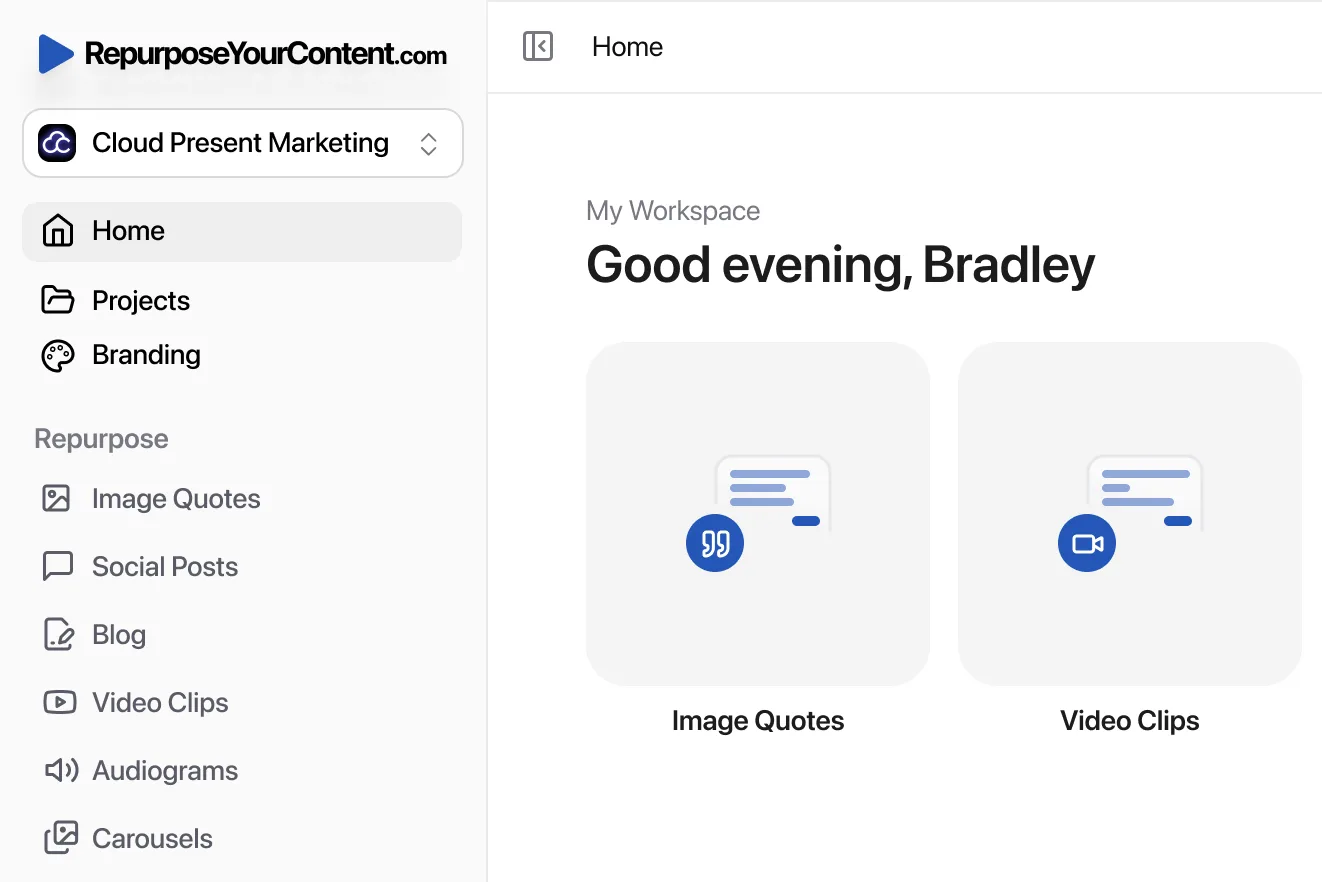
A quick product walkthrough helps show the mechanics:
The assets that matter most for evergreen
Not every derivative format supports long-term search and discovery equally. For evergreen strategy, four outputs usually do the heaviest lifting:
| Asset type | Why it matters |
|---|---|
| Blog posts | Capture search intent and become the indexable core asset |
| LinkedIn carousels | Repackage structured teaching into a format that keeps circulating |
| Video clips | Extend the life of expert explanations and support social distribution |
| Newsletters | Bring the evergreen topic back to the audience without rewriting from scratch |
The point isn’t automation for its own sake. It’s reducing the cost of producing durable content from existing expertise. When that cost drops, more teams can maintain an evergreen content strategy for B2B without adding headcount.
Building a Perpetual Distribution and Refresh Calendar
Companies that refresh older content often see outsized returns from work they already paid for. One cited benchmark is a 106% traffic lift after updating and republishing evergreen pages. The bigger point for B2B teams is operational. A webinar-first system gives you a repeatable source asset, but the return comes from distributing and refreshing that asset on a schedule.
Publishing everything in the same week shortens the life of a strong webinar. A better approach is to treat each webinar like a 30 to 90-day campaign with planned reuse, role-based angles, and a review date on the calendar before the first asset goes live.
A 30-day distribution example from one webinar
One webinar on a durable topic can support a full month of promotion if each touchpoint serves a different job. The blog captures search demand. LinkedIn posts create repeated exposure. Email brings the topic back to subscribed buyers who missed it the first time.
A practical sequence looks like this:
Day 1
Publish the core blog post built from the webinar’s main lesson.Day 4
Post a short video clip answering one specific problem in under 60 seconds.Day 7
Publish a LinkedIn carousel that turns the webinar framework into a step-by-step visual.Day 10
Send a newsletter with the main takeaway and a link to the article or replay.Day 14
Publish a text post built around a strong audience question from the webinar.Day 18
Share a second clip aimed at a different buyer role, such as the VP of Marketing instead of the content manager.Day 22
Publish a supporting article based on a recurring objection, comparison, or implementation question.Day 26
Reshare the best-performing asset with a new opening hook and a different CTA.Day 30
Review results, then flag one asset for expansion, one for refresh, and one to retire.
That sequencing does two things. It gives the market more than one chance to notice the idea, and it gives your team more than one format to test. For planning, a reusable editorial calendar template for marketing teams helps keep every derivative tied to the original webinar instead of drifting into disconnected tasks.
Evergreen content performs best when distribution runs like an operating rhythm, not a launch checklist.
Build refresh into the calendar on day one
Evergreen topics stay relevant. Individual assets do not.
Screenshots age. Product language changes. Search results shift. Internal links break as the library grows. If the refresh plan lives in someone’s head, it usually never happens. Put the refresh date in the same calendar as the original distribution.
I use a simple rule. Review high-intent evergreen pages every quarter. Review lower-intent educational pages every six months. If a page influences pipeline, keep it current even if traffic is flat.
A practical refresh routine
Use the same checklist each cycle so the team can move quickly:
Check traffic, rankings, and conversions
Prioritise pages that already attract qualified visits or sit just below stronger ranking positions.Update facts, examples, and screenshots
Replace anything dated. Add fresher proof points from recent calls, demos, or customer conversations.Tighten the structure
Rewrite weak intros, improve subheads, and add FAQs where buyers need more specificity.Add internal links to newer webinar-derived assets
Connect the page to clips, follow-up posts, and supporting articles created from later sessions.Republish and redistribute
Push the updated version through LinkedIn and email so the refresh creates new reach, not just a cleaner page.
This is also where ROI discipline matters. A refresh calendar should be tied to business impact, not editorial neatness. If your team needs a framework for deciding which pages deserve another round of work, this guide to measuring content marketing ROI is useful because it connects content performance to contribution, not just page views.
The trade-off is straightforward. A team can spend five hours creating a net-new post that may or may not gain traction, or spend those same five hours improving a webinar-derived page that already ranks, already converts, or already supports sales conversations. In mature B2B programs, the second option often wins.
Measuring the True ROI of Your B2B Evergreen Content
A webinar-first content engine earns its keep long after the live session ends. The ROI shows up in search, influenced pipeline, lower production cost per asset, and faster turnaround on follow-up content your sales team can use.
That requires a measurement model built for shelf life. Weekly page views are too narrow for evergreen B2B content because buyers often read three or four assets over weeks before they request a demo or reply to sales. Teams that want a clearer framework for tying content to business outcomes should review this guide to measuring content marketing ROI.
Three metrics worth tracking
Organic traffic growth by topic cluster
Measure traffic at the pillar and cluster level, not just by individual post. This shows whether each webinar topic is building durable search coverage.Page-one rankings for buying-intent terms
Track the core terms tied to problems your product solves. A ranking jump on a term with sales relevance matters more than small gains on informational variations.Influenced leads, MQLs, and opportunities by source webinar
Tag every derivative asset back to the original webinar. Then compare which sessions produce the strongest downstream conversion path, not just the highest attendance.
Source-level reporting matters too. A webinar that draws average registration numbers can still become a strong evergreen performer if the topic maps cleanly to search demand and buyer questions. This webinar metrics and KPIs to track guide is useful because it ties event performance to content output and revenue contribution.
What ROI looks like in practice
Strong ROI usually comes from topics with a long decision window and repeat sales relevance. In B2B SaaS, that often means webinars built around implementation questions, category comparisons, pricing considerations, or operational problems that keep surfacing in demos and customer calls.
The practical test is simple. Compare the total cost of one webinar-first content package against the traffic, conversions, influenced pipeline, and sales enablement value it generates over six to twelve months.
The teams that get the highest return do one more thing well. They review performance by webinar theme every quarter, then feed the winners back into the next event calendar. That closes the loop between content, demand gen, and customer insight, and it turns webinars from campaign assets into a repeatable system for finding topics that keep paying out.
Tags: