Full Service Podcast Production: The Complete 2026 Guide
Full service podcast production explained: deliverables, workflows, pricing, and how to choose the right provider for your show or B2B team in 2026.

805,508 new podcasts launched in 2020, then the market settled to roughly 262,155 new shows a year, with 216,653 launches already counted in 2026 so far. Full service podcast production is the complete stack from pre-production planning through recording, editing, publishing, distribution, repurposing, and analytics, and the cost of doing it badly is a show that gets published once and then stalls.
That matters because only 28.0% of podcasts are actively publishing, which means teams are fighting consistency, not creativity. The work is no longer about pressing record. It's about building a system that keeps a show alive after the first episode, and that's where providers cut corners.
What Full Service Podcast Production Actually Covers
The category is bigger than most buyers think. One market report valued the global podcast production service market at $1.3 billion in 2024, projected $1.47 billion in 2025 and $5.0 billion by 2035, with full service production estimated at $540 million in 2024 and projected at $1.85 billion by 2035 Wiseguy Reports. That growth tells you something simple. This is no longer a side service for trimming audio.
A true full service podcast production partner covers the whole path from planning to performance. That usually means strategy, guest preparation, recording support, editing, show notes, publishing, distribution, repurposing, and analytics. A studio may only handle capture. An editor may only clean up the file. A real partner carries the show through the system.
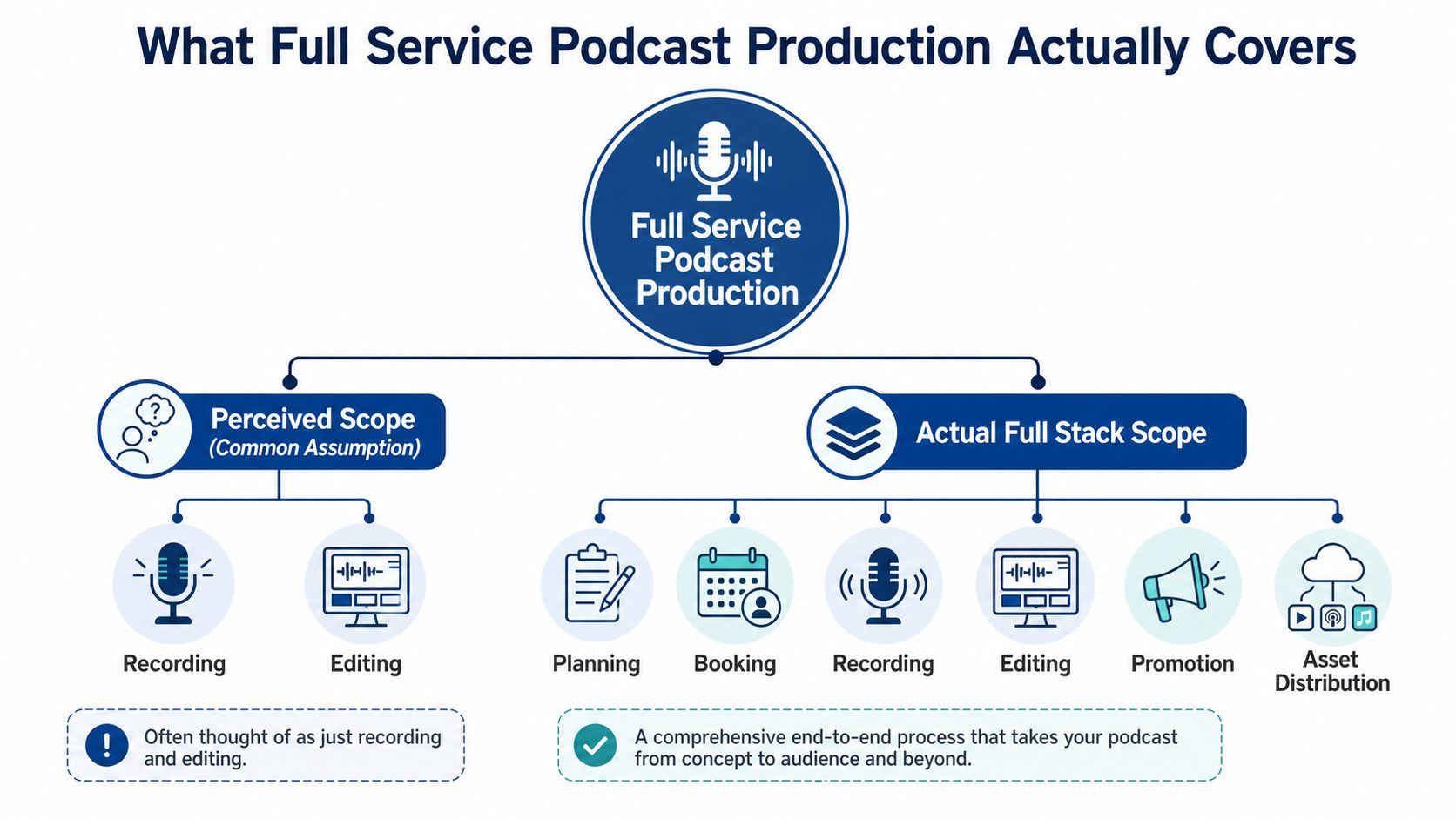
Practical rule: if a proposal stops at editing and publishing, it's not full stack. It's a partial workflow with a nicer label.
The buying mistake is confusing a vendor with a production team. A vendor hands back an edited episode. A production team keeps track of cadence, packaging, and downstream content. For podcast teams that need consistency, that difference is the whole game. For a definition you can compare against vendor proposals, see the podcast repurposing overview and map every deliverable back to the stack.
What buyers usually miss
Most public descriptions of full-service work mention recording, editing, and some growth help, but they rarely define ownership boundaries. That leaves room for confusion about who books guests, who writes the show notes, who posts the episode, and who turns the recording into assets. Those handoff points matter more than the brochure language.
A clean proposal should tell you exactly what happens after recording ends. If it doesn't, you're buying optimism, not operations. That's where the cost leakage starts.
The Seven Layers of the Production Stack
A full-service podcast stack is easier to judge when you break it into layers. The work starts before recording and continues after the episode is published. If a provider only handles the clean file, it has covered a slice of the job, not the whole stack.
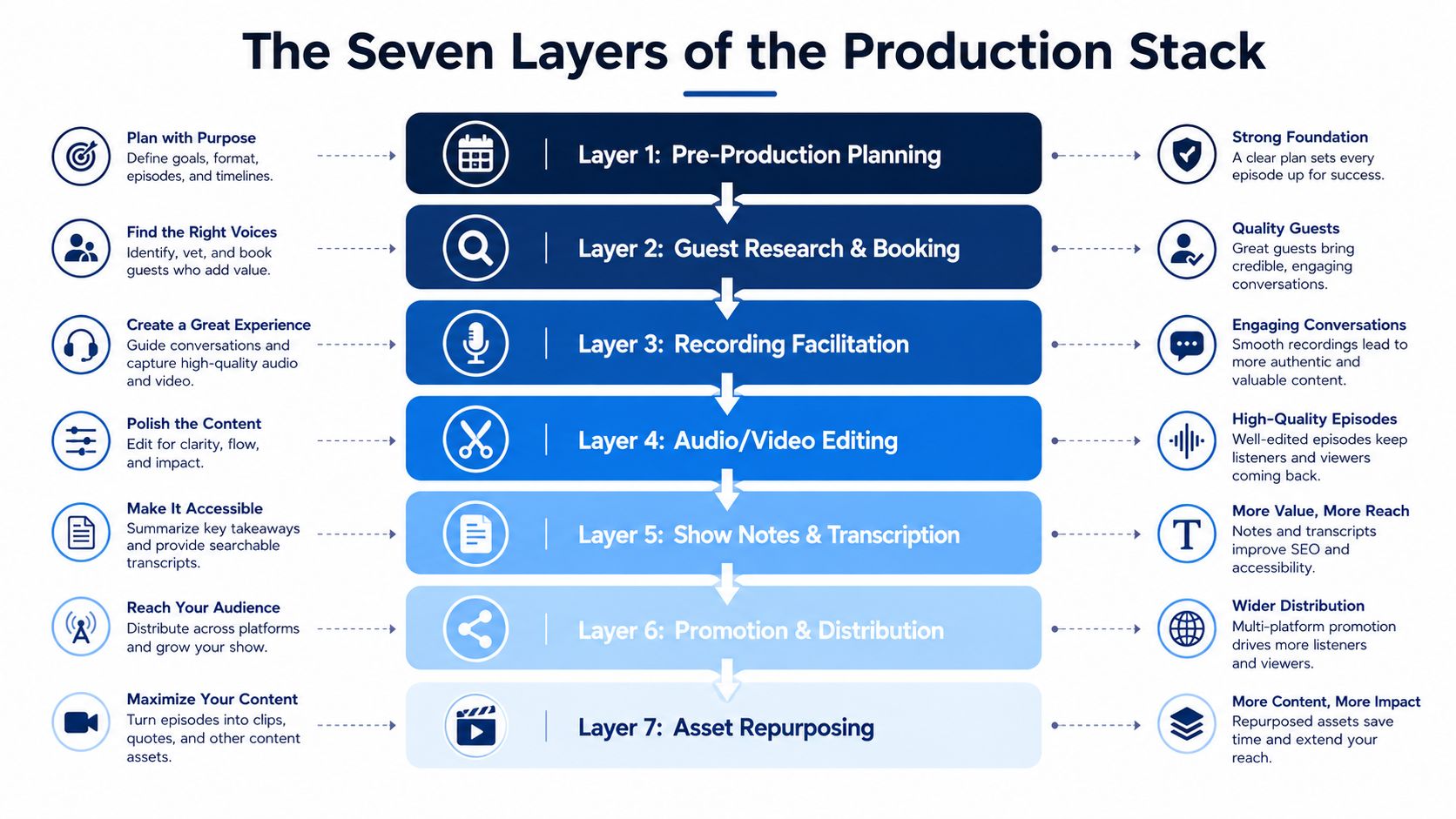
Layer 1 through Layer 4
Pre-production planning sets the episode angle, guest fit, and recording brief. If this step is weak, the team pays for it later in cleanup, re-records, and weaker conversations. Guest research and booking usually sits with the producer or outreach lead, and a manual pipeline can consume a surprising amount of time. Recording facilitation keeps the session on track and reduces avoidable retakes. Audio and video editing is the technical core, and it is also the place where quality drops fastest when teams rush or cut corners.
A broadcast-ready workflow often targets 44.1 kHz or 48 kHz sample rate, 16-bit depth, mono for talk-heavy content, and about -16 LUFS for streaming platforms, with peak levels capped near -3 dB to avoid clipping Spotdown. Some platforms are mastered closer to -14 LUFS, so the provider should explain its loudness standard instead of waving it away with “we make it sound professional.”
Layer 5 through Layer 7
Show notes and transcription turn the episode into searchable text and give the audience context. A small team can handle this, but only if someone owns it and checks it carefully. Promotion and distribution covers publishing to podcast platforms and managing the episode metadata. Asset repurposing is the layer most shows underbuy. It takes one recording and turns it into clips, posts, graphics, and long-form written assets.
For a more detailed glossary-style breakdown, use the podcast repurposing guide. That is where the stack stops being abstract and starts helping with procurement.
A provider that owns only the middle layers can still be useful. A provider that owns the full stack saves coordination time, revision churn, and missed deadlines.
The best proposals make every layer visible. The weak ones compress four jobs into one line item and count on the client not asking how the handoffs work.
What It Really Costs to Do It Yourself
DIY looks cheap until the calendar gets involved. A 45-minute episode can disappear into post-production for most of a workday, and that's before repurposing enters the picture. If the goal is a podcast that stays active, the time cost matters as much as the invoice.
Realistic DIY time per 45-minute episode
| Task | Estimated time | Output |
|---|---|---|
| Clip selection and editing | 2 to 3 hours | A few short clips |
| Show notes writing | 45 to 90 minutes | Episode summary and timestamps |
| Quote graphics design | About 1 hour | One or two visuals |
| Distribution setup | 30 to 60 minutes | Platform publishing |
| Repurposing for social, blog, and email | Several more hours | A small set of extra assets |
The table only covers the obvious work. It doesn't include the back-and-forth, the file checks, or the lost time when a guest audio track is rough. Once clip selection, notes, graphics, and scheduling are added together, one episode can eat 8 to 12 hours after recording ends. That's a full production cycle for a lot of busy teams, not a side task.
That same recording can produce a very different return when it becomes a content system. One episode can become clips, posts, quotes, carousels, and a blog post, which extends the life of the original conversation across channels. The point isn't more content for its own sake. The point is that the recording you already paid for keeps earning attention.
For a blunt comparison of workflows, see agency versus DIY repurposing. The hidden cost usually isn't software. It's the operator time needed to make the pieces look intentional.
Rule of thumb: if the team only captures one or two assets per episode, the show is leaving most of its value on the table.
DIY can work for hobby shows. It breaks down fast for teams that need output every week.
A Real Workflow From Recording to Published Assets
A real engagement has a clear sequence. The client records once. The production team handles the rest. That's the only way the show stays consistent when the calendar gets busy.
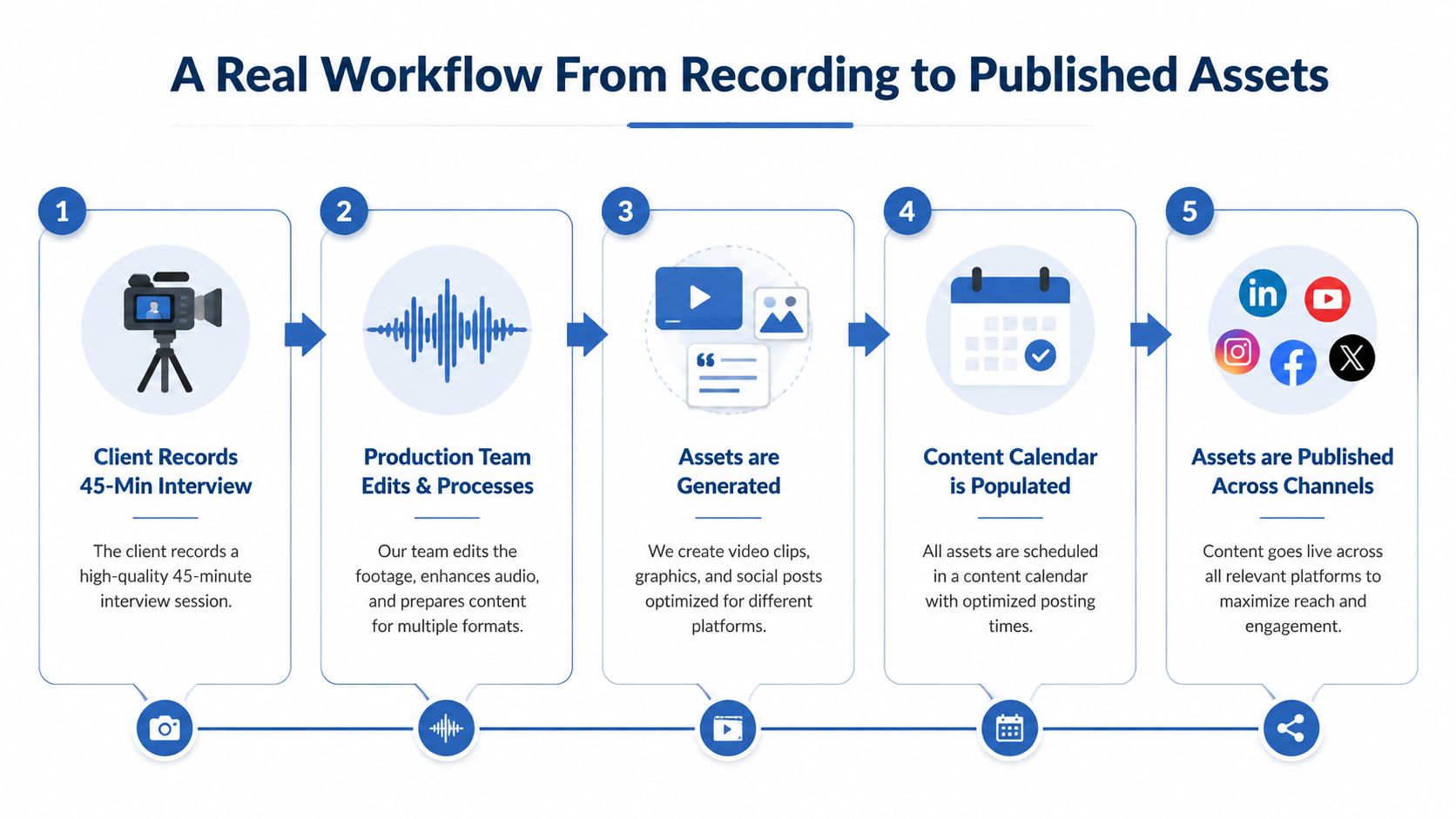
Step 1 and Step 2
The client records a 45-minute interview, keynote, or meeting and uploads the raw file. In a managed workflow, that part takes about 15 minutes of client time. The team then ingests the file, cleans the audio, and builds a rough cut. If the recording has two voices, the best teams keep each speaker on separate tracks.
Step two is where weak providers start cutting corners. They clean enough to make the file listenable, but they skip the editorial pass that makes the conversation flow. For a show that needs to sound credible, that shortcut shows up immediately.
Step 3 through Step 5
Next comes editing, mastering, and light sound design. A strong output aims for the loudness standards mentioned earlier, then adds music or branding elements without overproducing the conversation. After that, show notes, timestamps, and transcript go out for review. That review pass should be fast, not endless.
The episode is then distributed to podcast platforms, and the long-form video version goes to YouTube when the format supports it. For a practical walkthrough on show note structure, the show notes guide is useful because it shows how written assets extend the life of the episode.
Step 6 and Step 7
The repurposing team then pulls short clips, quote graphics, social posts, carousels, and a blog draft from the same source. That is where the content engine starts compounding. A single episode can become weeks of presence if the assets are packaged correctly.
The final piece is the posting playbook. It tells the client what to publish, where, and when. That part matters more than most buyers expect, because assets without distribution thinking often sit in folders and die there.
Service Models Compared and Honest Pricing by Tier
The right model depends on the problem a team is trying to solve. Some teams need control. Some need speed. Others need a content system that does not depend on in-house heroics. Choosing by label alone usually leads to wasted spend.
How the models differ
In-house production gives the most control. It also creates fixed payroll or contractor cost, plus management overhead. A la carte specialists can lower spend, but the coordination burden moves to the client. Full-service agencies bundle the stack and reduce moving parts, though they usually charge a premium. Done-for-you repurposing sits on top of an existing recording workflow and turns one source recording into many outputs.
Cost logic: the more vendors involved, the more time someone spends stitching the workflow together.
| Model | Monthly cost band | Best for | Main trade-off |
|---|---|---|---|
| In-house team | Higher fixed cost | Teams with steady volume and internal capacity | Hiring, management, and software overhead |
| A la carte specialists | Variable, project-based | Buyers who want control over each piece | Coordination takes time |
| Full-service agency | Retainer-based premium | Brands that want recording through publishing handled | Less flexibility, higher commitment |
| Done-for-you repurposing | Around $999 to $2,499+ depending on volume | Teams that already record and need multi-format output | Needs a usable source recording |
Pricing by tier makes more sense when you look at output instead of only hours. The entry point can be around $999 per month for one recording and roughly 20 to 30 assets, while a larger weekly content engine can reach around $2,499 per month RepurposeYourContent pricing context. That higher tier is where the unit economics start to matter, because one finished asset can land around $14.
The spread also shows the trade-off between one provider and a stitched-together team. One provider is simpler to manage. A specialist stack can work better if a team already has internal producers and knows how to run the handoffs. The choice should come down to whether the main bottleneck is production management or content multiplication.
For teams that want the repurposing layer handled as a service, RepurposeYourContent pricing context is one option in that category, with the focus on turning existing recordings into multi-format assets.
The Buying Checklist Questions to Ask Any Provider
A polished pitch can hide a weak workflow. The safest way to buy is to ask for the operations, not the marketing. A real partner can answer scope questions without dodging.
Questions that separate real operators from editors
- Which layers are included? Ask whether strategy, booking, production, show notes, publishing, repurposing, and analytics are bundled or billed separately.
- Who owns the assets? The buyer should keep full ownership, with no watermarks and no weird republishing restrictions.
- What is the turnaround window? If the provider can't state a delivery timeframe, the process is probably loose.
- How many revisions are included? Revision policy should be simple, fast, and documented.
- Who touches the files? Ask who edits, who reviews, and who signs off before delivery.
The contract should also answer exit terms, confidentiality around unreleased episodes, and what happens if a deadline slips. That part is boring, and it saves deals. The same is true for ownership language. If the assets aren't clearly yours, the workflow isn't really done-for-you.
A provider that can show a step-by-step process usually runs a tighter operation. One that speaks only in broad outcomes often has gaps hidden somewhere in the handoff. The buyer should care about those gaps before the first recording, not after the first missed publish date.
Where Most Shows Leave Value on the Table
The value leak usually shows up after publication. Many shows record, edit, publish, and move on. That uses only one slice of a recording that could keep working for weeks. The file gets one audience touch, then sits idle.
A single recording can become 8 to 12 captioned clips, 6 to 8 social posts with visuals, 4 to 6 quote graphics, 1 to 3 carousels, and one SEO blog post, plus a posting playbook that tells the team what to publish, where, and when. In practice, that stack does more than fill a calendar. It gives one episode multiple jobs, from search discovery to social proof to newsletter support.
The ROI is straightforward. Clips help new people find the show. The article gives search a page to index. Social posts keep the topic in front of the audience after the episode drops. The newsletter version keeps existing listeners engaged without forcing the team to create a fresh topic from scratch every time.
A short case makes the trade-off clear. If a company records a strong interview and only publishes the audio, that episode earns a single run at attention. If the same recording is broken into clips, summaries, graphics, and a blog post, it keeps producing traffic and conversation long after the publish date. The extra lift does not come from making the episode longer. It comes from turning one source file into several distribution-ready assets.
For teams that only want the repurposing layer handled, the value is operational. One raw recording goes in, then a package of ready-to-publish assets comes back in a few days. That saves internal time on writing, formatting, resizing, and scheduling, which is usually where the bottleneck sits.
The market keeps calling everything “full service,” but a lot of bundles still treat repurposing like an add-on. That is where shows leave value on the table. They pay for production, then let the content stop at the publish button.
Onboarding and Contract Tips Before You Sign
Start with one episode. Measure the asset count, turnaround, and revision process. Then scale to a recurring cadence only after the workflow feels reliable. That keeps the risk low and the expectations clear.
Lock the contract around asset ownership, revision count, turnaround guarantees, exit clauses, and confidentiality for unreleased content. Those are the terms that protect the buyer when production gets busy. If the provider can't put them in writing, that's a warning sign.
The done-for-you alternative is straightforward. Send one recording, podcast or otherwise, and receive 20 to 30 ready-to-publish assets in 72 hours, including video clips, LinkedIn posts, quote graphics, carousels, audiograms, and a blog post, all in brand voice with unlimited revisions. Client time is about 15 minutes. That's the difference between managing a content project and handing off a content system.
Book a call to see a sample delivery and pricing for your show.
Tags: