How Does AI Content Repurposing Work: A 2026 Guide
Discover how does AI content repurposing work, from transcription to branded assets. Explore our 5-step process and why human review ensures quality output in

AI content repurposing is fast at producing drafts. It is not fast at producing publish-ready content.
The mechanics are straightforward. A recording gets transcribed, the system identifies useful moments and themes, and the model rewrites that source into assets for different channels such as clips, posts, emails, and blog drafts. Teams that automate parts of that workflow with tools such as n8n and Claude Flux automation can reduce a lot of manual handling in the middle of the process.
The primary constraint shows up after the draft exists. Raw AI output still misses context, misstates claims, flattens the speaker's voice, and produces hooks that sound interchangeable. In B2B, those problems are expensive because every asset has to be accurate, on-brand, and specific enough to sound like an expert instead of a prompt.
That is why human review stays required. Editors still have to verify quotes, fix captions, trim repetition, restore nuance, and decide which ideas are strong enough to publish. If the source recording is weak, or the transcript is messy, the cleanup gets worse. A clear transcript is the starting point, which is why a practical guide on how to transcribe video automatically matters before any repurposing workflow begins.
The promise of AI repurposing is speed. The bottleneck is judgment. Marketers who ignore that gap usually get more assets, then spend hours turning raw output into something they can ship.
The 5-Stage AI Pipeline From Recording to Raw Asset
Most AI repurposing systems follow the same broad sequence. Speech gets converted into text. The model parses that text for meaning. Then it generates derivatives for each channel. That basic pipeline is now standard across the category, from clip generators to writing workflows (Opus on the repurposing pipeline).

Stage 1 Ingestion and transcription
A recording comes in from Zoom, YouTube, Vimeo, Riverside, Teams, or a raw file. The first job is transcription.
That means more than turning audio into text. A useful transcript includes speaker labels, timestamps, and enough accuracy that later steps don't drift. If the transcript is weak, every downstream asset gets worse.
For teams handling this manually, automatic transcription is the only sensible starting point. This guide to how to transcribe video automatically shows the practical first step.
Stage 2 Extraction of moments and themes
Once the transcript exists, the AI parses it for the parts worth keeping. The model then looks for strong claims, sharp explanations, useful frameworks, story beats, and exchanges that might work as clips.
A better system doesn't just trim random sections. It identifies meaning. One content operations source describes the workflow as finding three to five distinct themes inside the source asset before creating channel-native versions from those themes (Kaltura on AI content repurposing).
Practical rule: Strong repurposing starts with theme extraction, not clipping. If the system can't tell what the recording is really about, the outputs will feel random.
Stage 3 Generation into target formats
After selection, the AI drafts content for each format. That usually includes short clips, text posts, summaries, carousels, audiograms, and article drafts.
This is the part often envisioned when asking how AI content repurposing works. But generation is downstream of the transcript and the extraction logic. If those steps fail, this step just produces cleaner-looking mistakes.
A simple example from one long interview could look like this:
- One transcript from the full conversation
- Several selected moments with distinct ideas or stories
- A set of derivatives such as LinkedIn posts, quote graphics, and blog sections
Stage 4 Brand application
This step decides whether the output looks generic or recognizably yours.
Brand application means using your fonts, colours, preferred formatting, banned phrases, post structure, and voice rules. In stronger workflows, the model writes from the transcript itself and then applies those brand constraints instead of improvising from memory.
This is also where design automation enters the workflow. Some teams build internal systems for this. Others use process stacks such as n8n and Claude Flux automation to connect transcription, writing, formatting, and delivery.
Stage 5 Human review
This is the step many tool-first workflows treat as optional. It isn't.
The AI creates a raw asset, not a finished one. A human editor still needs to check the quote against the transcript, decide whether the selected moment is worth publishing, and adjust the voice for the audience and platform.
Without that review layer, the output is fast. It just isn't ready.
The Quality Gap Why Pure AI Fails B2B Marketers
Pure AI workflows fail in a predictable way. They look impressive in the demo, then create a cleanup job for the marketer.
Independent guidance keeps landing on the same point. AI output still needs human review for accuracy, brand voice, and updated statistics, and stronger repurposing strategies focus on content that has already proven value through engagement, conversions, or traffic instead of breaking every recording into fragments (Optimizely on AI repurposing limits and review).

What AI does well
AI is useful for three things.
- Speed: It can process hours of content in minutes when the source file is clear and the workflow is set up well.
- Volume: It can draft many derivatives from one approved asset.
- First drafts: It gives editors something to refine instead of starting from a blank page.
That matters when one recording contains enough raw material for a full campaign. It also matters when a team has more recordings than headcount.
A useful comparison of raw generation versus editing effort appears in this review of AI blog writing tools comparison, where the primary issue isn't output quantity. It's cleanup time.
Where pure AI falls apart
The most common failure isn't obvious nonsense. It's subtler than that.
The model picks the loudest moment instead of the most strategic one. It writes a competent LinkedIn post that sounds like everybody else. It paraphrases a quote just enough to change the meaning. It keeps a section that should have been cut because it lacked context, or turns a nuanced answer into a flat claim.
Then there are technical misses:
- Caption sync problems
- Incorrect names or titles
- Weak hooks for short clips
- Posts that repeat the same idea with slight wording changes
- Visual assets that match a template but not the brand
AI is good at finding content-shaped material. It isn't good at knowing what should stay unpublished.
That distinction matters in B2B. Buyers are allergic to generic content. A founder's voice has rhythm, vocabulary, and boundaries. Raw AI usually gets the topic right and the person wrong.
A short walkthrough helps show the issue in practice:
The four checks that make output usable
Human review closes the quality gap. Every serious workflow needs it.
An editor should check four things before delivery:
| Check | What gets verified |
|---|---|
| Factual fidelity | Quotes and claims match the transcript |
| Brand voice | The content sounds like the client, not a model |
| Selection quality | The chosen moment is genuinely strong, not merely attention-grabbing |
| Technical accuracy | Captions, names, titles, crops, and aspect ratios are correct |
This is what many marketers discover the hard way. Pure AI doesn't remove the work. It often shifts the work from production to correction.
A Real-World Example Podcast to LinkedIn Campaign
Take one 45-minute podcast episode. The goal is a week of LinkedIn content from that single recording.
Done manually, this is real work. Not theoretical work. Skilled work.

The DIY version
A marketer usually starts by listening through the episode again to mark useful sections. That alone takes about 1 hour.
Then comes the transcript cleanup and quote extraction. Expect another 1 hour if the transcript is decent. Longer if speaker labels are messy.
After that:
- Writing 3 to 4 LinkedIn posts: about 2 hours
- Clipping and subtitling 2 to 3 videos: about 3 to 4 hours
- Designing quote graphics or carousels: about 2 hours
That adds up to 10+ hours of focused work for one episode. And that assumes the person doing it can write, edit video, spot strong hooks, and keep the brand voice consistent.
For teams building a broader show strategy, this guide to a B2B podcast marketing strategy gives the bigger picture.
A workable output from one episode
A solid podcast-to-LinkedIn campaign might look like this:
- Clip one for a sharp contrarian statement
- Clip two for a practical framework
- One carousel that breaks the framework into steps
- Two text posts built from strong standalone insights
- One quote graphic from the most memorable line
- One blog draft built from the same discussion
That's why podcast episodes are such good source material. They usually have stories, tension, examples, and spoken phrasing that already feels human.
Useful filter: If a recording contains a clear opinion, a repeatable framework, and one memorable story, it can usually support a strong repurposing run.
The done-for-you version
The alternative is much simpler. Send the recording link. The production team handles the transcript, extraction, drafting, visual formatting, and review.
That changes the economics of the workflow. Instead of a marketer disappearing into editing software for half a day, the team gets back finished assets. A real example set can be seen in these Shopify content repurposing examples.
This is the difference readers are usually evaluating. Not whether AI can make content. Whether the process removes work or just rearranges it.
Best Practices for Choosing Content to Repurpose
Strong repurposing starts before any prompt, transcript, or editing pass. The primary win comes from picking source material that already has enough substance to survive the jump from a long-form recording to shorter assets.
That decision saves hours.
B2B teams often assume AI can fix a weak input. It usually cannot. If the original recording is thin, repetitive, overly contextual, or unclear on its main point, the model will still produce output. The problem is that the output reads like stretched material, and the cleanup lands back on the marketer.
What makes a source asset worth repurposing
Choose recordings with clear raw material for multiple formats, not just a decent full-length watch.
The best inputs usually have a few traits in common:
- A clear point of view. Strong opinions produce stronger posts, clips, and hooks than safe commentary.
- A usable structure. Frameworks, step-by-step explanations, objections, and Q&A moments convert well into carousels, text posts, and short videos.
- Staying power. Ideas with ongoing relevance hold up better than commentary tied to a narrow news cycle.
- Evidence of audience interest. Good source material has already earned replies, watch time, pipeline conversations, or repeat questions from prospects.
- A credible speaker. Subject-matter expertise matters because spoken authority carries farther than generic marketing language.
A good reality check is this: if a human editor cannot pull out three specific, publishable ideas from the first review, AI will not magically create them. It will mostly rephrase what is already there.
For teams benchmarking what high-performing repurposing programs tend to measure, these content repurposing statistics for 2026 are a useful reference. The practical takeaway is simpler. Strong source material makes the workflow faster, cheaper, and easier to approve.
What usually creates more editing than value
Some recordings look promising because they are recent or easy to access. They still make poor source assets.
Common examples include:
- Internal meetings that assume too much shared context
- Status updates that expire quickly
- Sales calls where the interesting parts depend on deal-specific details
- Interviews with vague answers and no strong examples
- Webinars with long intros and weak teaching sections
These can still be useful as research material. They are rarely efficient starting points for publish-ready content.
This is the quality gap in practice. Pure AI tools will turn any transcript into drafts. Human editors still have to decide whether the underlying material deserves to become content at all, cut what does not travel well, and shape the few parts that do.
Check the archive before creating something new
Good source material is often already sitting in the content library. Recorded webinars, customer interviews, conference talks, founder Q&As, and old podcast episodes tend to outperform fresh but underdeveloped recordings because the best ideas were already worked out in the original conversation.
Teams that do this well review the archive with a simple filter:
- Does this recording contain a clear argument?
- Does it include a repeatable lesson or framework?
- Can at least one section stand alone without heavy explanation?
- Would a buyer outside the original context still care?
If the answer is mostly yes, the asset is usually worth repurposing. If the answer is no, forcing AI through the workflow just creates more draft volume and more review time.
Selection is an editorial job first. The software comes second.
The Done-for-You Alternative 30 Finished Assets in 72 Hours
Raw AI output is fast. Finished content is still a production job.
The practical alternative is a service model that uses AI for speed and human editors for judgment, QA, and brand control. That is what closes the gap between a transcript and assets a B2B team can publish.

What the service looks like
A team submits one recording. That can be a podcast, webinar, keynote, interview, sales call, meeting recording, or livestream.
Within 72 hours, the delivery includes 20 to 30 ready-to-publish assets such as:
- Video clips
- LinkedIn posts
- Quote graphics
- Carousels
- Audiograms
- A blog post
Client involvement stays light, usually about 15 minutes to send the source file and any brand guidance. The heavy lifting happens in the workflow: transcript cleanup, angle selection, copy shaping, visual packaging, and editorial review. Assets are aligned to brand voice and style rules, and revisions are unlimited.
That changes the actual workload. B2B marketing teams do not have to write prompts, stitch together multiple tools, fix captions, or sort through a folder full of exports that still need another editor.
Why this model works better than pure tools
AI models can generate volume. They do not reliably make editorial decisions.
The difference comes from the operating layer around the model. Strong transcription matters. Clip selection matters. Brand inputs matter. Human review matters most, because someone still has to check whether the claim is accurate, whether the excerpt can stand alone, and whether the final asset sounds like the company instead of sounding machine-written.
That is why teams often see much higher throughput from AI-assisted systems without handing publishing risk to the model itself, as discussed in broader AI content workflows and strategies.
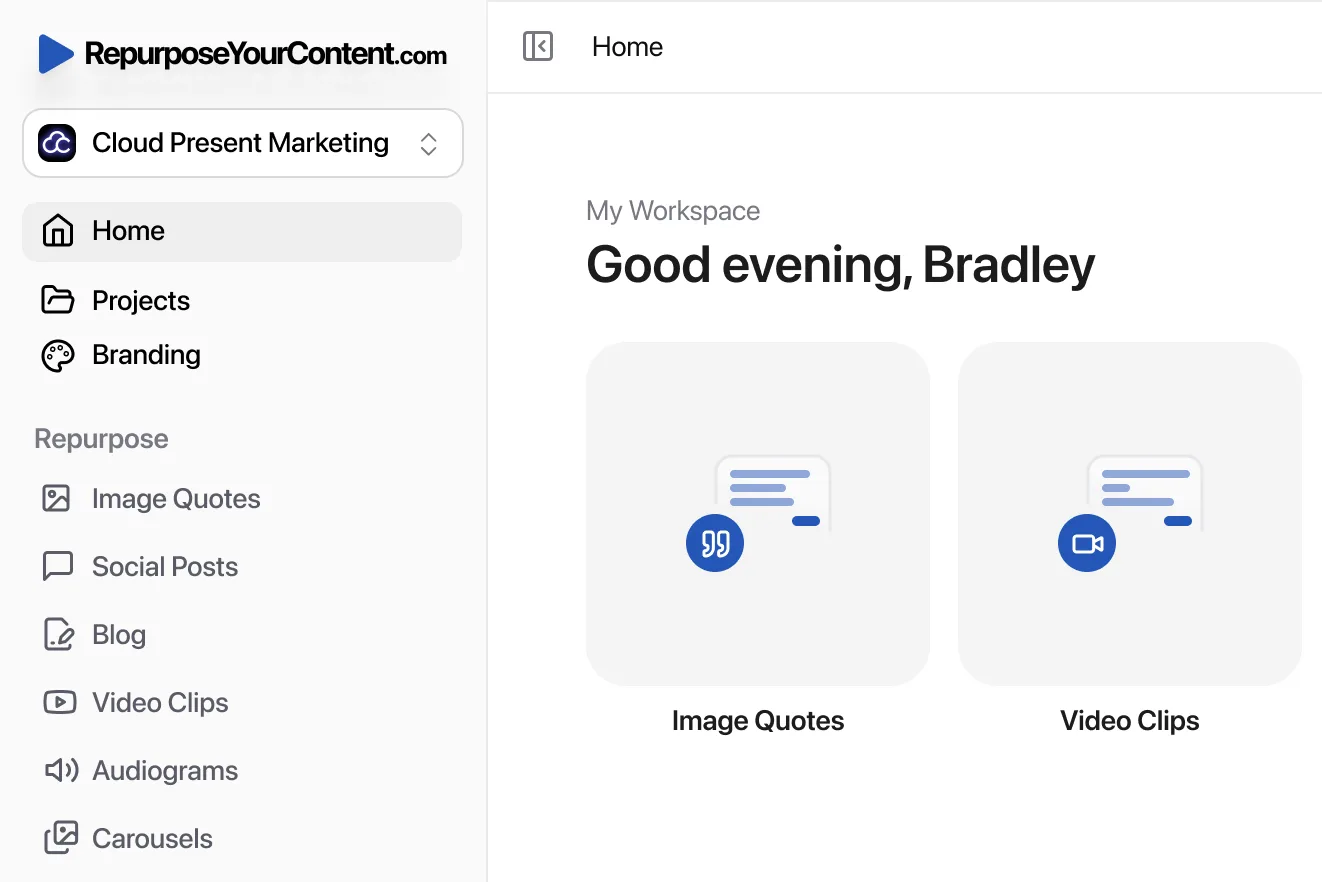
One option in this category is RepurposeYourContent, a done-for-you service where clients send a recording and receive finished content assets back instead of running the workflow in-house.
The practical numbers
The offer is simple:
| Input | Output | Time |
|---|---|---|
| One 45-minute recording | 30 assets | 72 hours |
The commercial terms are clear:
- 72-hour turnaround guarantee, or you don't pay
- From $14 per finished asset
- Unlimited revisions
For teams comparing this with a DIY stack, software price is only part of the decision. The bigger cost usually sits in editing hours, review cycles, and the internal skill needed to turn rough generations into assets that are safe to publish.
That is where a service model tends to win. The team buys finished output, not another cleanup queue. For a direct breakdown of plans and deliverables, review the content repurposing service pricing.
Your Next Step in Content Repurposing
AI content repurposing is useful because it turns one approved asset into multiple channel-specific formats fast. But raw output is rarely publish-ready on its own. Human editorial judgment is still the step that decides whether the content sounds right, says the right thing, and should go live at all.
That is the part busy teams shouldn't ignore.
For anyone comparing approaches, it helps to review broader AI content workflows and strategies and then decide how much of the editing burden should stay in-house. If the team wants speed without inheriting another cleanup job, a done-for-you workflow usually makes more sense.
Book a discovery call to see how it works for the brand, or request a free content sample from one existing recording.
Tags: