How to Create a Content Flywheel from Webinars
Stop the content hamster wheel. Learn how to create a content flywheel from webinars. Turn 1 event into 30+ assets & endless insights, compounding your effort.

Most webinar programmes fail after the live session. The team posts the recording, sends one follow-up email, then moves on. That is a linear content model, and linear models stall.
A better system starts with a simple fact. 73% of B2B marketers rate webinars as their number one source of quality leads according to Goldcast's content flywheel article. That matters because a webinar already contains topic depth, audience questions, objections, proof points, and speaker authority. It is not one asset. It is raw material for many assets.
For teams working out how to create a content flywheel from webinars, the shift is strategic, not cosmetic. The job is no longer to produce one event and squeeze out a recap. The job is to build a repeatable system where each webinar creates assets, each asset creates signals, and those signals shape the next webinar.
Why Your Content Program Has Plateaued
Content plateaus when production resets to zero every time.
When marketing leaders see performance flatten, the cause is rarely a lack of ideas. The problem is an operating model that treats every asset as a standalone project instead of part of a system. One webinar gets planned, promoted, delivered, and forgotten. The next campaign starts from scratch. Output continues, but momentum never builds.

Linear production creates drag
Linear production looks tidy on a marketing calendar. It performs badly because each asset has to earn attention on its own.
A team spends weeks preparing a webinar, gathers real audience questions, captures expert perspective, and surfaces objections sales hears every day. Then it posts the recording and moves on. That wastes the highest-value part of the process. The hard work was never the live session alone. The hard work was capturing insight in a format rich enough to spin into multiple assets.
Practical rule: If a webinar ends as a recording, the team has only completed the collection step.
This makes webinars strong flywheel fuel. A webinar already contains topic depth, natural language, proof points, and buyer friction. Used properly, one session can feed search content, social clips, email nurture, sales follow-up, and future webinar planning.
The plateau comes from broken handoffs
Content programs stall because the handoffs are weak. Production hands off to distribution. Distribution hands off to demand gen. Demand gen hands off to sales. Then the signal gets lost.
The usual failure points are predictable:
- Single-use assets limit shelf life and force the team back into constant creation
- Channel silos keep insights from moving between search, social, email, and sales
- Manual post-event work slows extraction and creates publishing delays
- Missing feedback loops stop each webinar from improving the next one
The fix is to build for compounding, not volume. Each asset should create inputs for another asset. Each distribution result should shape the next topic, angle, or format. If you want a broader model for structuring that system, this guide to building a B2B content engine lays out the operational side.
Webinars are the right starting asset
Webinars work as the source asset because they carry more substance than lightweight formats. They force clarity on topic selection, they capture expert explanation in full sentences, and they produce audience response in real time. That gives the team more than content. It gives the team reusable market intelligence.
They also support format variety. Some prospects will watch a full session. Others will read a blog post, respond to a follow-up email, save a short clip, or engage with a sales recap built from the same discussion. A flywheel accounts for that behavior by turning one strong source asset into a library of assets matched to different channels and stages.
A plateaued program keeps asking what to publish next. A flywheel asks what the last webinar made easier to publish, distribute, test, and improve.
The Four Stages of the Webinar Content Flywheel
A webinar flywheel fails when the team treats repurposing as a cleanup task after the event. The system works only when each stage creates inputs for the next one. That is what turns a single webinar into a repeatable growth loop instead of a short burst of content followed by another planning scramble.
The model is straightforward. Produce. Extract. Distribute. Re-source. Four stages, one system, compounding output.

Produce
Production sets the ceiling for everything that follows. If the topic is weak, the speaker is vague, or the session structure is loose, the rest of the flywheel has less to work with.
Treat the webinar as a source asset with downstream jobs to do. It needs a clear problem, distinct teaching points, usable audience language, and a close that can convert into follow-up content. Good production gives you more than a live session. It gives you raw material that can survive outside the webinar format.
Extract
Extraction is where teams either create a content library or end up with a transcript nobody wants to touch.
The job is editorial. You are selecting what deserves to live on as an article, a clip, a sales follow-up, or a nurture email. Strong extraction also depends on media quality. Clean audio makes transcript editing faster and improves the quality of short-form assets, which is why teams working on unlocking audio with AI can reduce friction in the post-production process.
A useful visual breakdown helps here:
Distribute
Distribution decides whether the flywheel compounds or stalls. The goal is not broad posting. The goal is fit.
Each asset should have a specific job tied to a specific channel. A strong opinion clip may earn replies on LinkedIn. A transcript-based article can capture search demand on the site. A customer-objection segment can support email nurture or sales follow-up. The same webinar can serve pipeline, audience growth, and content inventory if the team maps assets to intent instead of treating every output the same.
If you need a clearer operating model for that mapping, this content multiplication framework for turning one source asset into channel-specific outputs is a useful reference.
Re-source
Re-sourcing is the stage that prevents the content plateau.
Every distributed asset produces signals. You will see which questions triggered replies, which clips held attention, which article angles pulled search traffic, and which follow-up emails got clicks. Use those signals to brief the next webinar. That is how the system compounds. One webinar does not just create assets. It improves topic selection, messaging, and format choices for the next cycle.
This is the difference between repurposing and a flywheel. Repurposing stretches one event. Re-sourcing makes the next event better, which makes every later asset stronger too.
Produce and Extract Your Core Assets
A common mistake is building a webinar for the live audience only. That decision kills compounding before the flywheel even starts.
If the webinar is structured like a one-time presentation, post-event production becomes expensive and inconsistent. The team has to hunt for usable moments, force a recap from a messy transcript, and settle for generic clips. A flywheel needs the opposite. It needs a webinar designed as a source file, with clear segments, clear intent, and clear reuse paths.

Build the webinar like a source file
Treat the run of show like a production blueprint. Every segment should do two jobs. It should serve the live session, and it should create a reusable asset with a defined purpose afterward.
A practical planning model looks like this:
Open with a sharp problem statement
This can become a short video clip, a social hook, or the opening section of an article.Teach in distinct thematic blocks
Each block should answer one major question. That gives you clean boundaries for standalone written, visual, or video assets.Leave room for audience Q&A
Q&A gives you customer language in plain terms. That is often the best raw material for objection-handling content, FAQs, and sales follow-up.Close with a clear next step
Strong CTA language can be reused in email sequences, landing pages, and enablement content.
As noted earlier, the right workflow starts with the webinar as the primary source asset, then breaks it into layered outputs. Transcript and Q&A become search-focused articles and FAQs. High-retention segments become short clips and quote cards. Objections, use cases, and CTA moments become nurture content.
A real workflow example
A senior content team should run webinar extraction as an operating process, not an editing scramble.
| Step | Action | Output |
|---|---|---|
| Step 1 | Finalise topic and segment outline before recording | A webinar built for modular reuse |
| Step 2 | Mark likely clip moments in the run sheet | Faster post-event extraction |
| Step 3 | Pull transcript and isolate major themes | Blog angles, FAQs, newsletter sections |
| Step 4 | Cut the strongest moments by intent | Awareness clips, consideration clips, sales clips |
| Step 5 | Turn Q&A into written assets | Objection handling content and follow-up copy |
Technical quality matters because bad inputs produce weak assets. If the audio is muddy, clip performance drops and transcript cleanup takes longer. Teams working with remote guests or noisy recordings can improve extraction by unlocking audio with AI before cutting clips or turning spoken sections into written content.
How product support helps extraction
Manual extraction consumes time in the least strategic part of the workflow. Editors spend hours finding clip points, cleaning transcript sections, and adapting the same ideas into multiple formats.
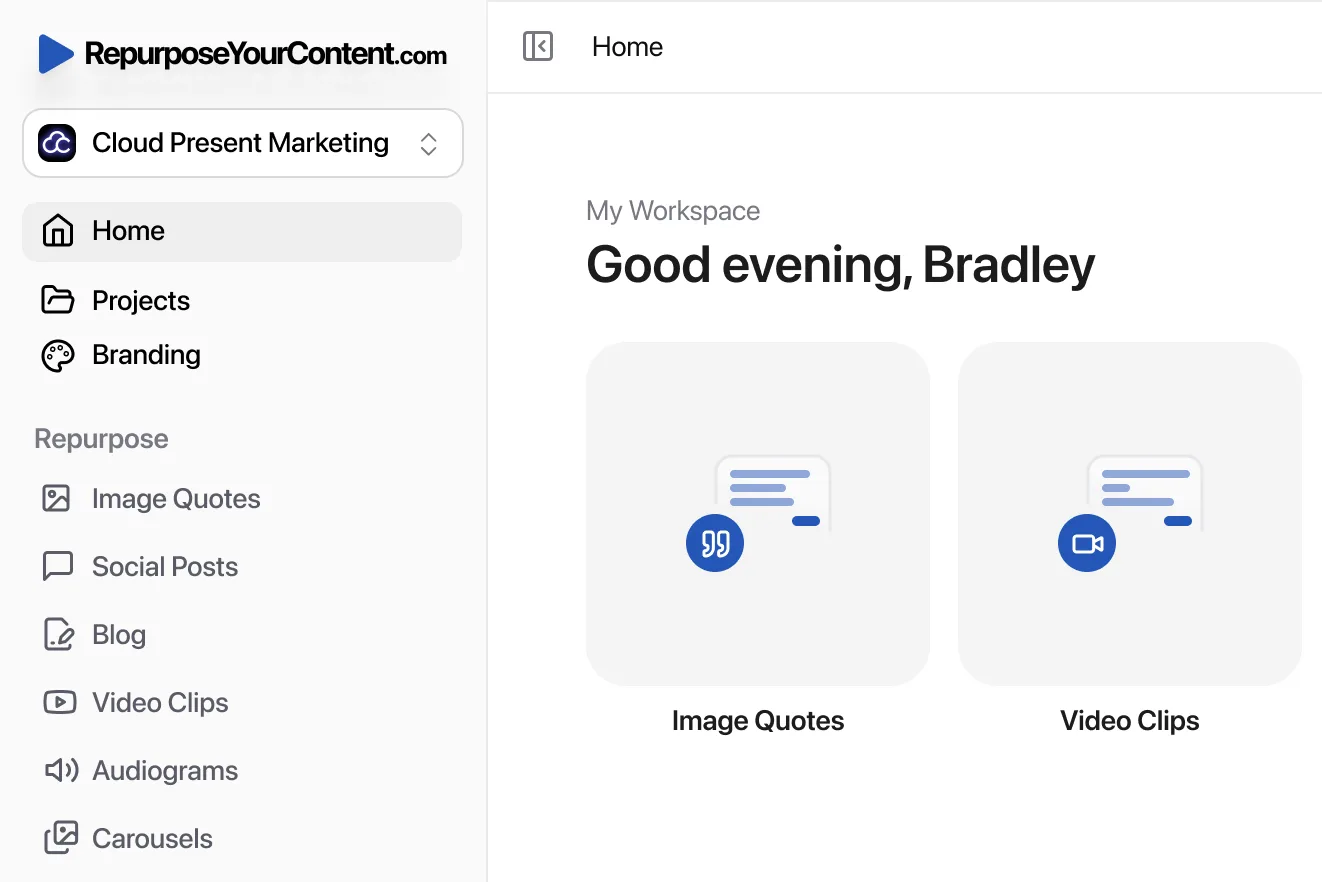
RepurposeYourContent takes a webinar recording and generates multiple output types from the same source file, including video clips, blog posts, social posts, audiograms, image quotes, newsletters, LinkedIn carousels, and timestamps. The advantage is operational. A team can choose formats and quantities inside one workflow instead of managing separate production steps for each asset type.
For teams that want to start with video first, this guide on extracting webinar clips from a webinar recording shows the process clearly.
A good extraction process asks, “Which moments deserve to become assets?”
Aim for a modular library, not one recap
The usual failure mode is publishing one long recap post and calling the webinar repurposed. That gives the team one asset and leaves the rest of the source material stranded.
Build a modular library instead. One webinar should produce components that can be reused by audience, channel, and funnel stage. A tactical clip for paid social. A transcript-based article for search. A quote card for LinkedIn. A newsletter section built from a strong objection answer.
That is how the system compounds. Each webinar adds structured inventory to the library, which gives the next campaign more raw material, more tested messaging, and less production drag. The goal is not to squeeze one event harder. The goal is to turn every event into inputs for the next cycle.
Distribute and Re-Source for Compounding Momentum
Even with well-extracted content, the system often breaks at distribution.
Teams publish a replay, post a few clips, and move on. That creates activity, not momentum. A flywheel gains speed only when distribution follows a repeatable cadence and every asset produces signals that shape the next webinar.

Distribution needs an operating model
Random posting kills compounding. If nobody owns timing, channel fit, approvals, and follow-up, strong source material gets diluted into disconnected assets.
Set a fixed distribution sequence for every webinar. Keep it simple enough to run every time, but strict enough that it becomes operational muscle.
A practical cadence looks like this:
Immediately after the event
Publish the on-demand replay and send a follow-up email to registrants and attendees.In the first week
Publish short clips, quote-led posts, and a transcript-based article tied to the webinar's core problem.In the following weeks
Turn objections, examples, and FAQs into nurture emails, sales follow-up content, and additional social assets.
Channel choice should match intent. Short clips expand reach. Problem-led posts support consideration. Objection-handling assets help sales conversations move. Teams that need a clearer framework should review these content distribution strategies for marketing teams.
The point is consistency. Every webinar should trigger the same distribution engine, with room to adjust messaging based on audience response.
UK teams need to handle accessibility and privacy properly
Scale creates exposure.
Post-webinar assets often include attendee questions, chat comments, speaker quotes, and registration data. That means distribution needs review steps for privacy, consent, and accessibility before anything goes live. Public-facing content in the UK needs to be usable for people with disabilities, and webinar teams should treat that as part of production, not a last-minute check.
Use a review checklist like this:
- Caption quality for video clips and audiograms
- Readable transcripts for long-form replay pages
- Accessible visual design for carousels and quote cards
- Consent checks before reusing attendee language in marketing assets
Fast distribution helps. Controlled distribution lasts.
Re-source the next webinar from actual signals
Here, the flywheel starts compounding instead of flattening out.
Distributed assets are not just outputs. They are research inputs. Watch-through rates show which angle held attention. Email clicks show which pain point earned action. Replies, comments, and sales follow-up requests show what the audience still needs answered.
Use re-sourcing questions like these:
- Which themes generated the strongest engagement across channels?
- Which objections repeated in Q&A, comments, or email replies?
- Which topic segments appeared in later sales conversations?
- Which formats underperformed and should be dropped or reframed?
Feed those answers into the next webinar brief. Topic selection gets sharper. Speaker prep gets tighter. Segment structure improves because it is based on evidence from the last cycle, not fresh guesswork.
A team page like RepurposeYourContent for marketing teams shows the kind of cross-functional workflow this supports, but the larger point matters more. Distribution creates reach. Re-sourcing creates compounding momentum.
Measuring Your Flywheel and Projecting Growth
If you cannot measure the flywheel, you do not have a flywheel. You have a pile of webinar assets and a story about effort.
Measure the system by stage, then connect those stage metrics to business outcomes. That is how you prove compounding value instead of reporting isolated wins.
What to measure at each stage
| Stage | What to track | Why it matters |
|---|---|---|
| Produce | Registration quality, attendee fit, live questions | Confirms the webinar topic pulled in the right audience and surfaced real buying signals |
| Extract | Time to publish, assets created, asset quality review pass rate | Shows whether the team can turn one event into reliable content inventory without bottlenecks |
| Distribute | Engaged visits, click-through, lead quality, opportunity influence | Shows whether webinar-derived assets are reaching the right people and contributing to pipeline |
| Re-source | Repeated questions, top-performing themes, requests from sales | Shows whether the next webinar brief is improving based on evidence instead of guesswork |
Stage-level reporting matters because flywheels break in specific places. A weak topic lowers attendee quality. Slow extraction kills publishing cadence. Poor distribution leaves strong assets buried. Weak re-sourcing sends the next webinar back into opinion-driven planning.
Track efficiency across the system as well. Cost per engaged visitor, cost per lead, and cost per opportunity are useful because they let you compare webinar-derived content against other content types and against prior webinar cycles. If you need a tighter reporting model, this guide to content marketing ROI measurement lays out the right framework.
What a 12-month projection should look like
A useful projection is simple enough to update every month and strict enough to guide budget decisions.
Model the flywheel with four inputs:
- Webinar frequency
- Average asset yield per webinar
- Publishing speed after each event
- Theme retention rate, which topics get repeated, expanded, or dropped
Do not build the forecast like a campaign calendar. Build it like an asset accumulation model.
In a linear program, output resets every month. In a flywheel program, each webinar adds searchable clips, articles, emails, sales enablement material, and audience language to a growing library. That library keeps producing value after the live event ends, and it improves the next cycle because the team starts with proof instead of assumptions.
A strong projection shows accumulation, efficiency gains, and topic learning over time.
Include four layers in the annual model:
- Asset library growth across clips, articles, emails, and visual formats
- Channel coverage growth as each webinar gives you more assets for more touchpoints
- Topic intelligence growth as stronger themes get repeated and weak themes get cut
- Operational efficiency gains as production and distribution become standardized
This is the budget argument that holds up. One good webinar can create a temporary spike. A measured flywheel creates a larger asset base, lower production friction, and better topic-market fit with every cycle. That is how content programs get past the plateau.
Start Your Content Flywheel Today
Most content teams don't need more ideas. They need a system that stops wasting the ideas already captured.
That is why learning how to create a content flywheel from webinars matters. A webinar is already one of the richest assets in a B2B programme. It contains expertise, questions, objections, examples, and language from real buyers. Treating it as a one-off event is operational waste.
The better model is straightforward. Produce a webinar built for reuse. Extract modular assets instead of one recap. Distribute with cadence, accessibility, and channel intent in mind. Re-source the next webinar from actual performance and feedback.
This approach fixes the plateau because it replaces isolated effort with compounding effort. Each cycle builds a larger asset base and a better brief for the next cycle. The programme gets sharper because the system learns.
Teams that want that system in place quickly should try RepurposeYourContent. It helps turn a single webinar into a structured set of ready-to-publish assets, so the team can spend less time on manual extraction and more time running the flywheel.
Tags: