How to Improve Content Quality for B2B Teams
Learn how to improve content quality for B2B teams with a practical audit framework, editing checklist, and measurement plan that actually moves the needle.
83% of marketers now prioritise content quality over publishing frequency. Improving quality starts with audience evidence and a scored audit before any editing begins.
That benchmark matters because most B2B teams still treat quality as a polishing step. They fix grammar, tighten headlines, and add internal links after the main work is finished. The better approach treats quality as an operating system for research, production, repurposing, and distribution.
The Quality Gap Most B2B Teams Miss
A widely cited 2025 Content Marketing Institute benchmark found that only 17% of B2B marketers rated their content output as excellent or very good. Another 44% called it good, while 35% rated it fair and 4% poor, as reported in this summary of the Content Marketing Institute benchmark.
The gap rarely sits inside sentence-level editing. It sits between the audience research, strategic brief, source material, and publishing workflow. A polished article can still miss the buyer's question. A beautifully designed deck can still repeat a claim every competitor makes. A repurposed clip can drift so far from the original recording that the speaker's meaning disappears.
Three warning signs deserve attention:
- The asset ranks but doesn't convert: Search visibility brings visitors, but the page doesn't answer the commercial question or offer a credible next step.
- The asset sounds professional but interchangeable: The copy contains familiar advice without original evidence, a clear point of view, or a useful example.
- The derivatives lose the source: A podcast, interview, or keynote produces several posts, but each edit removes context and weakens the speaker's authority.
Quality also depends on format. A strong blog post needs search visibility and meaningful downstream engagement. A landing page needs conversion action. A sales deck needs clarity, proof, and usability in a live conversation. Repurposed content needs fidelity to the source and a reason to exist on each channel.
Practical rule: Don't rewrite an asset until the team knows why it deserves to survive.
Teams should also separate native content from adapted content. The distinction affects format, context, and audience expectations, as explained in this guide to native content versus repurposed content.
The useful question isn't, “Can this draft be improved?” Every draft can. The useful question is, “What kind of intervention will create the most value?” A scored audit answers that before senior editors spend hours polishing weak material.
Score Every Asset With a Five-Dimension Audit
A quality score turns editorial opinion into a production decision. Score every asset across five dimensions, using 1 to 3 points for each category. The maximum score is 15.
The five dimensions
Audience fit asks whether the asset addresses a real audience problem. A score of 3 requires clear evidence from customer conversations, search questions, sales notes, or first-party behaviour.
Intent match measures whether the format and answer fit the reason someone sought the content. A buyer comparing vendors needs different information from a beginner learning terminology.
Originality tests whether the asset contributes a distinct observation, example, opinion, process, or source. Generic summaries score low even when they read smoothly.
Structural clarity covers the opening answer, headings, sequence, examples, calls to action, and readability. Readers and answer engines both need a clear information hierarchy.
Distribution readiness checks whether the asset can travel in its current form. A long-form article may need strong metadata and internal links. A short clip may need captions, a visible idea, and a platform-specific opening.
Use the score to force a decision:
| Total score | Decision | Required action |
|---|---|---|
| 13 to 15 | Keep and amplify | Extend distribution and adapt the strongest sections |
| 9 to 12 | Targeted edit | Fix the weakest dimension before publishing |
| Below 9 | Rewrite or retire | Return to the brief, replace the source, or remove the asset |
The framework works because it prevents endless editorial debate. It also supports content performance analysis methods without relying on a generic industry average. A page's own baseline matters more than an abstract benchmark, especially when comparing blog posts, landing pages, clips, and resource guides.
Pull 20 existing assets and score them this week. Plot the results by asset type and distribution channel. A pattern usually appears quickly. The team may have a depth problem, an originality problem, or a distribution problem.
For a broader operating model, connect this audit to content lifecycle management for marketing teams. The score should determine whether an asset gets rebuilt, expanded, refreshed, or repackaged.
Build Quality From Audience Evidence First
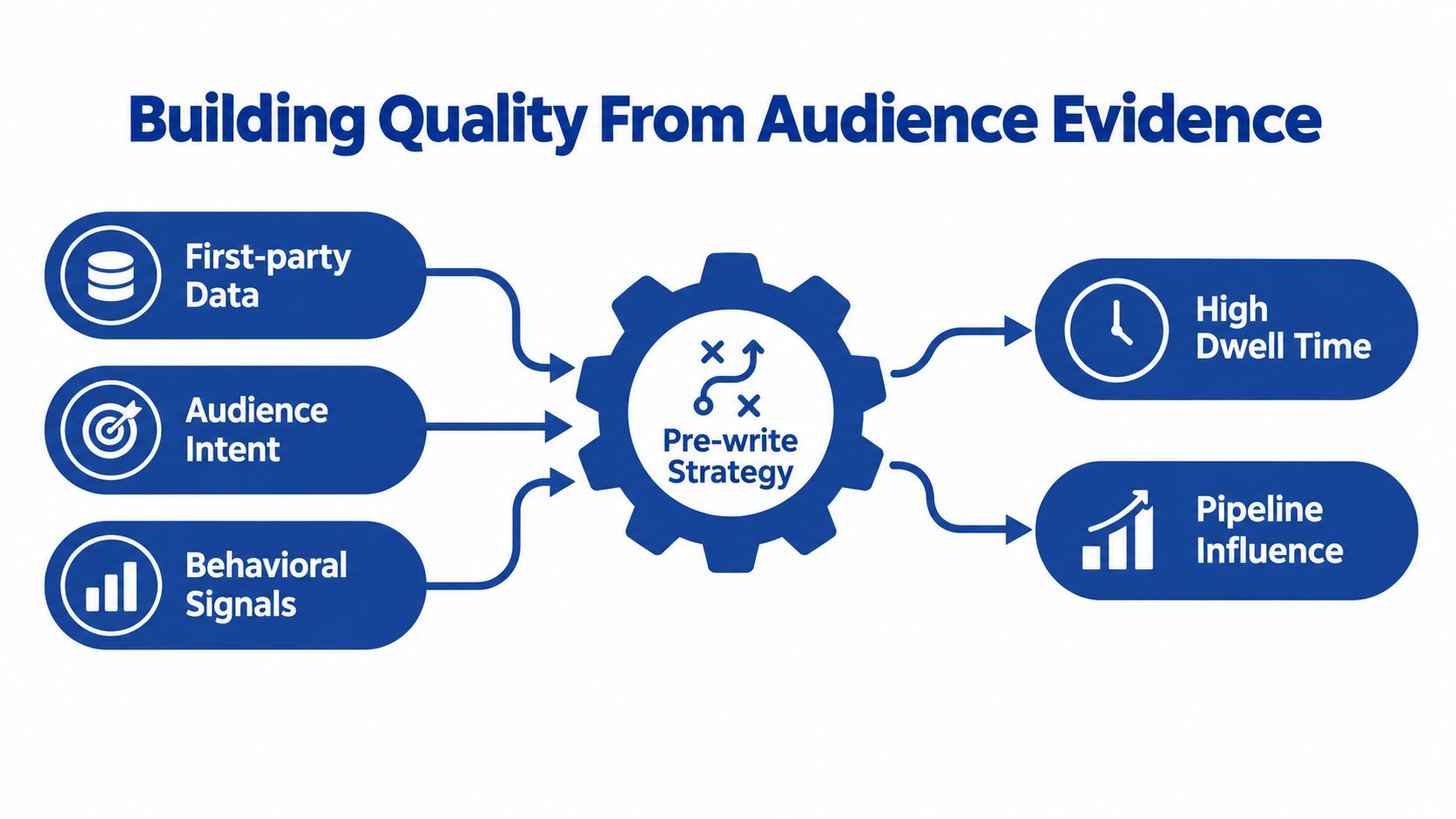
The strongest content decisions happen before anyone writes the opening paragraph. Audience evidence determines the topic, the angle, the format, the proof, and the language used to explain the problem.
A useful evidence layer has three inputs.
First-party research comes from customer interviews, sales-call transcripts, win-loss notes, support conversations, and questions submitted during live sessions. These sources reveal the words buyers actually use. They also expose objections that keyword research often misses.
Search intent mapping turns those words into specific questions. A broad topic may hide several jobs. Someone searching for “content quality” might need an audit method, a production workflow, an SEO fix, or a way to reduce editing time. One page cannot serve every intent equally well.
AI-search visibility checks test whether the answer is clear enough for generative engines to retrieve and cite. The asset should lead with a direct answer, use descriptive subheads, cover related questions, and present evidence in structured, quotable passages. Modern content-gap guidance also emphasises semantic coverage, intent match, and format fit for AI search.
Assumption-led briefs start with what the team thinks the audience wants. Evidence-led briefs start with what the audience has said, searched, asked, or done.
A lightweight research ritual can keep this practical:
- Pull three recent transcripts from customer interviews, sales calls, or recorded conversations.
- Extract recurring pain phrases and objections.
- Group those phrases by buyer stage and intent.
- Choose one specific question for the next asset.
- Require the brief to cite at least one verbatim audience phrase.
- Define the answer, proof, format, and next action before drafting.
A 45-minute customer interview can produce sharper angles than several internal brainstorming sessions because the buyer supplies the tension. The team doesn't need to reproduce the entire conversation. It needs to preserve the strongest evidence and build around it.
Research quality remains a weak point for many teams. A 2025 industry study found that 60% of respondents only sometimes or rarely use data to determine how audiences prefer to use content, while 31% rarely or never conduct qualitative research into audience preferences, according to the 2025 content trends report from Leff Communications.
The audit and evidence layer should reinforce each other. Audience fit and intent match come directly from research. Originality comes from first-hand material. Structural clarity and distribution readiness then make that evidence easy to understand and reuse.
The True Cost of DIY Editing and SEO Fixes
Many content teams budget for writing time and ignore the work around it. That mistake makes a single asset appear cheap until senior staff spend a full day rescuing it.
For one recording-led blog asset, a realistic manual workflow looks like this:
| Task | DIY time estimate |
|---|---|
| Transcription review for a 30-minute recording | 45 minutes |
| Substantive editing for clarity and structure | 90 to 120 minutes |
| On-page SEO, including title, meta, headings, and internal links | 30 minutes |
| Fact-checking and quote verification | 30 to 60 minutes |
| Original graphic creation | 60 to 90 minutes |
| CMS upload, formatting, and schema | 20 minutes |
Those tasks already require several hours. Add an approval round, revisions, a second-pass edit, and coordination across writers and designers. A single blog post can consume six to eight hours of senior time before distribution begins.
That estimate aligns with broader production benchmarks. Small business owners often spend 15 to 25 hours per week on content, while one 1,500-word blog post can take 4 to 10 hours to create. Review cycles can add 1 to 3 business days each, with a benchmark reporting 2.3 review cycles per post, as detailed in this comparison of AI and manual content creation time.
The hours don't all deserve the same treatment.
- Compress transcription review: Searchable transcripts help editors locate claims quickly, but humans still need to verify meaning and speaker intent.
- Protect substantive editing: Weak arguments become useful explanations here. It deserves experienced editorial judgment.
- Standardise SEO checks: Titles, headings, metadata, schema, and internal links can follow a repeatable checklist.
- Keep fact verification human-led: AI can flag uncertain claims, but a subject-matter reviewer should confirm them.
- Template visual production: Reusable brand systems reduce design time without forcing every asset into the same format.
At ten assets per month, the cost is no longer abstract. It becomes a recurring capacity problem. The team either delays campaigns, lowers review standards, or pulls senior marketers away from demand generation.
A detailed breakdown of content repurposing costs helps expose where the budget goes. Quality improves when the team knows which hours create judgment and which hours merely move files between systems.
How AI Tools and Done-for-You Compare
AI-assisted production reduces the mechanical work of content creation. Transcription, rough outlines, headline options, and draft summaries take less time, but editorial judgment still determines whether the finished asset is accurate, useful, and visible in AI search.
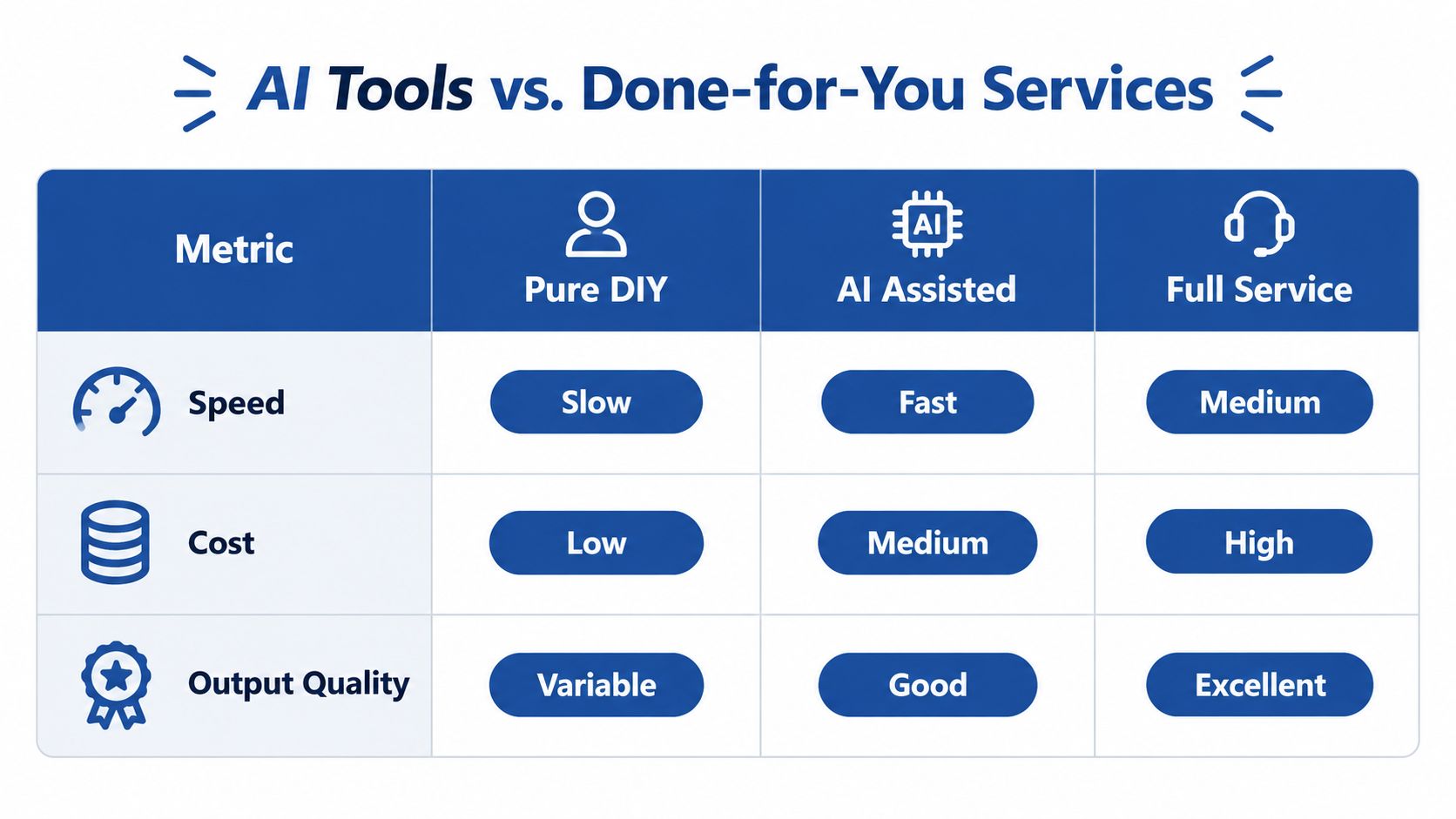
The practical choice is between three production paths.
Pure DIY requires the least direct spending and the most internal capacity. A strong asset can take 6 to 8 hours once research, editing, design, SEO, approvals, and publishing are included. That time competes with campaign planning and demand generation.
AI-assisted DIY can reduce production to roughly 2 to 3 hours per asset when tools handle transcription, drafting, and outlines. A senior editor still has to check factual accuracy, brand voice, source fidelity, audience intent, and the asset's position in the 15-point quality score.
Done-for-you production exchanges direct budget for delivery capacity. A specialist team works from a podcast, interview, keynote, sales call, livestream, course, or other long-form recording, then handles editorial work, design, formatting, and SEO.
| Production path | Main advantage | Main constraint |
|---|---|---|
| Pure DIY | Low direct spend | Slow delivery and high opportunity cost |
| AI-assisted DIY | Faster drafting | Human review remains necessary |
| Done-for-you service | Predictable delivery and specialist execution | Higher direct cost |
AI improves quality only when the workflow includes clear audience evidence, review standards, and search requirements. 58% of B2B marketers using AI content tools reported improved content quality, while 12% reported worse quality, according to this summary of AI content marketing statistics. The tool can produce a plausible draft. It cannot independently confirm customer intent, brand boundaries, commercial context, or whether the answer deserves visibility in AI-generated search results.
Choose according to the constraint. DIY fits a team with spare editorial capacity. AI-assisted production fits a team with strong reviewers and repeatable briefs. Done-for-you delivery fits a team that has valuable recordings but cannot absorb the production workload. For a fuller breakdown, see this comparison of a content repurposing agency versus DIY tools.
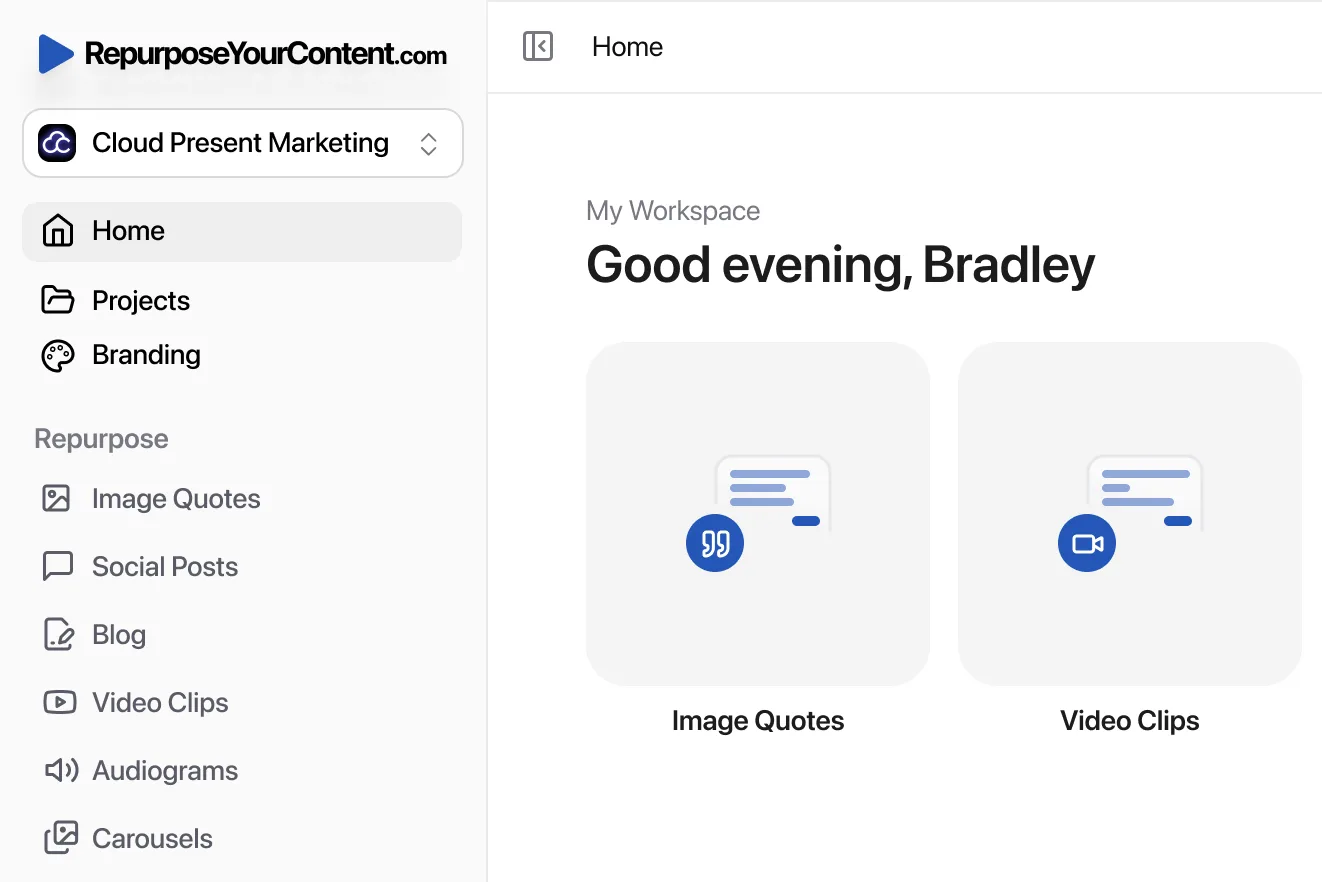
A service such as RepurposeYourContent takes one long-form recording and returns 20 to 30 ready-to-publish assets within 48 hours, including clips, LinkedIn posts, quote graphics, carousels, audiograms, and a blog post. Its stated terms include unlimited revisions, a 48-hour turnaround guarantee or no payment, and pricing from $14 per finished asset.
Tools produce drafts. Editors make them trustworthy. Done-for-you delivery removes the production burden when the recording already contains the expertise.
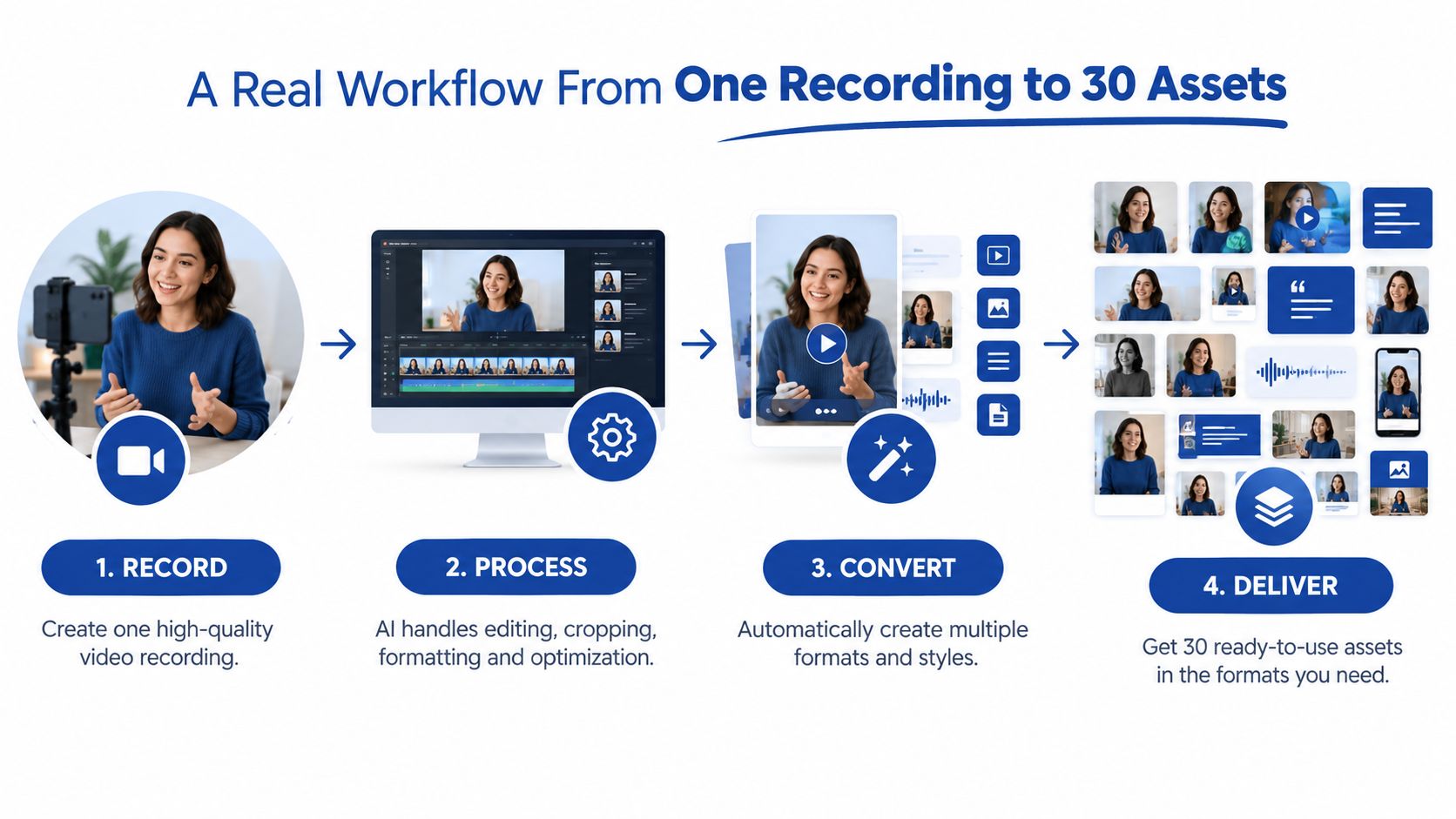
A Real Workflow From One Recording to 30 Assets
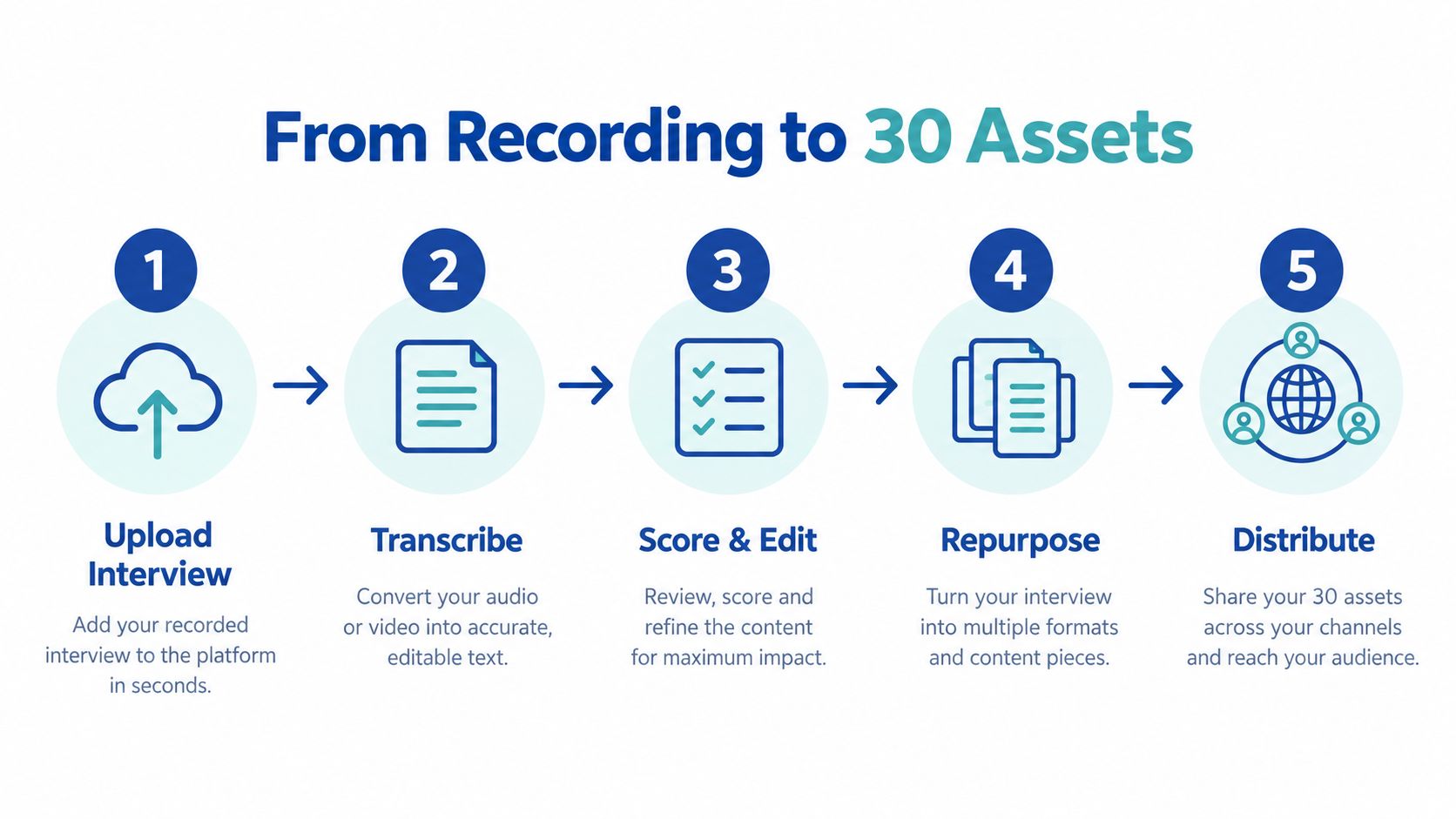
A single 45-minute recording can support a complete content system when the team extracts evidence before adapting the format. The source might be a customer interview, podcast episode, keynote, sales call, or founder conversation.
Step 1
The recording is uploaded and transcribed in under an hour. The transcript becomes the source of truth for claims, timestamps, speaker attribution, and supporting examples.
Step 2
An editor applies the five-dimension audit to the recording and flags the three strongest claims. The selection should favour clear buyer pain, original insight, and useful proof. Weak soundbites don't become stronger through repetition.
Step 3
The three claims become a 1,800-word pillar article, published within 72 hours. The article leads with the answer, uses structured headings, preserves the speaker's meaning, and links each major point to evidence from the recording.
Step 4
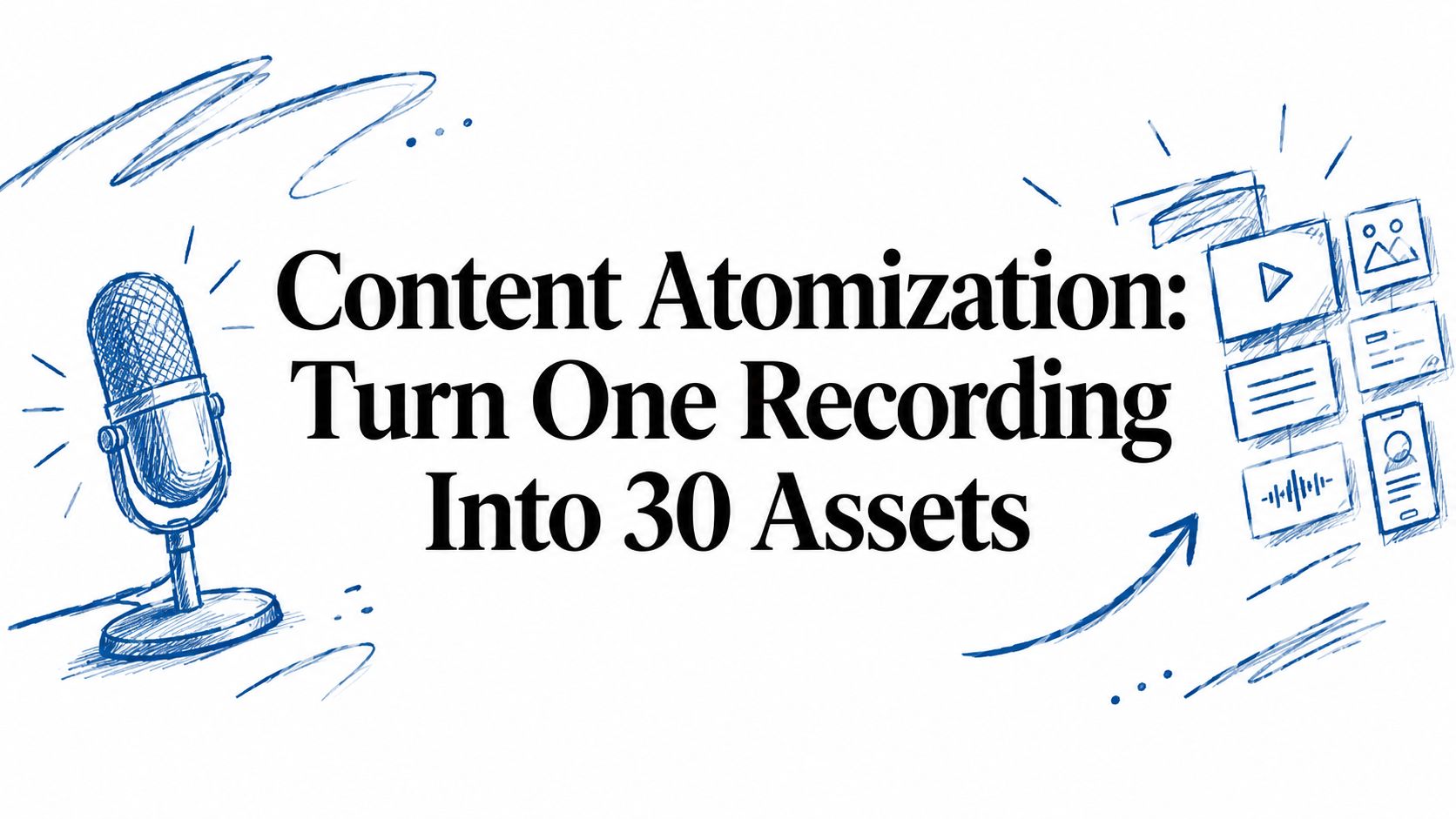
The same source becomes 12 LinkedIn posts, 8 email snippets, 5 quote graphics, 3 short-form video scripts, and 2 sales enablement one-pagers. Together, those outputs create 30 derivative assets.
Step 5
Each asset receives the original speaker, source timestamp, intended channel, and buyer-stage tag. That information helps sales teams verify context and helps editors revise without searching through the entire recording again.
This workflow isn't volume theatre. It's evidence preservation. Every derivative should add a format-specific use, not merely repeat the same paragraph across channels.
Audio quality can affect the final result. When a recording contains noise, clipping, or uneven levels, teams can consult these practical fixes for common audio problems before extracting clips.
The workflow also creates useful feedback. If LinkedIn posts generate questions, those questions can inform the next interview. If sales enablement assets help representatives handle objections, those objections can shape future briefs. The recording becomes a research asset, not a disposable media file.
Teams building this internally can follow the same sequence described in how to turn one piece of content into many formats. The essential discipline is selection. A source recording may contain many statements, but only the clearest evidence deserves distribution.
Measurement, Cadence and Your Next Step
A quality system needs a review cadence. Re-score published assets every 30 days, log each keep, fix, or retire decision, and recalibrate the scoring model quarterly. Refresh audience evidence twice a year, or sooner when the product, market, or buyer changes.
Use content-type-specific KPIs instead of one universal benchmark:
- Organic sessions and AI-search citations: Track discovery for search-led articles and answer-focused pages.
- Time on page for gated assets: Check whether the structure keeps qualified readers engaged.
- MQLs per republished piece: Connect derivative assets to pipeline activity where attribution is available.
- Repurposing velocity: Measure how many finished assets ship from each recording.
Measurement should support decisions, not create a reporting ritual. Guidance on proving content ROI with real data can help teams connect engagement signals to commercial outcomes.
A practical starting point is a 20-minute call with a content specialist. The team can bring one podcast, interview, keynote, sales call, livestream, or course recording and request a sample workflow. The next step is to book a call and request a sample that shows how one recording could become finished, brand-ready content within 72 hours.
Book the call, send one representative recording, and ask for a scored sample before committing to a larger production workflow.
Tags: